
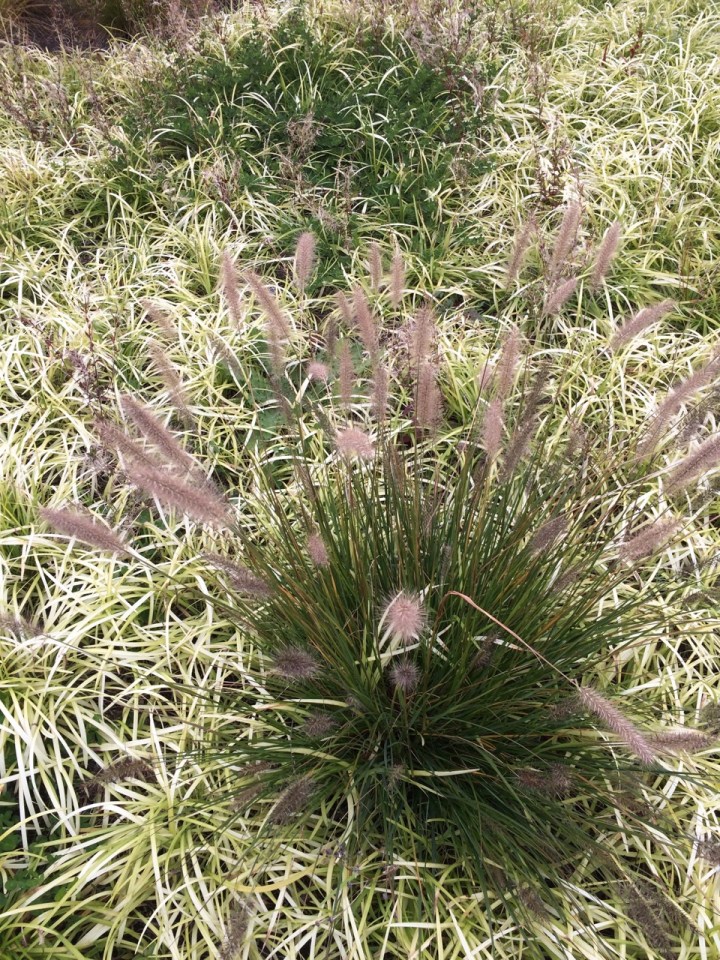
This planting of Liriope ‘Silvery Sunproof’ is immediately adjacent to the above. This Liriope forms spreading clumps, not a continuous mat and so is more subject to invasion. This cultivar is often used as an edging plant as it is less likely to invade its neighbors than cultivars of the other commonly used species, Liriope spicata, though it too can become a problem. This same growth habit means that it is less like to be able to resist invasion. The related species, L. spicata, forms a spreading mat and can be more ‘weed resistant’. One might think that it is immune to infestation by weeds but this isn’t true. Monocultures, which this is on a small scale, fill only one niche that is available. Particularly vigorous seedlings may possess the energy to germinate, root down through the mass of roots and over top the pre-existing planting. It is generally only the most aggressive plants, often invasives themselves, that can dominate to the extent that they can maintain single species stands over time, like Purple Loosestrife or Reed Canarygrass, and even then under certain growing conditions. Liriope is not one of these. In this photo you can see how a seedling of the adjacent planting of Pennisetum has ‘volunteered’ amidst the Liriope. Sometimes the plants we specify in plantings themselves possess the vigor to move around a landscape which can be problematic as they disrupt the intended design effect, though this is a ‘normal’ characteristic of a natural plant community. There is also Epilobium that has moved in here, though its less obvious. The green mass further back is Dutch White Clover, commonly planted, and entirely capable of invading landscapes, as this one has, to the point of dominating. This one, an ecologist friend classes as an ecosystem disrupter, so powerful is its ability to dominate.
 GardenRiots