
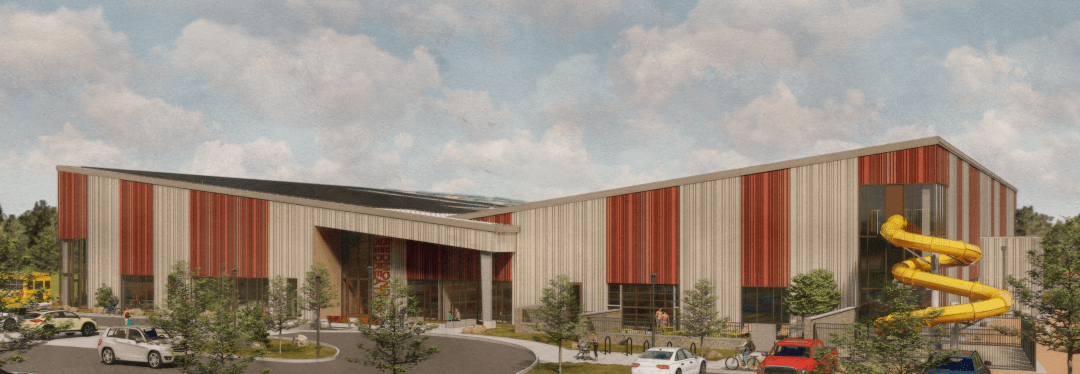
This is the rendering of the new facility’s south entry. It’s the banner on the RAPRD’s announcement of Novembers funding levy for the new facility.
Much of what I write of and post here are topics concerning ‘place’, its centrality to life, including our own. This post is specific and narrow, focusing on a non-gardening, non-horticulture, activity important in my life, swimming. I am recently turned 70 years old and their are many physical things I can no longer do and others I have had to modify, given my record of injuries and ‘weaknesses’ of my body particular to it. I have always ben physically active, craved movement and enjoyed the sensations of moving through ‘space’, of strength and competence, of engagement with….I would run, climb over things in my path, do things to prove that I could, explore the world in front of me; physically, and test that understanding. I enjoyed, and still do, the feeling of being ‘capable’. It is a necessity for me, just as is my mental engagement. It is of the same piece. As I age now, while my physical capacities have lessened, sometimes because of my past efforts, I, like a machine, have been wearing out. But, unlike machines, that physical activity, that stressing and testing of ourselves, allows us to stay capable and strong, a response within limits, to the stressing we subject ourselves to, as long as we get enough rest, have a healthful diet and recognize our own limits.’
I haven’t been able to run or participate in sports that require it, without significant consequence, for quite a few years now. The recognition of my own limits, lead me first to yoga, which I practiced regularly and incorporated into the physical movement of my daily work during my working years. While not ‘slavish’ to my practice, I still do this adding in some specifically core strengthening exercises. When, almost thirty years ago, a local public pool was significantly renovated, I began to lap swim, to help with my upper body and core strength as well as my flexibility. The demands of my work were such that if I didn’t do something, the physical demands of my work, which were greatly lessened during the continuous running around of summer, lead to a weakening of my upper body, just as I would be back to placing it under most demand. As I was aging my spinal anomaly was becoming an ever bigger limitation and I was looking about for solutions. I wanted to be able to continue my work in horticulture/parks and was afraid my career might end with me in chronic pain and incapable of doing the things that gave my life purpose and direction. I overcame the idea of boredom and tediousness of swimming face down in a pool lap after lap, as well as my unease with breathing while face down in water, and both my health and sense of well being improved. I still swim. It has become essential. I know what stopping for a significant amount of time means for me. So when we moved, having ready access to a pool was a top priority for me. We bought a home in a community with a lot on which I could garden, with a view of the Cascades and a pool…at least the promise of one. The pool has not yet been built.
This brings me to the point. I’ve been swimming, regularly since we moved at the indoor public pool three days a week. There are many ‘regulars’ there. There are multiple water exercise classes, at least one every weekday, which is well attended, water polo and swim teams, scheduled swimming lessens as well as the periods scheduled for the ‘open swim’ craziness of young people and children. People use it and it is showing its age. It was built in 1979 when Redmond’s population was around 6,500. It is inadequate to serve a population of almost six times that today. A new pool/community center was proposed, plans made and residents approved its construction a year and a half ago, our first election as locals here, while at the same time ‘we’ voted down the levy which would fund its operation. Another levy was proposed this last November….

The old pool, serviceable, but….The original plan was to keep both facilities open. Now they are talking about only operating only the new one. This old facility is actually owned by the school district and RAPRD’s lease expires in 2028. If need be they will close this facility. Due to the age of its equipment it is in need of higher maintenance and equipment replacement costs. Keeping it would allow more users and more programming. Given our political climate the closing of publicly funded facilitiies and programs of all types seems to be the new reality everywhere. This is a positive feedback loop which reinforces resident’s negative feelings about government service. They more that is cut, the worse the service and the more residents can complain that the money spent is done so poorly.
I recently wrote the following to our local paper. It’s too long for them and I’m working with the editor to pare it down while keeping the essentials. It speaks to our wider political situation and of the necessity of community and our relationship with our neighbors whom comprise it.
The RAPRD operations levy was voted down a month ago…and it still bothers me. I know that I shouldn’t be surprised anymore, but this particular result only makes sense in a community that has lost faith in its government AND its neighbors. Only 33% of the district’s voters, voted to fund the staffing, operation and maintenance of the aquatic/recreation center we are building today. ‘We’ voted to build it and then not fund it??? What are the board and the managers of RAPRD to do? Is continuing to build a facility ’we’ apparently aren’t interested in funding responsible? Should we stop? Or, should we finish it and then mothball it until we have funds at some future date to operate it in a responsible manner? Should we operate it with our current budget with skeleton staffing, and an abbreviated schedule, disappointing its users? Because current funding only supports current staffing and programming, what should be cut? I assume the first cut will be our current pool facility.
Do the voters believe that government, has all of the money it requires to provide the services we expect, if they cut ‘waste’ and tighten their fiscal belt? This story has been circulating for decades now. If you check, and this is a matter of public record, RAPRD staff are amongst the lowest paid of regional government employees. We are all aware of the increasing cost of living, should RAPRD staff be part of the unhoused working poor? How can we justify that? What does this portend for other social services and programs which serve only a segment of the population? Should roads, schools, water systems, sewers, libraries, schools, mental health services, police and fire protection, airports, forest and rangeland management, parks, all government programs and projects, be operated strictly in a pay as you go manner? It won’t work.
Governments have always subsidized the costs of those things we deem important and we, as users, are then recipients of services we often don’t fully pay for. If we each paid the full cost of every mile we drove our road system would be radically reduced. Parks programs have historically been funded by their communities so that all could participate. We don’t all have the same resources or options. Those with plenty of money have other options they can afford. Natural/wild lands would not exist. All would be privately owned and used as their owners saw fit. You would be excluded. We provide tax revenues to fund our roads, any program, because we value them. Do we not now value our neighbors? If so, it is no wonder that we are suffering the societal problems we are today.
There seems to be a shared belief that if something is important, private enterprise will fill the gap….Would it? Doesn’t history show us the opposite? That these programs were created because they are of general public value and businesses didn’t provide them, because they couldn’t profit in doing so? That does not mean that they have no value to a healthy functioning society! Wasn’t this the reason why the regulation of business came about and public services were funded in the first place? Businesses, in our economy, must pursue their own goals, their economic survival. Any benefit to society is a bonus. Profit is their priority, not human well being. The two are, however, directly linked. Orderly and developed societies provide businesses with that which they need to operate. Society is also how the rest of us are able to maintain and improve our situations, they provide us with opportunities. Societies succeed by providing for their members, not by excluding whole classes. Problems arise when the disparity between members becomes so great that life becomes insecure. When survival is in doubt. Without opportunity and support, one’s efforts are often for nought…even for the wealthy and powerful, who by the way, survive through the supports of a society.
We need to ask ourselves why did voters approve the building of the facility if they had no intention of funding its operation? What accounts for this disconnect? Who does it serve? We ‘owe’ each other, if for no other reason than it better positions others to help us.
How can a community, or nation thrive, or even survive, if a large portion of its members, are under valued, ignored or denied opportunity? The root of the word itself implies a necessary reciprocal relationship. Community. Communicate. Common. Sad, cannot begin to explain how I feel at this outcome. ‘We’ can’t afford it! How can we not afford it? This failure is a product of our current toxic political and anti-government atmosphere. What do voters expect? This is quite the message to kids and community members in need of assistance, which at some point, includes us all.
The message is that if at some point you can’t afford something yourself, even those things you need to survive, screw you! Privilege and opportunity are assured only for the select few. To do this is a denial of community and society’s value, and assures that very result. Such a ‘society’ cripples, impairs and diminishes us. Many. Thousands, Millions, are left behind in a struggle, unable to contribute much to those around them, their lives reduced to base survival. Governments thus fail the people! No, the people, through their government, fail society. We have failed. Great societies are so because their members are healthy, motivated, free to risk and attempt, and capable of doing so. Without cooperation, some kind of minimal support, a fair structure, endless competition promises only that there will be losers and those losers will do so consistently. Our system is built narrowly to favor the winners and so that group, as they increase their advantage, push everything further out of balance…and then we blame the poor and powerless. Competition and cooperation are both necessary. Denying members the support and opportunities they require damages them and us. A vibrant economy and healthy society is possible only if we work to assure both….A healthy society is not possible in a world of denial and lost opportunity. To so injure and impede others is to do the same to ourselves. So we build facilities. The architects, engineers and builders benefit…for the moment, and then it sits there. A dream and promise unfulfilled, because we are unconvinced that community and society have any value for us. That is so wrong…and sad.
 GardenRiots