
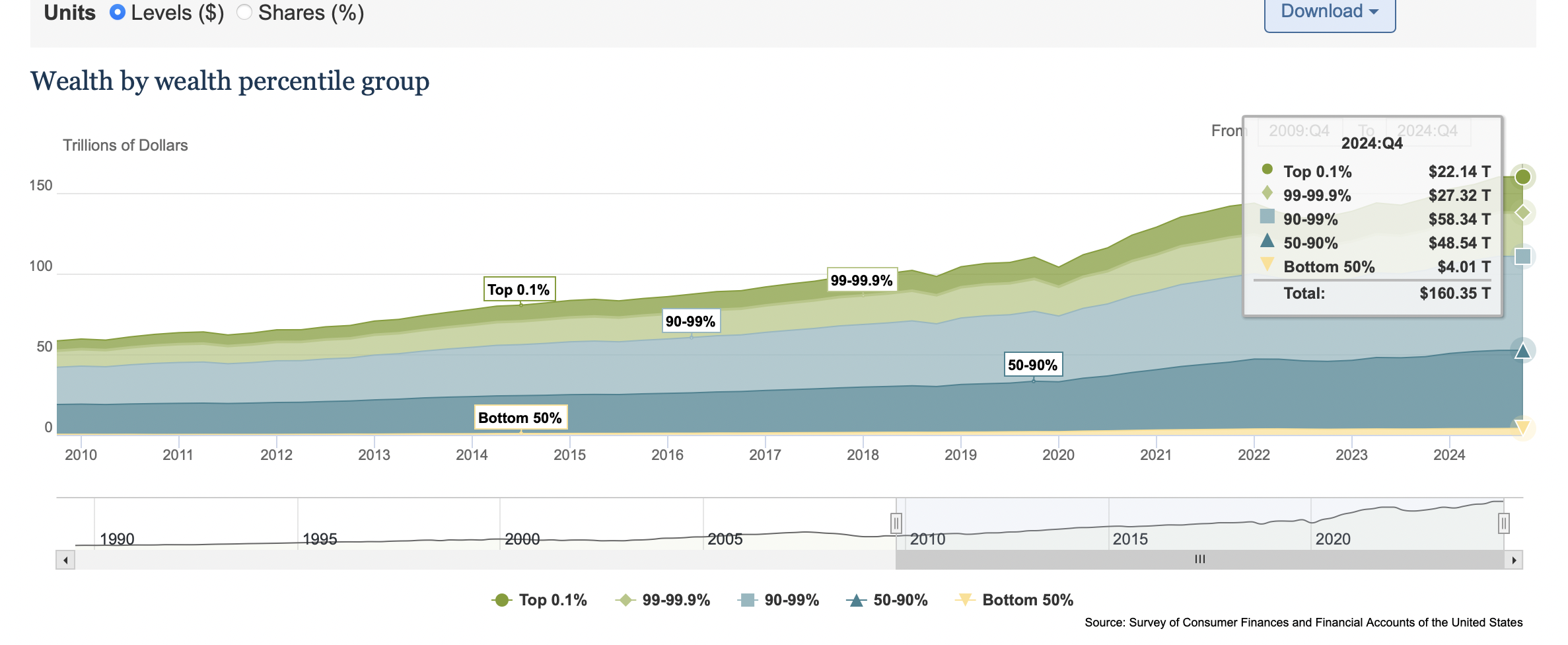
Go to: https://www.federalreserve.gov/releases/z1/dataviz/dfa/distribute/chart/#range:2009.4,2024.4
to examine this interactive graph in more detail.
If you follow the pundits, social and mainstream media, the problem in America would seem be one of a splintered society, one fatally compromised by a mix of peoples that simply cannot be reconciled. The American ‘melting pot’ separated into battling bits, the ‘recipe’ that formerly held it together proven to be a ‘suspension’ of parts that never really belonged together and now, without, enough support, is failing…but is this true? If you go to a more primal, basic, level and ask what do people need, it always begins with survival and how when one’s survival, our security, feels in doubt, when we are confronted with overwhelming threats, fear begins to take us over. We become less nuanced and subject to manipulation, by slick talkers and those who would use us. Truth, becomes malleable as we struggle for something ‘real’, something ‘solid’.
Well, that’s a real problem. All of this culture wars stuff, the ‘threat of others’, of difference, that’s a mask, a ‘straw man fallacy’ or at most a secondary threat. If we are having trouble paying the bills; if putting food on the table is iffy; if the rent or house payment just isn’t there and the prospect of ever having a secure home/house is demonstrably impossible given our income; if we can’t afford to go to the doctor when we’re sick or injured; our ability to get to work, is dependent upon on a functional vehicle we have no money to fix; our ability to pay for the education for ourselves, or our children, so that we might better ourselves, just isn’t there; if our own retirement is a futile fantasy…well those are real problems and they are reality for millions of Americans. The stress they put us under is undeniable.
Politicians and billionaires blame the others struggling to do the same, distracting us with the continuous sideshow of us vs. them, but that will never get us to a solution. The solution is an economic one and the answer definitely does NOT lie with those of us struggling ourselves to make ends meet…it is with an economic system that has been so twisted that the ‘fruits of our labors’, the profits that flow from our collective efforts, don’t reward us, they go first and foremost to a relative handful of billionaires and their well compensated lackeys, those miserly millionaires always wanting more, all while the masses of workers and people are forced to make do, very often without enough. Enough.
What is enough and fair? Deserved compensation, is never discussed in this country. Neither is what’s enough, but we all seem to agree on the concept of a minimum wage, one set at poverty levels, that according to theory is supposed to push workers to greater levels, to better themselves, without ever considering the fact that so many necessary, even essential jobs, pay to little for anyone to live a secure life. Someone has to do that work. If they don’t society fails to work. Crops are left to rot in the field all of those poorly paid service jobs we depend on would go undone, but they are done and are very often done by those trapped in them with little option. It is simply more important that those in position have access to their profits than those at the bottom have health, security and dignity. We demean that work and those who do it. We tell them, us, “If you want a better life, work harder! Work more!” Many millions do, but they have little power to address their compensation and little option to pursue other work. No leverage agains massive corporations.
Small business owners get pinched between the prices they must pay their suppliers, their operational costs and the limits their communities can afford to pay for what they have to offer. That is the American problem, not the so called lazy poor, not the ‘woke’ Americans who want a better America for ALL of us. It is greed, at the top, that drives all of this and we won’t find a solution by attacking the literal millions and millions whose lives are defined and limited by the same economic challenges, challenges which are quite literally impossible for us as individuals to address.
I’m writing about economics, a topic the economists keep trying to mystify so that we don’t bother them or the leaders for whom they work to prop up our current system, the root of our problems. In many ways with its complex implementation rules and its even more complex ‘measures’, most Americans have learned to ignore economics and leave their involvement limited to bitching at politicians. Complaining amongst themselves about the cost of….So I’m going to simplify it greatly. (I took 8 different college level economics courses many years ago, so I’m not an expert, but I think I understand the basic ‘purpose’ of any economy.) An economy is that system that exists between members of a community, or society, for which rules have been implemented to direct and facilitate the exchange of goods and services between members. All of us are members and have a role in it.
An economy is the system by which we meet our needs. We as individuals rely upon it. In the simplest economies individuals, families or tribal groups do for themselves and each other. None of us are blessed with the capacity to provide everything that we need to live our lives, unless we really ‘dial back’ our life expectations and live entirely on our own off the landscape. Doing for one’s self, for all things, is the lowest level. For thousands of years most people relied on subsistence economies, in which most people produced most of what they required for themselves and maybe a little they could sell or trade to get other essentials they could not grow, collect or make for themselves. Time, ability and resources are limited. Assumed in the notion of an economy is membership and the idea of roles, roles which everyone of us have and fulfill in order to keep the economy and society functional and our individual lives, possible.
The next step up is a barter system in which you traded with others in your groups for the things that maybe they could produce better or more effectively than you can. This allowed some specialization and the development of expertise, in which some people with these more specialized skills could share them with their neighbors and in return be supported by trading with them for food or whatever they were in need of and was available from their group.
With the development of ‘money’, an abstraction, people were able to trade with others further away and with those with whom they had no formal agreements, beyond their acceptance of a particular currency with a set valuation. Each deal, with each party, did not then have to be individually negotiated. Money carried an agreed level of value so all one had to do was agree upon a price for the goods and services to be bought and sold, not some other item to be traded for it of an agreed value. Money simplified trade as long as its value were agreed upon. The US dollar, any ‘currency’, is in itself worthless without this agreement. As an ‘instrument’ that carries an agreed value, it simplifies trade. Value is assigned for the goods and services and, in using ‘money’, we agree to the rules of trade and the values of what we are purchasing. These ‘dollars’ are purchased when we trade our work for them. Our wages then represent the value of our labor ideally. This allowed a more wide flung economy to develop and with it an increase in specialization which can result with ever more complex technologies. An economy, by setting our levels of compensation, our wages, determines our standard of living, our ability to acquire what we need and may want, our ability to have some level of security.
There are several general forms a modern economy may take if it is to participate in the larger global economy and money is a necessary component of all of them. There is our own of capitalism, of mercantilism which preceded it historically, communism and socialism. The later two are commonly confused with those governments which claim them, governments which often stray far afield from their original definitions. There are still tribal economies remaining in a few places, but they are highly localized and relatively few in number. They exist largely outside the global economy which often ignores them. The others can all interact through their various monies.
I’m not going to take a lot of space here to define these and their differences, but here they are. To be fair I’m going to rely on Wikipedia’s simplified versions, with minimal editing: Capitalism is an economic system based on the private ownership of the means of production and their use for the purpose of obtaining profit. This socioeconomic system has developed historically through several stages and is defined by a number of basic constituent elements: private property, profit motive, capital accumulation, competitive markets, commodification, wage labor, and an emphasis on innovation and economic growth. Capitalist economies tend to experience a business cycle of economic growth followed by recessions.
Mercantilism is a nationalist economic policy that is designed to maximize the exports and minimize the imports of an economy. In other words, it seeks to maximize the accumulation of resources within the country and use those resources for one-sided trade.
Mercantilism promotes government regulation of a nation’s economy for the purpose of augmenting and bolstering state power at the expense of rival national powers. High tariffs, especially on manufactured goods, were almost universally a feature of mercantilist policy.
Socialism is an economic and political philosophy encompassing diverse economic and social systems characterized by social ownership of the means of production, as opposed to private ownership. It describes the economic, political, and social theories and movements associated with the implementation of such systems. Social ownership can take various forms, including public, community, collective, cooperative or employee…Types of socialism vary based on the role of markets and planning in resource allocation, and the structure of management in organizations.
Although the emergence of the Soviet Union as the world’s first socialist state led to widespread association of socialism with the Soviet economic model, it has since shifted in favor of democratic socialism. Academics sometimes recognized the mixed economies of several Western European and Nordic countries as “democratic socialist”, although the system of these countries, with only limited social ownership (generally in the form of state ownership), is more usually described as social democracy….
Communism…is a sociopolitical, philosophical, and economic ideology within the socialist movement, whose goal is the creation of a communist society, a socioeconomic order centered on common ownership of the means of production, distribution, and exchange that allocates products in society based on need. A communist society entails the absence of private property and social classes, and ultimately money and the state.
It is a ‘refining’ if you will of the socialist ideal.
Needless to say socialism, communism and capitalism are very mixed bags, highly influenced by their leaders and governments. The primary rift between capitalism and them is the issue of private property and the accumulation or distribution of wealth that the economy creates. The far right’s criticism of socialism and the closely related ‘subgroup’ of which it is a part, communism, as a singular, all encompassing ‘evil’, is entirely manipulative. Socialism does place the well being of individual members into a priority position, unlike capitalist economics which takes it as a given that a capitalist system, with its narrow goals and profit motive, will naturally benefit everyone. Socialism may or may not exclude private ownership. It supports the equitable distribution of wealth to its members, thus prioritizing their well being.
The primary beneficiaries of our capitalist economy, rarely discuss the role of governments and politics in how the rules are made and how it is managed. They would like us to believe that they are either neutral or working for all of our benefits. The reality has been otherwise. Our ‘free market’ is in reality highly structured and has been done so to benefit the most powerful and wealthy in the nation. There is no level playing field, the claim that there is, is yet another political manipulation, a helpful lie. The proof is in the continuously concentrating wealth among the most wealthy and influential of Americans while the vast majority, increasingly, live our lives in a state of declining security of all types. This we are told, is the fault of our fellow Americans who are different from us, not that of the monomaniacal, narcissistic billionaires and their millionaire wannabes. It is, they say, the poor, the working poor and struggling others who are the threat. We can’t even have a discussion of what a living wage might be or about whether each successive billion dollars the nation’s most wealthy acquire, is in anyway justifiable while so many others live without, resources rapidly diminishing, the land, air and water polluted, species and their necessary habitat lost…all so that the most wealthy can continue to accumulate more.
By any measure that values the health of the people and the land upon which we all depend for our sustenance, the very air and water we require, the beauty and vitality of the natural world upon which we depend to maintain our spirit, to which we look for our inspiration, all of these things are under threat…and for what? The ultimate social purpose of any economy remains the same, to meet the needs of society’s members. It is failing us. And, rather than address the real problems our leaders and corporate media, in all of its forms, would have us attacking each other rather than them…and we all too willingly play along.
The agreements which shape and regulate our economy are politically set. They will not self-correct through the actions of some ‘magical’ invisible hand of economics. That same mythic ‘invisible hand’ does not lead us to the best or most efficient of outcomes, to an equitable treatment of its members. That is not automatic. Even if it could, it isn’t allowed to, because that is not the goal of the economy’s leaders. Outcomes are determined by the rules of the game, set by the directing and constraining government. These rules will always be imperfect, but they reflect the will of those who make and influence them. Over recent decades that has been done by a relatively small and greedy group of well connected and powerful people. Either duped, or willing, Congresspeople have been largely complicit. Congress and the President, have the power to ‘tune’ and reshape the economy, but they refuse to. They are either too invested personally in the lopsided system, are so fearful of losing their positions, or are simply corrupt beneficiaries of the system, taking whatever they can get away with.
This is not the way this country must work, but it will for as long as we allow ourselves to be distracted by the games of the greedy, corrupt and weak. The ‘culture wars’ is a creation and distraction. The continuously roiling chaos produced by the tRump mis-administration makes it all but impossible to focus on what is really at stake. Most of the journalistic world seems to revel in this chaos reporting every announcement, every political perturbation, executive order made and rescinded, every outrageous demand of the political far right and the response of the Democrats, always two or three steps behind…rarely attempting to clear the air and lead.
We Americans, in general, are in the process of sacrificing democracy, our Constitution, the rule of law, the civility that binds any people together, why, because we are unfocused on the real problem, an economy that is being stolen from us and it serves the wealthy, powerful few behind all of this, or at least, they think it does. Theirs is a world that only rewards the wealthy and then ‘blames’ us and our neighbors. The pressure keeps increasing as we feel less and less secure in all facets of our lives. Politicians and the greedy rich keep trotting out targets for our wrath and fear, always pointing the finger away from themselves, the ultimate source of the threat and our unease. We suspect those around us who appear different. They are made easy targets. We have traded human community for ‘virtual’ community, the real links between people abandoned while awash in the never ending flood of social media, its continuous bombardment and debilitating effects. We are overwhelmed and disconnected, unanchored and our unease continues. We begin to ‘eat’ each other and never look at the real problem, an economy that has been stolen from us at the behest of a government that is more invested in maintaining its own power and position than it is in the founding ideals of this country. We are consumed by bickering while the country burns down.
 GardenRiots