
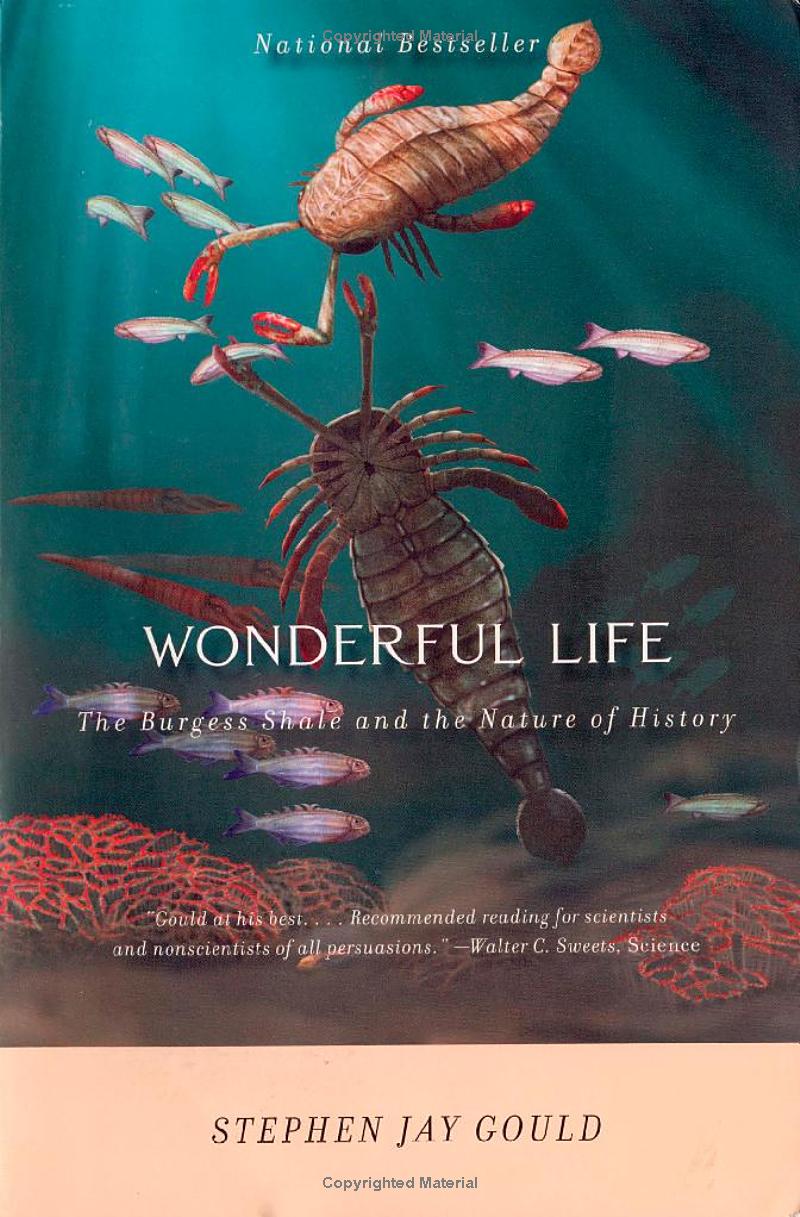
 I am a newbie to the writing of Stephen Jay Gould, a paleontologist who has attracted a sizable share of critics and detractors for his reasoned and outspoken views on our understanding of evolution, the history of science, humanism and ‘Man’s’ place in the overall scheme of things. I find this book an ‘eyeopener’. Previously my education on the topic of evolution has been casual, incidental, social, something I’ve observed and absorbed as a product of living my own life, a book here and there, not formal or studied. Over the last ten years or so I have been more focused on the science of life, that defining ‘force’ which animates all organisms, what it is to be alive at a time when the traditional divisions between the sciences, particularly between physics, biochemistry, what has come to be known as ‘systems science’ and cell biology are beginning to dissolve and merge. Science continues down its more traditional pathways with its atomistic, reductionist, approach, which has dominated most of the accepted work up until today. Under the ‘old rules’ scientists utilize what we understand as the ‘scientific method’ in which they conduct ‘controlled’ experiments, repeatedly, to understand a particular action or process. Such demand for control leads them to break problems down into limited, often tiny ‘bits’, in which it is more easy to examine and evaluate a single isolated process with ‘confidence’. Others then assemble all these bits that they’ve learned into a theory of the whole. Traditionally conducted science works from the idea that we can understand the whole by studying a problem in its parts, often ever more minute. While this has proven to be a very valuable strategy, improving our understanding, shaping the way we act in the world and our technologies, it has also become more evident that this approach has left something out, that by limiting our examination of life in this way we are missing something essential. What actually constitutes life? The study of life’s origin and its evolution expose the shortcomings of relying on this approach alone.
Gould writes about what he calls ‘historical’ science, those studies which can’t be unwound, broken apart and re-examined multiple times. They unfold only once in the spool of time. This book is not about this, but it is important to his discussion, because the ‘old’, more traditional ways of doing science are not the only way and in fact they cannot reveal the world of the past. Specifically, controlled lab experiments cannot tell us about evolution and how our world has come to be. The historical record is laid out in fossils, in stratigraphic layers, that require great effort and care to ‘read’, compare and understand, each moment following the next, never repeated, in impossibly complex relationships, buried in the earth’s crust, or uplifted on to mountain tops, accessible, seemingly everywhere, but subject to chance and the ravages of time, erosion, heat and pressure . Gould takes a renewed look at Darwin here and at his struggles with his grand theory too often simplified down into natural selection alone, which has commonly been watered down into the phrase, ‘the survival of the fittest.’ This ignores much of Darwin’s thinking, what vexed him.
Darwin was aware of the fossil finds that revealed a very different world than his contemporary one. He had studied geology and was current with the concern of his peers. He undestood that this is a far more dynamic physical Earth than it might appear to most, although plate tectonics was still a long way off. They were aware of the explosion of life that became known as the Pre-Cambrian which brought forth the modern fauna we recognize today, and, as it turns out, so much more which has vanished from time. What explained these fossil finds? What could account for these strange creatures lost to time long ago? If time moves forward and that movement was one of progress and improvement, a belief common amongst those pursuing science at the time, and even into today amongst the public, that man sat at the pinnacle of development, with our complex brains, our abilities to think, our capacity to perform the work of God…how does this all square with what we are learning about the Earth and the nearly impossibly long stretches of time that it has been ‘here’, periods that include widespread extinction ‘events’, a time period over which we humans have existed for only a fraction. Other such periods prior to the Pre-Cambrian saw such ‘explosions’ of life, which died out leaving little trace within the remaining fauna.
The Burgess Shale, located in the Rockies of British Columbia, in the Yoho National Park, dates to over 550 million years ago. Originally a sedimentary formation formed when an undersea slide occurred burying bottom dwelling, benthic and swimming, pelagic, organisms in its sediments, later turned to shale under great pressure and temperature. Such a fossil find, containing so many soft bodied organisms, others with hard structures covering parts of their bodies, is relatively unique in the world. (More limited similar finds have since been made elsewhere.) Typically it is only the hard parts which are preserved during the fossilization process. The focus of Gould’s writing is on these fossils and the work of Charles Walcott, the site’s discoverer, who lead the excavation and retrieval work of the thousands of fossils recovered there. Walcott made his notes, packaged and shipped these back to the Smithsonian where he was director with the intent of studying them more closely. His commitments kept hm from doing so. Only ever cursorily examined Walcott never found the time to do a more thorough examination. What he did do was ‘fit’ what he found into the already known classifications of life, unaware of what he was missing. Science of the day, and his own moral biases, would not allow him to consider that the idea might be wrong. He never questioned what came to be called Walcott’s Shoehorn, the shared belief that the progress of life was a given, that evolution moved ever forward and upward. This was paired with the idea that over time the diversity of species was increasing, that there were more and higher organisms in terms of complexity and specialization than there had ever been previously. What came first was more primitive, less specialized, than life today. This was the ‘shoehorn’ he and others automatically fit his discoveries into. And so, his fossils sat in their boxes, stored, largely unexamined for decades, merely more raw data to support the then status quo. Valuable, but not life changing, in terms of science.
Years later others took interest, among them Harry Whittington who engaged a couple of standout graduate students and, a few years into it, other peers, to examine and catalog them. He was not looking for, nor did he expect to find, anything that was going to change the science. He was conservative that way, but his mind was not closed. The three worked largely independently. Gould spends the center half of his book looking into their examination of the fossils, the painstaking process, their careful preparation of their monographs others would judge their work by and their gradually emerging understanding that here had existed organisms unlike any alive today with seemingly impossible characteristics in ‘molds’ completely unlike any today.
In Walcott’s day they thought of the fossils themselves as flat, two-dimensional pictures if you will. Whittington and his team realized that while compressed the whole organism was often preserved in the fossil, its carbon based cells replaced by hardened silica. In many cases the fossils had preserved a high level of detail. Knowing this they were able to remove material in layers, very finely, revealing the internal structure of the organisms. The made detailed drawings as they worked because photographs, contrary to what one might believe, did not illustrate what they actually saw. What they began to find was that many of these organisms were not just different, but had overall body plans that were very dissimilar from any living species today. In many cases they couldn’t be fit into any existing genera, family or even phyla. Totally unique. They included ancestors of the already known Trilobites. Other specimens could be directly linked to existing Arthropods, while others were classed as intermediate an odd ‘mix’. Then there were the exceptions, fossils revealing creatures, entire families and phyla, that have been lost having no existing descendants. Many paleontologists, along with Gould, argue that our old preconceptions and ideas of the inevitable progress through time and ever increasing diversity, is wrong. Instead they argue that the Pre-Cambrian explosion produced a world with far more ‘disparity’, far more variety in successful body plans, than have existed since. They further argue that life on Earth has been shaped by a more or less random process of ‘decimation’, of species loss. Far more body types existed previously than do today. While there may be more species today, overall they are far more similar than what lived before. This gets him to the fascinating idea of contingency as a major shaping factor in evolution.
If you’re curious about the book’s title, ‘Wonderful Life’, yes, it is a direct reference to the old Frank Capra movie, where near its end, Jimmy Stewart’s character, reasoning that the world would have been better off had he never been born, is ‘shown’ by his angel what the world would have been like. Change one piece, remove him and what happens. This illustrates contingency, change one element and all that follows will change, a change that has continuing impacts down through time. Contingency may seem simplistic, that it presents a circular argument that can leave one dissatisfied. What exists today was contingent upon what existed previously. What survives does so because of the many circumstances, relationships and conditions in operation before, and these have changed, in some cases drastically over time.
Species success, survival, is impossible to determine before hand as conditions are in a continual state of change. Change one thing and the entire ‘future’ result may change markedly…or not. Gould is fond of writing about rewinding the clock, and letting it play out again, each time yielding a different result. Yes, that’s an impossibility. He understood that. One can never know before which change will result in which result, how events will play out. We do know that any change leads to an even less predictable outcome the further out you look. Each change resets the table for the next change and this happens continuously. How does one define ‘Fitness’ in a world in which challenges and threats can be so widely varied? Fit for what? While being physically fit, that is healthy, does give an edge over others who might be unhealthy, is that enough? Is nature, through this natural selection process capable of forseeing the future, of identifying and preparing those preferred successors for what the future may offer? Genetics, which is variable even between individuals, is somewhat randomized during the sexual reproduction process. It cannot evolve lead linearly, in a predictive manner. There are not superior lineages which will always ‘triumph’, whatever that means. Genetic diversity, an absolute necessity for a species long term survival, ‘sets the table’ for species survival. but what must be survived is unknowable. Many will fail. Which ones? It depends. Nature, through genetics does not ‘anticipate’ future conditions planning accordingly by creating continuous superior lineages. You cannot have it both ways, the randomness of sexual reproduction and a definitive line to species improvement. Life shall always be dynamic, with outcomes only probable over short periods, but not predictive. Life is not ‘determined’. Like life, superiority, fitness, is variable and must be redefined from moment to moment. What could possible ever select for these conditions? For the unknown and unknowable? While a species may contain genetics which favor success, under particular conditions, the individual is fixed and limited. Change those conditions and that advantage vanishes.
Gould also critiques the idea of species progress by mentioning the continuing existence of organisms with some of the oldest, simplest body plans. Single celled organisms, predate all, more complex, ‘higher’ life forms. Yet they still exist and more complex organisms depend on many of them. Should not these ‘lower’ organisms have been replaced by ‘improved’ types? If the old ‘theory’ holds? Progress is a human expectation we have attached to the world. It underscores our own perceived superiority and ignores the reality, instead forcing ‘reality’ to fit our ideas of it.
In the latter portion of the book Gould works to demonstrate, and argues, that those species in existence today did not necessarily survive because they are ‘superior’, that they are bigger, stronger, smarter or even more desirable sexual partners, than those that failed and are now extinct. Survivors were simply able to ‘weather’ the changes in a region’s or the overall Earth’s living conditions, Changes in temperature, atmospheric gas composition, the movement of continents, the rise of mountain ranges, the rise and fall of oceans, changes in oceanic chemistry, the occurrence of disease, the loss of another species, climate swings between long ‘cold’ and ‘warm’ periods, cyclic changes in solar radiation, asteroid strikes….Small locally limited species, or populations, will be more likely to be lost to local changes. Other species will have been better able to survive these if they were spread across wider geographical ranges. Scientists have been unable, and probably always will be, to say that this species survived and this one didn’t because….We will always be able to make up explanations, stories that seem plausible, and we may get closer by examining the historical record as we discover it, but it will always remain a mystery. This is the nature of the past and historical studies like ours of evolution. We cannot go back and observe events. We cannot repeat a sequence in another way. Events unfold within a historical context that will never repeat exactly. So we study patterns and look for similarities, drawing conclusions from them. All of those now extinct species found in fossils, persisted on Earth for some millions of years. Ineffective body plans would not allow that. Theirs were success stories…until they weren’t. When any individual organism’s functioning is chronically poor, or unhealthy, it’s life is at risk. Organisms cannot long endure when they cannot maintain proper internal functioning between rather narrow margins. Such conditions put them under stress. Too much stress leads to collapse and failure. That stress can come from many quarters and in many combinations. It’s really not about being superior, but about health and being in tune with one’s environment…and to a degree, chance. We are perfect examples.
Scientists today understand the story of the history of evolution differently. Life has undergone several ‘beginnings’. An initial ‘flowering’, burst or ‘start’ in which the relative few fill the empty niches. Then begins the process of decimation, the many are reduced to the relative few and then the cycle begins again, ‘building’ off of the survivors of the preceding cycle. Over time through adaptation and radiation, after countless generations, differences form in isolated populations. With enough time, one species becomes several, all closely related. Those lost in the previous cycle, are simply wiped away, unrepresented. The author, and these researchers, now understand that before the Pre-Cambrian, before the current cycle, there was far more, what Gould calls ‘disparity’, species with entirely different body plans. Decimation, extinction, greatly narrowed the gene pool, far more than anyone had ever imagined. Through these cycles the extant/living species of today, while showing incredible diversity within their genera and families, exist within far fewer ‘body plans’. Those species, genera, families, entire phyla lost, are irretrievable. They existed in forms that seem fantastical to us today. When these decimations or extinction events occur, the cycle begins anew, with fewer possible overall body plans. More diversity. Reduced disparity. It is a narrowing.
The Pre-Cambrian explosion of life brought forth incredible life forms. We see this pattern around us today because it doesn’t just apply to living organisms. It happens in the world of ideas and technology. When new ideas and technologies appear, if they ‘fit’, there is an explosion of variations, related alternatives inventions, itterations. Their adoption spreads rapidly until it is everywhere…and with it a winnowing process, an economizing, because not all things are continuously possible. Some will decline and often disappear, and, if they are remembered at all, they will be so as a fad. Does the ‘best’ idea or invention triumph. Not necessarily and with these losses, go lost possibilities. Others will become more ‘refined’ over time until perhaps one becomes accepted as the best. These will become a part of the common culture. The greatest variation occurs over that rich ‘beginning’ period and this, the Gould argues, is what has happened and continues to happen with the Earth’s species, an overall reduction in the ‘disparity’ of organisms, while a diversifying process occurs within very closely related types.
Gould writes here of cones, in this case an inverted cone, with a base, at the cycles beginning, broad and varied, narrowing over time. In Darwin’s day and even up until fairly recently, science viewed life as going from simple and primitive to more complex and modern, a ‘ladder’ Gould describes it, always advancing, improving. At the same time over the course, the ‘disparity’/diversity ‘cone’ has flipped, narrowing its possibilities.. The fossil record shows that these earlier life forms were very complex and successful and then they died out, not because they were inferior, but simply because the world changed in such a way they could not survive, whether the change was sudden and catastrophic or seemingly minor and lasting over countless generations, a loss by inches until there was an eventual collapse. Their genetics and circumstances, luck, in this case bad, caught them, and they died out.
Gould is thorough. His writing dense and precise…but accessible with a little patience. The illustrations are excellent and of great aid to the reader. As he states early on it is necessary to delve into the details, because this is a story about the details, they are pivotal to one’s understanding, while at the same time he endeavors to stay away from too esoteric of jargon. He is largely successful at this. But, again, this is not a light read. It demands a lot from the reader since it upsets much of what we may have been taking as given and other ideas that will have never occurred to us general readers. So, be patient. It’s worth it.
Gould leaves us with questions about the existence of our own species. Questions there are no answers to. What will happen in our future? Will we continue to evolve? To improve? What comes after the pinnacle of human existence? If it is indeed a pinnacle? When we are gone will someone/something else be able to say that, “Those humans they really were the best…until we came by and supplanted them.” Or is this simply more about the continuing and changing story of life on this planet? A planet ‘gifted’ in its ability to produce life in spite of the assaults it suffers? I found Gould’s book to be an eyeopener. A fascinating look from a previously unrealized vantage point. An opportunity to perhaps more clearly understand the world in which we live.
 GardenRiots