Not to ‘rain on anyone’s parade’, but walking home last night at 10:30 from a neighbor’s, the air was still, it was 81F and 51% humidity…ugh. Normally, it cools off significantly here in the high desert once the sun goes down. This summer is different.
Today, August 2, we’re forecasted to break 100F again. That will be the 26th day over 90 this year, the ninth over 100F…with less than 1/4” of rain since June 1. I’ve mentioned before that our average high temp for July is 85F. We were at or below that only four days in July.
Our old normals no longer hold. They are shifting consistently higher from year to year. This is happening worldwide. Its effects are greater, and more devastating, at equatorial latitudes and polar.
It is estimated that at or above a wet bulb (W/B) temperature of 35C the human body cannot cool itself. We cool down by evaporating away sweat on our skin surface. W/B temps mimic this by placing a wet cloth sleeve around a thermometer bulb, the evaporation taking away heat in the same way. W/B temps are then cooler, ‘chilled’ by the water evaporating away, drawing heat away from the thermometer’s temperature sensitive bulb, than ‘dry bulb temps. When these rise higher than W/B 35C, our internal organs and systems begin to falter and will fail in relatively short order, depending on our state of health. Some of us will have greater tolerance than others, but all will die at these levels if they have no way to cool their core temperatures. Some argue that this begins happening below this. Many areas are already experiencing such ‘events’. Governments are still slow to act We continue to build out our cities in patterns that maximize energy use and consume resources and products from around the world which must be transported to us, removed from where they other wise occur. Profit driven businesses, still refuse to change their practices and goals, insisting that the market will solve this…the same market that has created the problem…and we ‘demand’ this, these patterns, goods and services, ever more ‘divorced’ from the places we actually live, the limits and constraints with which we’d otherwise have to live.
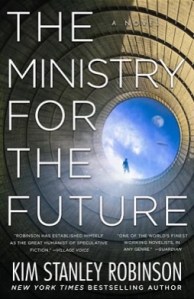
I’m recommending two books, one an amazing work of speculative fiction, “The Ministry of the Future”, written by Kim Stanley Robinson, a look into a possible future with climate change in which governments respond to seriously address it. Robinson does not shy away from horrific outcomes. In fact he plunges the reader immediately into it. His narrative lays out such events as necessity, as prompts to spur us into effective action, while also looking at how there is no clear cut path, that mistakes will be made and they will be ‘costly’, while inaction and insufficient change will be devastating. Avoidance and denial are translatable directly into loss. Both books acknowledge that this process is well underway and there is no avoiding it, so we’d best accept it and begin to respond and plan accordingly to avoid the worst outcomes. Horrific, apocalyptic outcomes are not inevitable, but they become ever more likely as we continue to deny and avoid proper action.
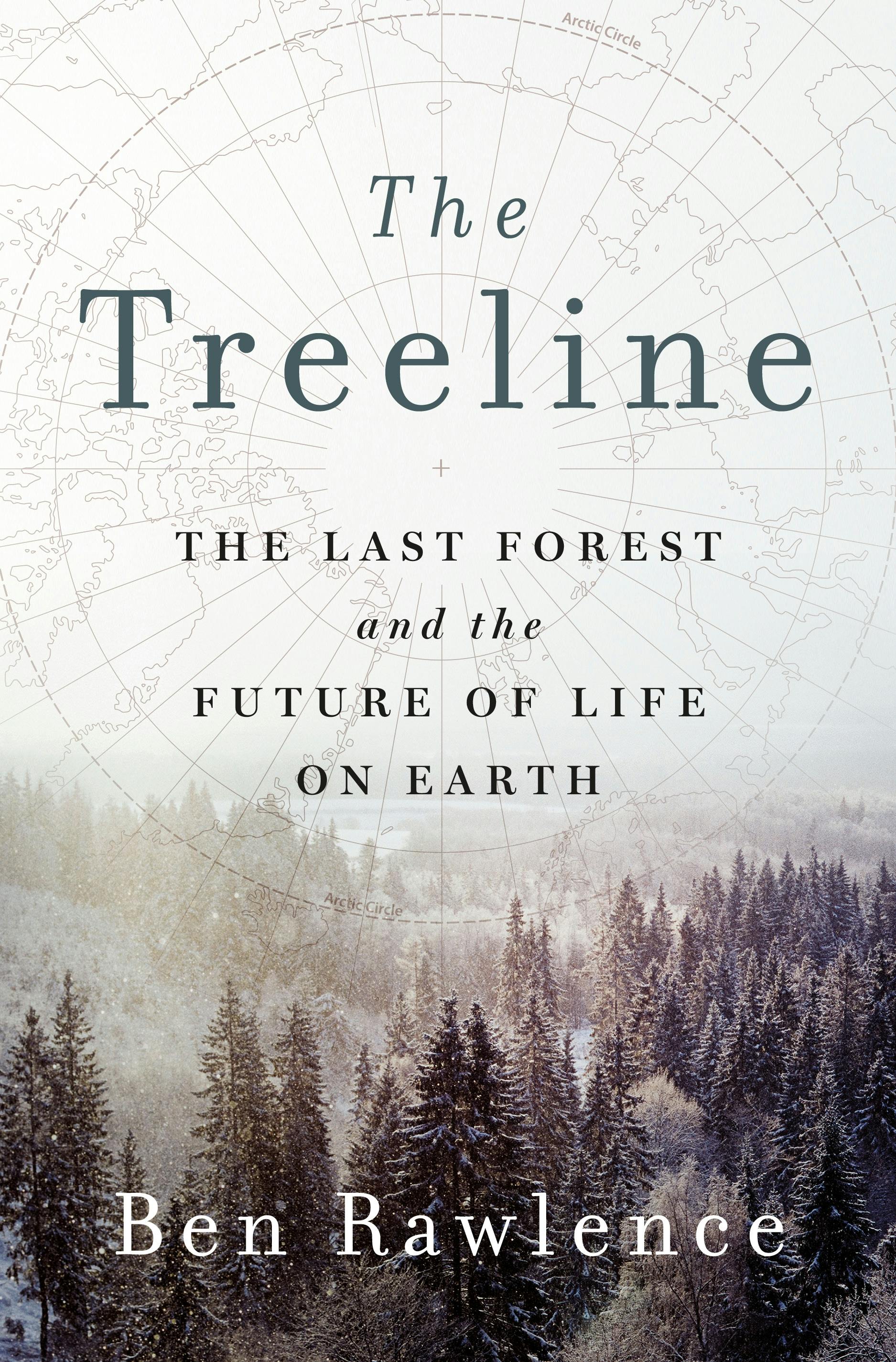
The other, a nonfiction book, “The Treeline: The Last Forest and the Future of Life on Earth”, by Ben Rawlence, looks into the fate of the northern boreal forest, the changes it is already undergoing, its intimate connection to global biotic and abiotic systems, their future, the indigenous peoples who live there and the scientists who have made this the center point of their own lives. This book is beautifully written and one of the most accessible presentations of the problem and links between all living organisms that I’ve read. Both books are disturbing, but both author’s books help define a path through this while emphatically stating that our world is changing and we must adapt and begin working with the systems which sustain life on this planet, rather than continuing to simply take what we want, while denying the wholistic reality of the world around us. It is mankind’s greatest challenge and an unavoidable one. What will we/you do? Avoidance and denial never solves anything. Because of the inextricable links between all things, loss to one will always be a loss to all. How far will we allow things to deteriorate before we take this seriously?

This is a great book! Very informative…difficult, in that this can be such a grim topic, but the author isn’t. If while reading, you periodically go to his short epilogue and read it you will be heartened as he is. There he relates a story about his two young daughters and his ongoing effort at creating a school which is intimately and integrally connected to place through Black Mountain College, in which nature becomes the classroom.
At each ‘stop’ that he makes as he examines the northern boreal he builds the story around the remaining indigenous people, giving us a glimpse into their lives, their relationships with the earth and life, their resilience, and capacity to adapt, qualities that western people and economics have too long ignored.
He travels with scientists and locals expressing their hopes and fears and their continuing efforts to do something positive, because what else is left? As the equatorial and temperate latitudes warm, pressing the boreal forest northward, the Arctic Ocean warming, the ice cap melting at an accelerating rate, the permafrost melting releasing its huge storehouse of methane, ocean currents about to ‘flip’ and the weather with it, the northern boreal forest is getting ‘pinched’, but the story of life will continue, forever changed. Our insistence otherwise will make the ‘transition’ that much more abrupt and chaotic while leaving us unprepared with tragically avoidable consequences. This is the message from both of these authors told in their own ways. Belief, insistence, in an outmoded story, one that was based more on desire and greed than the actual living, breathing world, does nothing but delay the inevitable, leaving us far less capable of coping in a radically changed world.
It is important that we understand what is happening and the gravity of the outcome, if we are to act purposefully. It is through resignation, through an acceptance of powerlessness, a failure to see our ‘true’ place in the living world and to do what we can, that the worst outcomes are assured. It is through thoughtful, informed engagement that we can better shape that outcome, an outcome that itself is dynamic and will continue to change. The world as we know it, and our ‘lifestyles’, is already undergoing an unstoppable process. It is underway. It is an illusion to believe that what we have ‘enjoyed’ over more recent years can continue…a self deception. It simply isn’t possible to grow and consume without limit. No species, no living system, can long sustain that. And the consequences of our collective action have pushed us past the point of return.
Relationship, family, community, in their broadest sense, the family of life, have always been at the core of everything. The last 300-400 years have provided us with some intellectual ‘breathing space’, but what are we to do with it now when its implementation becomes critical? The age of industry and consumption was never truly viable. Living in place, in relationship, has and always will be, enough. Our engagement is mandatory. Our acceptance of the relationships and limits of this living world must be recognized. We have literally been pushing life to its limit, and beyond. Change, one way or another, is on its way.
_____________________________________________
To have a better understanding of wet bulb temperature extremes I found
this online calculator and plugged in the numbers for today here. We hit 100F this afternoon with 19% humidity. That put our wet/bulb temp at 21C, ten degrees below the acknowledged danger zone, 14 below the ‘kill zone’. There are places in the world this summer like Pakistan, India and in Saudi Arabia hitting wet bulb temps of 35C on some days already, which can result in human death within 6 hours of exposure, without an artificial means of cooling. Wet/bulb temps of 31C can cause serious health problems. Any human’s ability to function productively at that level is non-existent. At 100ºF, 60% we would put us in the W/B temp danger zone of 31C. At 100F and 82% humidity we would be int the 35C W/B temp ‘kill zone.
I remember once being in Texas, Houston-Galveston area, years ago when the temperatures hovered around 80F and the relative humidity was around or just over 90%. equivalent to a W/B temp of of over 25C. People in the SE and east of the Rockies are very familiar with summertime conditions in which their skin is constantly sweat slickened. It may not feel like it but enough is generally still evaporating to keep their bodies within functional limits. But once you enter the W/B 35C zone, your body would simply continue to heat up effectively ‘slow cooking’ the individual as you begin suffering organ failure, and subsequently die, probably in less than six hours, far less if you are outside in the sun where the sun’s radiant energy would continue to essentially cook you. I’ve always found it ‘interesting’ how undesirable so many people find sweating to be, using antiperspirants for appearances, a rejection of their own body’s efforts to regulate itself.
Of course this does not address wildlife, domestic animals and plants all of which are effected as living organisms, although their limits will differ. In the case of fish and amphibians without the capacity to sweat and cool themselves, living immersed in water, their body temperatures are essentially the same as the surrounding water. We have long known that a very few degrees in water temperature eliminates salmon from the streams they have been using since long before our arrival ands disturbance of the forests through which they run. We ourselves are very limited and cannot survive for very long at all when our internal temperatures drop below 95ºF or over 105ºF. Increases in temperature accelerate all chemical reactions and all organisms contain a coordinated, coherent and incredibly complex system of chemical reactions. Beyond a very limited point organisms must shut down or these chemical reactions rage out of control. Shutting down is a ‘defense’, but a very limited one. All of this implies that there is an optimum temperature for us and much of life. Moving into either cooler or warmer climates begins to eliminate species. Some argue that humans perform best at and around an average of 70ºF. Author Rawlence and others argue that trees, forests share the same range with humans having evolved in close association with forests. We’ve been able to push those limits through the use of clothing, shelter, outside energy use and various technologies, but the limits remain. And of course, plants and animals don’t have these options available to them as an ‘aid’ to their survival. In addition plants, which are generally fixed in place can’t physically move to a better situation once anchored by their roots. Plant movement is accomplished much more slowly, generationally, as their seed and propagules are carried or moved off site. Rawlence describes this in his book as tree species move shifting toward more hospitable conditions if they can via natural cycles and systems or ‘aided’ by us, taking them with us as we move. On their own their us a significant lag in their response in the present as conditions change far faster than the historic thousands of years long shifts. He discusses the importance of ‘refugia’, stable pockets of populations able to hang on until once again, conditions return to those more amenable to their continuation.
Many often assume that plants are little affected by such ‘minor’ changes of temperature, as they are only ‘marginally’ alive from an animal/human perspective, but this is simply wrong. One of the dangers of ignorance is the smugness that often comes with it and the refusal to consider possibilities beyond one’s limited understanding. All of us, however, smart or wise, are limited. Without a little humility and empathy we are truly dangerous.

 GardenRiots