
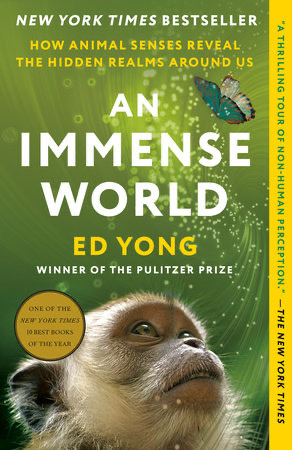
 I’m a member of a natural sciences book group. We all share a mixed range of personal experiences as hikers, Gardners, horticulturists, ecologists, wildlife biologist and a fascination with the natural world. There are always so many good titles to choose from. I’ve written of several in the past. Our current book is Ed Yong’s, “An Immense World”, a look into the senses and perceptions of organisms, to understand how an animal ‘sees’ its world. of course, we can only do this from our own limited, human biased vision heavy view of the world. We should never assume animals ‘see’ the world as we do. Many animals primary sense isn’t vision at all. In this book Yong writes of how even when we share particular sense organs with other animals, our perception is very different. Perception is something beyond the senses. It occurs after sensing, an attempt to make sense of the world around us in a way that works for us with our needs and limitations…It is not the world itself. Perception gives us our personal understanding of the world. It is shaped by the combination of our several senses and our need to understand. In evolution what ‘works’ shapes us. We, the biological we, that is, all organisms, are in turn shaped by the world around us…our bodies, our sense organs and our understanding of the world around us. We are shaped by necessity and possibility. While discussing this Yong writes repeatedly of a species’ and an individual’s ‘Umwelt’, our individual view of the world around US. Each is distinct. Individual and limited, making it near impossible for us to imagine another’s, but this does not give us permission to dismiss that of others…any others.
Different species ‘see’ different wavelengths of light, including those invisible to us. There eyes are constructed and positioned differently so what they see is difficult to imagine and this is also true for our other share sense, hearing, taste, touch and smell. Then there are those senses which are completely foreign to us: there are those that can sense the earth’s magnetism and use it as a navigational tool over long migrations; those that can sense very subtle vibrations in the air, water or soil around them and use them as clues to help locate potential dangers or meals; those that can sense the electrical fields all living organisms create simply by being alive. There are those few who can echolocate the world around them broadcasting directed bursts of sound beyond our hearing range and in the hearing of the returning ‘echo’ be able to identify the obstacle or potential meal by ti and those that can do so underwater with incredible accuracy. Toothed whales communicate and navigate at least in part by producing incredible loud, low frequency blasts that can carry over 1,000 miles underwater. Then there are those with sense organs in locations on their bodies we would never guess, smell or taste receptors on their feet; or all of the species that see so much faster than we can, as well as those who hear so much faster, their messages aurally invisible to us, yet their bodies able to respond in less than a blink of our eye.
He writes of proprioception, the ability to locate your own body in space as you move, without looking and the ability to know up from down, to maintain one’s balance. One of the most fascinating concepts is the ability of even the most simple organism to separate those sensations they feel, which are caused by others outside themselves, from those caused by our own movements, how our bodies communicate with their innumerable ‘parts’ so that we understand, instantaneously, what is of us and what is not, an ability without which all the sensory information we are constantly bombarded with, would plunge us into chaos. All organisms must do this. We thus ‘read’ our environments as we move through them, each species, each individual, in its own way.
Toward the book’s end Yong makes his case for how we humans, with our limitations, have ‘polluted’ the sensory environment of so many other species through the sound, vibrations and light our technologies produce, that don’t just inconvenience so many thousands of other species, but in many cases, so disrupt their world that they are either driven away or lured in, to their deaths. Light pollution of the night sky, sound pollution of the sea and terrestrial landscape, the deep mechanical thrumming of the earth beneath our feet caused by our machines, can be extremely disruptive when they assault the senses of other species, kinds of ‘pollution’ that we are too often insensitive to, yet upon which are central to another species’ existence. Some scientists argue, that we humans are also so affected, but we have a tendency, an adaptability, that allows us to tolerate it. While at the same time it disrupts and confounds our own healthy biological function. We are each immersed in our own ‘seas’ and because of this are somewhat oblivious to the changes, our bodies effectively screening out that which interferes with our abilities to continue functioning. In this sense it is much the same as our normal cancelling of the interference we create in our lives. We thus quiet the ‘chaos’, our lives go on…but its effects remain, as we push ourselves to the margins of our own limits.
One of Yong’s biggest points is that none of us, no two species, no two individuals, know the same world. We each live in a different world interpreting reality in our own way…a fascinating read. Beautifully written. Accessible to anyone who might care. I listened to it as an audio book, but also had the paper book I’d refer back to to check things. Read it!!!
 GardenRiots