
 ‘Global warming’ and ‘climate change’ have become trigger phrases, hot buttons for millions of Americans. What were originally coined as descriptive, short hands to signify a complex climatological process induced and accelerated by human action, has been thoroughly politicized. Today they separate ‘us’ from ‘them’.
For those on one side, the earth, is a closed, limited and complex system we are ‘pushing’ beyond its inherent abilities to maintain dynamic balance within margins which organisms can live in a vital, healthy state, biological processes continuing in a familiar manner. This ‘side’ understands that we are adding vast quantities of carbon to the atmosphere causing the earth to retain more heat, heat which ‘spins’ the entire system faster, potentially beyond the limits that life evolved with. Such a more ‘carbonized’ atmosphere resembles that here of many millions of years ago, of a warmer earth, that was nonsupportive, too warm, for the vast majority of organisms which exits today. Too much carbon released into the atmosphere? These effects are easily demonstrable in a lab experiment. These people have some understanding of what they must do to slow and halt these changes, what we must do to ameliorate the damage we’ll inevitably face. Pushed too far the system won’t return to the old ‘normal’ in a few weeks, months or years. It will be with us for generations to come.
To the other side, such change is simply a story, a ruse, told to rile up the public, intended to impose a change on people, not for any practical purpose, but to steer people through fear, into behavior they would not otherwise choose, in this case, to give up liberties and conveniences, the ability to ‘consume’ as much fuel as one desires, something no ‘rational’ person would choose….They see the earth as effectively open, ‘limitless’, that as individuals, and collectively, our choices cannot possibly effect a change that is substantial enough to disrupt the world in any way that is ultimately destructive of the earth and its systems which support us…Their ‘rationale’ seems to be that because they have no personal experience of such an occurrence, because it has not happened prior in their own experience, it cannot happen. The earth will simply continue as it ‘always’ has. Any necessary adjustments or corrections, brought on by our resource use, will be minimal, well within the capacities of our technologies to correct or stand in for…The earth then is to them can simply absorb whatever damages we inflict on it. Therefore there is no reason to alter course. No problem, they believe, is insurmountable. All problems are ‘fixable’. The problem of hubris is defined away.
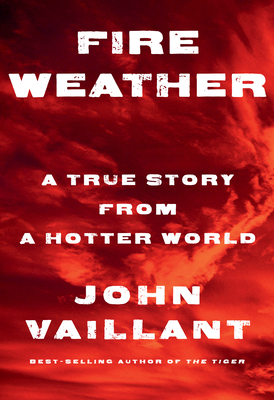
‘Fire Weather’, John Vaillant’s latest book, describes a world in which we have already altered the conditions to the point where life is effectively permanently changed…a drier, hotter world which is changing the conditions for life. Wild fire too has changed within these altered limits, consuming sequestered carbon at an accelerating rate, in a positive feedback loop, which will lead to even more damaging changes, even if we were to halt the burning of all carbon based fuels today. The ‘system’ perturbed, knocked off balance will take time to correct and find a new balance, a process that occurs at a geological rate. This is a book not just about wildfire, or the wildfire/urban interface, the WUI, it is a comprehensive look at how we got here, the coming together of fire science, a warming planet and human behavior. Ultimately it looks into the question of whether we have the capacity and will to change our collective behavior to keep the changes limited so that we might not just survive, but that the world retains the beauty and capacity to support us as it changes. The world will survive, as will life, but will it be habitable by us if we fail to recognize these limits?
Vaillant takes the first portion of his book to describe the massive fire that destroyed the city of Fort McMurray in Alberta, Canada, that exploded so rapidly in early May of 2016, forcing the evacuation of 88,000 residents in 24 hours, burning the city and eventually 2,000 sq.mi. of the surrounding tinder dry Boreal Spruce Forest. It incinerated 2,400 homes and commercial buildings, rendering another 2,000 residences uninhabitable. The fire burned for over a year before being declared out. It was the result of the ‘perfect storm’, the alignment of extreme local temperatures, record low humidity, several years of increasing drought which has been drying the Boreal Forest around the entire northern latitudes, as well as vast portions of all of the other continents. Normally wet soils, duff layers, muskeg and peatlands, were bone dry that spring the fires began. These he points out are becoming more common conditions of places all around the planet. He takes you through the fire with those who escaped it and attempted to fight it, and failed, not due to lack of effort, but because fire under those conditions are now an entirely new phenomenon. Traditional fire fighting methods could not and did not work. It wasn’t until 15 months later that the fire exhausted itself burning all of the fuel available. It became, as many there described it, a voracious ‘beast’ with an undeniable ‘hunger’ for fuel…for anything it could burn. It created its own weather, shaping the winds that fed it oxygen and propelled it and, according to investigators, often burned to over 2,100ºF, melting glass and aluminum, distorting steel, greatly weakening concrete.
Vaillant goes on to add in examples of other fires around the world and introduces several terms, such as pyro-tornadogenesis, a never before seen atmospheric phenomenon associated with a new class of fire, like a few in Australia and in Central California recently, in which the energy of fires effectively form what appears to be tornados of flame with hurricane force winds flattening trees, throwing vehicles. In the world today almost everything around us can become fuel. Firefighters and evacuees describe seeing approaching walls of flame, burning embers thrown far ahead, while entire sections of trees and homes explode into flame, essentially in a moment, the incredible heat preceding the flames, super heating the air before it and all objects in its path, one moment beyond the reach of the flames, entirely engulfed in the next, homes reduced to ash in as little as 3 to 5 minutes. Wood, plastics, synthetics, anything derived from petrochemicals, gasified and gone. In this increasingly combustible world he refers to us as Homo flagrans, Fire Man. Fire, combustion, oxidation, essential to life, are becoming increasingly, common and intense, thanks to the changes we have imposed and continued to worsen. Fire is occurring today even in landscapes where it has not in thousands of years, such as in the rain forests, the Boreal Forest and tundra, where perpetually wet landscapes are drying, warming and burning.
Another part of the book is a history of the petrochemical industry, particularly the oil sands industry of Alberta. Vaillant interweaves with his telling of the emergence of atmospheric and climate science, noting and documenting how the petrochemical industry recognized and furthered the research into the link between their own industry, the burden of carbon dioxide and methane their industry was injecting into the atmosphere in increasing amounts every year, and what that meant for the future. The petroleum industry once financed and led the research calling for change, until it didn’t, growth and profit becoming the only thing that then mattered to these petro giants. They did a complete and abrupt reversal, undercutting the research of, and labelling their opponents, as alarmists and worse.
An additional storyline is that of the oil sands, the bitumen industry, that is centered in the Fort McMurray area. It is the city’s reason for being, where oil companies from around the world had been heavily investing, promoted and abetted by the Canadian government. Oil sands require an enormous investment in terms of both capital and energy resources to produce a salable product, an industry that has only ever been profitable when the barrel price of oil is very high and is completely dependent on heavy government subsidies, public money. The Boreal Forest is the most stressed region of the world in terms of the drought and temperature rise it. Its wildfire season has begun to stretch to year round so it should not be a surprise that fire has come to define the region. The industries insistence that the bitumen industry continue despite all of this is telling. It is an industry which refuses to acknowledge the changed reality much of which it is directly responsible for.
Vaillant examines the mindset of an industry and public that ‘refuses’ to see the writing on the wall…or in the ashes. He introduces a concept which addresses much of this, the Lucretius Problem. Lucretius was a Roman philosopher who noted that people tend to think that the biggest or worst thing that they’ve ever seen is the biggest or worst of its kind in existence…or is even possible. It states that the limits of our experience shapes or skews our understanding of the possible, allowing us to chronically underestimate an outcome to a problem or situation we’ve not experienced. But records, memories, are regularly exceeded, limited as they are. This is the problem we face with climate change. Not only have we as individuals never experienced this, neither has our species.
Combine this with all of the attempts to undermine expertise and science, by those in positions of power, along with our ‘celebration’ of ignorance, how we dismiss the value of education and undermine curiosity as childish and it’s no wonder that we find ourselves in this conflicted and precarious position. It doesn’t help that as humans we tend to think that whatever comforts and resources we have available to us, we are entitled to and so are reluctant to examine the associated problems or consider voluntarily giving them up. There are many layers to this problem.
In the last chapters of his book, Vaillant, describes the increasing number and successes of legal battles against the petrochemical industry and the government agencies which are charged with protecting their citizens. Many of these class action cases around the world are lead by children and young people, charging governments with a failure to protect their health and futures. Unsurprisingly, most of these court battles go ‘un’ or under reported in the mass media. These youthful plaintiffs have their age used against them in public attacks. Greta Thornberg, for example, is continuously attacked or dismissed as an ignorant and selfish ‘child’ without the necessary understanding to be credible. (This is one of those funny cases where the conservatives, and climate deniers, claim an opponent lacks expertise to be taken seriously, a concept they normally reject, yet another indicator of their own lack of rational thought.) Plaintiffs, any opponents, are subjected here to accusations of being ‘anti-American’, and sometimes, overt threats to their health and safety. Others are ridiculed as being ignorant and selfish, in a process of ‘gas lighting’, while no serious discussion of their charges occurs. There is no effective forum for civil discourse. At the same time everything critical of the industry is questioned, derided, every discussion polarized…because there is no rational defense for its continuation as is. ‘Ad hominem’ attacks against those calling for reducing our carbon footprint are the norm.
Vaillant exposes how these giants of industry, once the most profitable corporations in the world, are now carrying so much debt, that their obligation to ‘pay’ their shareholders is under threat. They press governments for more financial supports and the cession of ever more regulations put in place to protect the life and health of the public. Their increasing financial insolvency is pushing them into an ever less tenable financial position. At the same time the international insurance industry, is increasingly unwilling to underwrite them, precisely because of the irrefutable evidence that their industry is destroying the capacity of earth to support life as we know it, which is resulting in ever more and larger payouts by the insurance industry to cover the losses of a warming planet. No significant investments are made in the business world without insurance in place. In most recent years even the banks are beginning to refuse to finance large projects. All of this flies in the face of president elect Trump’s promise to gut regulation and free up exploration and extraction of oil, gas, oil shale, oil sands, anything he can. The Canadian government, was still at publishing, heavily investing public monies into the oil industry instead of into alternative energy technologies, exactly what Trump is promising, crippling their own economic position in the process, as private monies continue to flee. How much public money will Americans allow to flow to a dying industry, that even the private sector is retreating from, precisely because it continues working to render the earth uninhabitable? How much more time will pass before we take effective, coordinated action, to end the increasing level of atmospheric carbon and all the changes that will bring for many generations?
[Today, Jan. 9, 2025, as I review this the multiple runaway fires are burning huge acreages of the Los Angeles area. Thousands of homes and structures already burned, over a hundred thousand people evacuated, the fires still out of control, creating hurricane force winds that drive the flames. This, Vaillant would probably agree, is the new norm, not a rare fluke. As the fires continue around the world, as we continue to burn carbon intentionally, as the warming earth speeds the decomposition, the oxidation, of carbon materials covering vast portions of Earth’s surface, the process of atmospheric carbonization increases, while ‘we’, collectively deny the problem.]
 GardenRiots