
 COVID-19, it’s pandemic, the fumbling attempts to head it off, all of the politicizing, the race to develop a vaccine, its distribution and administration and the curious and potentially disastrous attempts to undermine our confidence today in vaccines proven decades ago or for any disease, seem to be a fact of life today. While public acceptance of advice and programs advocated for by epidemiologists has always been difficult, many of us unknowingly owe our lives to their efforts, efforts that were they not made in years past, would have resulted in a world whose present populace might not be here, or if they were, in significantly compromised health and numbers. That is the nature of an epidemiologist’s life. Public doubt, fear and speculation, their work’s value invisible to the vast majority of us, because of what did not happen.
It is an epidemiologist’s job to keep society safe, to guard against avoidable deaths. The fact that disease outbreaks are unpredictable, often coming from surprising sectors, makes their job all the more difficult. Their responsibility it to prepare us for the unexpected so that when it comes we are able to respond effectively and quickly enough to prevent suffering and death. Because of the unpredictability of outbreaks of new and ‘old’ diseases, they are prone to error, to seeing a problem, advocating and working for programs to head them off, that when they ‘miss’ some will criticize them as over reacting, of ‘crying wolf’, the result of which is we often ignore them. Error is likely in any volatile ‘system’ whether we are looking at whether it concerns human health, economics or the climate, anything really. Our attention spans are limited and our personal experience often determines what we are willing to accept, especially when these ‘experts’ sound the ‘alarm’ and they miss. We then are prone to dismiss them, but we do so at our own peril.
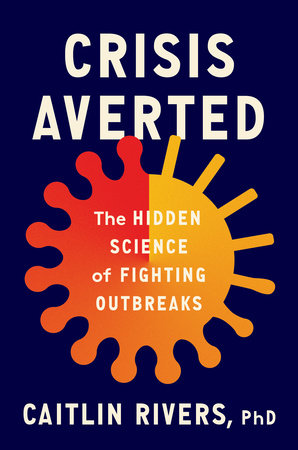
Caitlin Rivers is an epidemiologist and the author of the book, “Crisis Averted: The Hidden Science of Fighting Outbreaks”. In her book she discusses the history of epidemiology from before we were even aware of what today is understood as ‘germ science’, when disease was attributed to miasmas, bad air, the work of evil and witchcraft and God’s retribution visited upon those who’ve lead sinful lives. Disease vanquished the weak of spirit and mind, favoring God’s chosen and so on this continent when uncounted millions of Native Americans died from European diseases, which they had no historical contact with, and therefore little to no immunities, it was viewed as ‘providence’, God’s endorsement of his ‘chosen’ people. But over the many decades of study, from ‘our’ first discovery of wee ‘animalcules’, visible with the aid of early microscopes to today, we, at least those who study health and disease, have a much clearer understanding of disease and its ability to adapt itself to a changing world.
Disease and the world of viruses, bacteria and other agents of infection are also a part of the very process that drives the continuing evolution of life on the planet. Where there are living cells, there are viruses and bacteria. They are a fact of life and in many cases, essential for the health of the individual organisms of which they are true part, providing essential functions. We are surrounded by, and our bodies fully informed by, viruses and bacteria. It is the job of the epidemiologist to determine which are driving disease outbreaks and which are benign or necessary.
In an earlier portion of her book she draws comparisons with the developing science of meteorology and its abilities to predict storms. As a new science without a dependable ‘track’ record meteorologists, like early epidemiologists, were reluctant to go public with their announcements. Meteorologists, lacked predictive confidence and were worried to put themselves out there and risk being wrong leading the public to mistrust them or, provoke the opposite reaction, say predict a tornado and have the public over react out of fear. This went on for several decades, the public then experiencing storms that seemingly came out of no where with significant loss of life. This ended when meteorologists, at an Oklahoma Army Air Force base, worried that they might be wrong, didn’t sound the advance alarm and the base was devastated. The next time, with the active support of their commanding general, they announced the storm’s imminent arrival and the base was prepared in advance. This event triggered the creation of the National Weather Service. Epidemiologists had an even more difficult time, their ‘quarry’ invisible to all, and politicians undisposed to act on their advice, a state that largely continues to the day in which we generally favor preparedness after a disaster and then when one does not come along for a significant number of years, budgets reduced, we sit vulnerable again.
She dedicates many pages to the discussion of the political difficulties of gaining funding or any political movement at all toward programs that would improve detection and response to diseases. The successes of epidemiology are largely invisible to both the public and decision makers and their exists an inherent mistrust between the two. Why spend money on something that isn’t a problem? The problem with this is of course that when a pandemic strikes, it begins small, and through its early spread, does so at what seems to be a minor and manageable scale, at least until its numbers and potential pattern of doubling over each generation, when the problem and disease ‘suddenly’ appears to be ‘everywhere’. When and how much of our public budget should be dedicated? Without preparedness our response to a pandemic is even slower and when it gets to the stage where it suddenly seems to be everywhere and overwhelming our health care system, its effect is potentially even more devastating.
The final two chapters work to define the social aspect of epidemiology, the necessity for communication with the general public and the public’s essential role in limiting the spread of diseases. This she sees as the biggest challenge. Understanding the disease, its source and methods of transmission are not enough. Public health requires us all as knowledgeable participants and ‘coworkers’. There are diseases out there that have plagued humanity for hundred’s of years and still do. Their containment is extremely challenging given disease’s disregard of political boundaries, our ease and access to rapid worldwide transportation, our still expanding population that tend to live in urban centers with densities that support rapid spreading and the economics that go to determining a populations general state of health, therefore its vulnerability and the costs of medical interventions. Add to this our own resistance to changing lifelong habits in ways that promote our own individual improved health and you can begin to see the problems Rivers and her peers face. In the world of the epidemiologist all of these problems come together.
There is no single silver bullet available in their ‘arsenal’. It is in the nature of life that there will be death. It cannot be removed from our equation, but the quality of our lives and our longevity can be assured for most of us, but not if we stand by and leave billions exposed and vulnerable to disease. Whatever barriers we might erect they will be insufficient to the spread of many of our diseases. Disease, like any other living organisms are in a continual state of evolving and viruses and bacteria with their rapid life cycles and inherent capacity for change, are better at it than we longer lived clumsy humans. Denial is not a pathway to success when we work in opposition to nature. Public health is the collective result of individual health, everyone a link in the growing chain of connection.
 Another excellent book on epidemiology is David Quammen’s, “Spillover: Animal Infections and the Next Human Pandemic”, a book he wrote before COVID-19. It focuses on the field work many epidemiologists do around the world tracking down the sources of ‘new’ infections and trying to understand their transmission and the symptomology of the disease as it progresses in the human body. It is an eye opener and emphasizes the importance of doing the work. Diseases don’t dome out of the blue. They evolve in other living organisms, sometimes developing the capacity to infect species they previously did not.
Viruses and bacteria share a common purpose with more complex, larger organisms like us, to live and reproduce. Most diseases don’t infect and quickly kill their hosts, that would slow their possible spread, and disease, like us, depend on this numbers game producing enough variability in its population that it can ‘improve’ and meet the demands of a changing environment. Low numbers then, and the quick death of one’s host, tend not to be a path to success for a virus and bacteria, but these cases do occur. In a world shrunken by out capacity to so freely travel and where human habitation continues to push out into ‘frontiers’ that never contained any concentrated large human communities, disease today is afforded far more possibility to make the leap from one species to another and to improve its abilities to be more easily transmitted. Host and disease are dependent on this relationship between them and it will always be so. Better to prepare for it and do what we can. It is a fact of life.
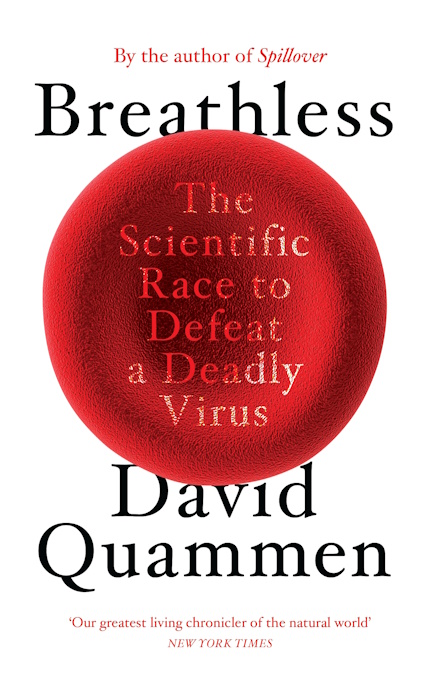 Quammen has a newer book out, “Breathless: The Scientific Race to Defeat a Deadly Virus”, covering the race to contain COVID and develop the vaccine, that I have not yet read. I intend to. Quammen is an excellent writer, capable of making complex topics understandable to the interested layperson. Put it on your list. To think that we are ‘done’ with pandemics is an error we cannot afford. All of the factors contributing to conditions supportive of pandemics are increasing. As our numbers and civilization continue to ignore the limits of a finite earth, these problems will continue. If we have any hope of avoiding catastrophe we better begin taking effective action to reduce our risk. So far we are not. We can neither wish it away nor deny its reality with any effectiveness. Action is required and that requires knowledge and understanding.
 GardenRiots