“From the viewpoint of the evolutionary biologist it is reasonable to assume that the sensitive, embodied actions of plants and bacteria are part of the same continuum of perception and action that culminates in our most revered mental attributes. “Mind” may be the result of interacting cells. Mind and body, perceiving and living, are equally self-referring, self-reflexive processes already present in the earliest bacteria.”
—Lynn Margulis and Dorian Sagan, “What is Life?”, 1995
 From what do sentience, awareness, consciousness and intelligence come from? Are these capacities a product of an organism’s complexity? At what point does it first appear? is it a property inherent to even the simplest organic chemicals? of peptide chains and amino acids, of atoms themselves?What of the organizing principle that seems to guide embryogenesis, the growth and form of every living individual of every species? Is it in action in the most ‘simple’ interactions between organic chemicals and the energy flowing through them, that favors one form over another and animates those same forms once they meet some critical minimal level of complexity? Is this evolution towards complexity and ‘awareness’ an inevitability? A product of its component parts and the energies within it? [This is an idea that is separate from the notion of an inevitable ‘progress’ of life, always moving ‘forward’. Progress is a human notion, an assessment and a valuation of the change around us, not a ‘goal’ of natural selection and the animating ‘flux’ of energies within the universe.] Rudimentary awareness must exists at some necessary and basic level in the simplest single celled organisms…even in plants.
I look to that which is shared between all organisms and question the idea of the animal brain, and its neural system, as the basis for these things and its purported absence in plants, fungi, bacteria, viruses and archaea, as lacking in them. The brain itself and associated nervous system is a unique and complex structure present only in ‘higher’ animals. This bias in favor of the brain and neural systems, especially that of the human brain, as the seat of awareness and consciousness, ignores the requirements of any organism. We are biased in our insistence that these capacities must be located in a singular physical organ and no other. A singular occurrence in the universe. A huge conceit on our part, that this capacity exists in us alone, in and organ and tissues we could could physically evaluate, one which we ‘carry’ internally within us as we move freely about. The body, any body, is a vessel which contains life and is shaped by it. Life is both of the body and transcendent, existing beyond it. Life exists within the continuously unfolding moment. Life is not a ‘thing’ so one can hardly expect awareness, consciousness and intelligence to fit neatly into a limited organ, however we define it. The roots of this reach back into the study of evolution, ecology, cell biology, neurobiology, the metabolism and thermodynamics of life and the expanding field of quantum biology.
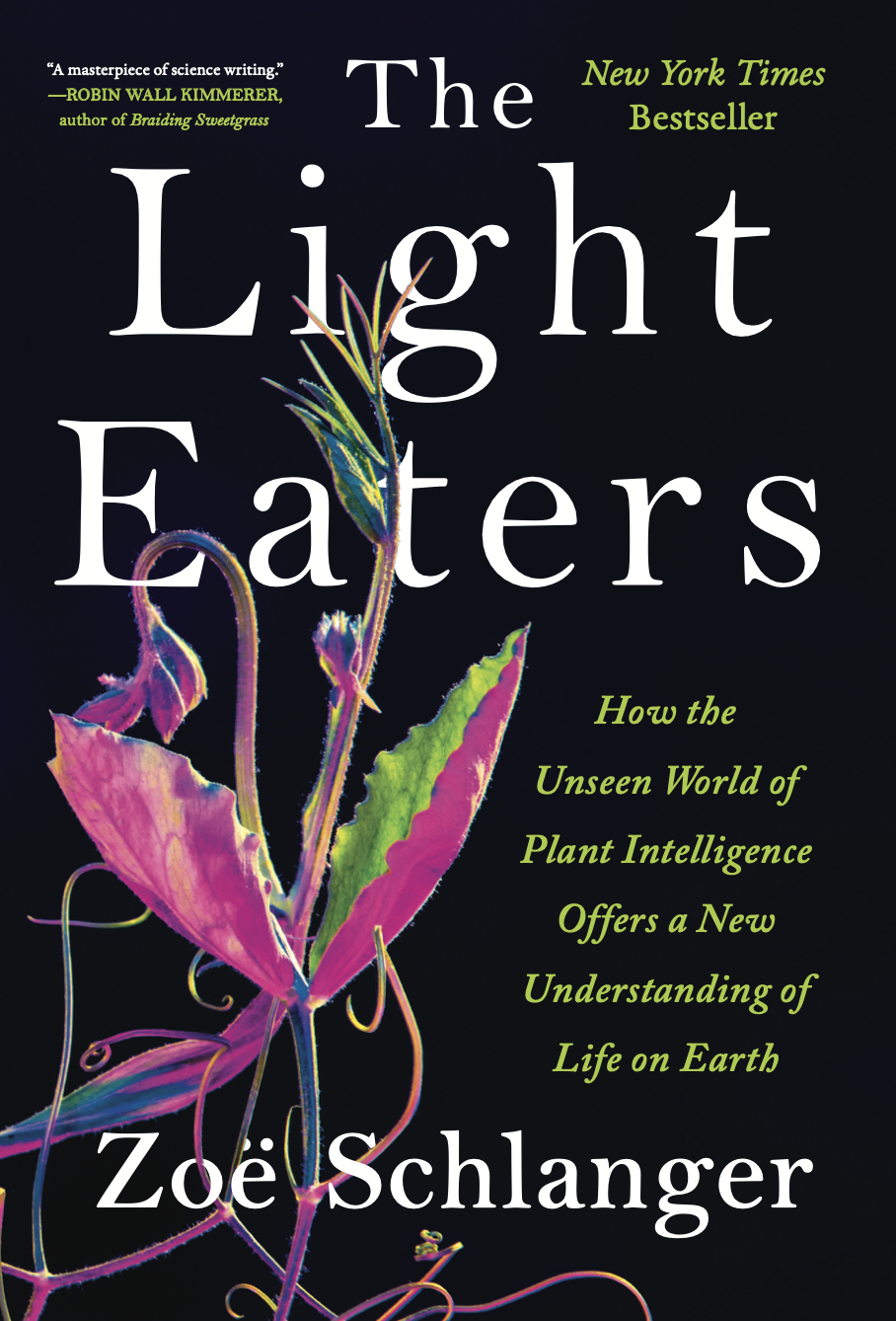
This latest thought piece has been inspired by three recent books I’ve read, Ed Yong’s, “An Immense World”, Paco Calvo’s, “Planta Sapiens” and Zoe Schlanger’s, “The Light Eaters”. I am not a scientist. I’m a student driven to make sense of this world. The connections and conclusions I make here are mine, although they may be suggested by the writings of others. Continue reading →

 GardenRiots