
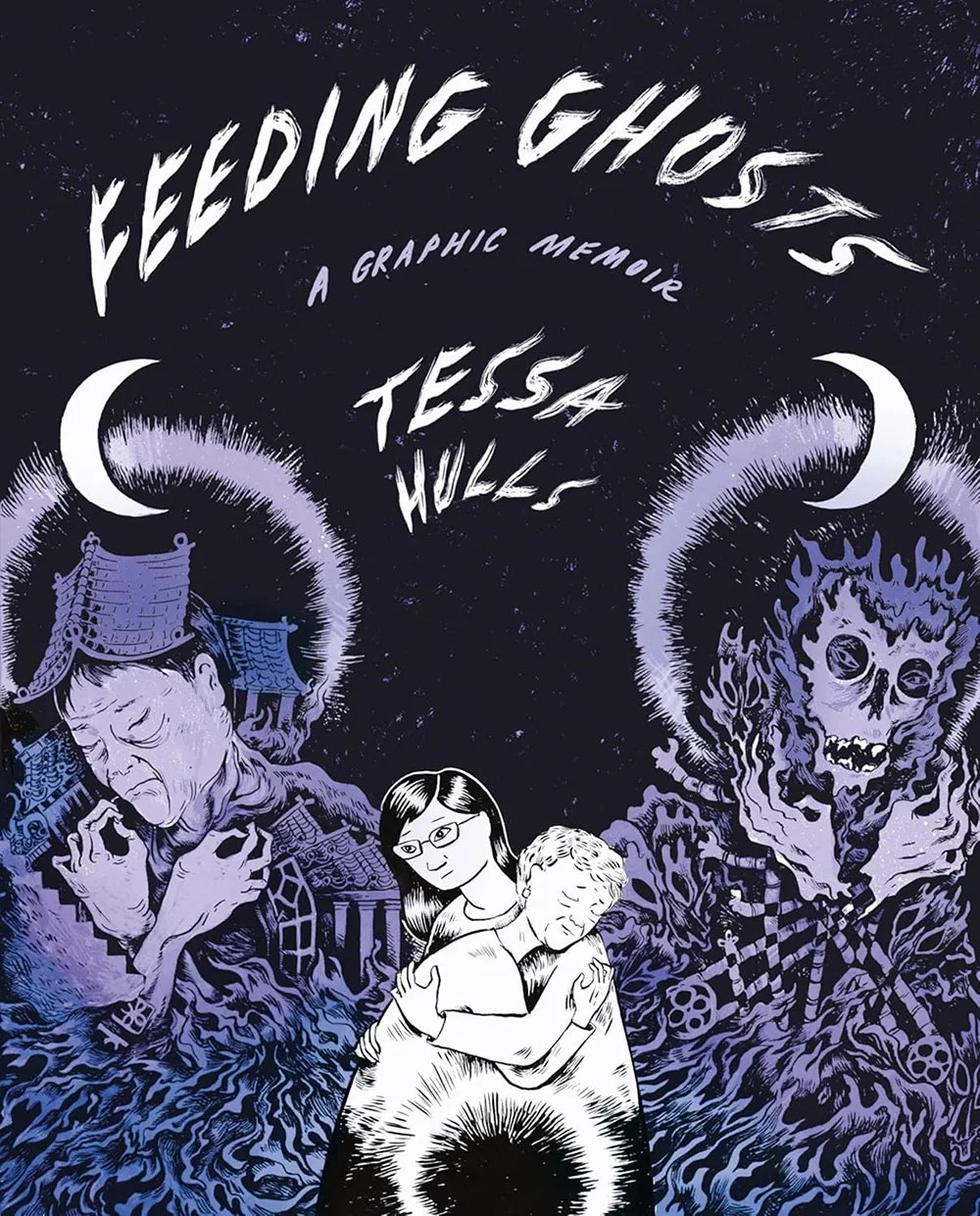
 Feeding Ghosts is a unique creation, a graphic memoir, a memoir that utilizes the format of the graphic novel, one that many associate with Marvel super heroes, but often tackle substantive social issues. In this author, illustrator, Tessa Hulls, tells the story of her family’s experience with trauma and how its echoes are passed on to the children; the trauma of the parent, the damage it has done, and their response to it; their defense against the pain, the ‘story’ they tell themselves of their personal experiences, that truncates their life and their ability to parent and model healthy behavior. These limitations then go to shaping their children’s world as it ‘collides’ with the child’s innate capabilities and vulnerability, like a wave breaking on a shoreline shaping the child’s life and their ability to respond to the opportunities and traumas that arise they will be confronted with. When the parent is so limited, and all of us are, this shapes the beginning point of their children. And the ‘original’ trauma is passed on, in altered form, to the children, from which they form their own stilted baseline for their lives.
Hulls is Chinese-American. Born in California, to a British father and a Eurasian mother, a term the Chinese assigned to children of European-Chinese descent, an assignation that in China of the time, put you in a questionable, negative, position versus the government. Her grandmother, Sun Yi, was an educated woman, a somewhat rarity in China of the time, who worked as a journalist for a newspaper that supported the Nationalist effort against Mao’s emerging communist government following their civil war. Many of the pro-Nationalists fled to Hong Kong and Taiwan. Against the advisement of many friends, Sun Yi stayed to continue her work. She quickly finds herself in an extremely vulnerable situation, prevented from working, a single mother of what is viewed as a European ‘bastard ’child, a child that represents their ‘oppressors’. Sun Yi thus became an enemy of the people.
In order for Hulls to place her family story in context, so that she herself can better understand her family story, a story that she grew up largely ignorant of in the US, Hulls recreates the China of her grandmother’s young adulthood through her mother’s early years, all of its upheavals, the civil wars, the wars with the Japanese, WW II and the victory of the communists, in which her grandmother and mother suffered through the purges and programs of a China that was attempting to rid itself of undesired elements; through a period of unrelenting, pervasive, suspicion and violent reformations. These traumas to the grandmother are passed down, unintentionally and inevitably through her child and then to the author.
I am familiar with the pivotal events of China from the Opium Wars to war with Japan and its horrific ‘Rape of Nanking’, through the struggle sessions, beatings, executions and the literal millions that starved while the new government publicly insisted that everything was great. Through all of this, Hulls takes the reader on a guided history tour through the forces that broke her grandmother, and in the language of Chinese culture, released the ‘hungry ghosts’, referenced in the title, that must be sated before the family can heal and move forward. Grandmother, Sun Yi, was subject to repeated interrogations, surveillance, threats and overt intimidation…for years, before they were able to flee to Hong Kong. The wounds were real and deep and Sun Yi fell into decades of severe mental illness, never emerging.
In Hong Kong, Sun Yi, ends up hospitalized, basically a ‘warehousing’ facility and her young daughter, Rose, is reforged, into the role she will have for decades to follow. Rose, who is taken in by Hong Kong’s successful Eurasian community, is placed in a school in which she excels. Rose’s inner life, her view of the world as threatening, her own mother’s weaknesses that led to her downward spiral, puts Rose into the position of her mother’s caretaker and defender, a world in which her mother, lost for years in her own mind, ‘haunts’ her own, becoming her own driving purpose, to do what she can to maintain her mother’s own created fiction of life. Later, she would come to see her daughter as subject to the same ‘weakness’ and in her zeal to protect her, end up pushing her away.
Eventually, on a scholarship to a midwestern university, Rose comes to the US, alone and through her own trials, builds a life here. Later, she brings here still ill mother into their home where she would exist like a ghost in the background. The reader learns how much of China, and her family’s past, has followed Rose and shapes her and her daughter’s relationship. Tessa, the author, amidst this clash of worlds grows up with an incommunicative grandmother and a mother trapped in her own past, her world view one of her own Chinese heritage and family trauma. In this space grows the conflict between Rose and daughter, author, Tessa.
The bulk of the story describes this rift, the resultant conflict and the daughter’s efforts to understand and heal the trauma, a process that guides and redirects her life after 30 years or so of misunderstanding and anger. As I read this I saw much of my own story in the telling and, see it repeated all around me in other families and across time. We each have our own origin stories, familial histories, often not very well examined, but histories we tell ourselves anyway, often completely unaware, taking them simply as the way things are and in so doing diminish ourselves and those around us. It is difficult to see the ‘water’ of our own lives through which we largely swim unawares. It is in looking at the more visible struggles of others that we might begin to see our own struggle and begin to find our way out.
Through out the book Hulls’ art vividly illustrates her family’s, and her own, ‘passage’. Through it the at times ‘warring’ cultures and colliding perspectives come to life. This book has won several well earned awards in both the literary world, including a Pulitzer for memoir, and the world of the graphic novel/comic book. Take the time to read it. There are many insights here we would all benefit from.
 GardenRiots