
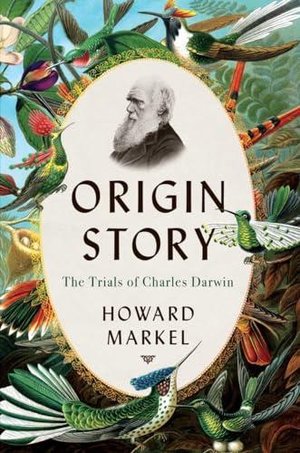
 Evolution, natural selection and Darwin are often triggers for many conservatives. On their announcement people will often enter into angry diatribes which nearly just as often sets off others into a defense of shared ancestors, adaptation and descent, sometimes with a reciprocal attack against a determining role for God. It quickly moves into a polarized argument, one side embracing a christian, all knowing and powerful God who created all things in their particular ‘fixed’ forms, with man in God’s ‘image’, railing against those who would have us descending from monkeys, as if one day a monkey simply ‘birthed’ a modern human, an idea that completely ignores the substance of Darwin’s theory. The public argument seems to remain the same despite the passing of decades with little change, the battle lines firmly established, arguments entrenched. So, it is interesting to read, “Origin Story: The Trials of Charles Darwin”, by medical doctor and author, Howard Markel, which came out earlier this year, 2024. This divisive, get nowhere, pattern was set from the very beginning.
“Origin Story” is book about how Darwin’s theory was formally introduced to the world, the key participants on both sides of the issue, their personalities, their arguments and errors. You should not be surprised to know that the major players, the supporters and ‘opponents’, had histories and predispositions, each with pretty well established ‘territories’ coming into this. There were some strong egos and each person brought their particular talents and weaknesses into the fray. It was also culturally a different world where money and position greatly effected one’s ‘voice’ in this newly forming world of science. The Enclosure Acts forced people off the land and into positions of hired labor. Survival became the dominant issue of the day for most and obviated opportunities, even for the most curious to make a career of scientific pursuit. Such a pursuit was a luxury. Of course women were excluded as were racial minorities just as they were denied even the opportunity to possess wealth and power. It was the landed gentry who claimed both and who possessed by the money and time to follow intellectual pursuits. Those without such generally faced insurmountable odds. Those who did find a place in that world were few and driven, advancing through sacrifice and pure doggedness, among them Thomas Huxley and Alfred Russel Wallace who figured prominently in the unfolding of the theory of evolution. Power to define the world was held closely and often coveted. Like now the ‘old guard’ was extremely reluctant to yield it. The fight to come over the acceptance of Darwin’s theory was nothing if not a struggle of the old guard to retain power and position.
Communication is essential in all efforts to influence and defend against change. There were etiquettes and protocols to follow. Gentlemanliness was expected. One could lose a debate if one descended into unseemly behavior, but that line was pushed. Obviously there was no internet. There was the newly created British Mails, which operated surprisingly efficiently, a limited publishing industry, abetting the sharing of ideas around Britain and the world…and a few recognized ‘venues’ for public speaking where ideas could be presented and debated. Eloquence, public speaking skills were often pivotal. Reputation carried weight. The natural sciences, sometimes referred to as the field of natural philosophy, was an exclusive club, mostly monied, men of prominent families, but religion, christian doctrine, was also a powerful force in the world and in this new arena. The line between them had not yet been defined in such a way as to make them separate worlds. ‘Science’ and the teachings of the church were not mutually exclusive. Christianity and the Bible were largely accepted givens and the new sciences were expected to be consistent with its doctrine. Developing science was expected by many to recognized the primacy of religion. It was expected to be subordinate to the dominant Christian belief. To be in conflict with it was, at the very least, controversial.
Darwin understood this, as did his several ‘champions’, and this along with his own poor health were largely responsible for his decades long ‘delay’ in publishing his theory. He had a very high standard. He wanted to make his case for ‘descent by natural selection’ irrefutable. Air tight. Darwin was by nature and for reasons of poor health, a private man, not a public persona. The ‘defense’ of his theory was dependent upon his several close allies, supporters and defenders. He endeavored in his writing to make his defense and claims, making it accessible to the educated common man, in language that did not require long years of study.
He understood intimately the ‘side’ of traditional Christianity. He, his wife and most of Britain, were Christians and he struggled with how to present this as he did not see a necessary conflict between his theory and the Bible. His understanding of God was not so limited and fixed as many conservatives of his time, and ours….In his mind God was all knowing, could anticipate all things, all events, over time. God’s hand, ‘His’ plan, were at work in all things, every day, over time. Perfection, was not fixed. Evolution was thus, not excluded. It was then, a process of ‘improvement’. Gods creation was evolving. While I don’t recall passages in the book discussing the question of man being created in God’s image as a fixed standard, it suggested to me that because we cannot know the ‘mind’ and intent of God, that as beings created in his image, we cannot assume that we are at the end of a line. Creation itself can be more of a pathway than a ‘destination’. Our attempts to understand what is meant by the statement, “in God’s image” is not clear. How could it be? Renaissance paintings of God, are not ‘portraits’, they are portrayals, of our understanding our bias. Who are we to say what God looks like or intended.
Markel takes a little time to discuss how ‘social Darwinism’ developed, quickly spawning the idea of eugenics. This was a world where ‘man’ through his own claimed successes and manipulations demonstrated their superiority and by taking an active role could direct evolution and improve ‘Man’. Hubris. Man claiming god-like capacities. This was not Darwin’s idea. Natural selection was morphed by a few into something which could be human directed and could be effective in the short term by our conscious ‘selection’ of ‘winners and losers’. We could tip the scales. This was not the process that Darwin envisioned. His was a process beyond human goals, beyond our ability to anticipate. Life on Earth operated under a different set of criteria, of limits which were more universal. Unknowable. Social Darwinism attempted to give such power to select humans, ignoring the whole. The world and its life are an entire, integrated and very complex system, beyond our knowing, which with the countless species and endless generations rendering it impossible to predict with any accuracy what may follow in the next generation, let alone those to follow.
Back in the day, when descent by natural selection, Darwin’s preferred term, was being hotly and publicly contested, his opponents took as their starting position, one that his theory was a violation of God and the word in the Bible. That God’s vision or plan was fixed and limited so that Darwin’s theory was in effect blasphemous. They essentially defined a fixed and limited God, one they could understand. Sadly, as is still often the case today, such opinions and positions, were often brought to the argument by opponents without reading Darwin’s work or making an attempting to understand how it may ‘fit’ in with Christian beliefs. They simply rejected it. Darwin’s champions, most notably Thomas Huxley (Darwin’s ‘Bulldog’) and Joseph Hooker, were thoroughly involved in the study and practice of the natural sciences. They were not anti-christian. They understood Darwin’s theory and how it could shape our understanding of the world, but it was a ‘new’ idea and all ‘new’ ideas come in conflict with what was broadly and generally accepted in the past.
Huxley, Hooker, Charles Lyle, Richard Owen and Samuel Wilberforce (the Bishop of Oxford) and others are presented in the telling in some detail, because all were dominant players. Who they were, what roles they took on, their errors are presented from various views. This includes some of their backstories, their family lives and how that came to shape their roles. Other players are mentioned, influential men from Prince Albert, the mostly indifferent, Queen Victoria, the American botanist Asa Gray and others as the ‘story’ continued to play out over the next 100 years or so, including, the film, “Inherit the Wind” which portrayed the Scopes ‘Monkey’ Trial, with the tactics of opposing layers Clarence Darrow and William Jennings Bryan, a battle again which became one of character assassination and not an examination of the theory’s ideas, but this is a small part of the book which focuses on the two years or so of 1859-1861.
It is unfortunate that this is how this unfolded, beginning as a battle between two diametrically opposed and irreconcilable ideas, two opposed camps, both argued by those with strong personalities, dismissive of the other. Drama was assured and the ‘press’ of the day fed on it, often fanning the flames and inflating the personalities of the major players. Stories became tales of winners and losers the substance of one’s arguments either assumed or denied without explanation. They author takes pains to describe how there were as many interpretations of the outcome as there were attendees. There was no actual record made of what was said by the various opponents and supporters and the stories changed and evolved themselves over time as they were told and retold.
Merkle takes the time to present multiple view. This book is a ‘history’ of these limited events and the major players. I could not help, but see how little has changed to this day when two sides come into conflict, polarized public ‘discussion’, rallying their ‘troops’. A contest of wills rather than an attempt to clarify and understand. A philosophical battle over ‘turf’, both sides claiming the ‘win’. Today, as it was yesterday, you can still hear the same arguments made in those early years. Flare ups continue to this day about what is taught in schools, what books should be allowed in libraries, with little attempt to either understand the ‘other side’ or to acknowledge the common ground. Markel attempts to show the reader how this argument began and how the resultant polarization continues to harm society.
Evolution is not the ‘devil’s science’. It is not necessarily opposed to the Christian Bible. It is in opposition to a narrowly literal and rigid interpretation of that Bible. We seem to forget too readily that creation and our teaching of it are human interpretations of the divine, which is not readily and easily knowable. Man, as a creation of God, who made us in his own image, is imperfect, often possessing our own self-serving goals, so we should look for the larger, more universal ideas, behind the limited words of those who would convince us of their own version of this world and life.
A personal admission: I have not read Darwin’s original work. I’ve started it several times and gotten sidetracked, but I have read multiple books in support of his work on how evolution has played out, particularly in Botany, but also in more limited looks into the animal world. I also read geology, plate tectonics, about the ongoing formation of Earth, its land, seas and atmosphere, how these have changed, both in response to evolving life here and how the abiotic constituents of Earth have come to support and, in many cases, drive the evolution of life. The world is indeed dynamic, with a history of both rapid change and others which are far too slow for us to directly perceive, with evidence of such changes locked away in limited fossil form, in the stratigraphy of Earth, in glacial ice, the layers of prehistoric pollen from long extinct plants layered in sediments, even in the study of tree rings of thousands of years old trees and within the record of DNA itself. I would suggest you do the same.
There is a small book by David Quammen, “The Reluctant Mr.Darwin” that looks more intimately into the man himself that is well worth the time; as is, “Darwin’s Armada”, by Iain McCalman, a collection of Darwin’s, Huxley’s, Hooker’s and Wallace’s adventures and explorations around the world leading up to Darwin’s publishing. I also really enjoyed reading, “Dispelling the Darkness: Voyage in the Malay Archipelago and the Discovery of Evolution by Wallace and Darwin”, a more detailed story of Alfred Russel Wallace, another natural philosopher, who travelled to South America and later Malyasia and many of the Islands of SE Asia, collecting and studying animal species, while confronting incredible physical hardships. Wallace, ‘starting’ later, independently developed much the same theory, while Darwin is largely credited with it. Both wrote back and forth to one another while Darwin was pursuing related studies at home in England to ‘flesh’ out his theory. Their communication, and the prodding of friends, particularly Hooker, Huxley and Lyle, spurred Darwin on to finish his formal and thorough presentation in book form. It was a fascinating period to be involved in the natural sciences. A pivotal period.
 GardenRiots