
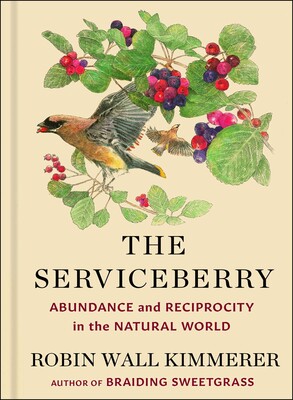
 Robin Wall Kimmerer is a botanist, ecologist, a teacher and a member of the Potawatomi people of the Great Lakes region, from whom she learned her people’s particular world view, one once common amongst many indigenous peoples and in stark contrast to that of our present day dominant culture, which has lead us to powerfully shape our our world today. Her three popular books, “Gathering Moss”, “Braiding Sweetgrass” and her latest, “The Serviceberry”, present to the reader a glimpse into the natural world as seen from this ‘alternative’ world view. All three are enlightening reads and not overly technical. They are ‘invitations’ to see the world from a different perspective. The latest is the smallest, a book barely over 100 pages, with large type and in a small page format…a quick read, unless you pause to give what she presents some additional thought. The best, and the one I read first, is “Braiding Sweetgrass”.
Each takes its namesake plants and the reader through a journey toward understanding what the plant meant to her people, laying out the relationship between the plant and ‘us’, making connections along the way, elucidating the relationship and what we as a ‘modern’ people have lost along the way. Along with this loss of relationship has gone much of the meaning and purpose which once went to defining so much of our lives.
In “The Serviceberry: Abundance and Reciprocity in the Natural World” she lays this out simply and clearly as she describes the differences between our different cultures, the indigenous view of the world as a ‘gift’ to be honored and ours, shaped by an economics of ‘scarcity’ which defines the world in terms of resources that can be converted into things of value, to be desired, a world in which the idea of ‘enough’ has been expelled…a world in which having ‘enough’ does not exist.
This book is less of one focused on botany and ecology. Instead it focuses on the link between ecology and its ‘relative’, economy. Whereas ecology describes the biological relationships between organisms that comprise a dynamic, living, community, economy describes the life giving interactions between organisms, the system by which individuals within a ‘community’ ‘acquire’ what they require for life. In the natural world this is often described as a ‘gift’ economy in which the largess of the community is distributed based on need in such a way that the vitality of the whole community is protected. Gifts do not compromise the health of the community, its capacity to continue, to sustain itself. Our present economy of ‘scarcity’ seeks to limit and control resources so that powerful individuals may maximize their gain, generally without consideration of the health of the whole. In an economy of scarcity, wealth accumulation is to be maximized, which means many will go without. In a gift economy, abundance, or its lack, is shared. When one has more than enough it is shared for the benefit of the whole. What is essential to maintain the health of the whole, is left in place to assure that the ‘gifts’ may continue on. int the years to come. Competition, which is often claimed to be the driving force behind nature and natural selection, may have service regarding the struggles of an individual, but for the whole community, cooperation must dominate, lest life be pitted in a zero-sum game in which losers go without and the health of the whole, is itself compromised and survival of the species becomes questionable.
If you read only one of her books, it should be this one, her most recent, in which she discusses this ‘gift economy’ and our need for it today All three books demonstrate her people’s relationship with the living world, their level of respect, gratitude, reciprocity, the concept of ‘enough’ and of one’s place and responsibilities to it. These are ideas sorely lacking in our world today. One need not be a botanist or a gardener to grasp the value of the ideas she discusses. Our collective errors of thought and practice should be evident to us all if our eyes are open. And the ‘simple’ corrections she suggests to us would be large in their effect. They go to the idea that in a complex world, especially one that seems to suffer serious problems, one need not solve each and every problem. Complex living systems, communities, possess a dynamism and intelligence, that when nurtured and supported, is corrective. Life and such systems are in this way self-organizing, when treated appropriately and allowed to do so. They require our active engagement. By beginning to act accordingly, problems can be lessened or even solved as our attention and its energy shift away from feeding these old damaging forms. Ideas themselves are powerful. This is why opponents seek to banish them from mainstream thought. There is nothing more powerful than an idea and a changed mind.
 GardenRiots