Category Archives: Relationship

The Nutrient Cycling Role of Fire in Central Oregon’s Arid Landscapes

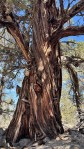
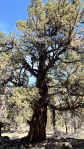
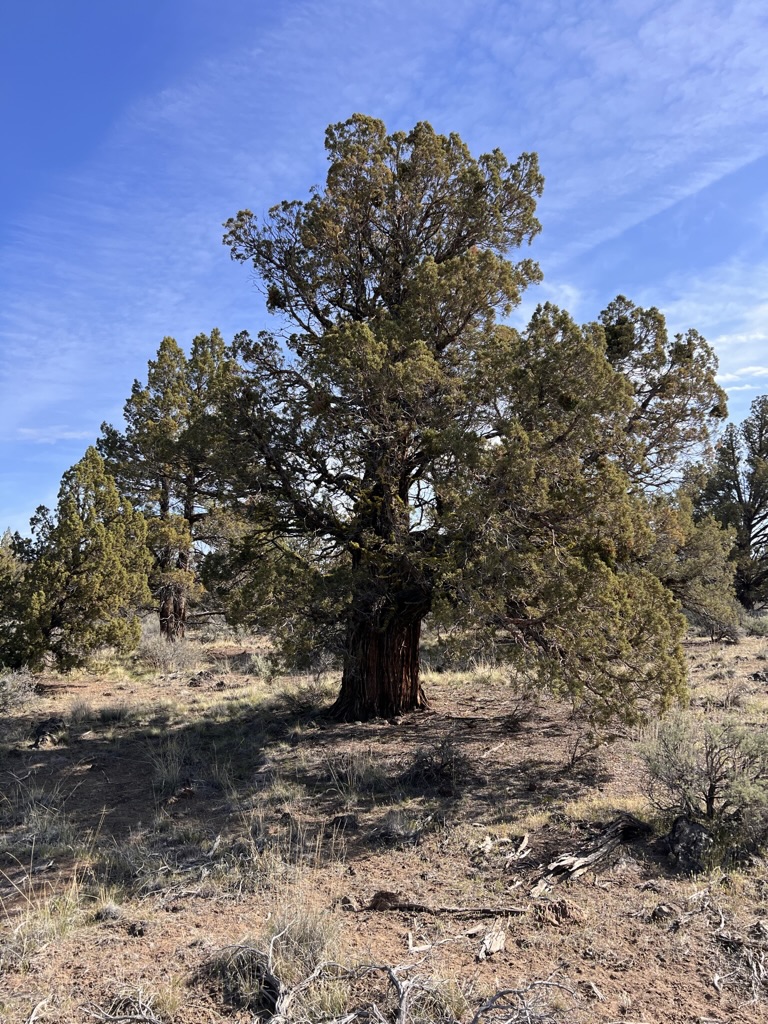
A Juniper like this one, growing out on BLM land around Cline Buttes, attains this squat and sturdy stature only after hundreds of years. Growing as they do on shallow, raised rocky areas, not only do they grow slowly, but there tendency is to caliper up. In irrigated pastures, these grow overly fast, spindly and upright. Look at that taper!

Ecologists will regularly claim that fire plays an essential role in the life and dynamics of the Juniper woodland, our sagebrush steppe and the grasslands of our arid and semi-arid plant communities, that without it, the landscape will deteriorate. Okay, but what does that mean? How can fire actually lead to a landscape’s improved vitality and diversity? What does fire actually do and what happens when it is eliminated? The short answer is that fire, in burning the collected fuels on the ground, breaks them down and returns them in nutrient form to the soil and the cycle of life. It provides the space necessary for a healthy and diverse landscape. To get there requires more thinking.

First some essential definitions and clarifications are needed: what are these ‘types’ of landscapes that together can be found in the arid reaches of Central Oregon; all landscapes are dynamic, evolving, changing over time according to the forces in effect on them, they are not static or fixed; what is meant by arid and semi-arid; fire, what is it, what is actually occurring when something ‘burns’; what is going on at a molecular level when an arid landscape burns; if this is so necessary, what fulfills this role in wetter landscapes; what’s the relationship between fire, rot and digestion; how, and does it, serve the nutrient availability and the necessities of organic growth. In understanding these basic parts we can better understand the self-renewing CYCLE of life as an ongoing process and how disruptions to it negatively influence its capacity to continue. Continue reading

On Wilding and the Return of Nature: Thoughts on an Idea

Talk of environmental crises is everywhere, climate change, mass species extinctions, losses of critical habitat, the privatization of once public resources and landscapes (and their subsequent ‘pillaging’ by corporate entities), critically dropping aquifers, what a chaotic climate may mean for world agriculture and our food supply, a world beset by an increasing rate of diseases and diminishing efficacy of the tools we have to combat and treat them….it is daunting and depressing. At the same time, generally barely mentioned in mainstream media, are notices of studies and ideas of what we can do to not just lessen these problems, quite a few of which are being implemented, but to repair the organic and global systems, whose faltering is leading to these increasing problems and potential catastrophes. To make head way on these is going to require a much more concerted effort by most of us. What, many are asking, can we do to usher in a return to a healthier, better functioning, world…before any looming system ‘course corrections’ do the ‘work’ themselves, eliminating the human problem, that ’we’ have collectively become. 

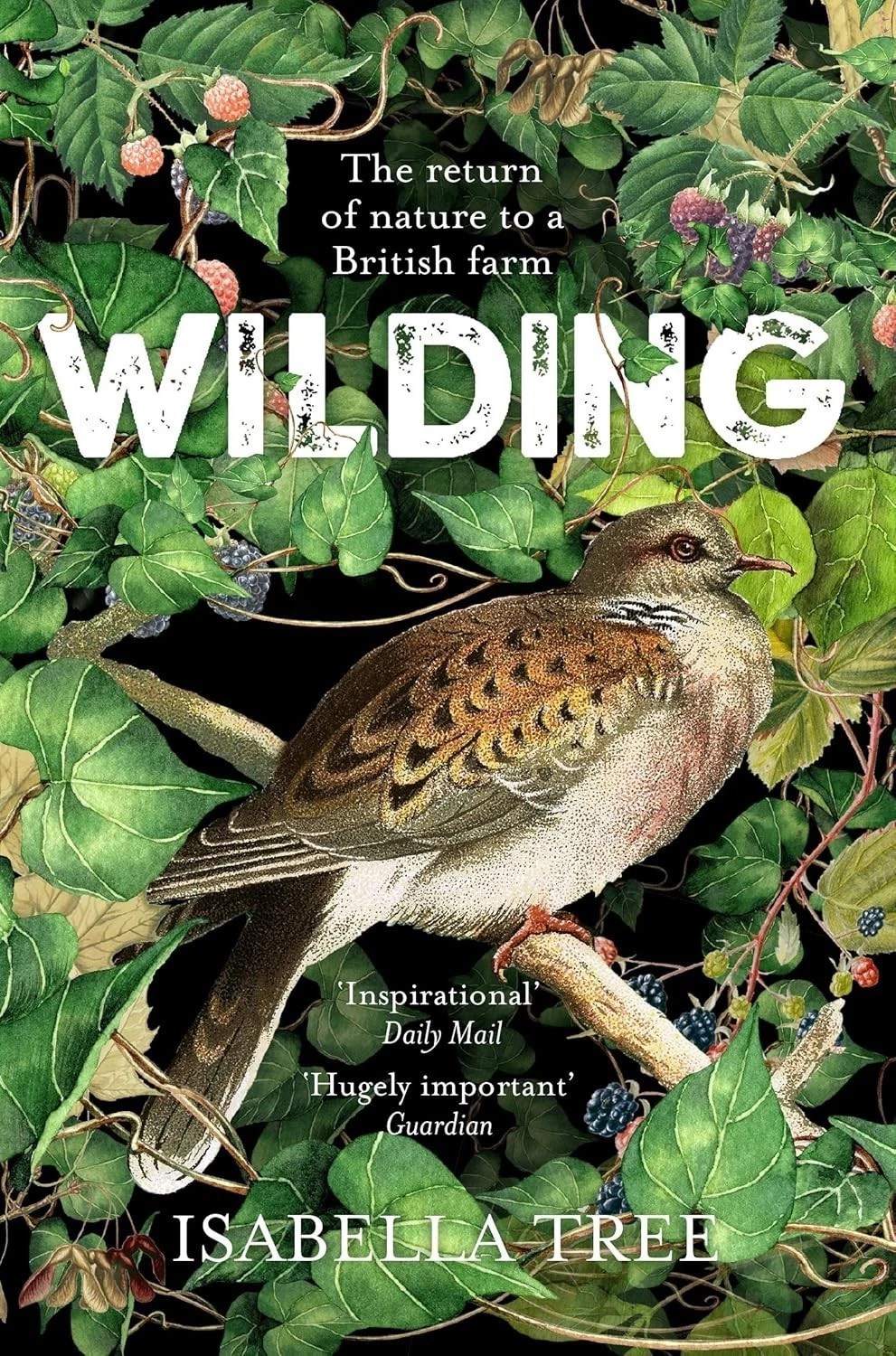
Isabella Tree’s, “Wilding: the Return of Nature to a British Farm”, which prompted this post, supports an approach in which mankind takes on a more responsive and respectful, while simultaneously, a less active role, in the management of the landscape. A ‘less active role’ because what she’s describing requires that we step back, relinquish some control, and allow the powers of nature to heal itself, stepping in where, when and how we must when those ‘forces’, diminished to the point where they are ineffectual, need the support…but no more. She calls for us to trust that our own evolved status is a product of the natural world, a potent nature with the inherent capacities and tendencies, to create, balance and heal, in like proportion to what it ‘takes’ and consumes; that we reclaim our ‘membership’, our historical relationship with this place and all of the life with which we share it. We are active agents of change and must, to the same extent, do the necessary work to heal those wounds, we’ve inflicted upon it through our economic demands and  industrial power. Her story here is one of a shared fate and a faith in life, which is illustrated time and again as she and her husband, Charlie Burrell, work to understand the land and life they are beginning to re-envision, more as curious students than confident ‘experts’. The process quickly becomes one of open discovery as they attempt to understand the health of the place they previously managed as a farm, with the economic expectations of a modern world that has itself become disengaged from life, seeing it narrowly in economic terms that had long ago been separated from ecological reality, limits. and the richness of a place. Continue reading

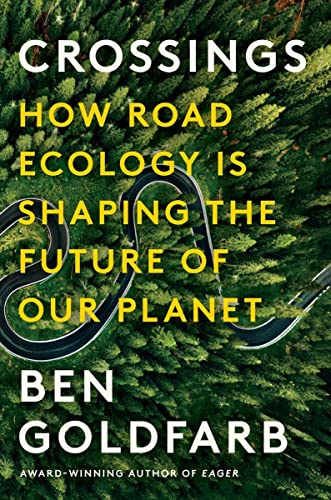
Crossings: How Road Ecology is Shaping the Future of Our Planet, My Thoughts on Goldfarb’s Book

Had I not read Ben Goldfarb’s 2018 book, “Eager”, I probably wouldn’t have picked this one up. Why would I want to read an entire book on ‘roadkill’? But I trusted him. And so I read it. 

I found his writing here crisp and engaging, like his other work, but I was still hesitant and did my reading in fits and starts. I’ve read several books lately about impending environmental crises and I didn’t really have the energy to do another, but I did finish it and found it a worthwhile and satisfying experience. Amongst these earlier books was Slaght’s, “Tiger’s Between Empires” which returned repeatedly to the problem of how devastating even the relatively little travelled roads of Russia’s remote Primorye Province are for its endangered population of Amur Tigers. In the world of ecology, roads routinely bring death to the wildlife they literally impact, as well as because of the discontinuities they create in the landscape, physical and chemical changes they visit upon the animal’s environment and the surrounding biotic communities. This is about the wholesale implementation of a technology ‘alien’ to the animal world, that purports to meet the ‘needs’ of humans while making little allowance for the uncounted species that reside alongside them. Continue reading

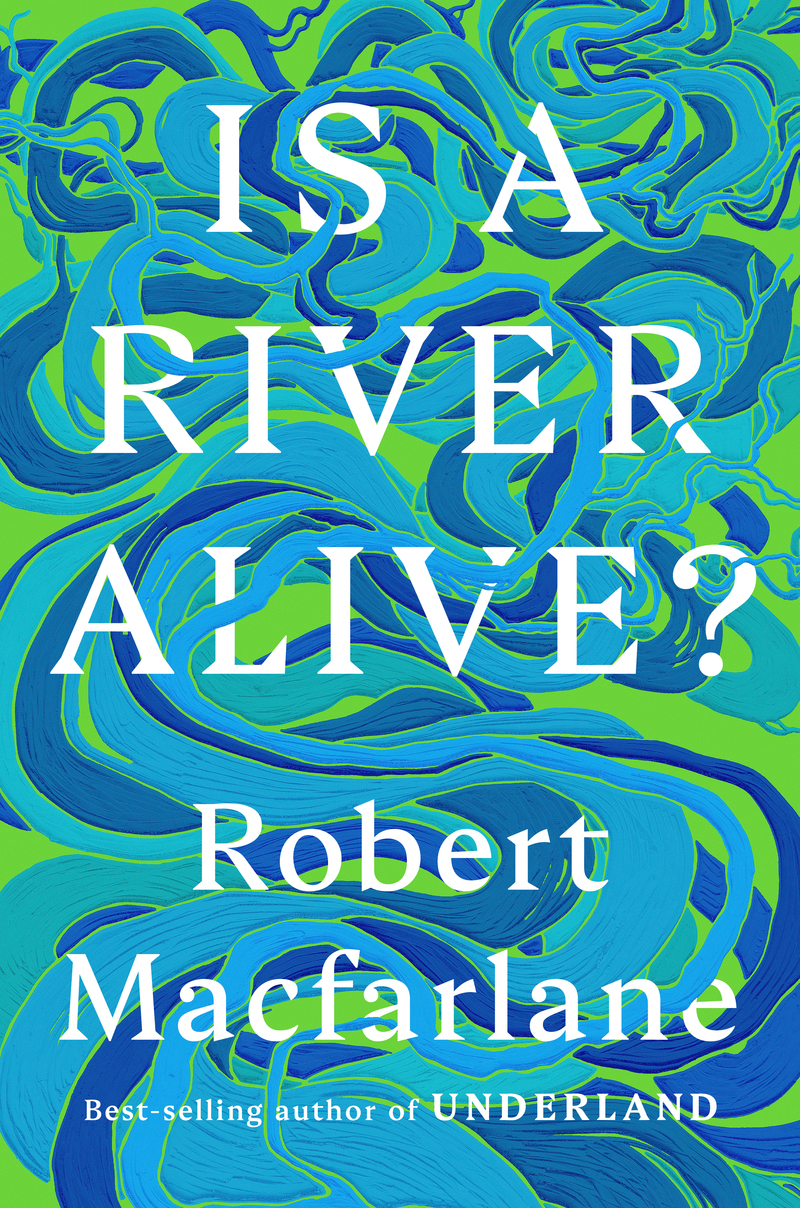
Is a River Alive? On the Rights of Nature, an Adventure Story and a Shifting of the Dominant Paradigm

Being a horticulturist, a student of ecology, evolution and all of the usual life science topics, my reading list is long with books I find and others recommended to me by friends. This most recent is one of the latter, “Is a River Alive?”, by British writer Robert MacFarlane. I hadn’t read any of his other books and my friend John thought I’d enjoy it…I did. I listened to it and, as it was read by MacFarlane himself, he added a bit of rhythm and emotion in his reading that would not have been there were I reading it in book form. This is particularly significant as you read the more emotionally driven sections, which, in this format, the ‘Canadian’ section, turns out to be a rollicking, adrenaline laced adventure story. 

While focusing on rivers, this is a book about the rights of nature, legal and otherwise. Why, does the growing community of such thinkers and activists, seem to think nature, in all of its forms, from fungi to mountains, rivers to oceans, the grandest to the most minuscule living species, deserve rights comparable to we humans? What makes them so special? MacFarlane and his compatriots, would turn that around, instead asking what makes we humans so special as to deserve that which we deny literally all others? Their only value, in how they serve us….The rights of nature proponents do not argue simply for their own favorite species or place, many of those so advocating, and protesting, come from thousands of years old indigenous traditions, peoples who have always recognized the links between all living things and those places and forces which permit and support them. And this isn’t because they are simple, backwards, savages or naive. Such thinking is not born out of the heads of green patriots, earth firsters and narrowly focused academics. This is a movement based on memory, connection, of those living in relationship with, in which respect for all things comes first, a world in which life is a gift, to be treasured…all lives, all species, all places, it is a remembering that no one individual, species or place is so special that any and all others may be sacrificed for its needs, its demands, its hungers. Continue reading

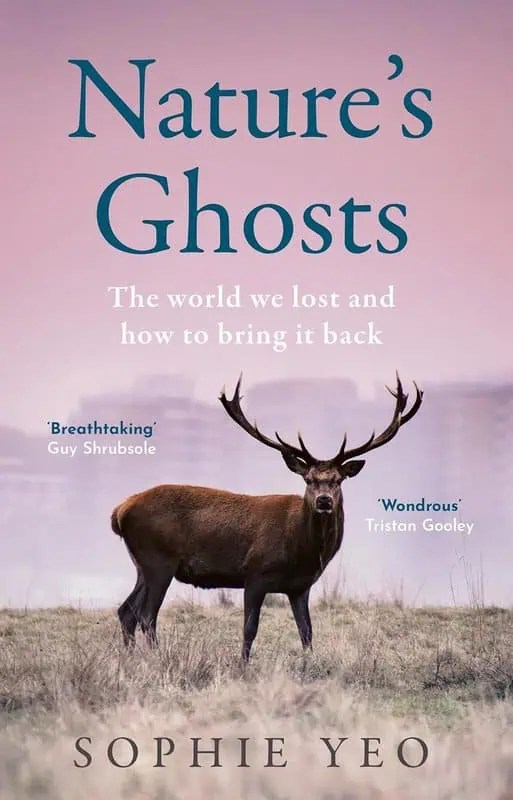
Nature’s Ghosts, Sophie Yeo’s Look into Ecology, the Loss of Species and Habitat, in a World that is more than mud, leaves and atoms.


An ecological study tends to start with a particular species, a place or biotic community and then goes on to define it in terms of its relationships with its various members and the place itself, with its physical conditions. Sophie Yeo, the author of, “Nature’s Ghosts: the world we lost and how to bring it back”, does that, but where most of the books I’ve read take a narrower view and focus on a particular species or place, Yeo takes a both ‘local’ and a more global view as well as one that goes back deeply in time. Hers is not a book limited strictly to ecology as we generally understand it, because she is interested in it as a tool, a tool for reclaiming what has been lost, the ‘Ghosts’ of her title.

As a horticulturist, who took care of landscapes, this book has strong appeal, because not only does it look at life and all of its integral relationships, she includes us, the humans, who so often set ourselves separate in the rarified and an exceptional world of our own making. This is also a critique of this decision in which she writes to show us where and how we belong in this world, how we once were very much a part, how we behaved as a ‘keystone’ species, actors in a landscape, shapers, ‘creators’, and how now, as consumers/destroyers, because of our self ascribed position as superior beings, we became removed and exceptional, a threat to the our other community members, as we changed the world into one that allowed them less and less space. It’s a tall order, what she sets out to do here, but I think she largely succeeds and she does so in a way, with language that is almost lyrical, beautiful at times, and like a ‘bad’ scientist, introduces herself into her story, along with the emotion and clarity that being a new mother can give one’s self.  Continue reading

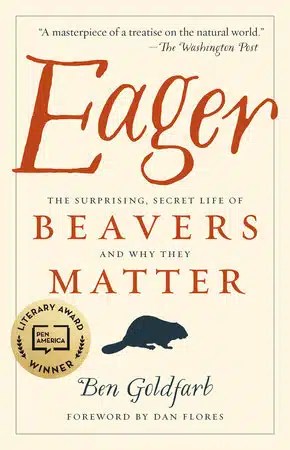
The Eager Beaver: Sociology, Ecology and the Role of Relationship in Life and Community

Ben Goldfarb’s, “Eager: The Surprising, Secret Life of Beavers and Why they Matter”, is an excellent model for other authors who write on ecology for the interested lay public. It is also an excellent entry for the novice into the world and thinking of ecology. As in any other ecological examination of a species, Goldfarb tells us about the roles and relationships the beaver has in their particular landscapes, how they fit in. In doing this he tells its history, that is, its historical role in the lives of us humans, and we in its, alongside those it shares intimately with the other species of its biotic community. It is a book very much about this important animal’s relationships, and, by extension those of our own and every other species on the planet. The beaver’s, or as the author also refers to them, the Castorid story, (the latinized name of our North American species is Castor canadensis, its old world counterpart, the other species, Castor fiber) is closely linked to our own. We, as the ‘dominant’ player in our landscape, have overlooked the beaver’s pivotal role in the world of water including the rivers, streams, ditches, ponds and seeps that ‘water’ the desert. Beavers were essential in the historical landscape and now, in their absence, our landscapes are often very much diminished. Wildlife, and even farmers and ranchers, who have often vilified them, are slowly beginning to understand the benefits their presence can provide, benefits that far out weigh any negative impacts they bring with them. People are, however, stubborn with long and selective memories. It is not easy for anyone to let their misconceptions go and accept what you have always rejected as patently false. Continue reading

“Transformer: The Deep Chemistry of Life and Death”, a Review and Thoughts on this Life

I begin this post in my usual way of attempting to incorporate the science presented in Lane’s book into my own understanding of life. That’s what I do through the first portions of this piece. Then I stray….discussing how I understand the process of homeostasis and what I see as the extension of this, relationship as integral to complexity itself, developing from necessary sensitivity, the ‘awareness’, necessary for internal communication,  signaling, responsiveness and, ultimately, the coordination of internal functioning and cognition, sentience and ,ultimately, intelligence. It is a process of accretion, with increasing complexity. The links between related ‘things’ are then not just physical, they are energetically connected. I’ll leave this now for later.

I’ve just finished reading evolutionary biochemist, Nick Lane’s latest book, “Transformer: The Deep Chemistry of Life and Death”.  It is not light reading. There are diagrams of chemical reactions, often with descriptions that urge the reader to not get overly hung up on them, the terms and steps. They are not simple processes. One transformation following another, necessarily, in precise order, until removed for other processes, other needs, the remainder augmented by what is required to continue on. Uninterrupted. Billions of times per second. He writes about the quantum hopping occurring in reactions instantaneously. Shared electrons. The flow of protons in the continuous ‘flux’ of life. The processes changing ‘directions’, spinning off secondary products, closing and reopening paths as the cell and organism works to maintain homeostasis, interpreting the seeming chaos of activity into the sustenance of life. It is a ‘story’ of constant metabolic change, patterned and ‘free’, the work of homeostasis that takes place within every organism. There is a lot here I write of not in the book, but which I’ve picked up in my other reading. And, again, I’ll remind you that as an intuiter, I combine ideas, works from disparate sciences and follow my own paths. This is another part of my journey to understanding this world.

His other books have been more accessible, for this reader anyway, but to move ahead in one’s understanding of life’s complexity, one has to have an understanding of the concepts and big ideas involved. Life isn’t magic. Its study can be simultaneously intimidating and fascinating as well as a wondrous process when look closely. I’ll be rereading this one to pick up more bits later. Continue reading

On Biology, Ecology, Evolution: Health as a Product of an Engaged Life Aided by Science

Biology, the ‘life sciences’, botany, evolution, cell biology, ecology, health and disease, plant communities, our relationship as humans with each other, geology and the life around us, are all topics that interest me. My most recent reading choices have focused on embryology and an organism’s capacity to maintain homeostasis, what is meant by ‘health’. Earlier I focused on the big question of ‘What is life?’ I’m an integrator, an intuitor, an assembler of conceptual puzzles. For me understanding is the goal and that usually involves understanding the ‘pieces’ of the puzzle and fitting them together into coherent wholes. That’s what I do when I select books and read. While my fiction choices are relatively wide and varied, when it comes to this question, I am far more focused, purposeful. I am not overly concerned with being correct in terms of conventional thought or even regarding that which is accepted as being scientifically correct. I’m looking for what makes ‘sense’. I ‘test’ what I read.

Science is conservative and rightly so. It works to define a foundation from which we may build on. Many, if not all scientific advances, came at the expense and pain of researchers who reach beyond the established to address the problems that accepted theory has revealed as the process advances. Egos and careers can get crushed. Arguably, every significant advance in science began as a controversial idea. Over time, with repeated experimentation, advances in technologies that enable scientists to address questions not previously possible, new insights and ways to ask the ‘question’, the new gains support, or alternatively, is revealed to be ‘wrong’. In this process other questions arise, that move us toward a more complete ‘truth’, a truth that enlightening and revealing, can never be the ultimate answer. What preceded it was not necessarily ‘wrong’, but more likely incomplete, unable to fully explain the world as our understanding of it itself changes. Science becomes a process of understanding at an ever finer scale. What once served, still does, but in a coarser grained way. Occasionally, it demands a radical rethink of our basic understanding of reality. Continue reading

The Comfort Crisis, Thoughts on one of those books that just resonated

I have always been physical. There’s a picture of me and my brother, I must have been four or five, sitting on a pile of boulders, on a hilltop. We had raced, which was common for us, to be the first to the top. I won. I’m grinning and my knee is bloody. It didn’t matter. 

I remember another time playing football in the yard with the older, bigger, kids, being excited after tackling one of them, no pads, no helmet, with my well earned bloody nose. No tears. I wasn’t masochistic, it was a sense of physical accomplishment, of doing something, beyond myself. Such events, not generally ending in blood, but having required physical effort, the outcome unassured, became habitual, even necessary…Sometimes I did get hurt, never catastrophically, although, in retrospect, there was some degree of luck or ‘grace’ in my efforts not having ended with more permanent physical consequences. It was a regular testing of myself. These were important learning experiences, a learning of my limits, the kind of lessons that stay with you. Continue reading

On the Danger of Being ‘Normal’ and Exclusive: The ‘Queer’, Diversity and its Essential Nature

  • I’m a thematic reader, certain topics appeal to me. My tendency is to dive in when they fit into the puzzle that intrigues me, particularly the big one about life; what it means to be alive; what organisms share in terms of their biological function as well as what connects us…all of us, as a species and more broadly across species; the ecology of life, how we fit together, necessarily; how this life would not exist  were we truly individuals, separate, isolated, independent organisms and how we delude ourselves when we insist otherwise. One book often leads me to the next. Sometimes several. So I read about quantum physics and how as we integrate that into biology, it transforms that science, adds an element of ‘magic’ to it. Neurobiology. Ecology. Evolution, The embryogenesis of that single egg cell into the the dividing undifferentiated blastula, to a mature organism with its multiplicity of differentiated cells, unique tissues and specialized organs. Metabolism. Gender and sexuality. Perception and consciousness, its complexity and variety. Relationship, function, communication, internal ‘signaling’ and ‘switching’.  How concepts of sentience and beauty, language and art, the soul, all spring from the complex act of living…. Integral to it. How species and individuals all play roles, simultaneously in every level of ‘community’ in which they belong/participate, indispensable and irreplaceable, all related parts of an ongoing, evolving, process; one that we are so embedded in that we cannot possibly discern the value of anyone ‘member’s’ contribution, each an element in the larger dance, a ‘process’ which itself, is the point. As Shakespeare once wrote in, “As You Like It”:

All the world’s a stage,
And all the men and women merely players;
They have their exits and their entrances,
And one man in his time plays many parts….

We do not and cannot know the ending. There is none, or rather each ending marks a beginning, any guess that we might offer of an ultimate purpose, of a goal, remains unknowable, beyond the continuing unfolding of life…endless change.. Progress? It’s difficult to say as the earth system collapses and ‘reboots’ over time. The expression of the whole is observable only in moments, in its parts.

The aphorism, ‘it takes a village to raise a child’, begins to get at what it means to be alive, that we all depend on each other, connected, related through the dynamic processes of being, the flow of energy and its ‘in-forming’, the translation of matter and form. We are each a unique expression of this process. If we are ever to fulfill our potential, if we will ever be able to discern what that might be, we must recognize these connections. Our individuality is a selfish story we tell ourselves, one that fires our ambition to differentiate ourselves, to put ourselves ‘above’ others, to claim exceptionalism, and in so doing, lose the larger game playing out before us. As ‘individuals’ we are incomplete, hobbled in our larger social and ecological roles, we devalue ourselves when we fail, individuals rather than the ‘collectives’ that we are. We may act individually, even ‘freely’, but our actions will always be informed by both our past and the actions of all around us. We forever linked across time and space, directly by lines of dependency, recognized or not. We are inevitably part of something much larger than ourselves. We are bonded composites, never truly independent, as both individuals and a species, communities integrated into unique wholes. Even our consciousness is a product of this collective relationship. ‘Shaped’ by and shaping the conditions in which we live. The synapses in our brains, responding and working to shape the world around us and within. We are connected in countless unseen ways, essential and impactful never the less. Continue reading