
Global climate change, in our current political climate, has been relegated to a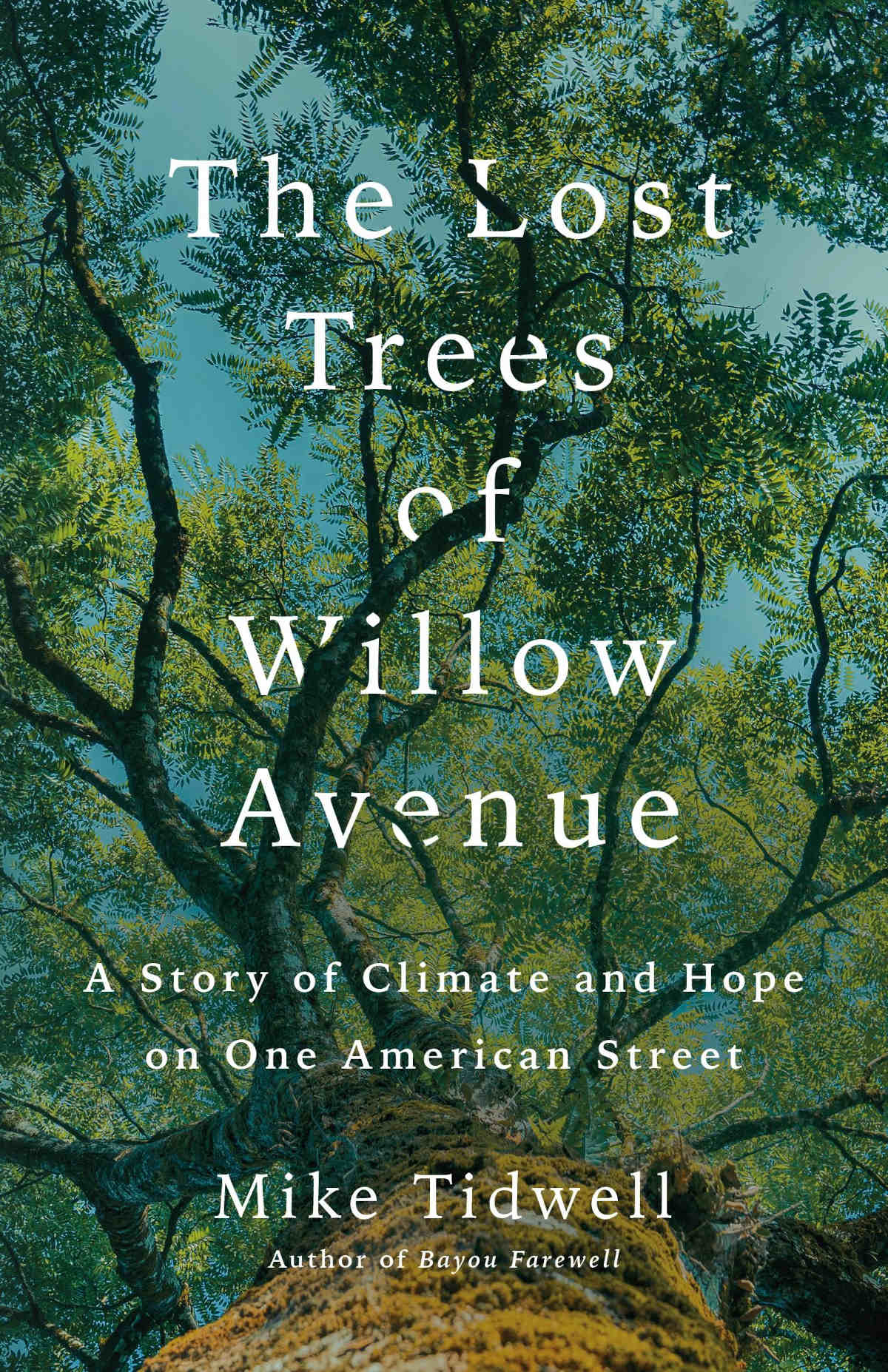 secondary status. There is so much ‘shit’ hitting the fan right now that it gets largely lost in mainstream media coverage. The science that supports it, continues, although at a slower rate. Our transition from fossil fuels to renewable energy has slowed along with the republican denials, their actions to ‘deBidenize’ America, cutting funds appropriated through the Inflation Reduction Act, ‘seed’ monies to fund needed infrastructure investment, along with their cuts to the funding of research into the supporting science and technologies. The topic has been rendered into one of ‘belief’ as if its consequences will have no real world effects, a simple argument of the uninformed, like ‘Ford beats Chevy’, pointless and personal. Author Mike Tidwell, an obvious long time ‘believer’ and lobbyist, has worked over the last 30 years to move the political dial toward climate action, amongst his neighbors, his home state of Maryland and Congress. Here, in his recent book, “The Lost Trees of Willow Avenue”, he tells his and his neighbor’s story, in his DC area neighborhood, of the real world impacts they’ve observed and are attempting to combat. Amongst his neighbors are Congressman Jamie Raskin, his friend, Ning, a college prof who has been working tirelessly on getting a novel carbon sequestration program up and running, a local state legislator who has been working to get massive scale wind generators built off shore and others working in smaller ways, dealing with the fall out of a climate already changing around them which, among other things, is causing crazy weather perturbations, changes in rainfall and temperature swings that are leading to things like a large increase in Lyme disease, because the milder winters are killing fewer of the disease carrying ticks, while also leading to the massive die off of mature trees across their neighborhood.
Tidwell, and his activist neighbors, continue in their efforts, as the changes accelerate around them and the world drags its collective feet, never relenting, but experiencing periods of depression, before recapturing their energy and sense of purpose. Here are a collection of very personal stories, events and introductions to his neighbors and those working hard to push the political and social needle in the direction we need. A neighbor who converted his gas station to an EV charging station, while maintaining his car repair business, keeping the gasoline vehicles running while we transition. A young women he has known most of her life who talks about her decision not to bring children into this world of her own while considering the idea of taking in foster children. The dairy farmer who is donating land for a carbon sequestration project, burying the trunks of trees dying at an increasing rate, beneath a layer of clay in a perennially wet field where they could rest a thousand years without decaying, retaining their carbon in their intact structure. Tidwell tells many such stories with an urgency and sense of hope, because what else do we have.
He spends a good deal of the book’s pages discussing the idea of geophysical engineering, specifically SAI, Stratospheric Aerosol Injection, putting millions of tons of sulphur into the atmosphere which will reflect away from the earth some small amount of the incoming solar radiation that powers and heats the earth, an idea that sprang from our study of volcanic eruptions and their cooling effect.
[In an interesting side note, Tidwell explains that in our burning of carbon fuels, gas, oil and coal, dumping all of that carbon into the atmosphere, there were also countless tons of sulfur compounds released during combustion which actually lessen the greenhouse effect. Now that’s an interesting fact. This is important to understand because even when we were to completely stop burning these fuels, the planet will continue to warm as the airborne sulfur precipitates out of the atmosphere over time, causing the atmosphere to continue warming!]
There are many possibilities and some like this one, make scientists nervous, nervous that we might push things too far. Tidwell emphasizes that no single solution will be adequate. Not buying an EV, not putting solar panels on our roofs and retiring your combustion vehicle, not switching, even massively to renewable energy sources….The change is already occurring and it is beginning to do so on its own in direct feedback loops. Any solution must be multi-faceted and even so the change will continue and we, like all organisms, will have to become more adaptable, living in a warmer, more chaotic world. It is easy to get bleak, but solutions and opportunities are still, and will remain, available. Research and action are needed. Pausing, denying, simply wastes time and opportunity while allowing conditions to worsen.
News sources tend to focus on the problem elsewhere, when they aren’t mired in the pointless back and forth between the uninformed, those invested in the status quo and those attempting to take effective action. There are stories, if you look for them, of the flooding and extreme heat events in Pakistan, the melting ice caps and glaciers, the rising seas and the threat that presents to tiny, low, island nations. As is becoming increasingly clear this is not just a matter of rising seas and the inundation of coastal land. These seemingly tiny changes in earth’s temperature can and are beginning to upset ocean currents and weather patterns, effecting farming and how the world feeds itself. The earth is a closed system. Energy does not simply flow in and out, intake and exhaust, the engine of the earth running for ever. These engines we build heat and pollute the atmosphere upon which its operation depends. The earth itself is in a continual state of flux, of adjustment, to maintain a state of livable equilibrium…corrections. Our way of life, our existence here, is a single factor in its functioning…and not a necessary one. Tidwell points out local events, things beginning to accumulate around our own neighborhoods and lives if we would only pay attention. The problem is real and here. So are the solutions.
His book was going to printers just before tRump’s fall ’24 election. He posts a short note suggesting what that means and how the ‘deniers’ will slow our progress, but he briefly argues, the pendulum has already swung. There is no going back. More aware manufacturers have already begun investing in new energy saving technologies. That he says will continue amidst uninformed attempts to push them back.
This was a hard book for me to read, especially given our current political climate nonsense and insanity. I often set it down, taking a day or two to recover enough to continue. But this is an important book because not only does it show the problem in a single neighborhood, it shows their response to it propelled by a positive vision and hope for the future. Read it.
Book Review: A Single Street as a Parable for Global Warming
 GardenRiots