
 Every book tells a story, even the driest academic tome…or rather, utilizes the form of a story. Humans communicate through story. It’s how we give some communicable ‘form’ to our thoughts which we can share. Without it everything is disconnected reportage of facts, personal impressions, emotions. Raw data. Zeros and ones. incomprehensible. To communicate through story requires that we share enough elements of the story, its language, form and ideas, with our ‘listener’, that they can understand what we are saying/writing. If it is too alien, communication does not happen. The listener/reader, hears the words, but the meaning eludes them. Meaning and experience are not shared. Without these, connection, communication, fails. The more esoteric the topic, the more important it is that both ‘parties’ share a common language, that each is ‘educated’ to some degree, about the world the other is attempting to communicate. As science and technology become ever more specialized and schools and social institutions become more isolated from their larger communities, communication fails more often than not. Especially when the ‘other’ is viewed in a negative light, as untrustworthy. Communication then requires a leap of faith, because as our understanding of the world becomes deeper and more complex, we cannot all become expert in all things. There is just too much to learn. This is when effort, trust and faith, become essential. We must share a commonality, a trust in the other. As shared knowledge, and ‘ways of knowing’ decline, assumptions then dominate. Intentions then become suspect and the very possibility of community and communication evaporate. What we ‘see’, is what ‘we’ see, not what someone else does. Whether or not that is shared is the crux of the communication problem.
Our perceptions themselves will always be personal. Take the color green…according to AI:
Green light typically falls within the wavelength range of 495 to 570 nanometers.
The visible spectrum ranges from approximately 380 nm (violet) to 750 nm (red). (A nanometer is one billionth of a meter.) A relatively narrow range which we humans share as visible light, a range not necessarily shared by other organisms. Of course our brains don’t determine color this way, we don’t possess a device that measures light wavelengths. We simply see a color or don’t…and we assign it a ‘name’. Where green becomes brown is murky.
The specific shade of green can vary, with different wavelengths, within this range, representing different hues.
The perception of green can be influenced by surrounding colors and lighting conditions not to mention variations in our own acuity.
We literally perceive and see the world differently, yet we often assume that our perceptions are shared.
When we painted our previous house, the trim color, according to the paint manufacturer, was ‘Southern Vine’, a green. My wife saw it as such…I saw it definitely as brown. Did I ‘learn’ green wrongly? Do I see color differently? Or do I just draw the lines between the two differently? I’m a horticulturist and a retired land manager. I walked landscapes daily scanning the ground for plants and could pick out slight variations in color, green, and leaf texture, as I walked, assessing the site to determine what work needed to be done. Perception, our personal reality, is shaped by what we expect to see, what we have learned to see. When we describe our reality we assign ‘values’ to it. When we discuss it, when we tell stories, we use words that carry with them the meaning as described in the dictionary. We use language as though its meaning is fixed and dependable, but as anyone strings a series of words together their collective meaning becomes more malleable.
Science attempts to be much more precise than casual language. It has to be and, because of this, it must ‘invent’ new words to describe previously unknown, or unrecognized, properties, sometimes even borrowing other words from the common lexicon and assigning them new and different meanings.
Physics, for example, borrowed the word ‘color’ and assigned it entirely different meanings in order to describe the several qualities of ‘spin’ associated with quarks. In that world color and spin refer to qualities that don’t exist in the classical, observable world….If you hear or see them written they can likely confuse the layman. The layman lacks any knowable reference to understand such concepts and communication, without a whole lot of effort, easily becomes impossible. Such confusion in the classical, observable, lay world, is also possible.
Our familiarity with the language, however, tends to support the idea that we are on the same page as the other person.
Again science, if we are to be clearly understood, requires more precision. More ‘agreement’ as to the meaning of its terms. Science requires that we look ‘deeper’ than we may generally be required to do in the everyday world, to ask questions, to wonder what ‘hides’ behind what’s so obvious to others, perhaps even to ourselves. When we see something, science teaches us to ask consistently, the four questions, What? Where? When? And in some cases, broadly, Who? ‘Why’ often becomes a philosophical question. What is behind a thing or phenomenon can seem solid, and fixed, in front of us. Trying to communicate what we’ve learned through ‘science’ is all the more difficult because, the language, the very structure of our thinking, our literal ‘world view’ is different, more layered and complex, nuanced. When trying to communicate with those who don’t have this kind of structure to their thinking, it can sound manipulative, like word salad, in which the speaker is trying to convince them with nonsense. Experts can easily come across as being ‘arrogant’ or even, dare I say, stupid. Seeing things, that to so many, are plainly not there. Understanding ideas that are unfamiliar to a person requires effort by both parties, the listener/learner/student and the expert/teacher/ scientist. Explanation, simplification, can only go so far, before meaning is lost. In science details matter.
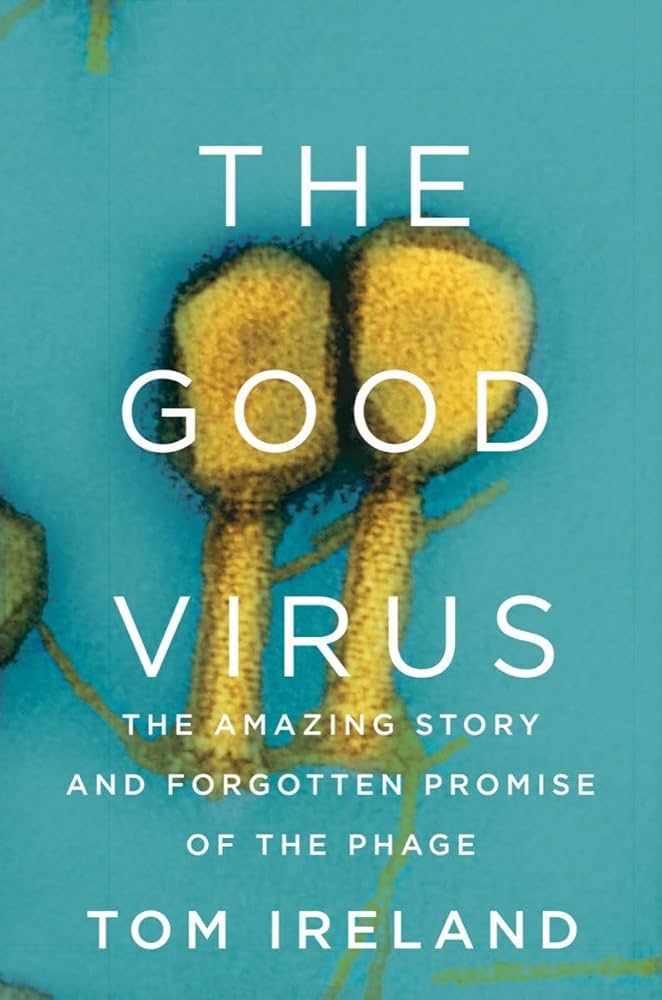
Take this book, Tom Ireland’s, “The Good Virus: The Amazing Story and Forgotten Promise of the Phage”, which presents the history of our discovery of bacteriophages, those viruses that infect and kill bacteria. Viruses that kill bacteria. Wait, what? We have learned that viruses are bad. Remember COVID, Measles, the Flu??? Yes, you’re right, they do, but around the world there are maybe 100 different viruses that cause serious disease in humans…and literally billions and billions of other viruses that don’t. The vast majority, have been found to infect bacteria (and archea too, but they aren’t discussed in this book). Some of these bacteria cause diseases like Cholera, Dysentery, Staph infections and many others. In the process of infecting specific bacteria, they ‘trick’ the bacteria into manufacturing the components of themselves, the virus, and then burst the bacteria’s cell membrane effectively killing it. Viruses are unimaginably small bits, mostly of DNA, sometimes RNA, encased in particular protein structures invisible to the eye. So small that they cannot be seen with any optical microscope, Bacteria can. The wavelength of visible light is too large and coarse to be used to image them. They can only be seen with the magnification capabilities of the electron-microscope which bombard the object with streams of electrons, not light.
These ‘good’ viruses, called bacteriophages (phages), are beyond tiny, most are in the range of 50-500 nanometers…. A nanometer is 1 billionth of a meter (.000000001 meters). For comparison, a human hair ranges between 17 and 180 millionths of a meter across (.000180 of a meter at the large end) and a water molecule is 280 TRILLIONTHS of a meter (.000000000280 meters.) A phage measuring 100 nanometers across could be set 180 of them to be aligned side by side to bridge the width of a hair.
Ireland takes the reader through the history of their discovery by the ‘French’, quote marks because his country of origin is unknown, researcher d’Herelle in 1918. He pioneered lab techniques that made their actions visible, not the phage itself, as they literally exploded bacteria cells from inside leaving clear spots in the bacterial film that was growing on petri dishes in the lab. Because he never earned a university degree, in any science, and lied about his background, combined with his combative nature, established science refused to accept his findings. It would not be until after the development of the electron microscope, in the late 1930s, when others were first able to image viruses, that science grudgingly began to examine and adopt his idea of what a virus is, how it invaded specific bacteria, hijacked their metabolic processes so that they produced thousands and thousands of ‘copies’ of the invading viral DNA, its necessary protein parts, before exploding the bacteria’s cellular membrane, and the virus then ‘assembling’ itself from the ‘manufactured’ parts. d’Herelle, saw from the beginning, how phages could be used in medicine to defeat bacterial diseases and infections. He demonstrated their efficacy.
The book takes you through the next stages where Russian scientists, embraced his ideas and methods and medical personnel researched and refined the practice of phage therapy. Lenin, and later Stalin, at least for awhile, supported this in part because the West had rejected it. With Stalin, as his violent and authoritarian rule intensified, the absence of communication between east and west became even more absolute and the state’s support of phage therapy and research declined. The West continued its denial of the validity of d’Herelle’s and the Russian’s work, a situation that lasted for decades adding to the conflict that began between d’Herelle himself and the microbiologists at the Pasteur Institute and Europe in general. The West with a few scattered exceptions, simply refused to acknowledge and support the value and promise of phage therapy, the idea and role of these viruses, despite their use by the Russian military, more broadly by its general population and by the few western bacteriologist studying them.
This slowly began changing over time given especially the ever increasing resistance of particularly virulent bacteria to antibiotics and the pharmaceutical industry’s increasing difficulty in developing ‘new’ antibiotics with chemistries different enough to be effective while safe to use in human patients. Phages, as products found freely in nature, were not patentable. Read profitable for pharmaceutical companies. Additionally to their own dynamic character and their effectiveness often only with very specific bacteria that were themselves continuously evolving, meant that both the standards the health regulators were enforcing, and the phages’s instability, made it impossible to introduce these into medical use. The dynamic nature of the relationship between phages and bacteria, each one continuously evolving to counter the efforts of the other in dynamic balance, the tiny, but significant differences in local populations of species of bacteria, added to the resistance of doctors and regulators regarding their use. As a therapy phages gradually and only sporadically were allowed to be used in select rare cases where the patient’s imminent death was near. We didn’t understand the evolving relationship between these two very different life forms and their roles in the homeostasis of healthy organisms. Eventually studies would call into question the old ‘bad germ’ paradigm which sought the complete eradication of the other. A re-examination of what constitutes health and a healthy system is ongoing.
The general public and the medical establishment have for many years since the initial acceptance of ‘germ theory’ taken the broad, and overly simplistic view, that bacteria and viruses are bad, even though it was for many years demonstrably not the case. Certain bacteria were commonly used in fermentation processes in the creation of various dairy products and alcohol. Beyond these few economic uses ‘germs’ were all considered bad. This social resistance combined with a pharmaceutical industry and increasingly powerful regulatory agencies in the West, have combined to stymie broader acceptance and research. It is really only since the recent turn of century that the west has seriously began to investigate the effective use of phages. The current administration, having defunding basically all medical research as well as that of basic research, which overtime prepares the way for break throughs such as those we were just beginning to make, has now set all of this back and put the future in doubt.
Author Ireland does take some pages, although it isn’t a major focus, to discuss the role of phages in evolution, how they and the countless bacteria, are engaged in an unending struggle in opposition to one another, each devising an amazing array of defensive strategies to ‘protect’ themselves from the other, strategies that medicine is now studying and beginning to implement in our own battles against disease. CRISPR technologies, which were derived from studies of how bacteria defend themselves from viral attack are the other side of the coin in this dynamic relationship between bacteria and phages. Much is yet to be learned. Bacteriologists, who once studied those microbes that cause disease, are now looking at them more for their beneficial contributions to both evolution and in the maintenance of the ‘biome’, the local communities within and around Individuals upon which their own health depends.
The microbial world cannot be described, in any helpful way, into simple fixed categories of good and bad. It is often a matter of perspective. Good or bad for whom? The status, and very often, their capacities change dynamically over time. It is also important to understand that their relationship is not always a ‘combative’ one. The process of homeostasis is a balancing process where the total eradication of one’s ‘enemy’ isn’t the point at all. One’s so called enemy is also a partner in maintaining those conditions ideal for the overall community/biome. ‘Attacks’ are most aggressive when the biome is moving out of balance while moving into a kind of state of truce when conditions are more in the ‘Goldilocks zone’. The biome/community, much like an individual organism which is in a continual state of making and unmaking, as energized, complex ‘structures’, are highly responsive and adaptive within prescribed margins. Moving towards those margins causes corrective responses. Going beyond them results in system collapse. It is a finely tuned organic system. Odd, as it may sound to us, viruses, including bacteriophages and bacteria are necessary parts of a healthy community.
Ireland doesn’t really go into this very much his focus remains primarily on the history of the research and medical uses of phages emphasizing their potential role in the control of bacterial diseases, like a range of Staph infections, such as MRSA (methicillin-resistant Staphylococcus aureus), and others which are becoming increasingly resistant to antibiotics, (Some disease causing bacteria are already completely resistant to our available antibiotics.) because if and when we lose these as effective treatments, without alternative therapies, this will be a very different world, with formerly treatable infections leading consistently to death.
There’s also our recent brush with the pandemic, Coronavirus disease 2019 (COVID-19) a contagious disease caused by the coronavirus SARS-CoV-2, a virus which has shown a high degree of adaptation. Of course phages are ineffective on it as it is a viral disease, not bacterial, but this goes to the dynamic nature of disease itself and the relationship between bacteria and phages. The technologies being birthed by CRISPR, the naturally occurring bacterial defense system which protects many of them from particular viruses, finding and destroying individual virions, is the other side of the coin. The current US administration’s recent refusal to fund mRNA research, destroy’s our ability to find and create other vaccines to protect us. (For more on this read Issacson’s “The Codebreaker: Jennifer Doudna, Gene Editing and the Future of the Human Race”, a book I reviewed in an earlier post.)
All of life exists within infinitely complex communities. Ecologists and bacteriologists often refer to them as ‘biomes’, ‘biological homes’, in which all organisms, including viruses, bacteria and humans, contribute in both positive and negative ways to the overall health of the whole system. It is a nearly infinite combination of checks and balances. Individuals live and die, shifting the ‘balance’ in the process, keeping the ‘whole’ within the relatively narrow margins supportive of complexity and life. It is a part of what drives Darwin’s ‘natural selection’ process, playing out at a micro-scale across the planet…and it is consistent with those theories of thermodynamics which describe the metabolism and energy flow within and around every individual organism and its associated communities.
The physics of the organism often describes a living individual, within space and time, as an energetic ‘wave’, a process, in a continuous state of making and unmaking, the energy flowing through us as out of balance, non-equilibrium thermodynamic systems. Organisms are complex asymmetrical structures, which will quickly degrade, should the flow of appropriate energies be interrupted. Our complex structures are a product of this energy flow. It maintains us in a higher state of complexity. Disease is a direct threat to, and a product of, an individual’s faltering complexity. An organism can tolerant only minimal disruption before catastrophic failure. We die. This perpetual making and unmaking are integral to the process of living. Life exists only on this ‘edge’, between collapse and creation. This dynamic state is then dependent upon the health of the entire supportive community. It fails without adequate compensation and correction, failure becoming inevitable. Multicellular organisms, both directly and even more commonly, indirectly, ourselves included, are all dependent on the health of the entire community, including the viral and bacterial members. All, collectively, are responsible for maintaining the necessary conditions. Health is not a matter of the eradication of the bad. Whether we acknowledge them or not, all play an essential role.
Disease, is a lack of ‘ease’, of ‘normal’ functioning, within the system. Health is a result of homeostasis, of the dynamic balance of the living community. Disease occurs when balance is compromised. We should keep this in mind when we push the larger community, of which we are a part, out of balance. What is viewed as ‘bad’ for a particular individual of a particular species, is often simply an individual bias causing us to fail to see or understand the value of another individual or species. Our knowledge of the system within which we live is necessarily incomplete. Recognizing only an organisms or individual’s perceived negative role carries with it the refusal or inability to recognize its positive role. Knowledge will always be imperfect, and incomplete, and we should conduct ourselves with that awareness.
 GardenRiots