
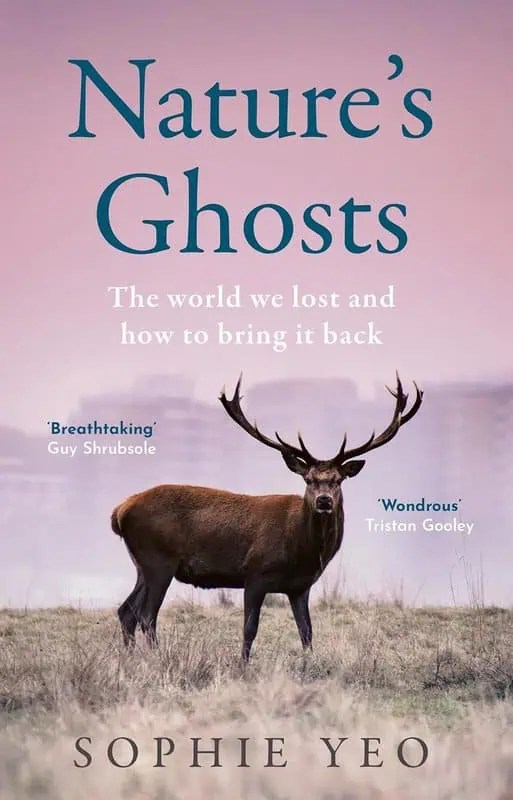
 An ecological study tends to start with a particular species, a place or biotic community and then goes on to define it in terms of its relationships with its various members and the place itself, with its physical conditions. Sophie Yeo, the author of, “Nature’s Ghosts: the world we lost and how to bring it back”, does that, but where most of the books I’ve read take a narrower view and focus on a particular species or place, Yeo takes a both ‘local’ and a more global view as well as one that goes back deeply in time. Hers is not a book limited strictly to ecology as we generally understand it, because she is interested in it as a tool, a tool for reclaiming what has been lost, the ‘Ghosts’ of her title.
As a horticulturist, who took care of landscapes, this book has strong appeal, because not only does it look at life and all of its integral relationships, she includes us, the humans, who so often set ourselves separate in the rarified and an exceptional world of our own making. This is also a critique of this decision in which she writes to show us where and how we belong in this world, how we once were very much a part, how we behaved as a ‘keystone’ species, actors in a landscape, shapers, ‘creators’, and how now, as consumers/destroyers, because of our self ascribed position as superior beings, we became removed and exceptional, a threat to the our other community members, as we changed the world into one that allowed them less and less space. It’s a tall order, what she sets out to do here, but I think she largely succeeds and she does so in a way, with language that is almost lyrical, beautiful at times, and like a ‘bad’ scientist, introduces herself into her story, along with the emotion and clarity that being a new mother can give one’s self.
Many will think that she crosses the line with her introduction of religion, as an ‘attack’ on Christianity, but it isn’t. What she does is question one common interpretation of the Bible, with respect to the place of the world and its life in God’s plan…questioning the human contrived and promoted notion, into the dogma that relegates non-human life to a subservient role. So not the religion itself, but the very human manipulations in its interpretation. She writes of various myths of Britain, once a part of daily life, but now only remembered, if that, as quaint stories with little connection to daily life and our estrangement from nature, the intimacy of animistic beliefs, born from a people’s direct relationship with a truly ‘wild’ world, its sacredness, and how without it we have reduced the world into material awaiting our use or thoughtless dismissal.
Much of what I’ve read elsewhere across the years fits in here. I found comfort in the echo of the familiar and hope in her own, for a world going terribly wrong, that still contains the necessary seeds by which it can grow and heal, with the essential aid of our belief and help. I began this book in a less than great place and now having finished it, I’ll say, thank you, Sophie Yeo.
Throughout her book she draws on examples of particular animals, both threatened and gone, and their relationships with the places in which they once thrived. Being a Brit, many of her examples come from the UK and Europe, but there are also those from North America, a few of which I’m familiar. As she progresses she builds context, fleshing out her terms and ideas common to the study of ecology and the work of restoration. When we desire to restore a community, a habitat, a community, what is our target? All communities change over time, even in those landscapes before man become a disruptor and those before our species even existed. Landscapes are dynamic. They exhibit degrees of stability. They follow patterns, but changge over periods of time, longer than our human lifespan, beyond our memory, and ‘new’ ones arise. ..slowly. She takes us on a tour, sampling what ecology means in today’s world, how it has changed over time, going back millions of years while also addressing the rewilding of the world today and what that means in a world careening into climate crisis, over burdened by a blindly consumptive human population that is leaving little room for the other species which have all played roles in earth’s several billion years long experiment. She addresses what we can do; the earth’s biotic communities overall resilience in its maintenance of its homeostasis; and ultimately our replaceable role in it. She discusses a more open process in which we support nature, its places and communities, in ways that permit, release, or allow, the natural cycles and flows of energy and resources to continue. To reestablish. There is no definitive plan, that we could possibly know, because it does not exist, that we can implement and push through to completion. It is process. Natural and uninterrupted or diminished and limited. She hopes, that we can find our place in the complexity of the world. The earth abides. Whether we will also is dependent on what we decide to do now.
Midway through Yeo’s book, I became intrigued with what she was saying and with several of her sources I was unfamiliar with. At one point she includes comments about an essay that resonated in me.
In 1967, historian Lynn White Jr., a professor at UCLA, published his essay, “The Historical Roots of our Ecologic Crisis”, in ‘Science’, vol. 155, no.3767, in which he discusses the Christian West’s dominate idea that nature was created so that ‘Man’ might have dominion over it. He does this in expert detail. He concludes with a discussion of the ‘heretical’ Saint Francis,
“The key to understanding Francis is the virtue of humility–not merely for the individual but for man as a species. Francis tried to depose man from his monarchy over creation and set up a democracy of all God’s creatures.” He failed and the problem remains with us in its metastasized form.
“…the present increasing disruption of the global environment is the product of a dynamic technology and science which were originating in the Western medieval world against which Saint Francis was rebelling in so original a way. Their growth cannot be understood historically apart from distinctive attitudes toward nature which are deeply grounded in Christian dogma. The fact that most Christians don’t think of these attitudes as Christian is irrelevant….we shall continue to have a worsening ecologic crisis until we reject the Christian axiom that nature has no reason for existence save to serve man.”
It is interesting to note that the idea that nature is here to serve us, as miniature god like copies of Himself, that the core of this idea is in direct conflict with everything we’ve learned about nature, biology and biotic communities. In ‘nature’, no individual organism is of superior value to the others. No individual is exceptional in the sense of being privileged. Even those of ‘keystone species’. Each plays an essential role in the living Earth community and dies, to be replaced by others, which can fill the same or approximate niche. It is the health of the community rather than of the individual that ‘matters’. A healthy community permits the lives of individuals. And, the prioritization of the individual, assures the sacrifice of the community…upon which it depends.
Biotic communities and individuals function in much the same way. An individual human’s several trillion cells work integrally with the rest to maintain the body’s homeostasis, one’s healthy functioning, so too does each species and individual of its community in its homeostasis, its health. To remain healthy the overall function must remain within ‘livable’ margins. To push an individual or community outside of these margins, puts the whole at risk, necessitating a larger correction to bring it back in line…if it can survive it. If not, that population of individuals, will necessarily be reduced so that the compromised community can continue supporting them at a now less than the previous optimal level.
While nature is resilient, its ‘form’, is not rigid. A community’s ‘form’ will change over time. Species may be locally extirpated or go extinct. When we push a system, a ‘community’ past its limits, it will be impossible to predict the result. The idea then that we can use nature however we may choose, runs directly into this.
The planet, the living Earth, is a closed system. It receives a roughly uniform amount of energy in the form of sunlight which powers all of life. Other than random, relatively insignificant objects occasionally making it through the atmosphere, the Earth’s resources are relatively set. The light, combined with the fixed available resources, can produce and maintain, only a limited quantity of life. Bio-mass and the organisms that comprise it, as living or dead individuals, are ultimately limited. Together the biotic and abiotic, systems combine in their dance of cycles, continuously cycling earth material and solar energy into the creation and reforming of life, transforming the abiotic materials into its products. As the proportions are shifted in favor of one species over another, over the community, others must decline, changing the relationships of the entire system, even the conditions within the system, diminishing them, as it is no longer operating at an optimal level. Over the several billion years of its existence through the process of natural selection and homeostasis, life, has tended to gain in complexity, adding species, losing others, while maintaining it at optimal levels. The process can be thought of as being akin to a freely operating economic system, at least one that operates without biasing structures that give one group preference over another, each ‘actor’, independent, working in relationship with all others. Independent action within the supportive ‘demands’ of life. In any such system to take more than can be sustained over the long term by the system, spending its capital, is to diminish its productive capacity. As the saying goes there is no free lunch and you can’t get something for nothing.
Read this for yourself. In a paper published in 2018[…BliegeBirdNimmo2018…a]n anthropologist and an ecologist — argued that, for most of history, humans should be regarded not as disruptors of the natural order, but as a part of it: a keystone species whose actions were integral to the ecosystem as the creatures with which they coexisted. [..] ‘Just as with the loss of other keystone species, these co-evolutionary relationships can unravel when such societies are displaced via colonialism, or their interaction substantially and rapidly altered by radically, changing political economic circumstances’, they wrote. To restore today’s ecosystems to an authentically natural state, they argued, rewilding must reinstate not only the lost ecological functions of megafauna, but also people. p. 136
Yeo, picks that up and goes on:
“What I did learn, however, is that rewilding is not a zero-sum game: that there is still space for humans in the wild — if we make it. But equally, that it is incumbent upon us to remember how to belong to the natural world. To become creatures the wild might absorb once more. To reclaim our role as a keystone species.” p. 140
“It struck me once again how just recently our species has become disentangled from the wild….
She then begins to focus on the practice of ‘rewilding’ how the reintroduction of keystone species, be they predators, ungulates and especially us, need to be ‘added’ back into the processes of nature…the ‘process’, again, because nature is not fixed. It can’t be preserved static, a picturesque, idealized nature is our own fiction. It can’t work. It never has. “[…]conservation should’ve never become about displacing people from the land. The wilderness is not a blank slate: until recently, it was our home, our larder, our library. The trouble is that we have forgotten how to live there. Abandoning our role as a keystone species, we forfeited our rights to its deeds. The wild harvest offers a way for humans to reclaim something of that role; to expand our minds at the same time as expanding the wilderness itself. Seen in this way, rewilding becomes not an act of severance, but revival: for earth and humans both.”
Thinking about this after reading it, brought to mind the writing of Robin Wall Kimmerer, in her book, “Braiding Sweetgrass”, a theme she expounds on in her other books as well. Much of her work there was in illustrating how we of western cultures have lost the idea of the ‘gift economy’ of the practice of ‘reciprocity’, of respect for the essential non-human world of which we are very much a part. Kimmerer, and her association with her own indigenous people, explains the different philosophy that separates so much of western culture with her own. That is what Yeo is doing here in her book, describing the loss, our need for it and how we might begin to go about bringing it back about. Healing the living earth and ourselves at the same time.
These changes and their origin have been lost to current memory. Yeo discusses how, especially in periods of rapid change, the losses that accumulate, are forgotten.
In shifting baseline syndrome, “We assume that the landscape of our childhood was rich and wild, measuring any losses against that memory. The next generation does the same, except this time the landscape of childhood is already a little less rich, a little less wild. Although a human lifetime is generally long enough to notice the whittling away of the natural world, it is not sufficient to fully comprehend the kind of catastrophic crashes that become apparent when we deal back further in time…. We are too shortsighted to know what abundance looked like in the first place.” P. 166-167. Our culture has a tendency to dismiss these losses as worth it, for the benefits we believe we’ve gained, but we never really understand the loss.
This then raises the important question of, ‘What are we to do?”
“To recover species in large numbers across their historical range would be impossible without making major sacrifices ourselves”[…] in our ways of life. “Certain species have declined because of luxuries we could’ve easily forgone — […] or because they’re wildness rubbed up against our sense of civilization. Others have been pushed to the margins for more reasonable requirements. The fields, cities and solar panels required to sustain an expanding population needed to go somewhere and that somewhere was wilderness. Wildlife cannot be restored to prehistoric levels without massive reductions in the human population: the Earth will only support so much life. The subjugation of the wild is the trade-off we make for the comforts that we enjoy today.”
“At some point, however we began to take too much […o]ne thing is clear, measuring conservation against the baseline of extinction has allowed us to skirt the uncomfortable truth of this bargain for too long. We are not coexisting with nature, but rather obliterating it. Only by shifting towards an historical perspective, may we realize the extent of the damage: […i]nstead of counting our successes, we are forced to confront the depth of our debt.” P. 169
There is another important related ide, ‘the refugee species hypothesis’. This is the idea that an animals present range is, very likely, not reflective of its historic range. As the landscape changes, in prehistory most commonly by climate change, while more recently drastic changes have been wrought by us, man. In the latter case those landscapes desirous to both us and the animal, often become the exclusive territory of us. The animal is then forced onto secondary habitat, adequate perhaps, but not optimal. Over time, these reductions, ‘disappear’ with lost memory, a resultant of shifting baseline syndrome and we come to think of these refuges as prime habitat for them, their restricted and altered lives there, as normal.
“so long as humans remain dominant nature can never return to its primeval abundance and yet instead of allowing that baseline to inch forward, we can learn to push it back. Perhaps if we move over just slightly, we could rewind to a more recent past time when animals were afforded a little more space, to the baseline of our grandparents, of mountain men, of medieval forest.” P. 181
The lesson from the past is not that everything will be fine. It is that species have somehow found a way to cling on amid the upheaval. To resist global extinction, even as they underwent widespread declines, local extirpations, evolutionary adaptation, dramatic shifts in range. By understanding these responses, we can better prepare ourselves for the challenges ahead. P. 200
Yeo begins her chapter 8 ‘Redemption’ with, “Despite everything, the extinctions, the invasive species, the destruction of the Wildwood, there is still the sense that humanity can redeem itself. All we must do is disappear from the face of the Earth.
“In our absence, nature will recover or so the narrative goes. The forests will regrow and rivers resume their natural paths through the landscape. Populations of wild animals will rebound and repopulate their vacant strongholds. There will be carnivores again, fear of which will shape the movements of their prey. Cities will crumble beneath Ivy and moss. Oil rigs collapse into the sea. The world will re-wild. Nature is healing. […] humans are the virus.”
The preceding chapters of this book have explored the challenges, both socially and ecologically, of returning any ecosystem to a truly natural baseline. The impact of humans has been too extensive, too permanent, for a complete reversal. Since the loss of the megafauna onwards, the landscape has been our creation, it’s essence molded by the people who wielded the spears, and our interference has only intensified with time. Destruction, however, is not a one-way street. Forests do regrow. Species can spread. It is not unreasonable to think that if the original harm was small and distant enough, certain scars may eventually scab over, that the imprint of humanity may be swallowed up as vegetation returns, animals recolonize, and nature rebuilds.
“But the Earth has a memory. Past harms haunt us for longer than ever thought possible. These memories are not friendly ghosts, but restless, poltergeists, and the forest, especially, are full of them.” P. 209
“What kind of ancestors will we become? Industrial farms and sprawling mega cities have nothing in common with the crooked fields of Roman France, or the whalebone houses of the Thule. We live more wastefully, more excessively, more intensively, than at any time in the past. We drench our crops in agrochemicals, burn coal, and bury nuclear waste, depend upon materials that take centuries to decompose. Our descendants will not need to count oxlips in ancient forests, or sample the mud of Arctic lakes, to uncover our environmental legacy. It will be written in bold — in blood — across the surface of the Earth, and the scree that once held glaciers, the plastic on the remotest of shores, the silence where there should be song. The Earth has always remembered. Now the human race is making itself more unforgettable than ever before.” P. 222
Lynn White Jr argued that the damage inflicted by Christianity wasn’t restricted to its own doctrines of dominion, but also in pushing out the earthier religions that have been practiced in older times. “Before one cut a tree, mined a mountain, or dammed a brook, it was important to placate the spirit in charge of that particularly situation, and to keep it placated” he wrote. “By destroying pagan animism, Christianity made it possible to exploit nature in a mood of indifference to the feelings of natural objects. P. 249
In pagan and animistic indigenous cultures the landscape itself is alive and as such, is to be respected and honored. One can’t help but ask what we have surrendered today and question the worth of what we have wrought here. Yeo asks her reader this and many other questions about our views and actions here. What are we actually doing to this place? Is it what we really want? Can we stop long enough to question this and change our relationship with the lives of earth? What really separates us from life here? That makes us believe we’re superior? And all of the others inferior? Why do we reject so intensely that which we share? And, ultimately, if all other life is of so little value, why are we and any of it here? So wonders Jack Hunter, an anthropologist at the University of Wales, Trinity Saint David. He compares the Christian story to monoculture farming: “ you bring in one system and you plant it on the land, whereas with an honest religion, it’s a more poly culture thing. The stories are really rooted in particular places, and they don’t necessarily translate from one location to another.” He speaks of living intimately with place, in relationship with one’s locale.
That seems to be what we have done, taken one narrow set of ideas and applied them to the entire world, rejecting all that doesn’t fit the idea, and so grind it into sameness. A much narrower and reduced world, all that was once valuable, unique and beautiful eventually lost, in our case, through strictly utilitarian means, converted to profit, or of no recognized value, simply disregarded, even disposed of, our behaviors based on the singular idea of what can it do for me, now.
Hunter goes on, “I think a lot of stories have their origins in experiences….Where an ecosystem is allowed to flourish and do its own thing, that makes a place thin. [Thin, referring to where the world of the sacred blends with the tangible.] Take that away, and it becomes barren. In a wilderness world, there were more complex places and people possibly did have more types of experiences. And there was a place within the culture for that….”
In such a world violations were taboo and the community and the spirits of the place would exact a price from the violator. For several hundred years now in Christian Western culture, our laws have provided little protection against our hunger for ever more. We consume with little thought for the other and deny our dependence upon it in the same breath. This denial of relationship is incredibly self-destructive.
Our landscapes today have become particularly inanimate. With so little relationship connecting us today, most people don’t even recognize the loss. When the world is reduced to being a reflection of oneself, what other outcome could we expect? Today, we tell ourselves, one story, in a world of countless ‘stories’ and variety. Doing this serves both us, and the places in which we live, poorly.
Yeo writes, “beliefs, wax and wane; religions rise and fall. The trouble is not that the old stories have faded. It is that no new magic has emerged to take their place. I am not sure whether cause and effect can ever be disentangled: whether it was growing disbelief, the byproduct of education, urbanization, industrialization, and so on— that opened the door to the desecration of nature; or whether the desecration of nature, leading to the loss of the spirits that drew their life blood from its majesty and mystery.
“If we are ever to recover our sense of the sacred, we need more wild places: landscapes that set our minds whirring, and our senses tingling; that leave us, wondering what we saw in a half light of air and the wind. We also need to reconnect with such places personally. To get to know their hidden layers.”
Of Carl Jung, she writes that, “No voices now speak to man from stones, plants and animals, nor does he speak to them believing they can hear.” In his book, “Man and His Symbols”, Jung continues, “His contact with nature has gone, and with it has gone the profound emotional energy that this symbolic connection supplied.”
Yeo goes on, “The erosion of the wild from our daily lives, means that a potential for other worldly experiences has diminished. Is it still possible to regain something with that old magic? I think so: but how we go about it will always be a deeply personal mission.”
“What matters is not that we force ourselves to believe in ideas or carry out rituals whose allusions have been lost to time, but that we find meaning in the landscape as we encounter it today, as humans of the 21st century.
What we need now—what nature needs—is a new myth.
We can rebuild our contact with nature as we encounter it today, and in doing so discover our own symbolic connections with the natural world, from which the profound emotional energy of which [Jung] spoke, may flow again.” P. 259
Success will have to draw ”…upon our hope that there is still whimsy and wildness out there, if we know where to look. Without necessarily appealing to anything other worldly,[we need to] treat the Earth as though it were consecrated; something more than mud, leaves and atoms. P. 260
After her daughters birth, she writes, “my despair at thousands of years of destruction, condenses into a kernel of fear for this one little girl. I am used to dealing with scientific projections about years beyond my lifespan. The fact that I will not have to deal personally with this catastrophe to come has always helped to mute the pain. Now, for the first time, the future no longer feels abstract. It is terrifyingly real.”
She has so much to say, toward her closing, her fears for her daughter and her hope that we can return to the landscapes of the past, which were richer, more abundant than those of today. She believes that we have a moral duty to do this for the sake of nature itself. Humans have taken too much. She writes, “It is time to give some back of what we have destroyed. In my view, there is no better blueprint for that than history.”
Her second main point for this work is that by looking into the past, we can reinvent, invigorate our own relationship with a natural world. She writes, “I have showcased just a few examples of the entanglement that still exist between people and nature, places where humans can still claim to be something like the Keystone species, we were throughout much of history. For most of us, however, such closeness no longer exist. Mending this fracture does not mean we must all revert to hunter gathering or even small scale farming for a living, an unrealistic and undesirable goal. But it does require us to take a more ancient perspective of the earth, not as a distinct and distant entity, but is something woven through our being, our source of food and also wonder, of money and also magic, of materials and identity. It means to reconceive in our place a natural order so that we are not just admirers or even protectors of nature, but also participants in its cycles and processes: as the mammals we really are or as proxies for the megafauna, we wiped out; as managers, as foragers and fishers, or even a storyteller, who might translate the old narratives of the land into the language of the modern day. There remains a place for us in the wild if we can only re-wild ourselves.”
“… a third reason occurred to me. In the midst of those blurry, tired, milky days, what seemed most important of all, was that my new daughter should have a chance to live a happy and meaningful life. That she might experience the full spectrum of emotions that the world has to offer. She could have 100 years on this earth and I don’t want any of them to be diminished by the mistakes that her predecessors have made.”
“…the human brain still belongs to the ancient world. The primeval daughter of my imagination, would’ve had forest and grasslands for her playground, where she would have become attuned to the stimuli of the wild, her ears primed for the foot of predators, her eyes quick to spot threats on the horizon, her skin sensitive to a coming storm. Overtime that playground would have been transformed into a pharmacy, a tool shed, in order where she might’ve learned to make poultices from leaves, brew teas from herbs, harvest reeds for bedding and much more besides. The better she absorbed such lessons the greater her chance of survival.”
“Evolutionary psychology holds that, our ancestors passed down the skills needed to navigate the demands of the wilderness until they eventually became encoded in our genes (or, perhaps epigenetically attached to us). After this, humans no longer needed to learn these behaviors. They became a set of instincts, upon us from birth, unveiling themselves as we passed through life and encountered new challenges and threats. It is the psychological extension to Darwin’s theory of evolution: an acknowledgment that our minds, as well as our bodies, have been shaped through millennia of natural selection. P.266-67
This is not a book written by a scientist steeped and molded by the strictures of the scientific method, but it is by an author with a deep understanding and a passion for this world. It is well worth the reading.
 GardenRiots