
 Three years ago I read Jonathan Slaght’s book, “Owl’s of the Eastern Ice’, a book that takes the reader into the inhospitable wilds of Russia’s Primorye Krai, the province immediately north of the Korean Peninsula, its multiple mountain ranges pushing up against the Sea of Japan. With a latitude the same as Oregon and Washington, its winters are far more severe. The book guides you through the mountains and snow, along with the researchers and conservationists, both Russian and American, studying the Blakiston’s Fish Owl, the world’s largest owl, and as the name implies, one that hunts fish in the region’s streams
.
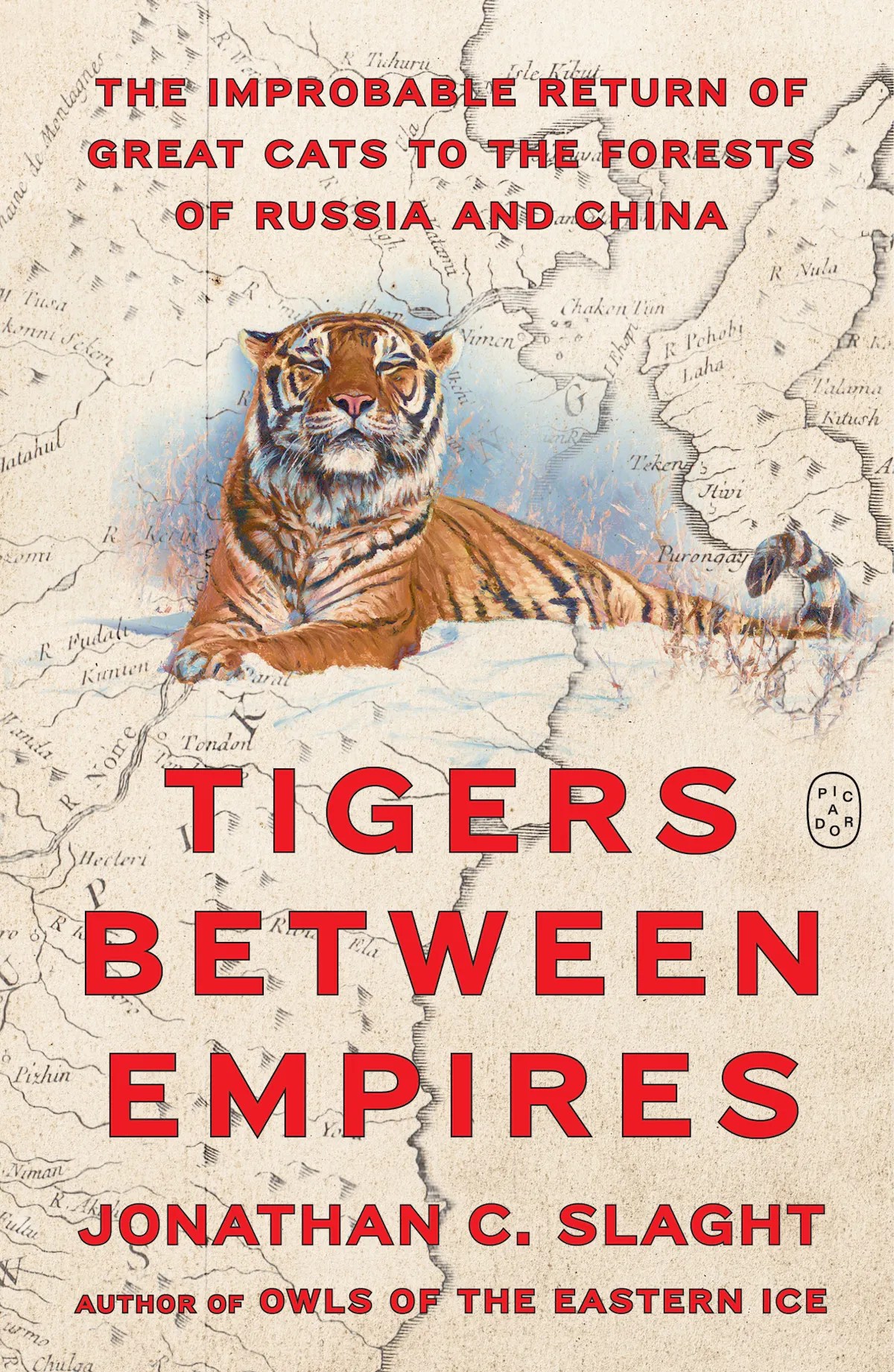
I’ve just finished Slaght’s second book, “Tigers Between Empires: the Improbable Return of Great Cats to the Forests of Russia and China”. Set in the same rugged country, Slaght takes the reader along on a 30 year effort of study and conservation of the Amur Tiger, previously called the Siberian, a region they don’t exist in. You go with them tracking, setting snares next to scent trees, around kills the tigers are still feeding on, and narrow game trails the tigers prowl, as the researchers learn and refine their capture techniques along the way, sometimes at great danger to themselves as they attempt to capture one of the 200-500 pound cats. No one had ever done this before. Snaring, anesthetizing, weighing, measuring, assessing their health and attaching radio transmitter collars so the can track them across their ranges.
It is another study combining Russian and American specialists, in a Russia struggling after the collapse of the Soviet Union. The Russian team members, expert in tracking the tigers across snow, understanding their behavior, essential for both the team’s and tiger’s safety, work closely with the Americans who bring insight and technologies gained from their own studies of other big cats and bear, neither of them fluent in the other’s language, at least over the first few years.
Biologist Dale Miquelle ends up spending almost 30 years of his life their, coordinating the project, developing field techniques, experimenting with GPS trackers, photo tracking, tracking them from the air, darting them from helicopters, traveling back and forth to the states, around Russia and China, dealing with the changing politics and budgeting, as they develop the project.
Biologists would spend days out in remote country tracking the cats through snow and swamp, never quite sure exactly where the cats were. As big as they are the cats were only rarely seen, but the cats saw them.
There are multiple episodes where the biologists, tracking the cats, stopped and suddenly realized the tigers were quietly watching them from 30 meters or so away…but a healthy tiger wasn’t interested in humans as prey. Over the years as they collected data they realized that ‘conflict tigers’ those that caused problems in local communities, taking dogs, the occasional horse or cow, generally only did so when they had recently left their mothers and were looking for their own territory, or were incapacitated by disease or injury, injuries suffered in conflicts with other tigers or bears, which were relatively infrequent, or with human poachers. Most of these conflict tigers that were captured or subsequently killed carried bullets or shot in their bodies. Survival in such a difficult landscape require that the animal be operating at an optimum level.
One of the major problems the tigers faced were the roads, even as infrequent as they were. The regional landscapes had formidable terrain, and like the road engineers, the tigers often chose the same routes to traverse their ranges putting them in contact with vehicular traffic and bringing potential poachers up close. Because of their relatively low reproductive rates these losses the tigresses, and very often their cubs, suffered, these early losses threatened the regional population.
Many minor roads, a lot of them little more than rough trails through the forest connect local communities to logging sites. This is important. Logging has been an economic main stay in the region and after the collapse of the Soviet Union, when the economy was plunged into effective ‘darkness’ the government was in no position to limit or control the practice and local people engaged in unsustainable practices as a matter of survival. The most economically desirable trees were the Korean Pine that covered vast highland areas and, coincidently, provided the best Tiger habitat. The tree’s pine cones were a major source of pine nuts as well and were essentially vacuumed up by competing harvest groups to sell to China’s insatiable and growing market, some of which made it to US stores. The pine nuts were essential food for wild boar and other prey animals of the Tigers, so, simultaneously, as prime habitat was being lost, roads were being cut into areas which would give poachers access to areas they could previously reach, and the Korean Pines themselves with such a reduction in seed were slowed in their ability to re-establish after ‘harvest’. The Tigers were being squeezed out, even after the Russian government began put restrictions on the cutting of Korean Pine. There was little enforcement and a public, under duress, often found it more ‘practical’ to violate the restrictions than to comply.
It was common with the poaching going on that young cubs were often found abandoned, their mothers, probably motivated to protect their young ones, exposing themselves and being poached and sold for thousands of dollars in China. Cubs stay with their mothers for a year and half before going out on their own and are very vulnerable before that. Eventually they developed a program to raise these orphans and figured out how to release them in habitat they could survive and reproduce in, often in areas that were part of the Tiger’s historic range, but were extirpated from decades ago.
Brown Bear and Tigers occupied similar niches and each consider the other a threat. Consequently their contact with each other, because again they shared overlapping territories and routes, could prove fatal, more often for the bears, but the tigers, even if not killed, could suffer injuries that impaired their ability to survive. Early on there is a story of a brown bear trapped in a snare set for the tigers which staff attempted to anesthetize, unsuccessfully, the bear was killed due to their errors, in an event that almost cost both staff members their own lives, a result that almost caused the Russian government to end the project. As the politics change over time, the welcome previously extended to the Americans deteriorates as Putin extends his control. Suspicion of the Americans growing until finally they are largely forced out.
Slaght discusses snaring techniques, the whens, hows and where’s and tells the stories of several of these events in detail, in a way that reads as an adventure story. Why they chose the snares they did, the fragility of these great beasts, when snared, especially under winter, subfreezing conditions; how they developed protocols to do this safely; the use of ketamine and various tranquilizers, the need to continuously monitor the anesthetized cats and the ability to revive them suddenly should their respiration drop dangerously; and, how they needed to plan for their own protection should the tiger awaken unexpectedly. Captures were relatively rare, but essential for their work, especially early on when they had very few other options. The last thing they wanted was to have to shoot one of these, even those cats that were known ‘conflict tigers’ threatening local communities. They wanted to know what drove them to do this. A dead tiger could tell them relatively little about what had happened or about whether such a tiger could be ‘rehabilitated’. All of this was central to their work.
They developed a census protocol, which they conducted every ten years, their goal being to not just save the Tigers, but to improve their numbers and future, working with the local governments, communities and hunting groups. A landscape good for Tigers was the same as the one good for hunters whose goal were the deer. They were able to demonstrate that their programs were effective, especially when combined with their outreach and public education.
Their efforts spawned others to save the Snow Leopards which were even more critically endangered and eventually lead to a softening of relations between Russia and China, coordinating their efforts across the border.
Slaght himself occasionally worked on the Tiger project while he was doing his own research on Blakiston’s Owl, sometimes joining the team out in the field tracking, snaring and evaluating the animals. The Tiger team did not just concern themselves with the tigers, they studied their competitors, their prey, came to understand the necessary components of supportive habitat.
This reads as an adventure story as much as it does an ecological study, within a shifting political context, in a regions dotted with small communities, often whose members themselves struggle to survive there and whose own struggles put them in the position of being threats to the tigers. It is a complex problem.
The Americans have been forced to take a more secondary role. Former key players like Miquelle and the conservation organizations he worked for, had to step back, as foreign, particular American influences, were targeted as suspicious, even undesirable. The efforts continue, but now more Russian scientists have leadership roles, a situation that previously could not happen due to political and economic problems, underfunding of wildlife sciences. The Americans had been important in creating a new generation of Russian wildlife specialists. The American staff have largely moved on to other regions where great cats still exist, although almost everywhere throughout Asia, they are threatened and have been in retreat. Each new partner country requires its own approach, but the work goes on.
The team worked with Peter Matthiessen, who later published his, ‘Tigers in the Snow’, in 2010, the book featuring photographs by Maurice Honocker, who was instrumental in the founding and funding of the Tiger project in Primorye Krai and John Vaillant, who wrote, “The Tiger: A True Story of Vengeance and Survival”, in 2010. Louis Charbonneau wrote the novel, “The Magnificent Siberia“, after spending time with the team, about an American biologist, based on the team leader Dale Miquelle, of course with added intrigues that never happened.
Both of Slaght’s books are great reads, at times inspiring, at others depressing, as researchers work to protect the predators upon which healthy landscapes around the world depend. These tie in nicely with other books that discuss ‘rewilding’ projects around the world, in which conservationists attempt to revive the wild, not necessarily reproducing the landscapes and biotic communities of old, but by reintroducing key species, that along with ourselves as ‘keystone’ species natural work together to increase diversity and stability to biotic communities which have largely been stripped of their larger predators and the forces and cycles that once worked to support such communities, have been disrupted for our own short term economic gain. This is inspiring work.
 GardenRiots