
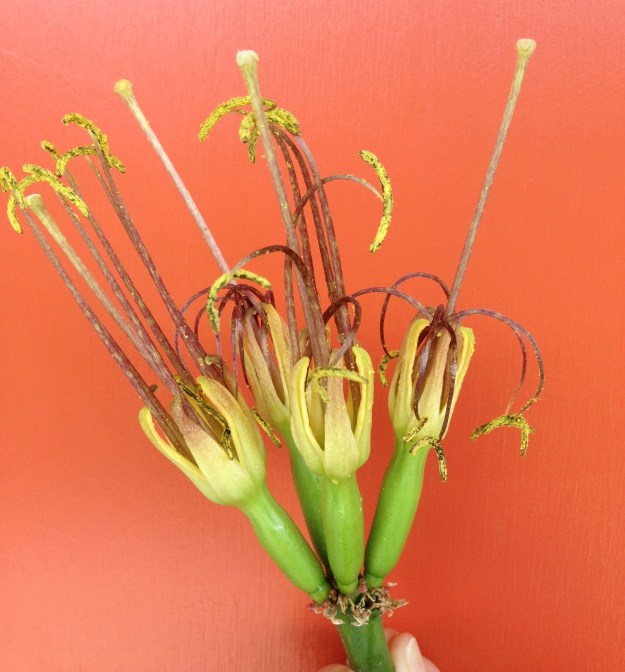
This is one of the lower umbels, the second peduncle from the bottom. The others contain more individual flowers. This umbel was caught in the stage where the filaments are collapsing and the styles extending. Nectar has spilled to many surfaces. The tepals have begun to shrivel as well. Coarse pollen grains show on the anthers with some ‘spilled’ to other surfaces. Individual flowers aren’t particularly pretty.
Flowers can be ‘incidentally’ beautiful. We often selfishly view them as products of nature intended to fulfill our own hunger for beauty, failing to recognize them for what they are, living organic structures evolved over time to continue their own species, organs and tissues meant to attract the necessary attentions of pollinators, to produce the seed of generations to follow. We, as a society, have learned to view a select few of these as beautiful. We respond to them in a way not unlike the pollinators themselves do, and by either ignoring them or focusing our attention upon them, we too alter their future form and their very existence. Sometimes we do this more directly through choosing the plants we want around us. Other times it is our indifference that seals the fate of a plant or landscape, especially when the flora is unable to grab our often preoccupied attention and we clear land for development wasting all of the ‘lesser’ weedy natives we’ve learned to undervalue, or, through our efforts to ‘improve’ plants by controlled breeding and hybridization, intentionally altering their form even the conditions under which they will grow. Sometimes, in our desire, for fashion and an idealized beauty, we attempt to control and remove that which we don’t want, creating sterile flowers, the antithesis of what a plant would ‘want’. We select for bloom size, scent and color, for period of bloom, we seek to increase the number of petals and alter the pattern they may be held in, even the lifespan of the individual flower, the height of the plant so that it doesn’t flop over, the ability to grow it in more sun or shade, the shape and color of leaves and the form of the whole plant. We attempt to control all of this and crank out a uniform product that can be ‘plugged’ into landscapes and gardens as desired. Plants with dependable performance characteristics, a pedigree.
We need to remember that this is what we ‘want’, not what the plants ‘want’, nor is it necessarily in their best interest as either a species or a member of a plant community. These days most of ‘us’ aren’t gardeners. Our relationships with nature were broken long ago. It is difficult to see the critical connections in nature, between plants and the organisms they have evolved with, upon which they are dependent, especially if someone is not looking. It is even more difficult to see where we ourselves fit into this in our materialistic, consumer society where so many of us measure ourselves and others by the things and property we own…and are quick to ‘take’ from others. I’m going to paraphrase a snarky rejoinder I’ve heard these last several years, ‘Yeah, you’re special, just like everything else!’ and I mean this in the broadest sense. Continue reading
 GardenRiots