Tag Archives: Quantum Biology

Notes on Complexity: A Scientific Theory of Connection, Consciousness and Being, Thoughts on the Book

[My ‘reviews’ are not strictly book reviews. I’m not trying to distill the author’s ideas down into a simpler ‘bite-sized’ piece or discuss their ‘style’. These are my thoughts after having read these books. My attempts to make sense of them, usually after several rewrites, as I work to fit them into what I already ‘know’, an attempt to make the ideas presented in this book, consistent with those which I’ve read by other authors. They include ideas not covered by this author. Rarely, if ever, can you come to an understanding from a singular perspective. This is a link to an annotated bibliography on my Blog of several of the more significant books which have  influenced me on this topic,]

Complexity theory? Do we need a theory to determine what is complex? No, that’s not what this is about. Theise’s book does not layout a system for determining what should be considered complex/complicated or not. This is a book about systems and structures in nature and how they come about. He discusses how mainstream science has fallen short in explaining this and why, the author believes, without changes in approach, we will continue to fall short. He goes on to present an alternative, or, rather, a ‘sister’ approach which can provide a previously excluded way of ‘knowing’, and in so doing, can account for the ‘gaps’. The problems are not just that this is a difficult concept to understand, but that at the most basic, quantum, level, that at which nothing can be divided smaller, where all things ‘begin’, actions and processes do not follow human logic and contemporary expectation….

I remember reading the book “The Limits to Growth” in the early ’80’s, which introduced me to ‘systems theory’, an approach which required looking at all of the parts and actions within a system, consider their relationships and how they work together, in order to understand its ‘working’. A system could be ‘modeled’, mathematically and the long complex equations run on a computer. There were generally multiple possible models to run. This gave us a degree of ‘predictive’ power, but these would always be approximations, because no model could be perfect and every situation, every starting point, would result in a somewhat different ‘answer’.  I followed this with James Gleick’s book on Chaos Theory and its ‘ability’ to explain certain types of patterns, which appear spontaneously in nature, while introducing me to the idea and maths of ‘fractals’. There were multiple  books on ecology which necessarily take a wholistic approach. James Lovelock and Lynn Margulis, published their book on Gaia Theory, a product of their collaboration which began in the 1970’s, a theory of the Earth itself functioning as a self-regulating system, as if it were a gigantic, single, organism of which we ourselves are a part. All of these were related, coming out over a short span of years. These were ‘new’ hypotheses and theories, never before seriously considered by science back then, but now being investigated, their validity, and the answers they suggest, impossible to ignore.

Science often advances this way. Seemingly radical ideas, rejected by the majority of the mainstream…until resistance worn down, their validity demonstrated through thoughtfully conducted and reviewed experimentation, the scientific community then coming around to more broadly adopt them and reshape science and our understanding. (Some argue that this ‘process’ requires some number of the old guard to literally die, younger minds being more free to consider the new.)  Margulis and Lovelock’s ideas were just too far out there for most at the time. For many, such thinking then belonged to the realm of metaphysics, or fanciful science fiction, frivolous exercises in thought and belief. Exploring these ideas, testing their validity, only became possible with the computational capacity of ever more powerful computers and an openness to branches of thought once rejected by science. ‘Game Theory’ and cybernetics played a role in all of this as well. Complexity Theory has far more capacity to explain how matter and functional systems emerge, or manifest, than mainstream science could historically. Nature, through the conditions and forces in play at any given moment, ‘drive’ the universe toward order along with the ‘creation’ of complex structures and functions, at the cost of energy spent, ‘held’ in the new structures and dissipated away as lost heat. All of countless processes linked to one another through a myriad of relationships and the feedback loops which comprise them. The universe continues to evolve, and as it does, it continuously spins off everything in it, from sub-atomic particles to human beings over time, a process which it itself is directly influenced by its evolving ‘self’.
Continue reading

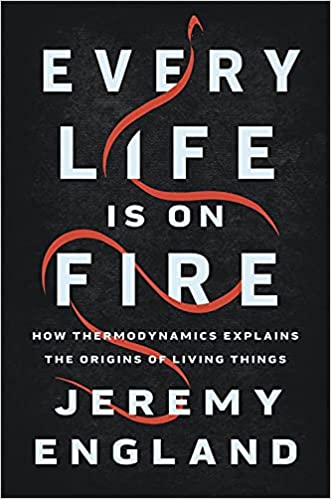
Every Life is on Fire: How Thermodynamics Explains the Origins of Living Things–A Review…and a Deeper Look Into the ‘Fire’ of Life..

This is a book about ‘life’, that which animates particular organic structures, organisms, while other, non-living, ‘structures’ remain fixed, but for the physical and chemical forces which wear them down. From our human perspective, this sets ourselves, and all other living things, apart from the inert, nonliving, matter that comprises our world and the universe. England, as a physicist, sees the world of nature and all matter within it, differently than most of us. Science has demonstrated that the universe tends to operates under consistent ‘laws’. Organisms, while a special ‘class’ of matter, are still ‘of’ matter, composed of the same atoms, only joined together in complex macromolecules not found outside of organisms, created wholly within organisms. They are a ‘family’ of complex, shared, organic structures. This complexity of structure goes to determining their functionality. Function increases and diversifies as complexity increases. Capacities are expanded with the flow of energy through them, an effective and sustaining agent in their ‘being’ and evolution. England’s view is consistent with the many other physicists who have looked into life and view it as an inevitable outcome of the processes, energies and materials that comprise Earth’s particular corner of the universe. Earth appears to be a relatively rare occurrence, but it is extremely doubtful that it is a singular one. The ‘ability’ of energy to organize and structure matter is universal. Given the particular mix of ‘ingredients’ and energies here on Earth, matter has come together over the course of over 4 billion years to form life as we know it, because it could, and whatever is possible/probable tends to happen with a degree of frequency. Particular patterns precede those to follow, not necessarily determining them, but increasing the likelihood that they will. The flow of energy through matter tends to ‘favor’ a range of outcomes. Those outcomes tend to favor the next, building from one ‘success’ to the next.


These patterns and energy flows occur at subatomic to molecular levels, well below our ability to observe and measure them. We can only directly observe the ‘results’. The underlying patterns are not generally obvious to us.  Our perceptions are shaped by our the physical limitations of our sense organs and our beliefs about the world. We tend to ‘see’ what we expect to see, not necessarily what is there. We shape our perceived world into the commonly shared story that has been passed on to us, a very human story. Our particular indoctrination, our educations, all go toward determining what we see, how we interpret it, and then taking our experience, we use it to reinforce that understanding. In a sense we ‘choose’ and make our reality. From the moment we each open our mouths or put word to page, we do this. Our language and knowledge limit us. It requires that we distill our perceptions, our experiences and our understanding into a comprehensible form. We are all at a ‘remove’ in this sense, apart from the world in which we live, although we are intimately immersed in it. And that is the source of much of our difficulty, for like fish swimming in a stream, we are ‘of’ this place, a part trying to understand its extended self, our boundaries, self-imposed, insistent upon our individuality and our misunderstanding of what that means in a world that fully integrated and interwoven.

As ‘western’ people we tend to see ourselves as separate from it. Independent agents. When in actuality, we can never be so. To be so independent, separate, would negate that which is essential to our lives, the flux and flow of energies through us, as parts of a larger, complex and whole system. England looks into this question of what life is by taking our modern and still developing theories of ‘thermodynamics’, our study of energy and the way that it ‘works’ on the stuff of the universe, on matter, as his way into this ‘story’. Energy is transformative. Matter, is arguably, a particular expression of energy. One can be translated into the other.


England is a theoretical physicist. You will not find in this book a detailed explanation of the living organism or description of the flow of energy through one. That is within the purview of the cell biologist, the biochemist, the quantum biologist. Thermodynamics, and his understanding of dissipative adaptation are larger concepts that can give us a framework for understanding the bigger picture of an almost unfathomably complex topic. England joins with those today who would argue that any living organism is not so much a thing as it is a process, in a state of continuous change, a process which both follows a probable, understandable, path, and is itself a part of the larger/longer process of evolution, of becoming, building on itself and life’s many patterns, as it moves ahead through time toward something unknowable to us. We exist from moment to moment, a ‘response’. Fall out of that moment and we are dead. Through us, the flux and flow of matter and energy, drive an organism, along a path, a path that follows one of a particular and massive set of more or less likely probabilities, each which influences what will follow, within a universe of definable ‘law’. Here England gives us an intellectual framework for understanding the processes at play in this process of living. Living organisms are conductors of a continuous flow of energy through themselves, from outside and back, after it has degraded. This flow of energy acts in very particular ways on the molecules, cells, tissues and organs of an organism…until it no longer can. An organism, is in a sense, a conductor, a channel through which energy flows from a higher, more available state, to a lower, less available state. Energy drives them, permits them and enables them, so that they are in this sense ‘self’ sustaining…as long as the energy flows and the organism can maintain the integrity of its structure at all levels.


The following is an extensive quote from his book: Every Life is on Fire: How Thermodynamics Explains the Origins of Living Organisms, pp. 113-116.


“…a plant—for example—has to be thought of as holding steady on a steep [energy] hillside in a constant state of free fall. Much like the chemicals in a battery powering a flashlight, many molecules in a plant are constantly undergoing reactions that convert them into other, lower-energy forms. At the same time, randomizing thermal fluctuations are taking the specially ordered components of each cell that have been assembled in a particular fashion and wreaking havoc with them, either through chemical damage or via larger-scale physical rearrangements. In permanent darkness, a plant is therefore on a slow road to death, for dying in physical terms is nothing more than sliding downhill in a variety of chemical and physical ways. Of course, plants can survive just fine for a while in the dark, but not forever. [Animals, for the most part exist in a much more precarious balance requiring much higher energy flows for a given mass.] Eventually, the twin tendencies to lower energy and higher disorder that are required by the fall to thermal equilibrium will win out, and the pile of matter that was originally a live organism will start to look less and less like one.
Continue reading

“Entangled Life: How Fungi Make our Worlds, Change our Minds & Shape our Futures”: A Review

Sheldrake, Melvin, “Entangled Life: How Fungi Make our Worlds, Change our Minds & Shape our Futures”, Random House, 2020.

I have spent most of my life outside amongst, growing, observing or studying plants and yet, every page here has caused me to take at least a moment to reconsider the life I’ve been so involved with. Everything here underscores what I’ve read and learned elsewhere, sometimes casting it in an entirely different ‘light’. While we learn to think of organisms as discrete individuals, fungi, a class of organism separate from the bacteria, plants, animals, even viruses which I’ve been examining, are impossible to consider on their own without looking into their vital relationships with the other forms of life.  While all organisms depend in many ways, great and small, upon other organisms for their support and sustenance, fungi are nearly impossible to imagine separately, their ‘bodies’ being literally intertwined in and around those of others.

Relatively early in the book, Sheldrake describes the difference between fungi and animals in this way, animals put food into their own bodies, fungi put their bodies in their food, digesting what they require by secreting acids and then drawing the broken down nutrients back into their mycelial bodies and transporting them to where needed. Continue reading

On Life: An Annotated Reading List of Titles Exploring the Physics, Biology, Evolution, Natural Selection and the Generative Power of Far Out of Equilibrium Dissipative Structures (Organisms)

Nurse, Paul, “What is Life?: Five Great Ideas in Biology”, WW Norton and Co., 2021. I’m placing this book out of order here, its American edition just released this year and I’ve only just read it, because I concur that this is an excellent introduction to its topic and should be accessible to a broad audience, one without an academic background in biology. It does what Carlo Rovelli’s “Seven Brief Lessons on Physics”, does for its readers, presents in a compact and cogent way the central ideas for understanding the science of life. Nurse, is a Nobel Prize winning geneticist and cell biologist, who has dedicated his research life to the study of the cell and what sets this class of matter apart and unique, looking into its structure, chemistry/metabolism, reproduction, evolution and the relationships and communication which must occur within and between cells. He looks into what genetics is and isn’t capable of, what it seems to control, the genes for 20,000 some different proteins included within our DNA, while leaving open to question the instructions and detailed directions, how the growth and development of an organism is actually determined. The reader will benefit from having some basic understanding of chemistry to fully grasp what he writes here, but this is an excellent starting point.  At 143 pages this book shouldn’t scare off the reader.  This is a window into life and should peek the readers interest as Nurse reveals what he still finds so fascinating about life and this world. Al-Khalili, Jim and Johnjoe McFadden, “Life on the Edge: The Coming of Age of Quantum Biology”, Broadway Books, 2016. In the world of science, quantum biology is a toddler.  Quantum mechanics itself only began a hundred plus years ago and quickly began redefining the way that physicists look at the world.  Today most branches of science are transforming themselves, aligning themselves with this new reality of physics.  This may be impacting none of the sciences more than it is biology and the life sciences.  What was once limited to the quantum world of elementary particles so much smaller than we can see even with technology’s assistance, today we are finding quantum actions behind even the most simple processes up to and including the energy and origins of life.  Mass and energy lie at the heart of everything and life is a very particular case of highly complex ordering of that mass and energy, intricately linked in coherent relationships, borne out of seemingly random, chaotic, actions at a subatomic level.  In these systems/organisms life has evolved effective patterns that ‘feed’ on themselves, self-regulating, self-maintaining, able to reproduce with great ‘fidelity’ to one’s parent organisms, energy dissipating structures, dynamic, balanced between stasis or death and a runaway consumption of one’s self,, a conflagration.  Patterns built on more basic patterns, conformed into very particular resonant structures which are additive and transformative, never perfect, evolving towards greater complexity and capacity, structures that ‘live’ in relationship to one another in a supportive manner, dynamic, time limited and ‘stable’ in a self-reinforcing sense…existing in different states, simultaneously.  Follow Al-Khalili and McFadden down part of a ‘proven’ path. Continue reading

What is Life, Biology and the Non-equilibrium State: The Quantum World of the Organism


Sometimes art does a better job of conveying ‘reality’ than does our direct experience as it forces us to look through the eyes of others. The swirling, blurred edges of Van Gogh’s work begins to show us something of the immateriality of the world out there as images bleed over their edges into others with a visual energy that a photograph cannot provide.

[Dear reader, if this seems a bit rambling, I’m sorry, but my first purpose here is understanding the role of Quantum Physics in the life of the organism.  This is me trying to make sense of it and I do this by writing.  In writing our errors become most obvious.  I have read and reread this many times, rewriting and editing sections, throwing others out I later decided were just wrong.  I suspect I will come back to this over time as I continue on this quest to understand this post’s central question and that should be okay, because my understanding, like the science I am reading continues to evolve.  I read fairly widely across the several branches of science and rarely find those who can integrate these ideas.  Quantum Biology is a real thing, but the work of synthesis or joining the pertinent work and theories from the separate sciences has really just begun.  Quantum mechanics, biochemistry, cell biology, enzyme action, evolution, metabolic activity, the unique role of the water molecule in life and the study of life as an integrated, complex system, is not something done.  It is my belief that to understand the miracle of life, one must have a grasp of the related sciences and their various complimentary and competing theories.  The story they each tell individually is, unsurprisingly, incomplete.  We will never understand life if we continue to examine it only in its isolated parts and functions.  Life is quite the opposite.  If you reader are able to gain some clarity from my struggles here…then all the better!]

What, some of you are likely thinking, does quantum physics have to do with biology and living organisms?  Physics’ realm, after all, is that of apples falling, billiard balls ricocheting off of one another, a planet orbiting around its sun, the electricity that powers many of our devices and nuclear explosions.  Yes, it is that, and so much more.  It examines and seeks to explain the physical properties of matter and energy in all of its forms and at all of its scales…well, at their most basic, tiniest scale, organisms are composed of this same matter, the stuff of planets and stars.  Quantum physics looks at this ‘behavior’ at unimaginably tiny scales, that of quanta, those tiny bits that physicists, like Max Planck discovered cannot be further divided, that contain fixed and set amounts of energy, that when multiplied by billions, gain enough size that we can directly perceive them.  At the tiny scale of quanta, of sub-atomic particles, the laws of matter change, those used to calculate the trajectory of a much more massive rocket or explain the movement of heat in water, no longer hold.  Such tiny bits of matter behave differently and such tiny bits play key roles within living organisms. 

At that level, all of these particles exhibit what physicists describe as quantum motion and uncertainty; they are capable of ‘tunneling’ and ‘walking’; of being in two, binary, states, particle and wave, at the same time; of having the potential for what physicists call ‘super-position’ or having the capacity to possess different properties at the same moment until they are caused to ‘collapse’ into a single state, a single position; and they do this at a scale well beyond our ability to directly perceive, that of nanometers and time frames of nanoseconds, billionths of a meter, billionths of a second.  These are the scales at which we could examine single atoms.  At such scales quanta, the component bits of atoms, the smallest atoms, like hydrogen, common to virtually every ‘organic’ molecule, ‘behave’, can do these things, coherently, as if they were directly linked and coordinated.  This is a ‘world’ in which velocity and location become problematic, in which a particle/wave cannot have its velocity and location known at the same moment, a world in which quanta could be in more than one place, at the same time, no, ‘are’ in any of several possible positions at a given moment, a world of ‘probabilities’, where in a very real sense all things are possible.  Physicist’s speak of ‘wave forms’ which are predictive tools to help them determine the probability of one’s velocity and location….What?  Such ideas boggle the mind.  At such an unimaginable level, matter does not exist, not in the kind of solid, fixed, massive sense that most of us tend to think anyway.  At that level matter consists of energy, that is ‘informed’, structured in such a way that through its energized action, its ‘behavior’, ‘wave forms’ collapsing in and out of ‘fixed’ position, manifest at our scale as the ‘stuff’ we know and can perceive.  This is pretty bizarre and ‘weird’ stuff.  Some refer to this as the quantum weird.

….This might be a good place to take a break…then reread the above.  The reader might do well to take this approach as your ‘work’ your way through this, bit or bite by bite.
Continue reading

Life Inside the Cell: Waking Up to the Miracle, part 1

[This is the first in an extended series of three posts, this one on life within the cell, the second, on the evolution of plants, and the third on the New Phylogeny and Eudicots.  This first ‘installment’ concerning life within the cell, is divided into two parts, the first covers the function of the cell itself and, importantly, the role of water in the cell.  The second, part 2, will examine the concept of quantum biology and its explanative necessity for life beyond the ‘simple’ construct of cells, tissues and organisms. While trying to understand the ongoing reorganization of and classification of plants, I found it necessary to better understand these other topics, what it is that we are ‘messing’ with! ]

———————————————————————-

I begin here with the cell, what I’ve learned about what makes the cell, its existence and life within it, so amazing, something which should give us all pause, when we consider our own lives and what we do.  When scientists ‘split hairs’ in their arguments on which group to assign a species, when they attempt to link them to their ancestors, many of which are now long extinct, to understand their relationships with other organisms, they have a purpose.  They are often looking much deeper into what a plant is, what constitutes life and how it evolved.  Phylogeny, the science that attempts to establish relationships between different organisms, different species, to link one to the other across time, is about both the history and the continuing journey of life on this planet.  It promises to tell us much about our own place as well as that of the hundred’s of thousands of other species with which we share it.  Ultimately, if we choose to understand this, it will change the way we garden and our relationship with the many landscapes that cover the Earth.  Our gardens are our own personal expressions, works of ‘art’, and must live within the ‘limits’ both permitting and governing life on our little pieces of ground and the Earth.  They reflect our understanding of the limits and possibilities at work here.  The better that we understand this the ‘better’ our gardens will be, the more in synch they will be with life.   Continue reading