
Part of the Dry Canyon plant series
Everybody knows Juniper and I suspect that a lot of people who think they know Sagebrush, that ubiquitous gray shrub you see everywhere, may be confusing it with other plants, blurring all ‘gray’ shrubs into one. Now this may not seem to be a big deal, but if you are trying to manage a landscape with these in them or trying to create a landscape which reflects the local plant communities, then it becomes much more important that you know what you have so that you can evaluate your landscape’s condition and decide upon what you may need to do, or stop doing, to meet your goals.
There are 18 different species. If you include subspecies and hybrids of Sagebrush there are 27 different taxa that occur naturally across the arid intermountain West. All of these are within the genera Artemisia, which is itself a much bigger group including many common ornamentals and herbs like French Tarragon and Mugwort which was once used in place of hops as a bittering agent in making beer, while Wormwood was used as sn ingredient in the making of Absinthe. All of the Artemisias contain a large and varied array of volatile oils and compounds which in Sagebrush gives it is characteristic scent.
Big Sagebrush, Artemisia tridentata, is what is commonly recognized as the Sagebrush we all know locally, love it or hate it, but is it? It is generally broken down into 3 subspecies, A. tridentata subsp. tridentata; A. tridentata subsp. vaseyana; and A. tridentata subsp. wyomingense. As you would suspect they are quite similar in appearance with the leaf apex, tip, all trident shaped. There are differences in the structure of the inflorescence, the structure which carries the flowers. There is also a difference in their physical size with Big Basin Sagebrush, subsp. tridentata the largest, up to 10′ tall, which is probably related to it occurring on sites with deeper soil; subsp. vaseyana is of medium size, tends to occur in mountain and foothill locations and is slightly different in its volatile oils making it more palatable as browse, compared to the others which deer avoid;
-

- Artemisia tridentata subsp. wyomingense in my home garden with its longer trident shaped leaves, probably the result of ‘better’ growing conditions.
-

- The leaf tips with the typical trident form common to the tridentata subspecies and arbuscula. These appear shorter than tridentata leaves
-

- Wyoming Big Sagebrush
-

- I think this is probably Artemisia tridentata subsp. wyomingense. It’s inflorescences are longer than 4” which if they were that short would suggest that they were arbuscula. Conditions can stunt any plant.
-
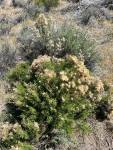
- Green in front of Gray.
-

- The longer, more branched inflorescences of A. t. subsp. wyomingense on my plant at home
-

- Antelope Bitterbrush, Purshia tridentata, next to the Deschutes River at Cove Palisades State Park flowering a little ahead of ours here.
-

- Open flowers on Bitterbrush quite pleasantly fragrant. With its tiny, but typical 5 petaled rose family flowers.

-

- Gray Rabbitbrush in the garden
-
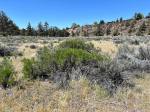
- Green Rabbitbrush center with the dominant Gray all around it.
. wyomingense is the one most common in our area and is more drought tolerant than the other two and tends to be smaller.
If this isn’t confusing enough there is another species, Artemisia arbuscula, Low Sagebrush, common locally, which as its name implies is even smaller, even down to a foot or so and is the most drought tolerant often growing on very rocky shallow soils as would be found near canyon rims and surface lava flows. And, to complicate this more, there are three different subspecies of this as well, but let’s just leave it at a species level. It too has the trident shaped leaves. Plant ID requires an eye for subtlety.
As I said this is really only of concern when managers are evaluating their work or when planning which species you might want to augment a landscape with.
Artemisia cana (Silver Sagebrush) and Artemisia rigida (Stiff Sagebrush) are also found in Central Oregon, but they have more linear, narrow, leaves, the former often atop stream banks and the Stiff Sagebrush with Pines and where they mix with Juniper.
Having said all of this, most of the low gray shrubs in Dry Canyon are Gray Rabbitbrush, Ericameria nauseosa. It out numbers by far any of the other shrubs on the bottomlands. It is a seral species, one that is an early colonizer on disturbed sites (and most of the canyon is disturbed). Think of them as preparing the way for the more complex and mature landscapes that will develop later on. Plants, as do all things, live in relationship with one another, whether recognized or not. Nature has its process, it is dynamic, change is continuous. Landscapes undergo maturation. Overtime they vary in composition and arrangement, adapting to conditions. One can’t simply plant a mature native landscape. Attempting to impose your will or to hurry them along by adding plantings the site isn’t ready for, will likely fail. Nature operates in an experimental mode within naturally determined limits. Natural landscapes are complex and no one can walk in, take a look, and tell you what to do with a high rate of success. The Canyon contains many individual micro-sites. Management will always be somewhat of an experimental process, but one must keep their attention on them and an eye on opportunities to move them toward a healthier state.
I suspect that these broad Rabbitbrush bottomlands, if one had maps of previous land uses, would overlap with those areas used as pasture, places with deeper soils where pasture grasses could have a larger soil volume to support them.
I’ve heard some people, who don’t ‘like’ Rabbitbrush, say that they ripped it all out trying to get a more complex landscape in its place. This, likely worked in opposition. to their intentions, because as stated above, this is a seral species and is necessary to move the plant community along. This is not a year or two process.
Some of the more upland, rocky areas, have populations of Antelope Bitterbrush, Purshia tridentata. This a deciduos shrub, with small trident dhape leaves much like those of several of the Sagebrushes. These are often found across our region and can dominate some plant communities typically where the soils are shallow and rocky such as on top of buttes. Under such conditions it can dominate even Sagebrush. These seem to grow on higher, rockier ground, and on the bottom, near the toe of the west rim. They can get quite old and like old Big Sagebrush and far older Western Juniper, can take on a very gnarly appearance. These are just coming into flower as we approach late April. Their masses of creamy yellow, tiny rose like flowers are held in masses and are relatively, pleasantly, fragrant and further extinguishing them from the Sagebrush’s flowers of the Aster family.. As the common name suggest this is a preferred browse plant which goes toward explaining the irregular and gnarly structure of many older individuals.
The link below is a great guide to learn and differentiate the Sagebrush in your region.
Click to access SGI_Sagebrush_PocketGuide_Nov12.pdf
Oregon Flora is the site to check out for Oregon plant taxa, those formally recognized botanical classifications.
 GardenRiots