
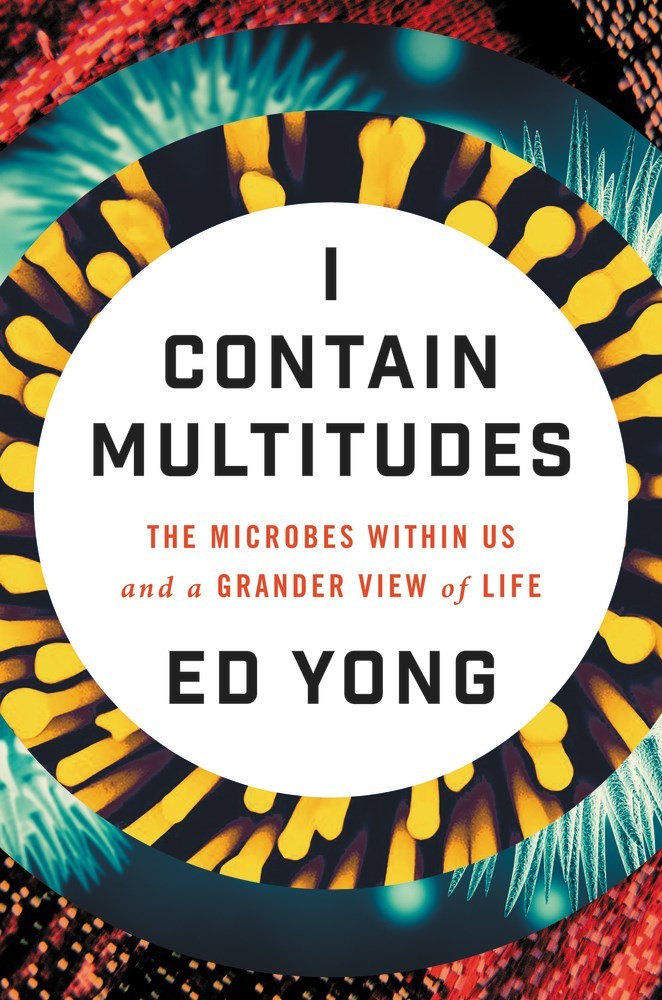
 Ed Yong’s, “I Contain Multitudes” takes a different angle into the biology of organisms, looking not so much at the functioning of the individual as it does those countless single celled organisms, protists and tiny ‘critters’ that live within and upon us, bacteria, fungi, nematodes, viruses, dust mites etc. There are bacteria living within larger, multi-celled organisms with viruses living inside these….And these are not unusual relationships. Such relationships dominate all of life. Their exception is the rare event. Together, in their multiplicity, these constitute living communities, living in the very specific ‘biomes’, found on larger, seemingly independent organisms. Numbering in the thousands, millions, billions, even trillions, these tiny residents live in dynamic symbiotic, mutualistic, parasitic and antagonistic relationships with their hosts, often filling more than one role, depending on the host, the conditions and constitution of the biotic community. Whew! Yong’s book introduction, of the reader to this world, should lay to rest the idea that ‘we’ are truly ‘individuals’. The countless microbes that occupy and ‘invade’ us, have previously been considered unnecessary or consistently compromise our health, sources of disease.…The idea that we can ‘sterilize’ our way to better health denies the necessity of these organisms, or at least most of them, in the health of individuals.
No, he presents a variety of cases which illustrate the absolute dependence of an individual on these microbes, bacteria that breakdown our otherwise indigestible foods into forms that we can then absorb and utilize. Others that may live on our skin, defending us from attack, by providing a defense against other microbes that could otherwise infect us. Their are microbes that infect other microbes (see Martinez Arias’ book, “The Good Virus”), tiny ‘organisms’ that infect that disease’s vector, killing it before we become infected or blocking the disease causing microbe from infecting the vector, keeping it free from the organism which can cause disease in us.
The microbial world, within and around us, exists in a dynamic state that responds to every perturbation. The health of this wider ‘community’ oscillates across a balancing point. It is not the absence of ‘disease’ organisms that is central to our health, but the dynamic community of organisms which collectively hold disease in check, a ‘background’ population which is largely innocuous, sometimes even necessary. These organisms put ourselves under a degree of stress, helping to keep our defense systems ‘alert’ and effective, within strict limits. These communities, those within and around us, become toxic when pushed out of balance. When an unhealthy host individual becomes available without the necessary dynamic, healthy biomes, ‘disease’ organism find their way in. Microbes, often even of the most virulent types, surround us, held in check.
Western medicine’s pursuit of sanitation, a sterile world, is one out of healthy balance. The microbial biomes within which we live are a part of our defense systems. These are active across the physical boundary of our skin, within our guts and blood. These microbes are effective extensions of ourselves, modifying, ‘blending’ space within and around us, as we shed cells and the microbes they contain, that we excrete and exhale. We share our communities with whom we share space, including our pets. We augment our own communities with each inhalation, each drink and meal. We supply our gut biome with what they need to live and when our diets are out of balance so too are our guts and our ability to grow and maintain ourselves. We share them with those with whom we are intimate. Our communities are ‘seeded’ and supported at birth as we enter the world, augmented by breast feeding. We shape the microbial and chemical envelope around us, and it shapes us, just as all other organisms do. We are interactive ‘players’ in the larger biological world. Under sterile conditions, contrary to common thought, imbalance becomes a threat. Explosive increases of populations occur commonly when unchecked by healthy communities, quickly overwhelming the larger multicellular individual dependent upon them, those organisms that would act on and limit them, absent or reduced to ineffective numbers.
This dynamism is a product of these complex interactions. It is bottom-up, top-down and a circular process, the microbial world responding and evolving far more quickly than larger, more complex organisms. Overlapping feedback loops, positive, moving in step, negative, in opposition. Dynamic and difficult to predict. When we rely on antibiotics we kill/control all susceptible organisms. Those that aren’t go on reproducing. This sets the stage for resistance single celled organisms adapting far more quickly to a toxic environment than we are capable of. While we remain susceptible to the diseases, the organisms which may cause them, can quickly evolve the capacity to survive our treatments, rendering them ineffective. Then what? Our antibiotics are derived from the natural world. Creating new ones that are effective agains bacterial and fungal diseases is a difficult proposition. Doctors don’t want to kill the patient with the disease. The similarities between our basic cellular structures and the metabolic processes which drive all of us are very similar. As our antibiotics become more powerful they also have a greater effect against our own health and this can manifest directly on our own cells and by killing or incapacitating those organisms with which we have mutual and dependent relationships…if we want to remain healthy ourselves. While our antibiotics become ineffective our own evolution proceeds far more slowly.
Microbial balance is dependent on this dynamic interplay. Antibiotics destroys this balance. Studies are beginning to support the idea that sterile conditions, such as those practiced in hospitals, can result in toxic brews of microbial populations, leading to disease and infection. Health is not a product of microbial absence, it is dependent upon microbial balance.
What constitutes that balance is not a simple problem. It varies with species, even individually, location on and within that individual as well as the varying conditions that surround them. Biological science and medicine are coming to understand this. Health, at what ever ‘level’, is not an absence of disease, it is the dynamic balance of health, all of its players. Disease, is opportunistic. It leverages ‘weakness’ and that ‘weakness’ is not easily defined. This is further complicated by the fact that each organism responds in different ways to the extant conditions operating on and within the community. Together, they reach a balance. Change one or more elements in that community, biome, and the balance shifts. Push it too far and it devolves into chaos, a state of unhealth, which can cause member populations to crash while others explode.
Sterility, effectively, is our attempt to simplify conditions. Remove the ‘bad’ in the hope that the ‘good’ will thrive. What we are finding is that that may indeed occur, but because the system is now out of balance, and lacks, a healthy dynamic community, it is very liable to crash into a state of unhealth, until a healthy community can be reinstated…and that healthy community is difficult to define and even more so to bring about. Healthy communities, of all scales, are organic and ‘evolve’ over time. They are not ‘plug and play’. We can sometimes approximate them, but we cannot transfer them wholly from one healthy individual to another, at least not consistently. Health is not supported by our current ‘disease model’ and it won’t be, as long as we cling to the out dated idea that health is an absence of disease, that healthy individuals, exist independently from others.
Others have written books which look at complex multicellular organisms in a similar way. Arguing that an individual of such a species evolved over many millions of years as communities of mutually beneficial cells. There were sometimes benefits from joining the ‘efforts’ that propinquity sometimes allowed. This lead to the formation of more specialized tissues and organs, while ‘giving up’ various structures and functions to better serve the combined whole, the complex individual. These views, that of this complex individual, and the wider microbial world, are consistent, the complex arising from a milieu of constantly and quickly adapting microbial organisms which constantly ‘tests’ and supports its more complex creations. The attributes of the complex individual arose from this, is dependent upon it and, in fact, can only be separated from it with a great deal of supporting energy, work and resources, services that would ‘normally’ be provided by the dynamic milieu of microbes and organisms which comprise the healthy living communities of which it is a part. Ignoring this is an invitation to disease and poor health. Independence, in any pure sense, is a biological impossibility.
Yong is an excellent writer. Accessible. He walks the line between simplicity and complexity, a path upon which scientists, in their attempt to be precise, often lose the layman. One need not have an advanced degree in biology to follow Yong here. This is a good entry level book, one which the interested reader could then build off of following paths to deeper and richer understanding.
 GardenRiots