
 I have always been physical. There’s a picture of me and my brother, I must have been four or five, sitting on a pile of boulders, on a hilltop. We had raced, which was common for us, to be the first to the top. I won. I’m grinning and my knee is bloody. It didn’t matter.
I remember another time playing football in the yard with the older, bigger, kids, being excited after tackling one of them, no pads, no helmet, with my well earned bloody nose. No tears. I wasn’t masochistic, it was a sense of physical accomplishment, of doing something, beyond myself. Such events, not generally ending in blood, but having required physical effort, the outcome unassured, became habitual, even necessary…Sometimes I did get hurt, never catastrophically, although, in retrospect, there was some degree of luck or ‘grace’ in my efforts not having ended with more permanent physical consequences. It was a regular testing of myself. These were important learning experiences, a learning of my limits, the kind of lessons that stay with you.
I played football in high school, competed in track and field into college, tried basketball, but decided, ultimately that team sports weren’t really my thing, hiked, backpacked, ‘bouldered’ in the canyon while growing up, climbed trees, fell out of one and worked, physically, testing my body, learning its limits. A friend got me running in college and I competed in 10 K’s, took enjoyment in trail running, before joint problems reared up, in my early thirties. This was often after physically working jobs in landscaping or after home gardening. Sometimes, sensitive to the occasional charge of my being ‘skinny’, I would go to the gym to lift weights.
Being curious and analytical, purely physical work wasn’t very satisfying. I’d gone to U of O, gotten my degree in Sociology with intentions of getting a Masters in Urban Planning. Taking a break from school, I found a job with a small planning firm in Central Oregon, I wanted to see if my desire ‘fit’ before working more specifically toward that goal. It didn’t. The work neither satisfied my need for physicality nor my more ‘cerebral’ needs. Driving around doing structure surveys to help determine urban growth boundaries or sitting in an office working on tables, charts and maps, wasn’t cutting it. It was ‘boring’, uncreative, without challenge (And people HATED us telling them what they could and couldn’t do!) I was going ‘nuts’ and simply running after work wasn’t enough. And thus began a period of about 7 years of floundering, moving from one unsatisfying, or at least unstable, job to the next while always gardening at home.
I fell into being muscle for landscaping companies. In gardening, I came to realize over time, I might find the answer, work that required regular physical exertion, skills and a level of attention to learn, both from the plants I was working with and the world that either supported healthy growth or didn’t. Plants, I had read by the author Steve Solomon, the owner of the Territorial Seed Co., always did their best, given the conditions under which they found themselves. At the same time I was discovering edible landscaping, agro-forestry and which emphasized thinking in terms of complex systems. This and the opportunity to create something, a place of beauty, drew me in…I went back to school and got a degree in horticulture and stayed working in the plant world.
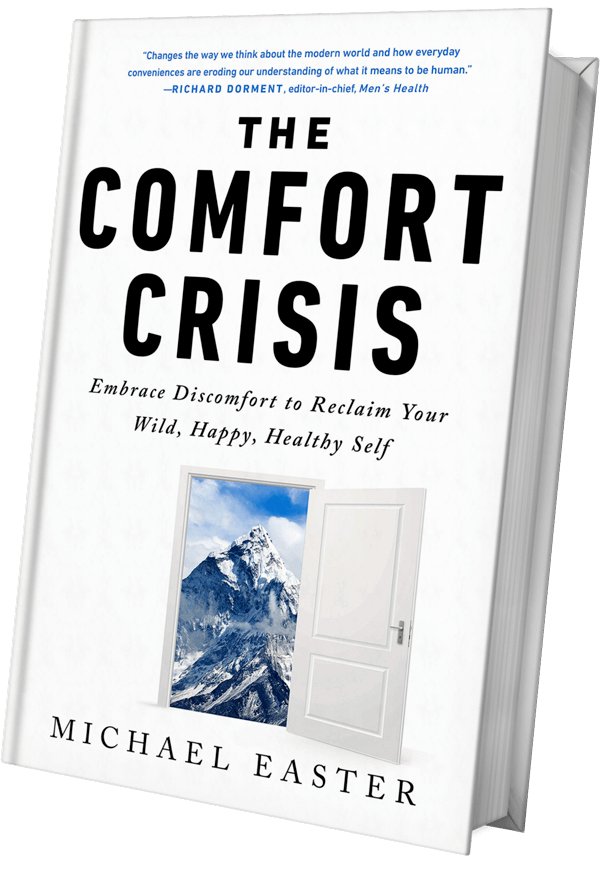
So that’s me, a horticulturist, with a drive for the physical, an endless curiosity, a desire to understand the world around me. Michael Easter’s book, “The Comfort Crisis: Embrace Discomfort to Reclaim Your Wild, Happy, Healthy Self”, (Okay, I really don’t like the subtitle they stuck on this book.) while not really addressing the plant thing, ticks most of my other boxes as he looks into what we as a modern people have left behind…things that physiologists, doctors, anthropologists and those whose lives still center around the physical aspects of this life, are studying as they consider the modern world and our disengagement, compared to the thousands of generations our species evolved through. Science is beginning to understand that the root of many of our worsening health problems (obesity, diabetes, depression, etc.), physical, psychological and ‘spiritual’, are rooted in this withdrawal from the living world, from our lack of active engagement. In our seeking out of ‘comforts’ and ease, Easter and those he interviews here, believe we are losing something essential to being human, which in turn is leading directly to a decline in our health, our capacity to live the life we can. Innate drives, capacities, even our physical structure, once directly served our survival. Now these same things, un- or underutilized, are contributing to our declining health. We are growing ever more sedentary, overweight, weaker and prone to diseases that once rare, are now common place, not just because we are living longer than people did in hunter-gatherer societies (In most recent years or lifespan is actually shrinking). We are becoming unhealthy because the researchers, practitioners and thinkers say, we are routinely avoiding being uncomfortable, physically exhausted, and hungry. Easter isn’t taking about the hunger we feel by missing a single meal, or being dissatisfied because we wanted ‘more’, he’s talking about going without, about having to work for that next meal because ‘mother Hubbard’s cupboard’ is literally bare, ‘switching’ our metabolism into survival mode, burning our fat reserve. Modern Americans, unless forced there by poverty, rarely feel this. Gone too are the drives and knowledge necessary to provide for ourselves. We simply spend the money we’ve ‘earned’ through our work, which is often incidental to our survival. We are disconnected in many ways.
Easter spends a lot of time discussing hunger, what it means, how there are different types, different drivers, how our bodies developed hormones and triggers to regulate our hunger, our drive to survive, ‘strategies’ to assure our survival, and how now, when so much of the West has ready access to food, these regulators are misfiring, undermining our health in their ‘work’ to assure our survival, a survival which is rarely tested today. The ‘drivers’ remain even though the ways in which we obtain our food, and the amounts, is vastly different. Our bodies, still operate as if those ‘primitive’ conditions existed, and we become ‘hungry’, because its meal time, or because the food we consume causes us to release pleasurable dopamines, over-riding the communication between our gut and brains, so that we eat beyond fullness. Hunger that threatens our lives was routine for most of human existence. We ate when it was available, built up protective fat reserves, that would protect us from lean times, protect us from starvation. Now over eating threatens us, our bodies having turned against us.
Much of the discussion in the book revolves around our physiological responses to our environment, how during the course of our lives, as we go about satisfying our needs, our species’ physical attributes have been shaped along with our internal functioning, the wash of hormones we produce and release to help regulate our internal functions and emotions. All of our systems, particularly our gut and brain, are linked and our normal response to need and conditions are determined, at least in part by, our species’ past patterns and the biochemical soup that courses through our bodies. Mind, body, environment are inseparable and those relationships are ‘built in’, not readily changeable. Society, technologies and economics can change relatively rapidly when compared to the physiological and biochemical realities of our bodies. We as individuals can’t. Our bodies can only adapt so far. Evolving so that our bodies no longer act in a certain way requires innumerable generations and the outcome is unpredictable. These patterns and processes within us are a product of natural selection. Today’s endless creature comforts can’t change that…and, in the blink of a handful of generations, they could be gone. Our species is in this for the long haul. Today is variable.
Discomfort, it turns out, is an essential aspect of life. While the pursuit of comforts is understandable, when ‘comfort’ becomes the general state of our lives, function is thrown out of balance, and our lives become a mirror of that distortion. We evolved under given, relatively stable conditions. These may have been seasonal, or cyclic while others may have been less predictable, but either way with very real consequences and we had to be adaptable enough to survive them, i.e. enough of us had to be able to survive cataclysmic events for the species to survive. Individuals die. It is the species that matters. But now, having ‘conquered’ those conditions, we are forcing a change on ourselves that our own bodies can’t do. And we are paying a price.
Easter discusses hunger along with our need for physicality, the advantages and necessity of physical stress in our lives to build strength and endurance, to put our bodies in a ‘cleansing’ mode, in which hungry, our bodies can begin to break down, and repurpose, our own cells. Every cell type, every tissue, is replaced over time in our bodies, but when resources are always plentiful, the systems that scour out the oldest, weakest cells, can’t effectively do their ‘job’ and those cells, that would under ‘tougher’ times, be broken down and replaced, are now more often allowed to continue and become more functionally ineffective, which effects how our bodies function and allow opportunities for disease. It is normal for the cells comprising our various tissues and organs to degrade and mutate. A healthy body has systems to limit that. Hungry, under physical stress, our bodies, don’t just consume the excess fat reserves we store over times of plenty, but we cleanup our living, functional tissues, so that they might function more efficiently. Of course endless hunger and physical stress, without adequate rest and nutrition, will lead to the continual breakdown of the mind and body, a balance is necessary. Where that point is has to be determined by the individual and that requires testing oneself and have access to what we require for recovery. Easter illustrates how we have been failing in this.
Some readers may be turned off by the ‘vehicles’ he uses to illustrate his points, but they fit. His ‘story’ is told from the perspective of what many might call the extreme athlete, the hunter and the soldier. The author writes for the magazines, ‘Men’s Health’ and ‘Outside’ so this angle fits. He introduces us to the term ‘misogi’. A misogi is a physical test that one might undertake once a year or so. It is a kind of coming of age test, in the way that the ‘vision quest’ of indigenous peoples all undertook when a young person comes of age, but in this case it is a physical test that, as he explains, gives the participant a 50-50 chance of success in which death is unlikely. He gives several examples and discusses the benefits. Normal, modern life, never tests us in this way, never pushes us beyond what we would think we can do, well beyond the point where one’s mind has said, ‘stop’! It is through the testing of our limits that we learn our capacities, that we gain confidence in our own abilities to succeed. The mind and body have evolved a conservative relationship. Unnecessary danger is avoided. Our bodies, however, have considerably more capacity to succeed and endure than we might think, but when we always stay safely within those bounds, we never discover those limits, are always held back by doubt and fear, never experiencing the ecstasy, if you will, of physical accomplishment. By staying within the limits of comfort we don’t grow.
Much of the book revolves around his experience hunting in remote Alaska and the psychological and physical demands of the experience when one spends 4 weeks completely out of touch with the rest of the world, its stresses and supports. Out of touch, without communications or support. Completely on one’s own, in this case, shared with his two companions. He and two experienced hunters fly in and are left, perhaps hundreds of miles from another human being. His companions are very experienced with such conditions. He isn’t. Here Easter discuss hunger, boredom and living in extremes without our ‘comforts’, supports and assurances. He discusses what he learns about life and himself. Along the way he weaves in what he’s learned from physiologists, psychologists, nutritionists, and trainers of elite athletes and members of the special forces.
Boredom is a condition today which is easily avoided. The modern world has become harnessed to the continuous input of the digital world, so rarely are modern Westerners without connection. Boredom, he explains, has an essential purpose. It prompts us to act. To depend more on our own internal resources and, he and others argue, gives us the opportunity for creativity, for thinking outside the ‘box’. It provides us the space to flip between highly focused states to those where are brains merely spin neutrally instead of being in a state of continuous overstimulation from outside. It gives us the psychological space to be truly present. Artists and athletes often speak of being in the ‘zone’, of shutting everything else out, being in the moment. Boredom, gives us the ‘space’ to reconfigure our brains, so that we literally see and act differently. Today we are rarely truly ever alone, living in place, and we are paying a psychological price. Being comfortable with boredom is one of those essential discomforts most of us seek to avoid today.
The hunting line reaches its ‘crescendo’ with his shooting of a caribou they’ve selected from a migrating herd. This is not a trophy hunt. The threesome have all spent a lot of time pondering the ethics of hunting and Easter discusses it in this book. They are purposeful and respectful, aware of their surroundings and the complex net of relationships they have entered into with this hunt. They choose the animal with care and they are continuously reminded of the harshness and beauty of the place they are in, of their ‘role’. Leading up to the ‘kill’ are the endless hours, weeks of ‘boredom’, where they watch, move and wait, passing over other animals, in an attempt to minimize their impact, essentially ‘culling’ an older, impaired animal, as they see it, fitting in and playing a ‘necessary’ role. This is an adventure for them and their goal is to more than ‘glean’ an animal nearing the end of its life. They absorb the experience, its fullness, its discomforts, reading the landscape, trying to understand the conditions, enduring the storms and cold, learning about the animals, the caribou, itself. And, when it has been done, there is the butchery in the field, and the grueling packing out of the animal’s meat back to camp, each of them carrying 90 to over 100 pounds in their packs for five miles, upslope, over tussocks, shale and the bad footing of the terrain of this part of northern Alaska. The exhaustion, the body persevering while the brains screams ‘stop’! Setting aside one’s limits and enduring. Finishing. It is a kind of a coming full circle moment in his self-discovery and telling of this story of modern man and how we have strayed. He reflects on his moments of clarity, moments that had absolutely eluded him before, now revealed after days spent in place, enduring. Only with that could he finally settle in and experience the landscape around him the events of which he was a part.
The book continues after his return home. Among others, he seeks out a dad, a Floridian and ex-Green Beret who has started a business promoting the events and equipment for ‘Ruckers’. A Ruck is the pack the military uses and Rucking is the process of covering distance, on foot, under load. It has been said that the Army moves on its stomach, but here the emphasis is upon the soldier being able to cover distances, under adverse conditions, carrying weight while remaining ready and capable. For special forces training soldiers often train carry 100 pound packs, not at a run, but not at a walk either. Rucking is a necessity for the soldier and a training technique to sculpt bodies. (I am reminded of one of my brother’s experience, years ago training and working as a smoke-jumper, fighting wildfires. It was comparably grueling done under impossible conditions, hauling all of the gear necessary to fight fire and survive.) In the military rucking is an exercise for developing the ideal body type, lean, tough and strong, while also developing mental toughness, a capacity to push beyond one’s self-imposed limits.
A bulky, muscular upper body, is not the goal. Like the warriors and hunters of long ago, the ideal is the person who can spend many hours in continuous foot travel, running-walking down prey or in pursuit of, or escape from, an enemy. These were basic and primary survival skills and both physiologists and anthropologists are beginning to understand that these were likely primary in the survival and evolution of modern humans…and now we have largely abandoned them in our modern lives, but our bodies and their requirements, remain largely unchanged, so we suffer.
Indigenous people, living traditionally, on hunts could routinely cover twenty and greater miles a day over irregular terrain…and do it day after day when needed. As hunters they then had to haul their take back home, or move ‘home’ to the site of the food, to process or consume it. Warriors typically carried their weaponry and everything they needed on their backs. Women, generally experienced similar rigors, moving camp, hauling, processing. In North America indigenous peoples, without horses or draft animals for thousands of years accomplished everything on foot. Toughness, which can only be gained through experience, has been on the wane.
Our Rucker, the former Green Beret, and military people in general, have observed that while our elite soldiers have never been more fit, the general population, from which they are drawn, has never been more ‘un-fit’! Studies show that the percentage of Americans suffering obesity and depression continue to rise along with the percentage of Americans who say they literally never exercise. Their working life largely revolves from bed, to sitting while eating, driving and working, relaxing in the evening, before returning to bed and then doing it again the next day. One can rightly say that traditional people’s didn’t exercise either, but their lives were one of nearly constant physical movement, of lifting and carrying. Exercise is a modern phenomenon and we’ve developed specific tools and practices for it along with ideals for shaping bodies, often into very inefficient and bulky forms. Our bodies and minds have become something we can purchase, but do we get a healthy satisfaction from them? Do they fulfill our need? Are we actually physically healthier in working to attain them? Our bodies, our health and satisfaction have become products and services we purchase as we otherwise busy ourselves with our lives, in pursuits that only indirectly relate to our health and well being.
The existence of modern humans has really only fallen into its current pattern with the onset of the industrial age, so sometime after 1800 or 50 (a relatively brief span of our species estimated 300,000 years as the anatomically modern species we are today, about .0667% of our existence.) This is not to say that life was ‘ideal’ earlier. Far from it for members of ‘western’ and urban societies. Resources have rarely been equitably distributed since our ‘advance’ out of hunter-gather societies. Life expectancy was often little more than 30 years over this ‘civilizing’ period, hunger, physical danger and disease exacting its toll. This was at least in part due to a economic systems which favored the propertied classes…things haven’t really changed that much except during the 25 years or so, from 1950 to 1973 when there was a general consensus among leaders and a priority was placed on growing the middle class. The excessive wealth of recent years was prevented then through targeted taxation on wealth. The revenues went to providing the funding to create public infrastructure and provide more stability to people’s lives. Since that time, the middle class’ position has been eroding, while wealth has been redirected upward. Our foray into a continuous state of comfort, never a particularly great idea, has created a situation which divides the lower classes as wealth has been stripped away and we find ourselves in competition with one another, the stress of maintaining previous standards being undermined and our lives, in the process, have become less connected to our own survival and the communities upon which our well being has always been dependent than they ever may have before.
In an interesting side note the author returns several times to the idea of an ideal community/organization size of around 150 people. Much more than that and relationships become more difficult to manage, along with communication. There is a balance a society must meet if it is to remain functional and healthy. We require community in order to meet our needs, both physical and emotional. We are currently suffering as disengaged, individuals, distrustful of others, resenting our dependence upon them often within organizations in which we feel insignificant. The lives of the majority are becoming ever less manageable, less satisfying and less healthy.
Engagement and scale have become problematic and we can’t solve them by more of what has gotten us to this point. With engagement, we can begin to find a new balance, reshaping our lives into those with meaning and purpose. It will be ‘uncomfortable’ in a variety of ways, but remember that discomfort is a necessary part of a healthy life. Health, not comfort, must become the goal, because, as we’ve seen, the pursuit of comfort has been a part of the force contributing to our increasingly ill health. It is rest, after our expenditure of effort, in our cyclic lives. Like muscle tissue, we as individuals, are strengthened through movement, active engagement, proper nutrition and rest. Not continuous action. Not continuous stress and stimulation. Putting ourselves under physical stress, finding our limits, allows us to grow and explore while discovering the world and the people around us. It allows us to develop a healthy human perspective on this life and can positively shape our relationships with others as we become both empowered and humbled.
Escaping from discomfort, never being truly hungry or being physically tested, living lives of continual ‘ease’, brings about its own set of problems, problems which more and more of the members of the ‘developed’ West are experiencing. Easter’s book is a call to question the path we are following, while suggesting a way out. Maybe all of this comfort and convenience, our continuous connection to the digital world, our escape from ‘boredom’, may not be so great after all. The quality of our lives requires more of a middle approach in which we are tested, challenged in a physical way that requires our attention, where we experience hunger, feel the discomfort, find and push back against our own self-imposed limits and, lets the ‘boredom’ we feel, push us into more productive and satisfying action, and perhaps, into increased self-awareness, tolerance and knowledge.
There is a developing field, sometimes called ‘discomfort science’, where all of these things are being studied for their health benefits. Our bodies demand this, have evolved with and need it. We cannot receive the benefits of a healthy full life without challenge and demands, without ‘discomfort’. We evolved with discomforts and are adapted to them. Our pliable minds are much more likely to succumb to the lure of ‘comfort’ than are our bodies. The life prepared and served up to us in the modern world is one comparable to choosing simply to only eat dessert, rest and eat it again.
That old phrase, ‘No pain, no gain’ comes to mind. Discomfort is more helpful than ‘pain’ as a directive. Pushing oneself passed those limits, suffering a torn muscle, a ruptured tendon, a torn achilles, is not what he’s suggesting here. Comfort, discomfort, the necessity for movement are central to our health and capacity to perform, to experience this life. The issue is more a question of one’s mental state. It’s uncomfortable, so I’ll stop. It ‘hurts’, so I’ll stop. Our bodies have evolved, anthropologists and physiologists believe, again, not for strength and speed, two categories many species out perform us on, but for our capacity to endure and to carry things, to continue under burden, but to do so isn’t easy, especially when life around us tells us to take it easy and we lose those capacities to disuse. We can only regain them with effort and time. It takes mindful attention to one’s state to understand whether we are risking real physical injury or simply seeking to avoid discomfort.
While not an ideal ‘specimen’, I’ve had people comment to me about how my metabolism must be such that I just don’t add on fat, while their’s is slow and everything they eat just goes to fat; or that they themselves just can’t make themselves go to the gym, that exercise is just impossible to sustain, as if that were not an issue for those of us who feel more compelled to do so. I swim, do some yoga and core exercises regularly. I walk, work in the garden, don’t generally eat three meals a day and find that I eat less now that I’ve aged and am no longer as active. I’ll tell them I eat when I’m hungry and that the more active I am, the hungrier I am, the less….Some look at me uncomprehendingly when I tell them this. I don’t binge or eat to reduce stress or because it makes me feel better on bad days. No, I either wallow in it or go out and do something physical, wear myself out, to quiet my mind. I move to reduce my daily levels of stress. I move, and adapt that movement, (I have a physical history of multiple joint surgeries which I’m trying not to add to, while at the same time, working to strengthen myself, improve my flexibility, so that I don’t require any more!). My goal is that as I continue to age, I still feel ‘strong’ and capable. A large motivator is the fact that I have a spinal anomaly, that if I don’t work at these things, my flexibility, which requires that I regularly put my body into positions that test that range, I will lose it. I know from experience that if I don’t do this, my back, as my weak link, will become my limiting factor and pain will shut me down. Once we stop moving, we can rapidly decline. We are complex systems and the whole requires a level of health, of vigor, strength and flexibility. Decline is not linear in such systems. It can seem that it is once here and then suddenly gone.
Pain/discomfort are warning signs, our brains recognize, that we must interpret and we can only do that with experience, intention and self knowledge. Living in this way we are much more ‘in tune’ with our bodies. Easter writes of what we once were as a species, how our physical capacities developed to meet the demands and possibilities of the environment, our existence, how today, having strayed far and rapidly away from that world of direct experience, we have put ourselves at risk. The promise that we have widely bought into of a deservedly comfortable life, like so many things marketed to us, cannot deliver. It must be ‘earned’ through continuous effort. When we sit all day, maybe go to the gym for a bit, we lose our capacity, our fitness. Fitness, health, is more a product of how we live our lives through the day. It is not a product of singular moments or genetics.
Back at home, after his 4 week adventure in a remote part of Alaska, he reflects on his experience and examines peoples whose lives are still shaped by necessary and regular ‘discomfort’, many who have for thousands of years. He talks with those who have studied the Hadza people of the African Rift Valley, the Sherpa of high Nepal, the Ama, those women of coastal Japan who would dive, unaided into the cold waters of the Japan Sea and the Pacific for food and pearls and Icelanders, a stable population that has lived on the inhospitable, cold and stormy island of Iceland for 1,100 years. In each case, these people have been shaped by their environments, in ways that we have retreated from and, as a result, have become hardier, ‘tougher to kill’, in the words of their researchers and the author.
At the book’s end Easter considers all of this and finds that he is more centered, more content with his life, less perturbed by what life throws at him…and, one more benefit, he has learned from his research and Alaska adventure, is that in this kind of challenge, this testing of himself, by attempting to do what takes him out of his comfort zone, by seeking new challenges, his life has become richer, more memorable, knocked out of the mind numbing routine that had engulfed him before. Time slows enriched by unique experience and accomplishment. He puts on his weighted ruck and goes out on regular desert hikes in his Las Vegas backyard and is planning his next ‘misogi’.
This book was a pleasant surprise. I wasn’t looking for it, or even knew anything about it. I saw it on the shelf as I walked by to pickup some other books (I’ve always loved libraries and am a big believer in the value of synchronicity)…and I’m glad I did. It incorporates many of the ‘health’ themes in books and articles I’ve been reading lately, without focusing so much on anyone of them. It resonates with my own experience while reinforcing the path I’ve made for myself. Well worth reading, it suggests a pathway available to any of us, guideposts, of how we might take better care of ourselves and the bodies that carry us through this life, accepting a little ‘discomfort’ along the way. And for those of us who benefit from such things, it gives us a rationale, for doing what we do.
 GardenRiots