
Biology, the ‘life sciences’, botany, evolution, cell biology, ecology, health and disease, plant communities, our relationship as humans with each other, geology and the life around us, are all topics that interest me. My most recent reading choices have focused on embryology and an organism’s capacity to maintain homeostasis, what is meant by ‘health’. Earlier I focused on the big question of ‘What is life?’ I’m an integrator, an intuitor, an assembler of conceptual puzzles. For me understanding is the goal and that usually involves understanding the ‘pieces’ of the puzzle and fitting them together into coherent wholes. That’s what I do when I select books and read. While my fiction choices are relatively wide and varied, when it comes to this question, I am far more focused, purposeful. I am not overly concerned with being correct in terms of conventional thought or even regarding that which is accepted as being scientifically correct. I’m looking for what makes ‘sense’. I ‘test’ what I read.
Science is conservative and rightly so. It works to define a foundation from which we may build on. Many, if not all scientific advances, came at the expense and pain of researchers who reach beyond the established to address the problems that accepted theory has revealed as the process advances. Egos and careers can get crushed. Arguably, every significant advance in science began as a controversial idea. Over time, with repeated experimentation, advances in technologies that enable scientists to address questions not previously possible, new insights and ways to ask the ‘question’, the new gains support, or alternatively, is revealed to be ‘wrong’. In this process other questions arise, that move us toward a more complete ‘truth’, a truth that enlightening and revealing, can never be the ultimate answer. What preceded it was not necessarily ‘wrong’, but more likely incomplete, unable to fully explain the world as our understanding of it itself changes. Science becomes a process of understanding at an ever finer scale. What once served, still does, but in a coarser grained way. Occasionally, it demands a radical rethink of our basic understanding of reality.
It is in the nature of life and the universe that it be this way. Unfortunately, this often leads the public to question the value, the correctness, of what science produces, the public not understanding that this is the nature of knowledge and the limitations of being human. There is what we know, what we don’t know and that which we have no idea at all that we don’t know, that we don’t look at, that we, as yet, cannot even imagine. Science and the process of gaining knowledge, was not wrong in its earlier ‘established’ theories and explanations, it is a process of revealment, where as we gain knowledge and the capacity to ‘see’ what was previously unavailable to us, our reality changes. What came before was a necessary step along an evolving path.
My own cobbling together of ideas, my speculations, are those of a student, eager to understand. I am not a scientist engaged in experimentation with my colleagues, in the lab. Scientists are ‘experts’ engaged in the intricacies and nuances of their study. Science, historically, has been atomistic, taken a reductionist approach, breaking its various topics down into precisely defined and contained problems and then subjected to analysis. The ‘whole’ being revealed in its parts. This is essential because, when it comes to life, we are looking at an incredibly complex and massive, in terms of numbers of variables/players, process, with countless interactions and feedback loops, each component/part acting within its own limits, in an almost simultaneous process, which results in the living organism and its overlapping communities. The study of science has, however, also lead us to an understanding, that many problems, such as life, are greater than the sum of their parts, that those ‘wholes’ can possess a layer of complexity not suggested by the examination of its parts alone. Life is not so ‘simple’, nor is it random, a thing preordained, nor is it a thing we can so easily pin down…it is a process of which we are a part. I’ve written of this in earlier postings, a few of which I need to review and rewrite. My understanding has evolved with my study. I don’t claim to be ‘right’. I’m looking for what makes sense, connecting the dots in a coherent way.
Recently I posted a piece on Alfonso Martinez-Arias’ book, “Master Builder: How the New Science of the Cell is Rewriting the Story of Life”, which looks into the ‘miracle’ of the multi-celled organism, how from a single fertilized egg cell, a complex organism develops with its many cell types, tissues and organs as a living, functional whole. It is a look into embryology from those earliest moments of the creation of an individual life. It is an excellent read and will require some effort by the reader. As in most books of this type written for the interested, general, reader, there is some daunting terminology there, but there won’t be a test afterward, so focus more on the concepts. You needn’t memorize the specific proteins produced by an organism at a particular stage. There are many. Biology, at this level is incredibly complex, so I think it is appropriate to keep a comment made once by Richard Feynman, the quantum physicist in mind, “Nobody really understands quantum physics.” It is a tool and approach which helps explain the previously inexplicable.
My most recent read, by Polish biologist Magdalena Zernicka-Goetz, “The Dance of Life: The New Science of How a Single Cell Becomes a Human Being“, is another look into the study of embryology, a topic she, and her lab(s), has been involved in for more than three decades. Where Martinez-Arias has a broader, perhaps more ‘technical’ and introductory approach to this particular science, Zernicka-Goetz’ is much more ‘personal’, focusing on her lab’s work and discoveries, the difficulties they’ve faced and the various personalities involved.
Her, and her co-author Roger Highfield’s, a science writer, have produced a book that provides a more detailed look into the process of the earliest formation of a living organism, its capacity to grow, differentiate, exhibit what she refers to as ‘symmetry breaking’ as the singular fertile cell divides and begins to produce various cell types to become specific tissues, fulfill roles, and eventually lead to the formation of organs, while the individual grows into a recognizable and particular whole. Over the years of research they adapted and devised technologies that allowed them to film these processes as they unfold, to identify and follow the production of proteins that call forth and direct the creation and placement of new cells, new tissues, even the pattern and symmetries of the organism’s body. The fertilized cell possesses the essential capacity for self organizing, the necessary chemical signaling, switching on and off of specific genes and an incredible ability for self assembly as it grows into an embryo and a mature, complex, multi-celled organism. There is no ‘blueprint’, no guiding brain or ‘author’ guiding the process. She writes of stem cells, totipotency, those earliest cells which possess the capacity to grow a complete individual even when separated from an organism’s earliest aggregation of undifferentiated cells, as well as those supportive tissues that form the placenta and yolk sack of the earliest embryo; pleuripotency, those cell which can go on to produce literally any other tissue, but not a complete individual. She writes of the capacity of particular cells to transform, how others, can be ‘teased’ back into a more ‘potent’ and adaptable state, how they can rearrange themselves through processes like that of gastrulation, that earliest of ‘realignments’ that precede the actual ‘building’ of the fetus. The typical adult human contains approximately 37 trillion cells, all created and placed where and when they should be, a phenomenal achievement.
What ‘plan’ there is, Zernicka-Goetz describes as more of a bias toward forming a pattern or goal, lies within the growing organism itself, morphing as it grows and changes, at times literally rearranging its internal structure, discarding that which it no longer needs, creating what it does, following recognizable patterns in adherence to a strict time schedule; each bit created and placed where and when it is needed; while that which is not, is ’killed’, in a process known as apoptosis, which is a regular function within the mature organism as well; the component ‘parts’ absorbed and repurposed as necessary. The individual of every multi-celled species, possess a bias toward a specific form and function. ‘Errors’ as they may occur, which could collectively lead to a decline in the individual’s viability, its health, within limits, are removed and replaced. The growing individual is in a constant state of ‘balancing’ itself so that it stays within viable margins. This is an excellent companion book to read alongside Alfonso Martinez-Arias’ book, “Master Builder”, as she takes you through her thinking, the work and results of her lab and collaborators, as they collectively come to reveal the process of embryogenesis and what it means for the future of IVF, health and regenerative medicine.
I’ve probably ‘blurred’ these two books together, so excuse me that. I was never particularly good at the traditional book review. It is not my intention to hold the work of different authors separate, to worry about who to attribute an idea or concept to, rather, it is to understand the whole. I had a few professors years ago at U of O who while being clearly interested in what I presented in papers I’d written, were distressed to learn that the links and leaps were my own, a lowly undergrad, and that was the reason there were no footnotes to corroborate them.
These books lead the reader to an understanding of the incredible complexity of life and how much of this is shared between all organisms. Adding in Ed Yong’s book, “I Contain Multitudes”, which introduces the reader to the roles of viruses, bacteria and other single celled organisms, to the reality that our bodies contain as many cells of our own ‘making’ as we do of other independent species, and they often have absolutely essential roles in the health and function of virtually every organism. The organism in and on which other individual species DON’T live, is not just rare, but probably doesn’t occur. We are all ‘hosts’. Often, even those, tiny organisms that populate us which can cause us harm, work in communities which support and maintain the conditions essential to our health. Health is a balancing acting of countervailing organisms and forces. It is always a matter of dynamic balance. All are a part of our ecology, a part that we should be very careful about ridding ourselves of. The individual, is comprised of communities. The health of one dependent upon the other.
Ferris Jabr, in his book, ‘Becoming Earth’, takes this model and expands it, viewing the entire earth as a coherent, integrated, system all functioning effectively in a parallel manner, the countless, literally trillions of individual organisms, functioning within a system that tends to support those conditions upon which the bulk of species and individuals depend. Whether you accept the idea of Gaia, that was first presented by James Lovelock and Lynn Margulis, that the Earth is alive, a massive self-regulating organism, at least originally, the earth does ‘behave’ in an incredibly complex manner of positive and negative feedback loops, between its trillions and trillions of individual ‘players’, each dependent upon, the conditions created through the collective actions of the whole. Lovelock, backed away from this limited and strict interpretation of their idea over time, but in a sense the damage was already done. Lines were drawn and many rejected even the concept of such a complex functioning at all. This rejection was likely, at least in part, because of ‘our’ tendency to clothe such an idea in our own limited idea of an individual life, its metabolism and function confined within its physical body without the countless links to virtually every entity, force and element of its wider community. But the earth system does respond to and shape the conditions which define it in ways similar to those of the individual organism. We need to get into our heads that the individual has never been an independent, stand alone, entity or system. We are all interactive and dependent on our communities, the closer those links, the greater the dependency. In the same way we also shape those larger communities within which we reside, although our actions are not singularly determinitive. It is about collective action and impact, every ‘player’ fulfilling its role and part in the outcome. All individuals play a role, all shape and adapt to their immediate conditions, all will die and be replaced in a perpetual cycle. Ultimately it is the process of life that is important. It creates the complexity and vitality of the system, defines the limits of what can exist and how we may live. Life as a process has evolve over vast time periods, modifying the conditions which support life, which were in fact, created as a result of the life on the planet. Life did not spring from the crown of the earth made full like Athena from Zeus’ head. Each moment grew from the previous in a collective and continuous and ongoing process of evolution, each life a tiny ‘tick’ along its path, fixed and determined only in our limited scope of understanding as humans.
Individuals that move too far away from that which sustains the whole, tend to make their exits as individuals and species, earlier. But all inevitably fail and return to the beginning of the process, even those that live strictly within those bounds, perish and are replaced. Within the individual, there is a tendency, a bias, towards health and vitality. This is also expressed in the species. The thermodynamics of living organisms, describes the function of an appropriate throughput of energy that works to create and support otherwise unstable, complex structures, from hurricanes to human beings, which are in themselves in a continuous state of decline/death and repair/vitality. Matter, of which every organism is composed, is ‘informed’ energy, born from it, modified by it. Some have likened this process of living, a continuously advancing wave of energy through a system, energizing, sustaining its complex form, without which these structures, these lives, would collapse. We, all organisms, literally exist in the continually advancing moment. Think of our heart beat, we survive in that moment between beats, within very narrow margins. We are, they argue, not so much individuals ourselves but processes, waves activating patterns of matter, from moment to moment, whole and ‘solid’ only in that that is how we individually perceive ourselves, how we string memories of ourselves and our world together and fool ourselves into thinking that there is something solid, fixed and real there. Separate. Individual and definable. But that is an illusion. A product of our own limits. By understanding our own limits the miracle of life becomes more understandable, but no less fantastic. In fact, for me, it becomes even more so than an inexplicable magic show.
Tom Ireland’s book, “The Good Virus”, takes the reader in another direction examining, explaining how bacteriophages, an entire class of viruses, which comprise the majority of known viruses (Yes, most of them are either good or of little direct consequence to our lives), have the capacity to enter and destroy particular bacteria, without doing any harm to ourselves, attacking that which may actually cause disease in us, the phage’s larger host organism. For the phage, this is a defensive action, utilizing the bacteria to reproduce the dependent phage, while in the process, destroying the bacteria. They do this alongside the larger host organism’s own defense systems. Bacteriophages then often work to maintain our health and the homeostasis of our body system, possessing abilities that researchers and medical doctors are finally beginning to look to to support human health, an alternative, often a more effective strategy, to the more disruptive antibiotics, modern medicine has been relying on, medicines which are themselves becoming less effective over time as various bacteria gain drug resistance through repeated use and misuse.
In a similar way, Walter Isaacson’s book, “Code Breaker: Jennifer Doudna, Gene Editing and the Future of the Human Race”, on researcher Jennifer Doudna and the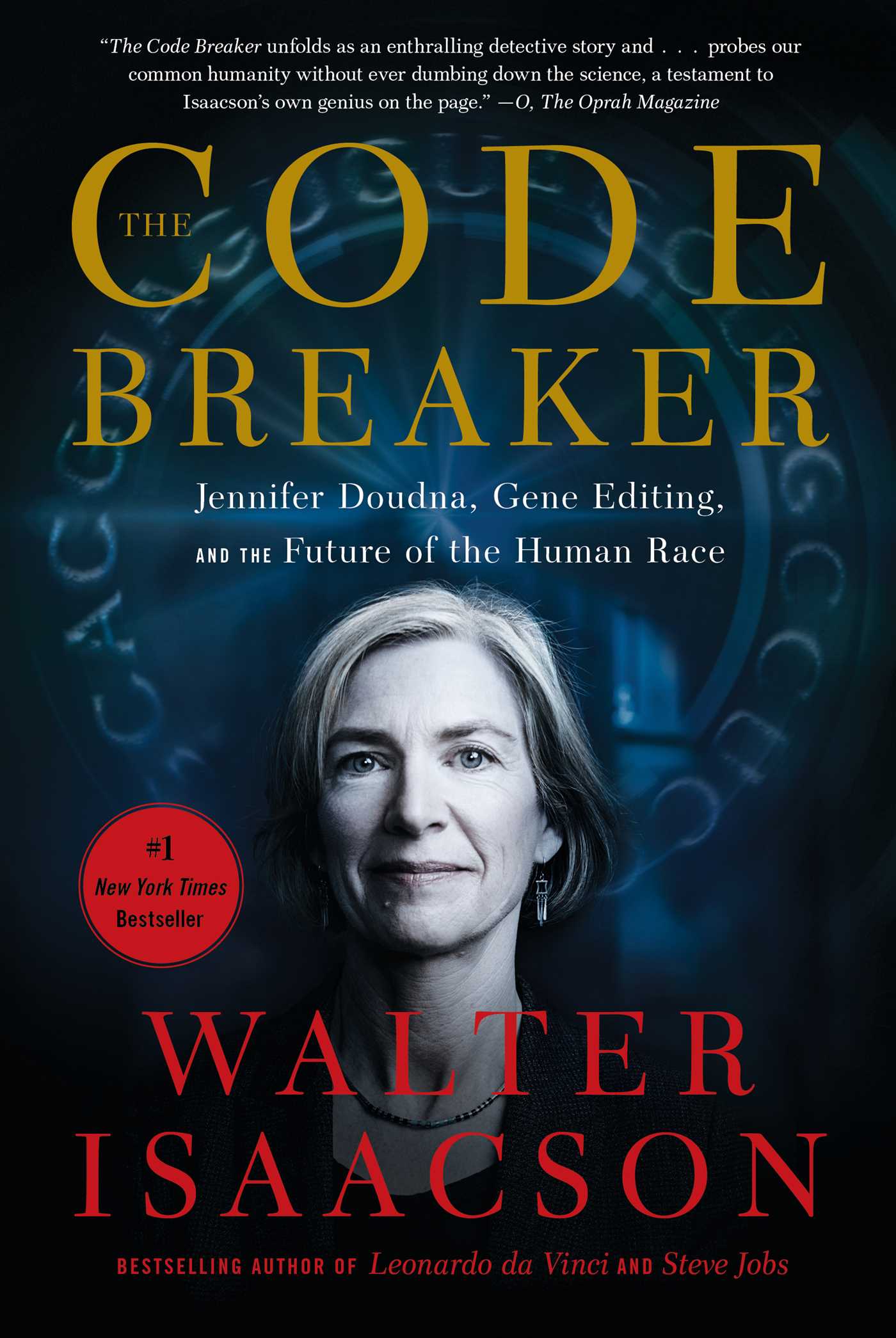 race to develop CRISPR, discusses one of the strategies many bacteria have to defend themselves from viral attacks, in which they attack certain viruses that attack them, after having penetrated the bacteria’s membrane, locating particular strands of the virus’ DNA, removing them, and cutting them into bits, destroying the viruses ability to replicate. Scientists have since developed this strategy into a viable and valuable tool for doctors to use in curing and healing us when infected with particular viruses as well as finding and removing defective strands of our own DNA and then ‘substituting’ healthier strands of DNA in their place. Isaacson builds this ‘story’ in the form of a biography and an examination of the politics and science of developing this as a technology.
In these two cases bacteriophages (viruses) and the bacterial strategy of CRISPR, we have come to a clearer, and more complex understanding, of health and how an organism maintains itself in a dynamic world. All of these advances have only been possible with our commitment to scientific experimentation and the increasing understanding that all of life, including human life, share much of what is essential. Through the study of E. Coli, fruit flies, mice, frogs, rats and, to the degree allowed by law and ethics, humans themselves, scientists have made advances in learning, that we as a broader population, with our relative ignorance of science and biology, are currently in danger of rejecting.
My book choices are generally very intentional, but sometimes, unexpectedly, a particular title catches my eye and in reading it, I find alternative perspectives and connections that those other books did not explicitly consider. I’m going to add a few thoughts from a book by, Michael Easter, “The Comfort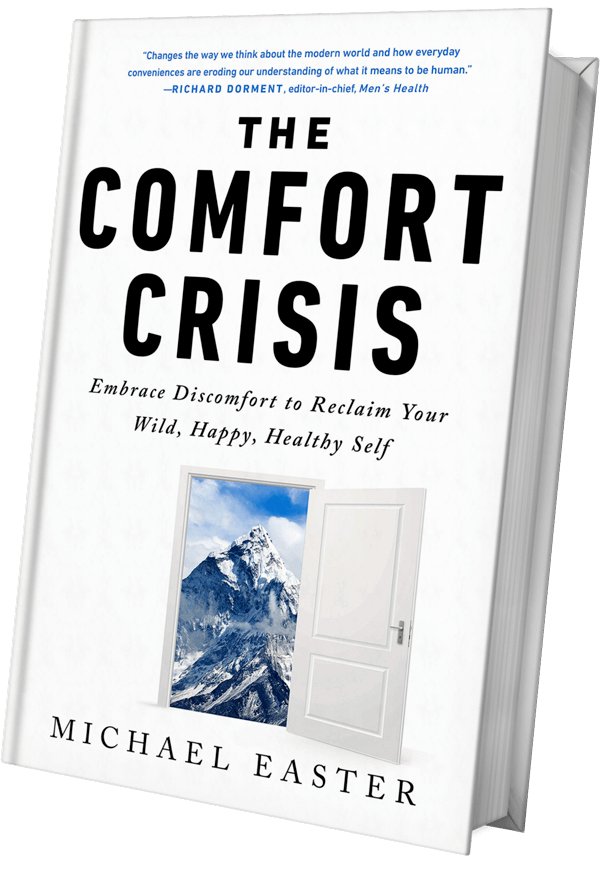 Crisis”. The author is neither a scientist nor a medical doctor, but he raises the issue of human evolution in a kind of critique of contemporary western culture, how in our recent obsession with comfort and ease, we have, biologically speaking, moved rapidly, and without too much self examination, away from the conditions of life in which our species evolved. Health and function are very closely related and over the course of several hundred thousand years of our becoming modern Homo sapiens, the bodies of those of us living in the modern western world are, for the most part, no longer confronted with the daily challenges that once shaped our species, unless we step outside of the paths offered and sold to us by the dominant culture. This is an issue of ‘fitness’. Not in the way that today’s specialized athletes are evaluated as fit or not, but in the biological sense. Biochemically. Metabolically…even psychologically. Our lives today, in the western world, have become easier, less challenged in comparison to those in effect as our species evolved. We have been sold the idea that this particular path is ‘better’, but is it? What our bodies once were regularly required to endure, they no longer have to. If you are a gardener, consider how when we introduce a new plant, we must be considerate of our growing conditions, especially when the introductee, comes from a different region of the world, with different conditions. What the plant cannot withstand, the Gardner must then protect it from, if it is to survive. As humans we have technologies available to us today which allow us to adapt our conditions to our needs, desires and demands. When doing this we can easily cross a line and over which our own health begins to decline. Easter points out that our decision to do this demands that we reevaluate our choice, a choice we may not be aware that we’ve made, and consider a ‘course’ change.
We live in climate controlled buildings, travel about in automobiles, sit in supportive chairs for many hours everyday, sleep on comfortable beds, rarely go without a meal and when we eat, often consume energy rich foods, foods that provide far more energy than we can ‘burn’ in a typical day. Our bodies, adapted to inconsistent food supplies, once driven by survival level hunger, generally aren’t at all today, but we retain the strategies and processes that evolved with our long, far more ‘difficult’ formative conditions. Our metabolism and internal chemical signaling that for many thousands of years served us well, in an increasingly large portion of our population, is now leading us down a path which is resulting in more and more of us becoming inactive, overweight and increasingly obese. As a result this is causing us previously rarely experienced health problems.
Easter, uses a lot of pages to illustrate our decline in activity and the necessary physical stresses they once provided us. Athletic trainers understand that fitness comes from a balance of activity/stress, with rest and proper nutrition. Our physical bodies require this and, he argues, that we can benefit, even psychologically, from not just regular movement, but from physically ‘testing’ ourselves and, in that process, testing our mental limits and coming to understand our true limits. In this process we become more actively engaged often discovering capacities we previously did not see to be within our reach. In short, we grow and gain increased physical and mental competencies.
Our bodies contain a ‘stew’ of chemicals and hormones that regulate our internal functions and these are directly influenced by the conditions we live under. We evolved over many thousands of years as hunter/gatherers. Anthropologists, physiologists and others point out that we evolved to walk and carry, to track and walk down game, to find and collect essential foodstuffs.
While other many other organisms, have been stronger and faster than we are, we evolved utilizing these capacities. We didn’t rely only on our brains. We walked upright, could survey the landscape and, our arms and hands ‘free’, could carry what we needed. We were complex ‘beasts’ of burden, with a developing capacity to devise technologies, tools, that enhanced our abilities and eventually, others that we had never possessed. We could plan, analyze, remember, calculate and developed our endurance. We became intimately and essentially engaged with the landscape within which we moved and sustained us. We moved to the food and either consumed it there or carried it back to our ‘home’…for countless generations. We moved ourselves and what ‘homes’ we might have, physically, on our own. We were built for survival and endurance, toughness. Biologically, we also evolved, a kind of governor, a limiter, so that we did not unnecessarily expend ourselves and so threaten our individual lives. We could conserve a reserve and draw on it when needed and we could do this thoughtfully, planning within our known limits, and trust that we had the reserves to push past that point if needed. This was built into us biologically, biochemically. Easter isn’t arguing for a return to hard times and starvation, but he is calling for an examination of ‘how’ we live our lives.
Today we have largely moved away from that. We seek out comfort and leisure, are often disconnected, in a direct sense, from our own survival, and our bodies and minds are paying the price. We avoid boredom and fill our days with distraction and entertainment instead of, as he lays out, taking advantage of these times as opportunities for self examination, for creativity and problem solving, as opportunities to explore and understand that place one finds themself in…to more accurately ‘see’ the place and our’s in it. ‘Boredom’ once served as a prod to action.
Today, our bodies, having evolved to move, generally don’t, except for those times when we might go to the gym, go for a walk or a bike ride. Dynamic and regular movement is often not a part of our lives and days…we have to make time for it. Our lives, in this sense, are out of balance, our capacities rarely tested. We seek ‘contentment’, but many today are beginning to see that as a little empty when our lives are without challenge, when we miss opportunities for problem solving and creativity. Being ‘entertained’ leads only for a desire for more, away from self, opportunity and community. More and more we have chosen passivity and consumption, not activity and engagement.
Easter goes further explaining that in our preference for comfort and abandonment of regular physical engagement, our biology itself suffers. Our bodies are normally within a continuous state of repair, of cell replacement. When physically stressing ourselves, our bodies undergo a process of internal assessment. In a way similar to how muscles are strengthened, their cellular fibers tested and stressed, replaced in a manner that strengthens the tissue, so too do many of our other tissues, accelerate their normal rate of repair and replacement. When our bodies remain in longer states of low activity, lowered stress, the body tends to retain these older, ‘weaker’, cells and the health of the individual, its ability to respond to future stresses, is reduced. Many of our tissues are self repairing. Some are not and we carry their cells over our entire lives. The health of these tissues and organs, like our brains, are then more dependent on the overall health and functioning of our entire system. As our levels of health decline, the performance of our organs do as well. Other authors have described how our skin, our intestinal lining and blood, continuously replenish our cells, our entire intestinal lining replacing itself every few days as it deals with that which it can’t use and extract what it needs from our food. In this case the quality, amount and ‘type’ of food matters. Like our bodies, every tissue, every organ, can only tolerate so much stress. Physically testing, the regularly testing of ourselves, within limits, allows our bodies to maintain themselves in a higher state of readiness, of health.
We are not only our biology, our basic survival needs. Our internal, biological lives, our growth, metabolism, our capacity for self repair, our physical selves require that we engage with the world directly. We are not wholly our own. We exist as a complex of nested communities, internally and externally. We are our relationships. We live as communities. Contrary to social media and marketers, we cannot buy ourselves a good life, nor, reflecting on our current travails, can we ‘steal’ it from others. It must be lived fully, engaged with the life around and within us, immersive and complete. Health is not just an absence of disease. It is an extension of the full expression of ourselves and that simply isn’t possible living apart, isolated, separate, as if under a state of siege. It cannot be acquired at the expense of others. Health is a dance. All, everyone, is a participant to be considered, supported, valued. Decline and death are a part of that and even in death we have our roles to play and, like the rest of it, we should approach it courageously and respectfully. It is said that all lives end in tragedy, but that is softened by living purposefully and respectfully. Fear and regret do not serve life. Rather life requires commitment, engagement, courage and a hunger to live our gift fully. Doctors will never find a silver bullet to cure all of our ills, but we have choices within the limited margins of our individual lives, to fill and enrich them, to remain as vital and healthy as we can with our always limited gifts. Many of our ‘ills’ are brought on by our own actions or the lack of them. While our biology is an undeniable element of our lives so too are our larger relationships with the world around us and our many communities. The ‘health’ of each of these is dependent upon all of those of which we are a part.
 GardenRiots