
 Ben Goldfarb’s, “Eager: The Surprising, Secret Life of Beavers and Why they Matter”, is an excellent model for other authors who write on ecology for the interested lay public. It is also an excellent entry for the novice into the world and thinking of ecology. As in any other ecological examination of a species, Goldfarb tells us about the roles and relationships the beaver has in their particular landscapes, how they fit in. In doing this he tells its history, that is, its historical role in the lives of us humans, and we in its, alongside those it shares intimately with the other species of its biotic community. It is a book very much about this important animal’s relationships, and, by extension those of our own and every other species on the planet. The beaver’s, or as the author also refers to them, the Castorid story, (the latinized name of our North American species is Castor canadensis, its old world counterpart, the other species, Castor fiber) is closely linked to our own. We, as the ‘dominant’ player in our landscape, have overlooked the beaver’s pivotal role in the world of water including the rivers, streams, ditches, ponds and seeps that ‘water’ the desert. Beavers were essential in the historical landscape and now, in their absence, our landscapes are often very much diminished. Wildlife, and even farmers and ranchers, who have often vilified them, are slowly beginning to understand the benefits their presence can provide, benefits that far out weigh any negative impacts they bring with them. People are, however, stubborn with long and selective memories. It is not easy for anyone to let their misconceptions go and accept what you have always rejected as patently false.
Whether you are interested in beaver or not, this book offers a wonderful ‘case study’ of a beaver’s ecology. Goldfarb describes the beaver’s world and their place in it. He gets the reader to think in terms of roles, networks, relationships and all the complexities which go into any healthy landscape and an unassuming rodent’s place in the world. There are helpful lessons here which we can utilize when considering any native community. It isn’t just about the details, laid out for us here, Goldfarb is also showing us ‘how’ we need to readjust the way we look at any place and its complementary biotic community. We have been far too quick to minimize the importance of any species that doesn’t appear to directly serve us. As role players we, and by that I mean all the members of a community, including us, play essential roles in the health and well being of the places in which we live. It is in our forgetting, or rejecting this, that natural biotic communities decline and collapse around us. While biologists widely regard the beaver as a keystone species essential to its community, we ourselves are powerful agents, with the ability to destroy, or should we decide, to preserve or steward the return of far healthier communities around us. Beaver, as Goldfarb tells us, are unique actors in their communities. They possess an inherent capacity to engineer and maintain healthy communities that we could learn from. Too often our own efforts are over engineered and rigid, two qualities that often doom our efforts from the outset, which beaver have naturally learned to avoid in their own work in the landscape. Our own abilities are put to best effect when we recognize the value and input of all of the other actors including our Eager Beaver. But first….
I got my first degree in sociology, the study of the relationships between people, the social ‘agreements’ and structures whereby we interact with one another, loosely bound, but with a degree of independence. Sociologists look at this methodically and group these social rules, structures and familiar protocols, they refer to as social institutions. These permit and support group interactions, define common ground, which in one way or another are shared amongst the members of the group. We can quibble as much as we want about which might be best or the most effective, but in the end, these institutions are central to our lives and the group, in their use of them, become one with them, shaping our decisions, often causing us to question those of other groups. These differences give rise to cultural differences and prejudices and conflicts when members focus on what is different rather than what is shared. Regardless of our ethnicities, our social ‘class’ or where we came from, we all share these and it is in trying to rank them where problems arise. These are the patterns of relationships which we humans form between one another.
Sociological institutions are organized, enduring systems of social rules, norms, and relationships that structure society, provide stability, and provide a set of rules and expectations so that we can fulfill essential human needs within the group. They shape individual behavior, values, and interactions, operating as the fundamental building blocks of social structure. In other words, members conform to them, and in doing so, become part of the group. We are born into them. As we mature who we are and what we become is powerfully shaped by them, not determined, but strongly influenced. When we adopt other expressions of these shared institutions, we can come into conflict with members, especially when they expect us to conform to their particular set. These include the family, education, religion, government, economy, healthcare, and media. Societies, organizations, tribal groups and others may define each of these structures differently and assign varying value to them. Put a group together and they will ‘come together’ by generally adopting the institutions they came from, even when the individuals are all personally unknown to each other. We carry these institutions with us. They aren’t consciously adopted, and as institutions they continue on after us. They comprise the common, shared, social structures, glue and lubricants from which social benefits arise. We may be individuals, but we are far less alone than many tend to think, and our lives themselves, are far more precarious when these crumble or fall into disuse. These are nearly as central to our existence as is the air, water and food that we must consume. This is the social function of human relationship.
All other organisms have their own set of ‘social’ rules which guide and support them through their lives, in addition to those biological imperatives that tie them to their immediate environment. This is not something for humans. We share this with them. A major difference between human and other animal social behaviors how we can flex and focus the group’s power and the technologies which arise through the mechanisms of our far more complex economies. This has resulted in our greatly increased global ‘reach’. Our personal landscape has thus empowered and technologized, expanded around the world to meet our needs/desires, making that ‘landscape’ upon which we depend, so large that we can never truly understand the costs imposed by our collective demands. Our demands have thus grown to be unrestrained. In this way our personal contact with ‘our’ world has shriveled as the scale of the engines that power our economic and political institutions become incomprehensible. Our ‘place’ has been rendered unknowable. We are so far removed from it that we have lost any sense of limits and dependence. In our world today we have come to expect that all things are possible, even deserved. The earth now belongs to us and in its unknowability has become limitless, a bank from which we can endlessly withdraw, without ever worrying about the balance in our accounts and the work that must be done to maintain them. That the world is without limits, is of course nonsense. None of the countless other species have such expectations nor the power to pursue them.
My particular emphasis at the U of O was on ‘community’, those social rules, norms, and relationships, which operate within human communities, towns and cities. Collectively these historically resulted in civil behaviors, a shared economy and created a community identify. something to which we belonged. We belonged to both people and place. These relationships allowed for the sharing between members. The only ‘ask’ was for our mutual acceptance of the community’s rules and norms. Members are then ‘of’ us. We in turn accept what is demanded of us, including the limits of the community and the resources connected to our place, so that we might enjoy the benefits they have to offer. It is important to remember this, those benefits which they have to ‘offer’ us, not that we might take. Communities can extend these ‘agreements’ to other communities with which they are in relationship, whom they trust, and in this way expand the range of goods and services available to them while also increasing their resilience, their ability to withstand perturbations. We belong, and these arrangements remain in placed, at least until these ‘ties’ break down, and community begins to disintegrate along with the institutions we share. Human community members take on different roles that serve to meet both their own needs for survival and the larger needs of the community, so that both might continue in a healthy and vital way. Communities possess economies through which members transactions can occur without undue stress. Ideally all of one’s needs, and those of others, can thus be met, as long as the needs and limits of ones place and larger biological community are respected. Economies do vary, as do their performances and they achieve these ends more or less well. We may consider our economies and political institutions, where by we govern ourselves, to be superior to the tooth and claw economies of other animal species, but which one is a better ‘fit’ for the biotic, all inclusive, economy?
Problems arise for any community when relationships between members become unbalanced, when some are favored over others. Communities can shape the rules by which communities operate, through the process of politics. This will always be a dynamic system and it is all dependent on our shifting definitions of community, what it is and what we expect through our participation. Things can go sideways in a hurry when expectations are skewed and particular members, or collectively, populations within them, are favored over others. Humans, with our capacity for complex social behaviors, are far more likely than other, less socially complex species, to push the process in our favor, or what we perceive to be our favor in the short term, the group, the community, suffering a barrage of inequities and injustices along the way.
Healthy communities, in this sense, are inherently more just and democratic. Unhealthy communities divide the benefits of the community, its wealth and power, structurally, so that they accrue to the favored group. Unhealthy communities, in the process, must expend an ever increasing share of its resources maintaining such a system, as mutual consent is weak. In such cases, to maintain the disparities, the community spends ever more of its resources, and its political capital, policing its members and manipulating them into compliance, as well as on attempts at environmental restoration of sites devastated by businesses which have been given more or less free rein, shunting costs on to others, while pocketing more profit and increasing their power. The ecology of such human communities, is in this way freed of its connection to place. The majority, in these skewed economies, receive little benefit in this disproportionate consumption, of goods and services. They suffer additionally, as the health and well being of other species are sacrificed to a limitless economy. In such a system the majority becomes a poorly protected class, and they find themselves relegated into lives of decline.
Ecological thinking is generally reserved for ‘animals’ other than us, how ‘they’ fit into the puzzle of the world around us. When we do discuss our relationships it is within the context of sociology, or psychology at a personal level, which is as pointed out above, limited to our affairs with members of our own species. When we discuss our relationship with the living world around us, with other species, it is as actors, shapers, disruptors. We, again, are exceptional. Privileged beings. Our tendency is to consider ourselves outside or above nature. Animals live in relationship with one another, that is ecology. These limitations of thought do us, and the entirety of the animal world, a vast disservice, in addition to being wrong in a fundamental way, further minimizing what we and all species share with one another. Ecology, generally classifies our interactions with nature as disturbances, in other words, ‘unnatural’. We are only rarely considered in ecological terms in our human role as partners in the unfolding and maintenance of our larger biological community. Simultaneously our sociology has erected another barrier sealing ourselves off from ‘our’ side. almost never considering are relationships with other species members…and, in this omission is the root of our downfall, our ‘threat’ to the world.
The concept of human exceptionalism, runs rampant, leading us into the decline of both the human community and the larger natural communities of which we are a part. We really need to get passed this if we intend to survive. In ecology, the unlimited ‘success’/growth of any population, inevitably ends in a crash of that population. In our case, with our numbers and capabilities, this could include the entire community or world system. On a limited earth, with a human population of over 7 billion, there is literally no other place that we can move to, to begin the consumptive boom and bust cycle again. As I said, sociology and ecology are linked and our misunderstanding of this can’t last. Our insistence that social and biological relationships are separate and unrelated is wrong. Social behaviors are extension of what many consider to be a separate biological reality. This is very much like our insistence that individual organisms ‘end’ ‘outside’ of our epidermis. Ecology, properly understood, show this to be incorrect. Genetics, and our skin, do not define us as discreet individuals. That ‘belief’ is in error. Just as our internal gut biomes, are composed of likely billions of ‘independent’ organisms, our external relationships are just as integral, if we would only consider them for a moment. Our connections with each other can be differentiated only by the use of very much human contrived measures and standards. Such differentiations do not make them real. They are human constructs.
Maybe this would be easier if we dropped the qualifier ‘social’ and just spoke of the relationships, the connections, themselves, simply as being of different types. The interactions between members of other species are still modulated in some way. They live in relationship, as they do with the other species which either support them, ‘test’ them and even eventually consume them. This is the way of life. Other species lack our particular social complexity, and this limits and goes to defining their relationships with their surrounding world, just as ours do ours. Ours permits us to escalate the power of our interactions via intentionally directing our individual powers and capacities into a unified, singular, approach, often toward a goal of our own making, although it still serves a basic need, indirectly. Our actions are in this way socially focused on group efforts. This is a political, organized action, distinct from those of an individual working independently to meet one’s survival needs with respect for the source of that same person’s continuing life. Without this added social organizing our capacity, our impacts, would be more variable and our impacts more dispersed, which would in turn limit the degree of perturbations we can impose on the community and landscape. Our impacts would be more diffused. Such is the way of other, less socially coordinated species. While the corrections induced by such ‘wild’ species’ may have individually life ending impacts, the species itself, and the community, will survive, largely intact. With our super charged brains, our emphatic insistence on personal liberty above community and relationship, and our technologies, we can push the ‘needle’ much further. The correction that follows, may be delayed by the inherent resilience of a healthy functioning system, our own structured mitigations and adjustments, but should we continue along the same consumptive and monolithic path, that collapse will be inevitable. It is in the nature of complex organic systems to be so. Some argue that one of humanity’s defining characteristics is our tendency toward hubris….That is a tendency, not a fact, of our existence. We still possess the capacity for choice and our chances are much better when we make ‘informed’ choices.
Other species live far more directly, enmeshed with the world around them, upon which their lives depend. While we, with our far larger capacity for complex social behaviors, have used them in ways that distort the fact that we to remain dependent upon the physical and living world with which we are a part. This larger ‘biotic’ community and its direct and essential relationship with its ‘stage’, the ‘abiotic’ structure and conditions in which all are ‘set’, are often dismissed or at least diminished by us as we barrel along. We do this, ultimately, at great cost to ourselves and ALL of the other members of the earth community. All things, including us, exist in relationship to each other. Forgetting or ignoring this puts everything at increasingly greater risk. Our insistence on our own ‘exceptionalism’ doesn’t and can’t ever change this basic fact of existence and dependence.
We humans, at least we ‘modern’, western, thinking humans, have a tendency to sort the world into groups and categories that serve our own expectations, while from an alternate perspective, they can appear quite arbitrary and cause us to make ‘wrong’ decisions, valuing one thing over another accordingly, in ways that ‘nature’ would not. We put a disproportionate ‘value’ on what we choose while undercutting, even sacrificing, that which we, at least for the moment, consider lesser. In this way with our exceptionalism, our technologies, our readiness to extract what value we can to convert to our profit, while discarding and diminishing that which we don’t currently value, we plow full speed ahead, indifferent to a world we make little effort to understand.
The studies of sociology and ecology share a lot. Both study the relationships which permit, even support, the existence of select communities. Both entities, human and biotic communities, are nothing without the relationships which define them. While a close examination would reveal our unique qualities, the fact is that we still wholly exist as a part of the living world…all of it. We are groups of, related, and necessarily so, individuals. With our complex of relationships comes dependence, a dependence which serves, even permits, the whole, in such a way that members become greater than the simple sum of their parts.
Human communities should be understood to exist as a subset of the larger natural biotic community, just as are the patchwork beaver communities along a stream, no matter how stridently we attempt to separate ourselves from them. We are ‘of’ the same processes of natural selection that ‘birthed’ the entire world and we can only exist within the limits it, ultimately, imposes upon us…no matter how emphatically we might insist otherwise. The idea some have that when this earth is spent and in collapse, we can simply move to another one, is an ignorant and selfish one. Create the complexity of a supportive, healthily functioning, ‘new’ earth on another planet, when we refuse to consider how to consider our own role in the demise of this one???
If you drew a Venn diagram (you remember those from grade school math class), the human circle would exist entirely within the all inclusive biotic circle. Examined individually in their parts and function, each organism, regardless of which species we may classify it as, shares much with all others. It is only in our drive to differentiate them from each other and ourselves, that they stand alone. While we may define each individual as unique, each with its own particular genetics and expression as it responds to, and is shaped by, the conditions within which it lives, including all of the communities of which it is a part, we will find that we are all far more alike than we generally care to admit, and this ‘likeness’, our relatedness, cuts across any divisions we might make, including species.
___________________________________________________________
Ecology is the study of relationship, of how an organism, any organism fits into the community in question. It is the study of complex systems, communities which much like an individual itself, are asymmetric, organic structures, that exists out of balance, in a state of disequilibrium, in constant flux, degrading/falling out of balance from one moment to the next, continuously, effectively ‘saved’ by being ‘kicked back up the energy hill’, as physicist Jeremy England puts it. In our human case, this is the result of the incomprehensibly large numbers of processes and chemical reactions going on in any given moment within our several trillion cells, internal functions strictly regulated as ‘we’ conduct a continuous throughput of an appropriate scaled and form of energy through each and every cell. This throughput of energy animates an organism’s structures, via its internal functions, which allow it to grow, repair itself and produce its succeeding generation on into the future. This same process permits our ‘social’ engagement with those others of our species and form similar relationships with other species so that we, and those who follow us might live…the community, the complex larger system, continue.
While strictly biological processes sustains an individual and its lineage, in an energetic, physical and chemical sense, an individual also requires the continual support provided by the ambient conditions of its environment, and the communities to which it belongs. Each individual’s actions go toward supporting or degrading both its biotic and social communities. As no individual can survive purely on its own, not bacteria, not fungi, not plant, not animal, this social aspect is central to the lives of every single organism. Our community serves in a way analogous to the constant flux that continues energetically and chemically within us, a community comprised of the literally billions and billions of organisms, which exist at every scale in and around us, each an individual, in a freely choreographed harmony of actions, which collectively set the stage for us, while we in turn, play a reciprocal role in their lives. There is no one individual in that community which is absolutely essential to another’s survival, rather, it is the collective effect of them all. Each member provides a range of services that will have echoes which are primary, secondary, tertiary and on down the line. Impact is impact. Richness, complexity, increases resilience and opportunity. It is a system on which we and all living beings depend and it has been in if effect for billions of years. When these are out of balance, as complexity is lost, we will feel their effects either directly or indirectly. We need not understand why, but they will impact our lives. This is true for EVERY species. Each individual is a necessary role player in the life of its shared community in a positive or negative sense.
In ecology the emphasis of study is on the community. The individual is not the point. The same can be said sociologically. Each is a role player and, as such is limited. In ecology while we study individuals for insights, all will eventually, and necessarily, pass. It is the process of life that matters, not the ‘parts, not the individual, that is of ultimate value. Having said that, each individual, plays a necessary role. It is very dangerous to rank them or suggest that some are expendable. Difference does not correspond to value. We may recognize a ‘keystone’ species of a particular community type, but that does not mean that ‘lesser’ players are expendable or unimportant. Perhaps it is our language itself that is at least part of the problem. We haven’t the words to properly describe the world. Perhaps it is the limitation of any language to fully discuss this. What matters is the vitality of the ensemble, their relationships, how vital and responsive members are to each other. When doctors examine an individual they are assessing the individuals capacity to maintain homeostasis, to remain in a vital state of health. Are we able to maintain our functions within livable parameters given the current condition of our body and the conditions within which we live? Are we healthy?
Communities can be assessed in the same way. When they/we can’t continue ‘performing’ above a critical ‘threshold’ level, any complex living system will collapse, catastrophically, just as any individual will. Homeostasis is possible only within narrow limits. This is normal. Small perturbations to the system will result in correspondingly small ‘corrections’, if the system possesses the capacity to do so. Large perturbations, in large corrections, if they are survivable. The quality of resilience of any complex, organic system, is sustainable only if conditions remain within a survivable range. Those parameters vary and will be unique to the community and its set of conditions.
Stasis is neither possible, nor adequate in describing the health of an individual or its community. There is not a fixed set of measures which can fully describe the state of health. Complexity, includes adaptability. A healthy system may exist across a variable range of ‘states’, a different ‘mix’ of species, different numbers of each, again, within limits, as long as they possess the responsiveness and needed resilience to remain a healthy individual/community. Stability also implies a certain fixity that exists only in death and even then an individual begins a rapid process of breaking down. There is nothing that is static in an organism. Everything is in flux. The pattern remains. The body, its manifestation, exists in a perpetual state of change. Life isn’t simply on or off. It is full of qualitative ‘gray’ areas. Just as we each ride a knife edge between life and death, throughout our entire lives, so does a community. With inadequate support, whether social or biological, communities will collapse.
Healthy communities, just like healthy individuals, have a greater capacity to successfully respond to serious challenges. The main difference is that as role players, individuals die and are replaced. In this replacement, communities may continue indefinitely, unless a challenge is too big for it to respond to, comes along. All remain only as long as they can stay vital, dynamic, responsive to their environment and their members. Change is inevitable and constant, whether we are aware of it or not, influenced by countless factors. The success of any such complex system over long periods of time can be assessed by its capacity to respond. This is as true, again, for the individual as it is the community.
When change occurs to a community, normally it is slow enough that the process of replacement and natural selection can work, to select those species and individuals, which possess traits that give them a competitive edge, while simultaneously providing a ‘service’ to the whole. Life has never been solely about competitiveness. The maintenance of a healthy community is paramount. Change at the individual level has never worked this way. Birth, an interim period, then death, often sudden, always unpredictable. We get in trouble when we confuse individual and community life, their value to the whole and, ultimately the ‘purpose’ of the individual. In a healthy community a death is offset by the individual’s replacement, but not necessarily of the same species. The health of the community remains central.
The community while it may ‘flex’ and flow, often following complex cycles, the populations of its many members adjusting and adapting to the change, it remains with in limits and continues on. This process operates over multiple generations. As abiotic changes occur, these changed conditions, shift the selection mechanisms, exerting ‘pressures’ on members that lead to adaptive behaviors and select for better suited qualities in the members who remain. In the very long run, measured in geologic time, new species evolve to take their place while others exit; the communities themselves, making demographic adjustments to its mix, enabling them to reach a new balance in a changed world. When changes are large enough and happen at a pace beyond which species can evolve and adapt, populations are lost locally, extirpated, or when an entire species is so threatened, extinction events occur. The process, rebooting its community. In such cases landscapes and their communities can be radically transformed.
Any good book on ecology is going to focus on relationships. Life has never been just a question of biochemistry. (Dr. Frankenstein was on the wrong ‘track’.) Living organisms are not, although many people will often try to argue this, some kind of organic machine. Any organism cannot be reduced to inputs and outputs. Organisms, wherever they may end up in someone’s hierarchical scheme, are not interchangeable cogs. There are none that are ‘unnecessary’. We cannot continuously remove species simply because we deem them of little importance as if we were playing Jenga. Sure, a healthy, intact biotic community, possesses resilience, is able to make certain internal ‘adjustments’ and continue on, that is life, but when this happens, a community, is forced into operating in a compromised state. This state is less stable. Less resilient. More subject to failure., collapse. The more pieces/species you remove, the more you move it away from ideal conditions, the less stable the entire system/community, becomes. And, because these aren’t linear, mechanical systems, they aren’t going to decline linearly or predictably. The fact that a healthy community continues on performing within the tolerances despite compromises, just means that you haven’t crossed that threshold, that tipping point. In compromising the communities upon which we too depend, we are setting ourselves up for a catastrophic failure. Communities, just like any individual of a species, don’t simply decline uniformly when under assault incrementally and uniformly. They might appear to be okay…until they suddenly collapse.
__________________________________________________________
All of this is in way of introduction to Goldfarb’s, “Eager”. In, “Eager”, Goldfarb introduces the reader to the beaver and its relationship to its community, its physical environment and us. One of the problems that plague us as stewards/users of this world, is complicated by a phenomenon that Goldfarb describes and continuously circles around, ‘shifting baseline syndrome’. This is a concept that is important to grasp when we are confronted with the losses of species and the healthy, dynamic, habitats they depend upon, which we, ultimately, depend upon. It is essential to our understanding this if we are to ever solve this, our role and responsibility in the creation and solution of the problem of these continuing losses. The beaver is widely recognized by ecologists as a ‘keystone’ species, so its loss from a landscape carries much more ‘weight’ than would the loss of most any other species from the same landscape, but every such loss will reverberate throughout the community.
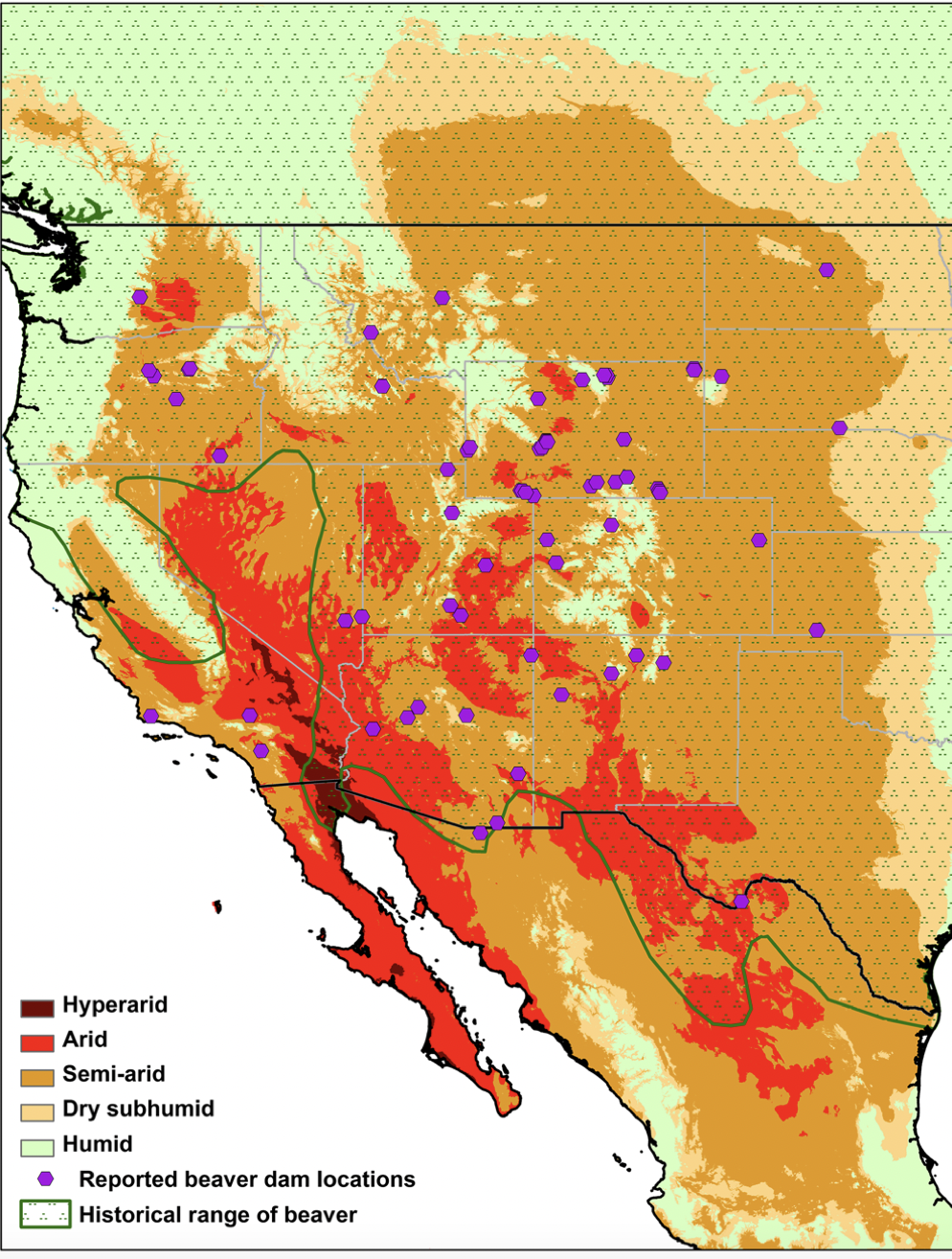
This map is from the article, “Ecology, management, and conservation implications of North American beaver (Castor canadensis) in dryland streams” by Polly P. Gibson and Julian D. Olden of the University of Washington, published online in Wiley Online Library, not from Goldfarb’s book. It shows the estimated historic range of the beaver in the arid West, with an overlay which assigns the broader moisture regime. It is important to understand, obviously, that beaver were never evenly distributed on these lands, but were where water was sufficient. It is also important to note that the presence of beaver colonies increases the availability of water and evens out its seasonal variability expanding the beaver’s range beyond what you might expect.
The loss of a keystone species, as the name implies, will result in a major population collapse upon its singular loss, and in this case, the disappearance of the habitat it created, resulting in a cascade of losses of other species. Beaver provide an indispensable ‘service’ to their larger community, without which, other species simply can’t exist. Beaver are the consummate engineers of an essential habitat and through their works, we too are beneficiaries of services of which we are often clueless. Much of this is due to the aforementioned shifting baseline syndrome. With the loss of the beaver follows a degrading of the habitat they created and maintained. The loss of species and environmental services that flowed from them disappears with the loss of their structures. We forget this. Or we come upon degraded landscapes and their habitats and simply have no idea what was there before. It becomes normal to us. We build our worlds on top of a degraded base and forever suffer the consequences. We might attempt to engineer our own solutions, solutions that meet our own narrow and particular demands, ignorant of what came before and its value; ignorant of what is required to create self perpetuating, sustainable systems on such landscapes. We pour money, energy and resources into these solutions, rigid and fixed as they are, and despair at what they then demand of us as we watch them fail. The beaver is ‘of’ such places. We aren’t, we deny our full role and responsibility in this and we do so insistently.
Beaver are consummate ‘engineers’. They specialize in the field of wetland ‘geomorphology’, the physical shaping of these landscapes. Goldfarb dedicates quite a few pages to describing what the continent of North America looked like before the slaughter and removal of beaver from streams across the continent. It is difficult for us to grasp this transformation because our own baselines, our reference points, are set decades or even hundreds of years after the extirpation of beavers from the landscapes we know. Upon their loss physically, hydrologically and biologically, North America looked and performed very differently. What most of us experience today when we travel across the landscape we see as ‘normal’.
What has been lost, we can barely comprehend. Written descriptions of the landscape from before their extrication, will always be inadequate for most of us to visualize what these landscapes once looked like, how they functioned. Those period descriptions which have survived, are few. In most cases beaver were long gone before photography became available to chronicle their decline and loss. Biologists and ecologists out in the field performing surveys were very few and they weren’t focused on communities. They were discoverers, cataloging and describing species broadly, the novel, the unexpected. Landscape painting fails us as well. For one thing there were few pioneering landscape painters and none among the trappers and mountain men who saw the unspoiled lands, and, whose actions lead to the beaver’s loss. Painting, as an art, has always been subject to personal and aesthetic biases. Painters, even the ‘realistic’ ones, portray idealized landscapes. What they chose to see. What they chose to include and emphasize.
Consider also that early American colonists came from a Europe whose beaver population, a different species with essentially the same capabilities, served as a keystone species in virtually identical habitats (Castor fiber) had already largely long removed. Early settlers often saw unfamiliar ‘chaos’ in the ‘wild’, natural, landscape upon their arrival in North America. Europe was at the time of their leaving ‘tamed’ around its villages, towns and cities. Wild nature was being ‘bent’ to serve agriculture and to meet the demands of people. Wild nature presented dangers; caused locals to wonder how it might better serve them. What few descriptions that do remain of North America pre- ‘debeavering’, describe the lush, unfamiliar and even chaotic landscapes, settlers sought to control, taming, rendering them useful as farm and field, for settlement and travel, to enable the commerce which drove them. And commerce, along with the hunger for land, drove the beavers extirpation here, commerce, turbocharged by the European fashion for a particular style of hat and the unique qualities of beaver fur, which made it superior to all others in the process of felting, a necessary step in the creation of these hats. Hats lead to their decline and financed much of the changes to follow in the wake of the beaver eradication.
Native people did not seek to control their landscapes in this way. They sought to understand the wildness that brought them all that was necessary. Theirs was an entirely different mindset. What looks normal today, has had the ‘wildness’ driven and beaten out of it. The North American landscape, overall, is much more limited and narrow than what existed previously, the wildness largely strangled out of it. An entire range of ‘wet’ habitats were thus dried up and lost, their soils later eroded away, often down to the very bedrock. Flooding became problematic and frequent. Meadow, pasture and farm saw declining water tables and with it the pauperization of species diversity. Domestic livestock suffered along with the wildlife and did much to contribute to the acceleration of erosion while creating conditions that were intolerable for the beaver’s return. Today, this is our baseline. We simply can’t ‘picture’ that which we’ve never experienced.
Goldfarb takes the reader to a variety of landscapes across North America and the UK, describing them, speculating about what they may have once been, before their ‘debeavering’, aided in his effort by those who’ve studied what historical records exist, scouring journals, and reviewing scientific studies and surveys, which often utilized soil core sampling, palynologists, scientists that study the pollen record, establishing what grew where hundreds and thousands of years ago, before the onslaught of change brought by europeans and sometimes before the arrival of indigenous people many thousands of years ago.
Pollen possess a structure resistant to decay and, tiny though each grain may be, each is identifiable to species. This, when conditions have been supportive over the long term for its preservation, provides a ‘book’, its pages layered one atop the other in the sediment layers, giving the palynologist a window into the past. This is not always possible, as very often, with the beaver gone, their transformative built structures weakening over time or destroyed by man, those once stymied and twisting streams spreading across wetland and meadow, then freed, proceed to accelerate in their downward movement, gaining velocity and power, eroding away the soil and landscapes with it, often resulting in steeper and deeper, incised streams cutting quickly down to bedrock, while washing away sediments that previously composed the rich soils of the meadows and wetlands the beaver’s activity brought about, washing the pollen record away in the process.
In contrast Goldfarb describes streams and meadows, wetlands and fields, mountainsides and deserts where resident beaver still remain, or cases where ‘re-beavering’ has been successful. In the latter advocates, researchers, ranchers and farmers are seeing just how quickly these landscapes can ‘self-repair’, often requiring little human intervention other than protecting the beaver and that which they are most dependent upon. ‘Beaver believers’ and cadres of agency biologists, geomorphologists and even a few converted civil engineers, are working at whatever scale they can, to reintroduce and support ‘re-beavering’ on sites available to them that have conditions most likely to support success. From there successful colonies can spread up and downstream accelerating and broadening their impact on the previously degraded and flood prone landscape…at least when property owners and managers are willing to let the beavers do their thing and modify their own practices that may be contributing factors in the landscape’s/habitat’s decline. What he presents is a history of the human/beaver relationship over time, the beaver’s decline and its struggles, given our relentless assault on them, up to today. With and without our assistance to repopulate and reclaim their former range, the work continues. Proponents and advocates understand that their success can never be complete, given that often times, potential prime beaver habitat, those same broad valley bottoms where we humans farm, ranch and live, will in their ‘developed’ state remain unavailable. The conflicts are hard edged and anti-beaver sentiment often runs deep.
Each chapter looks at the beaver issue from a different angle and the picture Goldfarb creates fills out and is, in spite of all of the problems arrayed against them, hopeful. Beaver have time and again demonstrated their resilience, within limits, and their adaptability to survive under what might first seem unsupportive, highly disturbed, often quite urban conditions. Their limits are surprisingly broad as long as certain limits of scale, water, food and materials are available, which they can build on as long as minimums are met, along with some protection from human encroachment, predators and limitations on ungulates, be they in the form of cow or elk herds, which can browse down the same shoots and stems the beaver depend upon. Large ungulates, uncontrolled, can also destroy stream banks through trampling and the resultant erosion that their presence can inflict.
To be successful ‘re-beavering’ require’s the participation, or at least the acceptance of the land owners, be they private or governmental. ‘Re-beavering’ brings with it a degree of ‘messiness’, wildness and a loss of control that many owners refuse to yield. As I’ve attempted above to emphasize, nature will forever be ‘wild’. Strict, rigid, narrow limits are antithetical in an otherwise ‘natural’ world. There remains a pervading animosity amongst much of ranching and farming communities. Goldfarb’s does not shy away from this. Beaver advocates understand that their’s is an extended process. While the beaver are amenable, efficient and effective, the humans around them whom they impact, are often not. There are success stories included in which these same communities, which once strongly opposed the rodent’s reintroduction, have softened their rhetoric and reactionary responses, even to the extent of having been transformed into outgoing proponents of the work. But always there is the counsel of those doing this work for persistence and patience. Meeting force with force never works.
Goldfarb describes the relatively rapid healing of several formerly severely eroded and compromised landscapes when the projects are thoughtfully considered and supported. Over and over again Goldfarb presents examples of the transformations and the impacts, both locally and downstream, as erosion is slowed, downstream sedimentation reduced along with destructive flooding, while at the same time habitat is restored at an amazing rate, ponds filling in with sediment and organic matter forming vernally wet meadows that support either wildlife or grazing livestock; long absent species often returning on their own, to these revived landscapes many of which have been denuded for many decades, fish, amphibians, birds and large game animals, returning, all of which had previously been reduced to nothing by lack of available water and food, the catastrophic trophic cascades of habitat loss, building back; while runoff is slowed and percolates into the ground supporting a more diverse landscape, evening out stream flows even through drought periods, the replenished ground water cycling with the surface water and stream flow in such a way that the earth cools the groundwater, which cools the surface water, insuring the lives of desirable fish populations. It is a remarkable community when allowed to function and requires, in many cases, little more than for us to get out of the way.
Goldfarb travels to and visits researchers and practitioners, out in the field, stream side and in wet lands, working with the beaver to enhance the conditions, and with human neighbors, devising and installing devices that won’t threaten the beavers continuing existence, and the benefits that flow from them, while protecting human infrastructure from damage and destruction. Time and again ‘believers’ run up against those who recognize only the potential damage a beaver colony might wreck upon their land, their infrastructure, completely resistant to a beaver colony’s potential of overwhelming advantages, including the cost effectiveness of letting the beavers do the work, work the owner would otherwise be continuously pouring money and resources into. Goldfarb meets with enthusiastic converts, who grudgingly agreed only after long opposition to the establishment of beaver on their property, who now exclaim the benefits their return has bestowed upon their property.
As a Pacific Northwesterner I noted the several projects in which Goldfarb goes into depth, that took place and hopefully continue here, as well as his inclusion of work being done in arid regions of the West, including the Great Basin region, where mountains join desert, abruptly, and the benefits of beaver returning to the watersheds, among other things protect and expand habitat for the Greater Sage Grouse, an iconic bird of the region, formerly native in much of eastern Oregon, Nevada, Utah and parts of southern Idaho, threatened by the fragmentation of its range and the loss of water, that many have attributed to the loss of beaver and their conservative benefits of retaining water, creating more places that provide the feed necessary for their success.
_____________________________________________
Again, this is a wonderful book. Well written with humor, full of characters you’d enjoy knowing and always with a hopeful view of the future, despite the many and considerable barriers in the beaver’s way. Thank you for making it through, for tolerating my attempts to join sciences, ecology with sociology. I’m not sure anyone else sees these links, but as I continue to read, study and observe nature, I see our tendency to divide and confine so much of the world as a process of self-blindering, putting us in the destructive and unnecessary position of literally not being able to see the forest for the trees. We are all trees in the same forest. This is a book for anyone interested in ecology, whether you care about beavers or not…although by the time you finish, you will!
 GardenRiots