

The massive fault block of Hart Mountain, Poker Jim Rim in the distance to the north. The gravel county road switchbacks up the more than 3,000′ beginning from the center in the distance here. From here this is how you get to Steens Mountain without doing miles of backtracking.
I woke up this morning to the sound of bird song…nothing else. There were Western Meadowlarks and a multitude of others, I’m sorry to say I don’t know, but beautiful and distinct. I was laying in bed, atop our truck, thinking about how rare an event this is for so many of us…not that the birds aren’t here greeting the morning every day, but that so many of us aren’t ‘available’ to hear them, sequestered away safely in our homes, otherwise occupied or, more commonly, the birds literally excluded from our urbanized and ‘modern’ places of residence, their own places developed/destroyed. Entire neighborhoods and cities excluding all but the most common songbirds and passerine species. Little quarter is afforded most wildlife in modern development…and that upon which their lives depend.

The sun setting over Abert Rim nearly 30 miles to the west, well beyond Hart Valley. Abert, another fault block mountain, slopes upward gradually to its high point and rim, which extends 30 miles north and south, the longest exposed fault scarp in North America. From here it is barely noticeable.

I sat at a picnic table here trying to pick out a viable route to the top, perhaps for another trip?
We stayed last night in a little campground, at the base of the eponymous mountain, on the edge of the Hart Mountain Antelope Refuge, that 280,000 acre reserve for an animal we almost drove to extinction. We’re in Warner Valley more than 3,600’ below the rim. It’s a flat bottomed basin made so by the deposition of eroded sediment over several million years. From here the water escapes only through percolation down through the sediments, clay and lava below, or via the powerful draw of evaporation in this arid region where annual evaporation rates exceed precipitation by four times or more….unless of course it is captured from the lakes themselves and used to grow pasture and hay. This is Great Basin country where it edges across the politically drawn southern border of Oregon.
For those who don’t know, this area is located in the far southeastern corner of south central Oregon, west of Steens Mountain, very close to the extreme NW corner of the state of Nevada. I don’t know what the current estimate is of the Antelope population here, but there are likely more of them than there are of resident humans (There are only 8,300 permanent residents in the whole of Lake County, almost exactly one person per sq. mile. In comparison Deschutes County, the most populous of those east of the Cascades with over 206,500, is crowded with 65 people/sq. mi.) Along with its remoteness is a harshness and beauty, a geology and flora unlike that which most Americans, even Oregonians, think of when they picture Oregon. This is Great Basin country, the land of the Sagebrush Sea and the surprisingly disruptive, and eruptive, basin and range landscape created by the massive faulting of the Earth’s crust here, accentuated by the 3,000’ depth of flood basalt which covered the area from fissures and vents near the present Steens Mountain around 15 million years ago. This is a landscape defined by its vastness and a topography which forces compliance. This is a land of relative climate extremes, not supportive of significant permanent human population. To live here requires us either to do so in strict and limited harmony with the land or heavily dependent upon the import of almost everything we require. It is arid, cold, hot, forbidding and beautiful all on the same day. This land makes emphatic demands on us.
-

- Looking south along the west face of the Warner Mountains which extend well into California.. Hart Mountain is the name ascribed to the single high point south and east from here, not visible.
-

- I hiked cross country to Poker Jim Rim east and north of Petroglyph Lake, this is the view down to the dry lakes on the valley floor below. This is looking north.
-
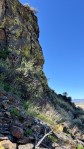
- Part way up the south face of the narrow opening into Degarmo Canyon looking out across Hart Valley.
Wildlife knows its place here and sticks to them wherever they might be. We are the interlopers here taking the few roads wherever, whenever we want. We’ve bent the landscape as far as we can to suit our demands, taking by claimed right the water and resources we value and depend upon. Anything outside of those ‘lines’ are expendable. Even doing this our hold is tenuous, non-sustainable and one day our occupation will end. That which we demand is exhaustible and the land and its life is lessened in our taking of it, but for now, here the sound of birds and the wind vibrates and animates everything coursing across the spare landscape. Even Juniper are widely scattered, huddled together where they can, their roots having found purchase, resulting in spare cover. The sounds so common to us living in the 21st century in and around the closely linked towns and metropolitan areas, linked by roads, railroads, rivers and coast lines, corridors through the sky, all for the trade on which we have staked our lives, are few, temporal or all together absent. You can stop on any county road, graveled, without worrying about oncoming traffic, even stopped along the paved Hwy 395, your vehicle’s engine off, you can sit in silence for several minutes, mid-day, waiting for an interruption. Business and its consequent pace matches the activity and pace of human endeavor. Plush, a ‘hamlet’, 15 miles from this campground, has gas pumps and a single market, serving the most local of needs of the area. The largest town is Lakeview, 55 miles from where I sit, with 2,200 people. Waiting and acting are personal, much less imposed by others. By road, Bend’s 100,000 people, its businesses and supplies, are 200 miles away. To the south and east there is nothing comparable until you get to Boise, and that’s over 350 miles by car to the east or Redding, CA, 235 miles to the southwest….Most of the noise here is personal, that which we bring with us or the sounds of a camping neighbor walking across the gravel to the pit toilet. There are only 8 spots in the campground here including that of the host. Other than us, everyone else is in trailers, campers and a single motor home. Thankfully, I’ve heard no generators.
My father died 3 years ago and I have his spotting scope. It’s missing a couple essential pieces which I haven’t yet located replacements…I wish I had it here. This site is Ideal for observing Big Horn Sheep on the ridges and cliffs above. Native here, they were hunted out, extirpated locally, and reintroduced from a population in BC. The exposed landscape of Warner Mountain and Poker Jim Rim were ideal for the Big Horns as they could readily observe their predators and nimbly escape them across the vertiginous and rocky landscape. That same exposure left them vulnerable to hunters with rifles.
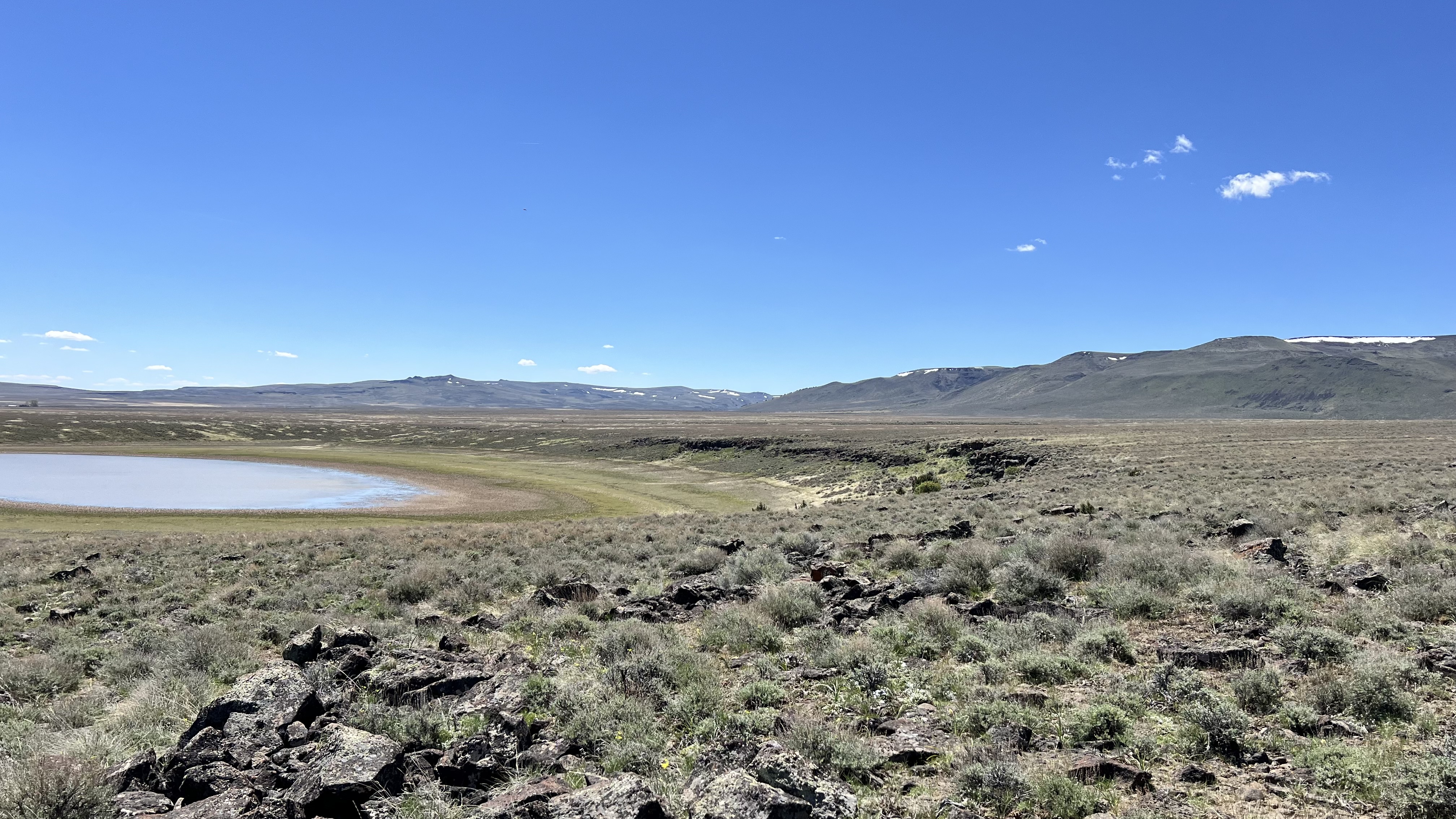
Looking south across Petroglyph Lake. To the far left, near the horizon, you can see the trees and headquarters of the Antelope Refuge. Roughly at the center of the picture is where the Hart Mountain Hot Springs are, just beyond the apparent ‘break’ in the mountains to the right.
Just as there is little to slow and divert the wind, the same holds for the view. This land is open. One sees the full expanse across the valleys and basins, the broad flat mesa like top of Hart Mountain. It is no wonder that Antelope are keen eyed and so fast. There is little cover for them, while ground hugging rodents proliferate in wide diversity various mice, rats and squirrels up to gophers, rabbits and Marmots. While bushwhacking I came across Badger holes with fist sized rocks in the excavated material. Despite all of the changes Man has made on these landscapes, in many ways, it still feels unaffected, unless of course one looks more closely at the details. Wherever our numbers intrude, in the campgrounds, along the roads and trails, at designated stops, at the hot springs up on the mountain, that is where our effects are most acute. We long for these places. We seek out their solitude, the wild, with its promise of relief from all things urban and modern, which deplete, frustrate, frighten and anger us. But our estrangement, our multi-generational absence from the wild, our chosen dependence upon the ‘comforts’ attendant to that same culture which dispirits us, all of the ‘things’ we too often bring with us, distracts and interrupts us from our experience and ‘practice’ in the ‘Wild’, our attempt to fill that ache and need we feel in our regular, adopted lives, where we too often ignore what ‘natural’ relationships are available to us nearby and in our own back yards, those places in which we live most of our lives. Our lives are too often inconsistent with actually ‘being’ in place, in relationship, with its freely available opportunities and responsibilities, the place developed, homogenized, patterned all too familiarly.
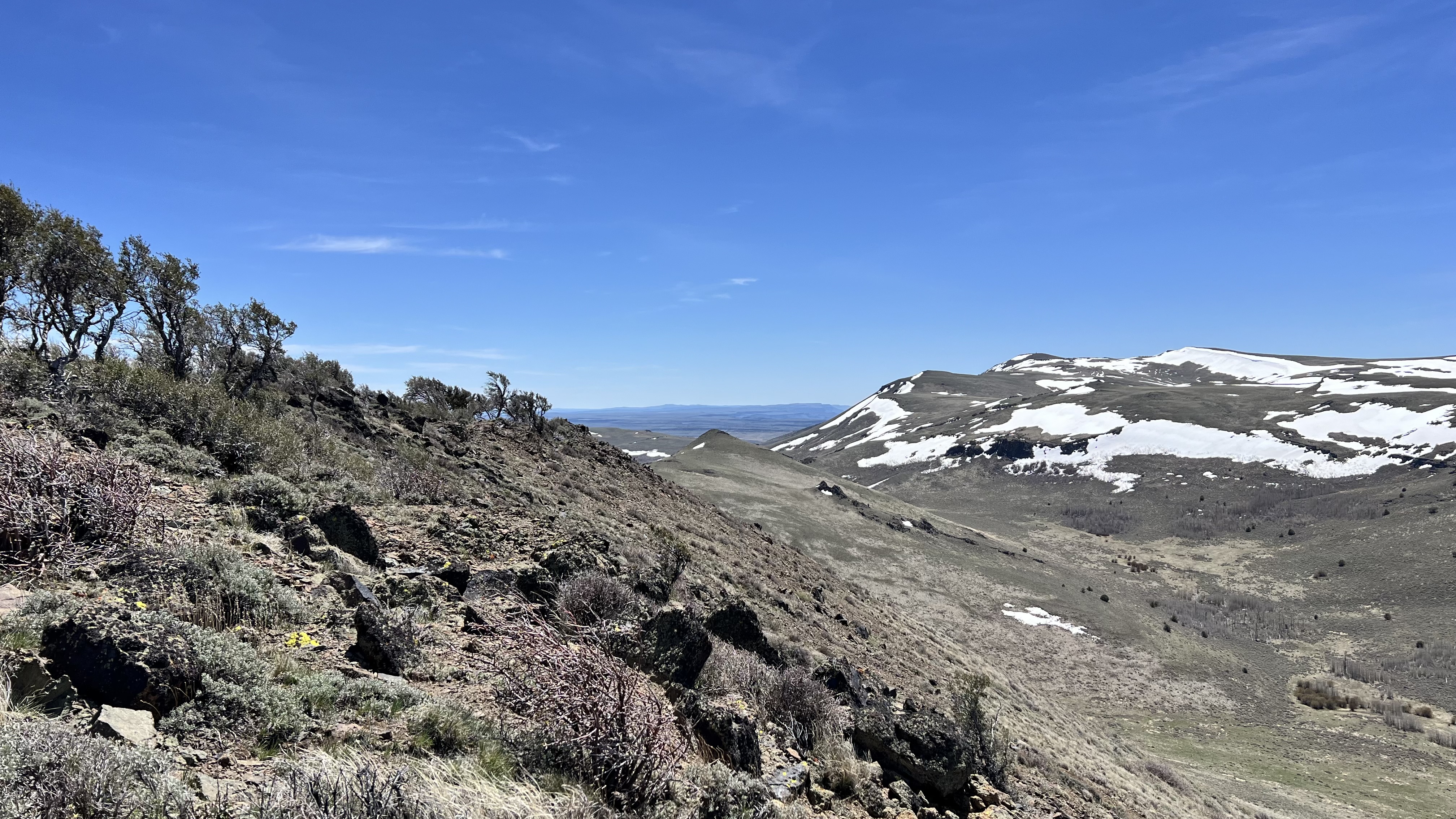
Looking across the broad upper bottom of Degarmo Canyon to the south. The top of the mountain looks much like a high, probably, 7,700′ elevation plateau, cut by the canyon before rising to the high point, the broad ‘peak’ of Hart Mountain.

Working my way down into Degarmo Canyon, looking westerly.
We have too often learned to see any place, as being there for us, without the corresponding and balancing role of our being in place ‘for’ it. By acting out of relationship with, our activities degrade the very qualities that drew us, that which we’ve sacrificed in the places in which we live, making room for the comforts and conveniences we’ve come to expect. The landscapes of our communities and homes, removed from nature, leave us with a gnawing hunger for that lost. Our escapes to healthy, intact, landscapes of wildness and beauty, which still possess this, are often tainted by that which we take, carry and drag along with us. We escape looking for beauty, connection and meaning, experiences that feel ‘real’, beyond what the market can provide us, which it consumes and transforms in the process extracting ‘value’ in its limited modern form
It is where people go then where damage accrues, when we visit ignorant of, or indifferent to, the ‘damage we may cause through our activities. Seeing a place requires more than just a windshield experience. The landscapes here are vast. To ‘see’ and understand them, demands something of us, our attention and time, that we get out and walk, struggle, sweat, shiver, thirst, survey the land to a find our path and route of return. We cannot go into them armored, protected with limited purpose and expect anything more than a cursory experience, an ‘I was there’ check off. Value is gained through experiencing the unexpected. If our experiences fit ‘comfortably’ within a box of our making, then there is nothing new or of real value in it. The world is vast. Experience can and must humble us, make us feel small and cause us to question our own understanding of it. We are estranged from the ‘wild’ within us and must work to refine our connection. It cannot be incorporated easily or even predictably into us. We, as a society, have largely banished the ‘wild’ from our lives, only to now be stricken by its loss, because with it has gone our connection, our relationship with it…and we are ‘wild’ as much or more than we are a product of culture and progress. When we damage ourselves in this way, we damage the earth and everything else, because all is ‘of’ it.
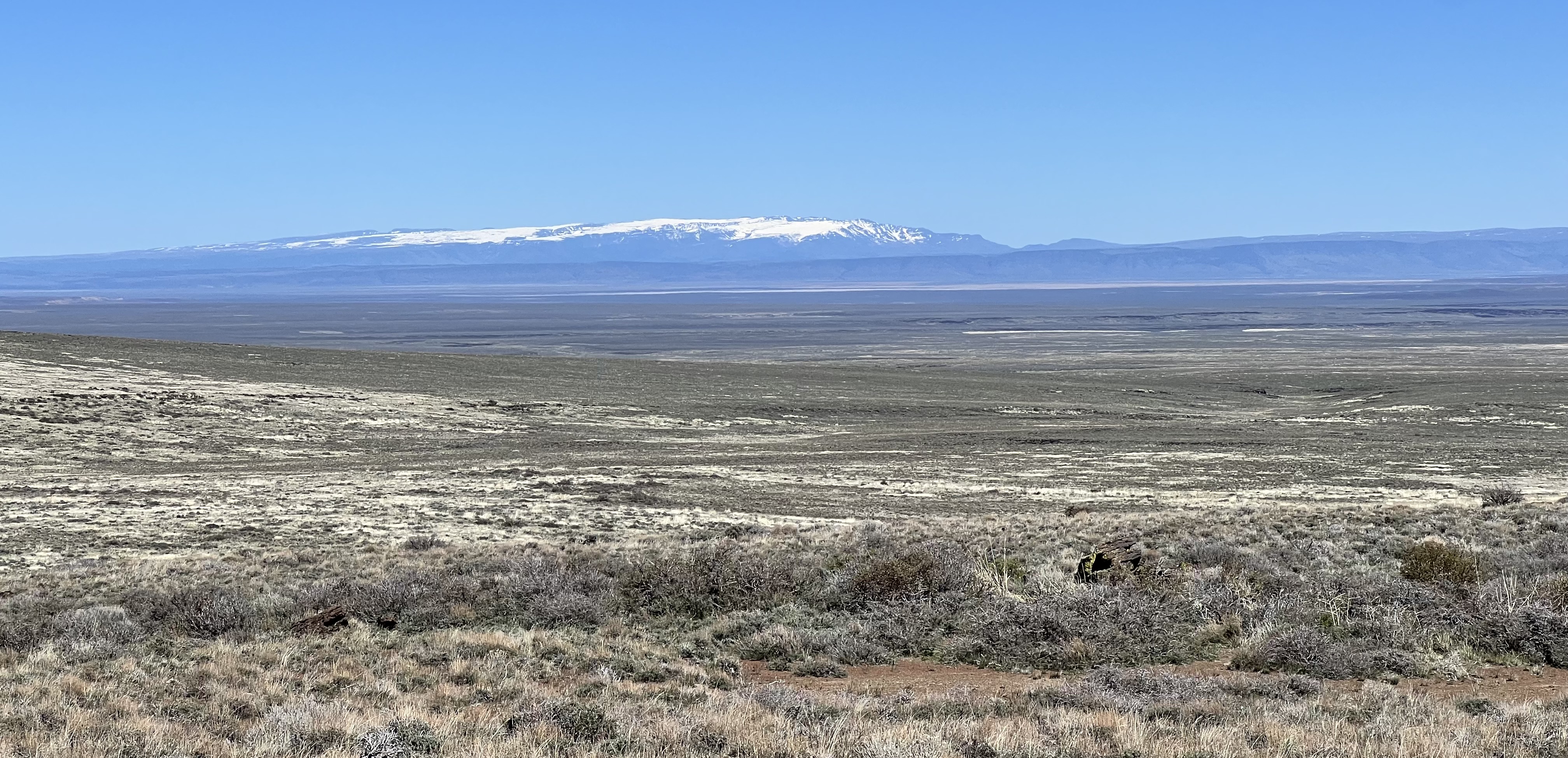
Looking east, across the Refuge and the Catlow Valley, to snow covered, 10,000′ Steens Mountain, which runs 50 north-south.
The topography of the Great Basin is daunting and beautiful, at a scale that stretches out far beyond most of our everyday worlds, boring to many, monotonous, up close, when one fails to appreciate a place in its wholeness, in its details, far beyond simply, what it might offer them. It calls to us emphatically…as do all wild places, but here, in its extremes, its ‘voice’ is clearer, sharper. The relative ‘poverty’ of such places, their spareness, makes its claim more emphatically. It is easier to be distracted away from this when living in places with wider margins, more supportive of human life. More species arose in and live today in equatorial regions, than in those lying further north and south.
Aridity makes its demands on life as does latitude and altitude. Water is essential for life. No organism survives without it though an individual’s requirements varies widely with its species. Each has evolved in place where conditions vary within ranges easily fatal to so many species of different origin. Any species requirements must remain within the local range of abundance and scarcity. Through our technologies, social and economic systems, we have increased our own survival range, but will never significantly change our individual survival demands for the requirements of temperature, hydration, nutrition and ambient temperature, While we can tolerate periods outside of these survival zones, we can do so for only so long. When we go places then with conditions beyond our range, we must limit our stay or bring support resources with us…and this is what our technologies allow us to do today…and if we’re not careful, we can easily forget our dependence and how fragile our own lives are.

Hart Lake, the little town of Plush on the far side, and Drake Peak and the mountains dividing us from Lakeview. Hart Lake has a man made dike across the north end, holding water for agriculture, limiting flow to the series of mostly dry, shallow lakes to the north.
When we inhabit or visit such places as this, we need to remember that we are guests here, that we are ‘ill fit’ for them which makes them more dangerous. Ignorance always introduces an element of danger. To forget this, to come to these places with unmodified expectations, unprepared, unsupported, places us both at greater risk as well as a burden on the place itself. We come here bringing long lines of support with us, like astronauts and deep sea divers, though we likely don’t realize this, nor our ‘taking’ from those places richer in life we depend upon to support ourselves in these far more spartan places. We cannot live without life support for long. Mistakes out here, especially without this connection, can be fatal.
Wild places, any place, are not there ‘for’ us, individually, but we often look at them that way. Without effort, we easily can fall into the trap of believing that if some place, or thing in it, does not serve us, that it can be ignored, any resultant damage to it, of little consequence to us or the place. We fail to understand that regardless of our attitude and understanding of a place, we are nevertheless in relationship with it, so that when it suffers, we and those to follow suffer. Our failure to acknowledge this does not lessen our impact and the consequences to follow on that landscape, and on the lives of others who come into contact/relationship with it.
Maybe if we thought more of ourselves as humans, ‘being’, rather that as discreet, singular humans, distinct individuals, we would see this. All life exists in the moment. We exist not as separate, transitory individuals, but as ongoing processes, informed, complex patterns and flows of energy, animated and alive, part of the much bigger, inclusive and complex processes which surround us, each shaped and informed by the countless processes around ‘us’. Just as we arise from these patterns and energies, so does our awareness, consciousness, sentience, our capacity for ‘agency’, for intelligence and learning. We are transient expression of a much larger ongoing process which we can never fully understand. So why do we behave in ways contrary to this? I don’t know, but I can’t help but think that any answers to that, any hope we may carry for a future which includes us and generations to come, must begin to mend the broken relationships that now threaten us, which divide us, set us in opposition to each other, life and place.

High above Lake Abert on my not successful ‘hike’ to the top of the Rim. The shallow lake, depending on its depth and diversion can be 20 miles long.
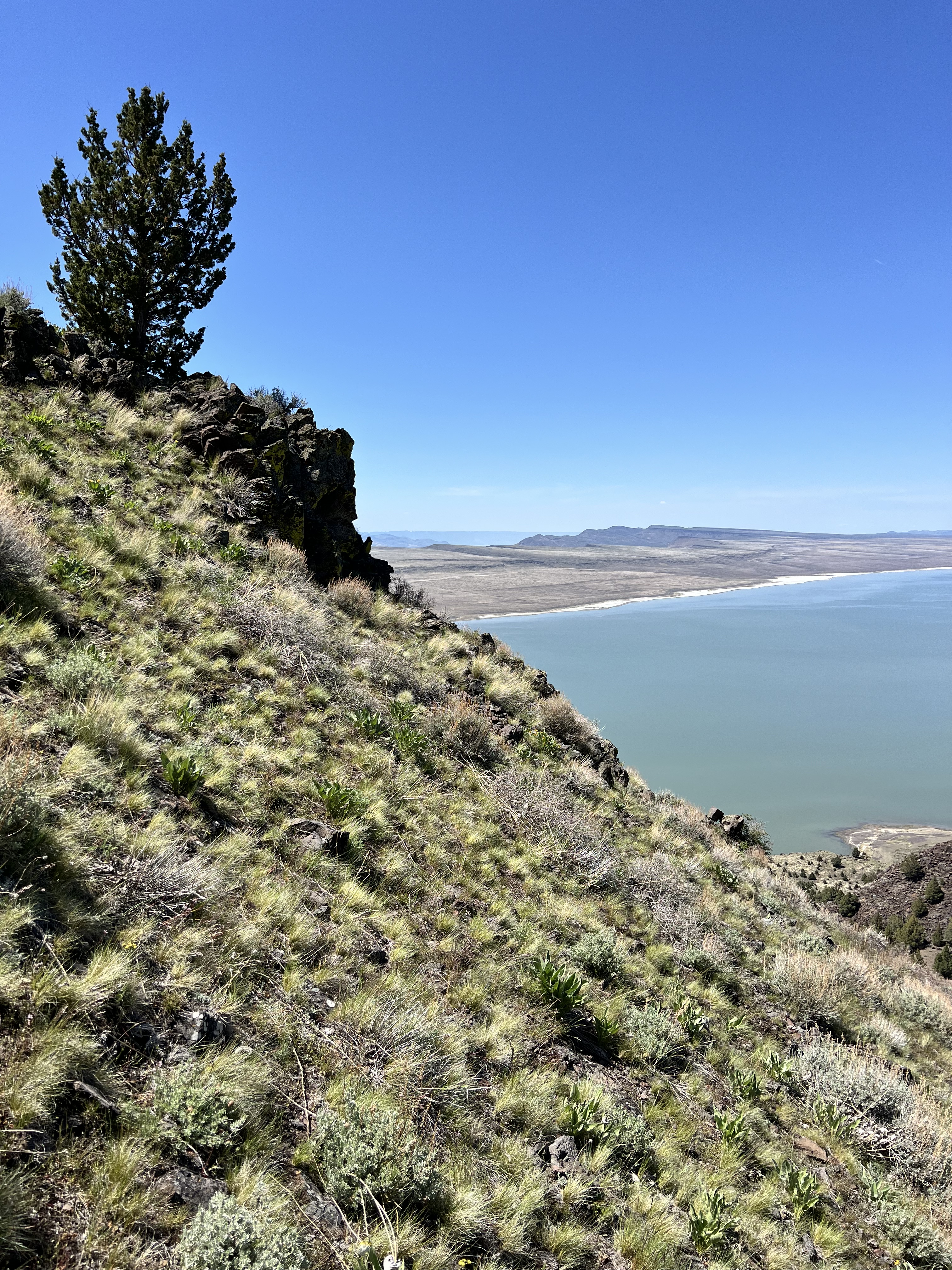
The hike up the rim, is a scramble. There is no trail so you pick your way through the Sagebrush, avoiding thickets and boulder fields. The no-see-ums were out feeding on this day.
Health is an expression of wholeness. What serves one must serve all, or ultimately, it fails. This is the lesson from ecology, from evolution, from an honest and positive economics. Taking exhausts, diminishes. Giving heals and is not just additive, but can increases exponentially as connections are made and reinforced, linked and cross linked, networked and thus strengthened. Harvest, consumption, taking, are necessary to life, as is death, but in moderation. When these are excessive the system and its relationships are weakened. Reciprocity, graciousness and respect for others are essential. Knowledge, brings understanding, heals relationships and thus assures health and a future.
We could work to bring the ‘wild’ back into our everyday lives, end the cycle of ‘development’ which it excludes, along with all of its other necessities and gifts. But this won’t just happen. It requires that we understand and transform the destructive patterns we have come to accept and expect. We need to begin having discussions of how to live ‘with’…to imagine an inclusive future, in its broadest sense; to develop a health model that is not medically invasive, but one which is supportive of the natural cycles and energies already here, which continue in spite of our actions, however compromised they may be. We need to recognize health as a basic right, one that all beings, all organisms and the places in which they live, possess. If we can grant super citizenship to corporations, a human abstraction, then we can do so for the living organisms which surround and support a healthy earth. We are an expression of the whole. A state of health which demands the sacrifice of other species and places, is not that at all. Health, is a currently unrecognized, inalienable right. Such ‘rights’ cannot come from the wholesale abrogation of the rights of another. ‘Rights’ over those denied the same ‘right’ are not rights at all. It is an idea built on a presumption of scarcity. That because there is not enough, security and power, demand that we take that which we can from others, others who ultimately do not matter. This sits a never ending struggle between classes and, as long as it continues, assures that the health of the whole, the world, all its countless individuals and relationships are compromised for a perceived, short term benefit. It is a path of mutual self destruction ignoring the fact that all exist in relationship, that all are ‘members’ and, as such, are a necessary part of the whole. Only when we reverse this and pursue the broader goal of a healthy overall ‘system’ of mutual benefit, of reinforcing patterns and cycles, a state of ‘homeostasis’ or dynamic balance, can we move ahead.
I can imagine a day when any of us can awaken to the sound of one’s regional songbirds. A world in which we need not leave our homes and landscapes and travel to have such experiences, requiring only that we pause for a moment and open our windows to admit their song, a world in which our actions are self-moderated by our understanding of our impacts on others, supported by our larger communities, because there really isn’t another way. Lawyers can argue in court all day long, but the final ‘judge’ will always be in the broadest court of all, how does what we do impact life on earth? Not simply you or me or my company’s bottom line. Our judicial system assigns legal standing stingily. It recognizes superior classes, and in so doing ‘inferior’ ones, and it does so based on precedent, on our history of the denial of that same standing and ‘package’ of rights, to those historically excluded, be they people, the several hundred thousands of species of animals and plants, the fungi and bacteria which cooperate in healthy biotic communities and the land itself upon which all of this dependent, all deserve ‘standing’, recognition of their essential role in this life…all of our lives. Our current legal system begins from a position of differential power, a product of a hierarchical system, which recognizes the legitimacy of such differentials. Some it says are deserving or worthy…others not. It is, In this sense, built upon a flawed understanding and as long as it remains operative, assures inequitable and unhealthy outcomes. Our legal system is broken and biased against healthy change. Power is tightly held and guarded. Those who hold it, are reluctant to yield it. But this can change. It won’t tomorrow, but hopefully, over time, coming generations will see these connections and relationships more clearly and the failures of our society will be more plainly exposed and the costs of their continuation more obvious. While decisions deferred always bring with them a reduction in opportunities, the choice will still be there.

Near the north end of Lake Abert, Oregon’s only hyper-saline lake. Here the alkaline mudflats widely rim the east and west side, extending across the flats for miles to the north. The lake water is not only hyper-saline it is also very alkaline, corrosive, so inhospitable to most organisms, but for those adapted to such extremes.
Life is complex and generative. The reductive world of natural selection so often presented as the driving force in nature, of claw and fang, of eat or be eaten, is only a part of the story. Life is generative. Without this propelling ‘force’ none of the complexity and diversity so evident in this world would exist. Life would have long ago been a failed experiment. Unnoticed but perhaps someday by a chance alien exploratory mission. We fail to see the world before us and, lately, refuse to reconsider our limited and mean point of view.
In a world of finite resources, with a societal and economic hunger for ever increasing consumption and boundless, and unfulfilled desires, the costs will become ever more evident..,until people begin to look more widely and deeper for satisfaction, beyond the tempting calls of schills, shysters and marketers…the seduction of false comforts and and the ‘worm’ of self doubt and inherent corruption. We have learned to look on our fellows with suspicion and project the worst in our hearts on to others and so withdraw from what would otherwise be necessary and supportive relationships. We need to be able to see the good in ourselves so that we can recognize and nourish it in others, repairing the damage of estrangement. All of this is possible through connection and healthy reciprocal relationships, giving ourselves a chance, being part of the whole, apart from the ambitious grab for power, a taking from others, a return to mutual aid. There is no security, no true society, without connection, cooperation, a willingness to do for others and an understanding that all acts that service the whole, serve ourselves and that which is taken without consideration, is a ‘theft’ from us all.
This belief, is why I sit and type these words. What other purpose can legitimately positively drive us? How much longer can we continue to insist that our unlimited growth and consumption is a legitimate path, desirable and inevitable? That the living world, its communities, relationships and many species don’t really matter? How much more loss will the Earth experience before we reconsider our choices? These escalating losses hollow out our lives, leaving us craving connection and experience with that lost. Thus our living has selfishly, ignorantly and insistently consumed and denied that which is essential to us. What will be our epitaph? RIP…died of a lack of imagination and courage, of a limited understanding of love.
Check out Ron Larson’s book: “A Natural History of Oregon’s Lake Abert in the Northwest Great Basin Landscape”.
 GardenRiots