
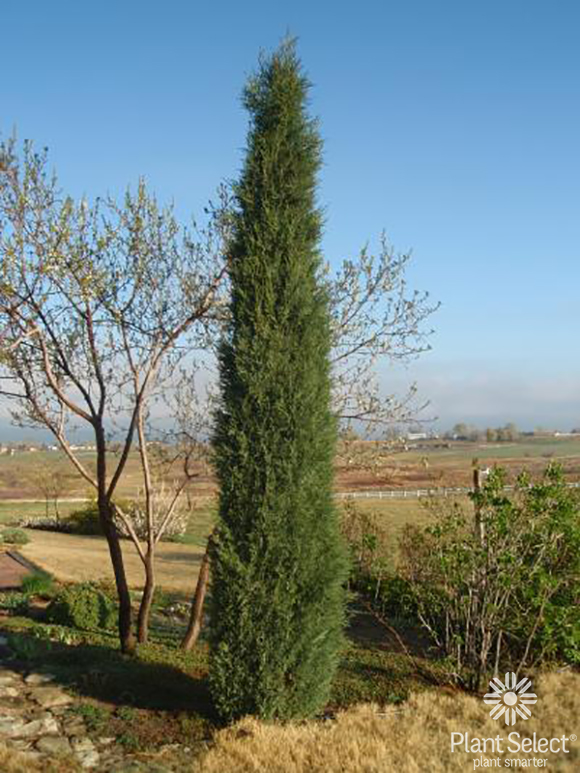
Perhaps an odd tree to start this with, Juniperus scopulorum ‘Woodward’, is not a ‘shade tree’. It is not deciduous. It is a narrow, fastigiate form of Rocky Mtn. Juniper that, growing to a height of 20′ with a 2′-3′ spread can serve as a formal accent in colder climates like ours, a ‘replacement’ for the more tender Italian Cyperss, and it can do quite well here with very little supplemental water.
Trees, specifically ornamental shade trees, have become an expected and desired part of our urban lives, at least util their leaves fall and await our cleanup. Many associate long tree lined streets and avenues with urban living. Broad Maples. Lofty Elms. Plane Trees and, in tighter spaces, perhaps Cherrys, Crabapples and flowering Plums. Urban trees provide several notable ‘environmental services’ increasing our comfort level with their cooling shade, their capacity to remove pollutants from the air, cover and nesting places for birds, food sources for the insects which the birds rely on and the sequestration of carbon. Trees are generally viewed as a public good, necessary even for our lives. We can get quite emotional about them. So it seems a bit ‘wrong’ to suggest that this ‘ideal’ may not always be ‘best’ or even desirable.
Broadleaved deciduous shade trees are ‘naturally’ members of mesic, temperate to cold-temperate regions of the world. That is where they evolved and where when we plant them out, where they do best. When we begin planting them outside of their historic natural ranges, especially when we ignore the conditions, the disparities and the extremes between their natural ranges and those where we choose to plant them, then we can have some serious problems. The trees may struggle along, or if we remain committed to making up for our local area’s lacking, usually in the form of supplying more water, they can do reasonably well. But this suggests possible real problems as one moves further away from the conditions of a tree’s natural limits and increase the numbers planted out. Where is this water coming from and what are the impacts of removing this water from its normal and healthy cycling of which it is a part? What will be going without? And, is that cost worth the losses it creates? Our selection and planting decisions depend on how we value that which is lost! In short, the typical deciduous shade tree of our imaginings do not belong here in a desert.
Knowing this, what trees should be included on Redmond’s municipal list of recommended trees? This is not the same as asking which trees are possible here? Which ones can survive our growing conditions with an acceptable amount of intervention…most importantly, supplemental irrigation, essential for the vast majority of possible tree species, given our arid conditions. Our region is often characterized as High Desert, so, yes, tolerance to cold is a major consideration, but life is only possible with water and, technically, as a desert, typically receiving 10” or less annual precipitation no where near enough to keep these summer wet ‘loving’ trees healthy. Trees commonly available in the trade, of a size that meets the requirements of most municipalities, tend to come from temperate, summer wet regions. Their water requirements are always higher and the precipitation regimes they are adapted to, are opposite ours. Water, when and in what quantity it falls, is then a critical determinative factor in choice. All organisms, including plants, require water. All organisms have evolved under different moisture conditions and cannot live where those conditions are not met. Temperature extremes must be met, but being so is not sufficient for success or even survival. Ideal temperatures alone cannot stave off death. Everything that affects the availability of water is a factor in a tree’s survival.
So, how do we go about creating a list of trees that are climate appropriate and will grow with minimal intervention, i.e., water.
A general guide to produce a municipal tree list
1, Understand the climate and growing conditions.
2, Select trees that will perform well given the conditions
3, Because goals and conditions vary, have lists that are tailored to them.
4, Relax minimum tree size requirements for planting, caliper, because availability declines as planting standard size increases.
5, Prioritize drought resistant trees for use in most situations to reduce the overall community water use. Reserve ‘thirstier’ trees for active use Parks and those locations that serve a broader public purpose, where grass lawns are typically installed. Native landscapes are less durable and subject to significant damage by active use.
There are an estimated 73,000 different species of trees in the world, some of which grow in all but the earth’s polar extremes and driest deserts. From hot, tropical jungles, to arid plains, temperate woodlands and forests, to tree dotted savannas. 40,000+ of these species grow only in the tropics and subtropical regions, an area that comprises only 7% of the earth’s land mass. None of those are remotely possible to grow outdoors here due to our temperature extremes and aridity, including the brevity of our growing season. Many of these ‘equatorial’ trees are endemic to small tropical and subtropical areas, growing no where else, many of which are vulnerable to loss/extinction, as trees are harvested for lumber, the climate warms and dries, their lands converted to agricultural uses or developed for commercial and residential use.
It should be obvious that when creating a list of recommended shade trees from those available for any city, that there are several important factors that must be considered, water among them. Not just the amount, but water, when and in the quantity required. This is linked to soil moisture and so the water available to a tree’s, any plant’s, roots. Trees are adapted to the places in which they evolved, over many, many generations. Trees, like any living organism, have a limited range within which they can thrive. Merely surviving under a site’s conditions, should be cause for exclusion.
In North America, with its narrower range of climates and landscapes, we have only 1,873 native tree species, very few of which are grown in significant numbers by the nursery industry. Those that are grown here do so alongside many others from other continents selected and produced for reasons of profitability. Many are grown as clonal, genetically identical, selections, while many others are never found in the trade. Most tree species must be sought out from small specialty growers, or seed found for the individual to grow on themselves. Municipal tree lists are then limited to what the industry produces, not what might be the ‘best’ species for one’s locale. The buying public does have a choice, but it is generally determined by those trees produced and marketed by the industry. It’s a tight, influential, feedback loop. They grow what we want. We want what the grow…and the circle tightens.
Soil too, is an important factor. It’s ability to retain moisture and allow it to drain down through it, drawing roots with it. Deep soils and deep rooting, support most tree’s ability to tolerate drought. The nutrients soils contain varies widely depending on its composition, which goes back to the base rock material from which it is derived; the soil particle size, so its ‘age’; and the plants and other organisms which grow upon it, thus influencing its formation and structure. Its organic content, physical structure and depth, which relates to the ability of roots to penetrate down and through it, as well as its capacity to hold the air roots require while they grow, as they metabolize, are all important. Even the other organisms with ‘whom’ they share the place, all go to maintaining the conditions that a tree, and its accompanying community, require, or not.
This is true for all trees growing in all environments. In our case, trees adapted to typical continental and arid conditions, tend to grow in the ‘leaner’, mineral soils, available to them. These contain a lower quantity of organic matter. This is particularly true here, in Central Oregon, with our relatively young, volcanic, soil. ‘Improving’ soil with organic matter, will aid the growth of trees and plants native to more mesic climates in which soils tend to be moist through the growing season, but can be a negative for arid country trees. Much of this passes below our notice, literally, in the soil beneath our feet.
When we do think of the other organisms living on a site we tend to understand them more as competitors that consume what the others need. There are many biotic and abiotic factors responsible for a particular plant’s success or failure. Many species contribute in creating and maintaining those conditions which are beneficial to the trees and other plants you might want to grow. Recognizing this, and making accommodations for them is important. Together all of this goes into forming the communities upon which so much of life depends. Their absence marks those places in which we must step up and provide the resources or protections supplied by their now diminished natural communities. As humans, our actions are often considered to be above, separate, independent of the living communities of which we are an essential part. As living organisms we are in much the same way dependent for our lives on the environment. The expanding reach and influence of our technologies and economy, tend to obscure our local dependence and the fact that all locales, no matter how distant, are dependent on their local relationships. All exist in wholistic relationship with their community’s biotic and abiotic ‘members’.
Resisting Drought: Outside and Within the Plant
Drought limits growth. Any tree, any plant, has evolved with a variety of strategies to avoid and tolerate drought. Drought, is a relative thing. Plants are uniquely adapted to those conditions they evolved with. Their ability to adapt is related to that ‘experience’. Plants are essentially fixed in place, more place dependent than mobile organisms. While ‘mobile’ organisms can move about to satisfy their needs, they are still dependent on their environment. While we can, plants cannot, ‘run to the store’ for what they might need. Our resource ‘independence’ is in this way an ‘illusion’. All organisms are dependent. Plants must possess the structures, adaptability and vigor to obtain whatever they need, from where they grow. To do this they have developed various survival strategies particular to their place and its local communities.
A plant from a rain forest environment can generally tolerate the ‘drought’ periods which occur in its native range. Drought is not a total absence of water. It is a local phenomenon. A predictable, peculiarity, in the local pattern. It is a reduction in what is typically available over a given period. The Amazon Rain Forest goes through a wet/dry annual cycle, the dry periods of which are far different than those experienced by what we consider to be a desert…just as a desert wet period in the Sonoran or Mojave Desert, for example, would be impossible for the typical Amazonian tree to endure,. Under those same desert conditions a local Juniper, Mesquite, Sagebrush or Cacti, may be fine, again, if what it needs is there ‘when’ it’s needed. Plants all have particular response ranges across which they are adapted and can survive. But go beyond those margins for any plant and death is nearby.
Any tree/plant has evolved strategies that allow it to ‘avoid’ local drought, as well as equip it to tolerate drought periods when unavoidable. Having a deep extensive root system allows a plant to access water from throughout the soil volume it can penetrate, reaching to depths that remain moist far below the dry surface layers. For many arid country plants, such deep roots allow them to tap into subsurface water sources not otherwise available to shallow rooted plants. In other cases, such as for Sonoran Desert Cacti and Agave species, they concentrate their roots toward the surface where they benefit from the occasional, but timely, monsoonal rainstorms common to the region, quickly taking the water up, replenishing its ‘stores’, growing and conducting needed cellular repair, before shutting down again with the increasing scarcity of water. All take advantage of various strategies to reduce their water loss during drought periods.
There are multiple strategies that allow plants to survive drought conditions. Some, such as the closing of their leaf stomata, those openings in their leaf surface through which gases and water vapor pass to support photosynthesis and various metabolic processes. Closing them slows or even stops a plant’s growth. All plants have some capacity to do this, but again, it is limited between species, and, it is not enough alone as aridity increases. It, as are all such strategies that slow or suspend metabolism/growth, are short term strategies that can compromise the long term health and vitality of the plant when required over too long periods.
Others follow a variety of structural leaf strategies, producing leaves that have ‘hairs’ on their surface which serve to shade and cool the leaf surface, reducing its need to cool itself allowing it to use less water. (The chemical reactions that make up any plant’s metabolic processes, are positively effected by temperature. They accelerate with increasing ambient temperatures, within limits. Above these, for most plants in the 90ºF range, plants begin to shut down their growth. Higher temperatures begin to threaten the structure of essential proteins that both regulate growth and are essential structural components of the plant itself. Regulation of temperature within a limited range in and around the plant is then essential.) Others have a thick waxy cuticle on the leaf surface, which again, reduces water loss. Others have smaller leaves with their consequent smaller surface area and/or grow more thickly protective tissues protecting them from some of the heat’s effects. Still others produce leaves in the form of ‘needles’ with their relatively rigid, thick walled structures more tolerant of reduced internal water volume and vapor pressure or have tightly clasping, awl shaped ‘leaves’ with stiff, thickened, more protective walls, all ‘working’ to reducing water loss and protecting their structures from cell collapse and permanent damage. Following these strategies reduce a plants daily need for water without undue harm. Cross these limits and the cells within leaves and the living cambial tissues begin to collapse, permanently. Alternatively, plants adapted to arid conditions, may suffer and die, when water is to abundant.
Plants also have varying capacities to tolerate drought via internal process which allow them to survive when such conditions occur. The loss of cellular and intracellular water from drought is measurable. Water in the cell also serves a structural function. When water levels drop within a cell, it begins to contract. As this continues the collective effect within a leaf is wilting. As this continues the plant approaches what is sometimes called ‘permanent wilt’. Botanists and cell biologists call this the ‘turgor loss point’ (MPa), the leaf water potential at which wilting occurs. In technical language this refers to the difference in water pressure, as drought settles in, outside the cell and inside the cell. Because of the close relationship between the internal state of the cell and its ambient conditions, as water availability declines, the difference increases and their is a strong tendency for the plant to balance its internal conditions with those outside. Low soil moisture, low humidity, with warm to hot temperatures, along with wind, increase water loss from leaf surfaces and the overall plant. Water then plays both functional and structural roles in the living tissues. As water is ‘drawn’ out of the cell, its internal water pressure, its turgor, drops, and the cell begins to collapse. At a critical point this collapse results in permanent tissue damage, particularly to the defensive cell membrane and wall, resulting in the leaf and tissues dying. MPa varies between species with a plant’s provenance, the conditions under which it evolved over generations, its physical structure and the durability of its leaves.
Actively growing cells and tissues in trees are limited to their leaves and cambial tissues that surround their trunks and limbs. Wood is less effected by drought. Wood, without ongoing metabolic processes, is a fixed, static, structure. Drought then effects only those living tissues and cells, tissues that do cover and protect the wood beneath each contributing to the health and longevity of the whole plant.
These factors go toward explaining why the trees in my list below of those adapted to arid and semi-arid regions like ours dominate the list. They have adopted these strategies. Most conifers possess narrow, needle like leaves or have adopted the tiny, adpressed, awl shaped leaves common to Junipers and Cypress trees. The more extreme these characteristics are exhibited, in general, the more drought adapted they are. (In biology, however, there are always exceptions.)
Market Availability
Biology aside, one of the major ‘problems’ we face in planting more appropriately adapted trees, is their lack of availability. The lack of choice. The trees produced by the nursery industry are limited by several factors. Those lists of trees municipalities have specifying type and size, can be a major limiting factor. You can’t grow what isn’t available. And the nursery industry isn’t going to invest the years into growing trees that meet the standard that aren’t on the lists. Unsold trees are a loss. The larger they are physically, the larger the loss. It is a truism. While limiting our choice, this benefits large growers, by reducing their competition and by allowing them to simplify their production. When most buyers want only a limited set of trees, their sales are more secure. Growing fewer species and varieties allows them to standardize production. A greater selection would require them to follow more varied protocols to meet the needs of a more varied inventory. Not all trees are the same. Nor do they require the same conditions. Uniformity is part of standardization which is a way to reduce unit cost. Marketing efforts then are focused on what they produce, inducing buyers to want/need what they have to offer, not what is best.
Trees take several years to grow to meet the minimum specified size municipalities demand and so growers limit choice to remain profitable. Land, time and labor available to them is limited, so they must choose. They grow those trees which are quickest to marketable size, from a ‘short’ list of those meeting the requirements of municipalities, which can be grown commonly in a large portion of the country…not specifically for ours with its restrictive conditions. Nursery growers, to maximize sales and be left with the smallest number of unsold trees, grow those which are the most consistent performers, in their nurseries that they can sell across the country, maximizing their sales. An unsold tree is a loss. Larger growers possess economies of scale that smaller growers don’t…and the limits that come with larger operations. The entire system favors large growers offering limited choices. To change this and increase the variety of selections, would require a reduction in the size municipalities specified in their approved lists. A nursery’s ‘investment’ in each tree is in that way reduced. Lower cost trees. More variety in those available.
Growing for the specific conditions of small market areas, isn’t profitable for the ‘big boys’, so they don’t offer trees of the best ‘fit’. They limit the discussion to cold hardiness, which, I’ve already pointed out as important, but not the sole or even most important concern in many cases. Some of those commonly available are ‘native’, somewhere in North America. Red Maples, Acer rubrum, is a North American native, but you need to understand something of the diversity of the continent’s landscapes, climates, soils and plant communities. Our conditions vary widely, often even across relatively small areas. Just as cold hardiness isn’t, neither is being ‘native’, a broadly applicable ‘badge of approval’. Trees, any plants, require careful siting, a matching of plant to conditions. ‘Right Plant, Right Place’, is a horticultural maxim, a must to be followed if success is to be had.
Smaller growers, which sell more locally, or to regions that may share more ‘extreme’ conditions, can do this, but it’s still a numbers game for them. Our immediate market area is relatively small, so a grower’s investment in its ‘field stock’, its inventory, must be limited and the sizes that they offer, smaller. Larger growers are very efficient in their production, but their ‘model’ constricts them. The ‘rules’, defining minimum caliper size, the diameter of the main stem or trunk, acceptable for planting, is set locally by municipalities, and works to limit our choices. If we want more appropriate choices we need to lessen the size requirement and require more climate adapted trees, or settle for the less appropriate choices the large growers offer us. This size requirement constricts and limits local choice.
Caliper size, diameter, measured 6″ above the ground on smaller trees and 12″ above on larger is assumed to effect the level of vandalism a tree will suffer after being planted out in the landscape. A bigger tree, it is often argued, suffers less than a smaller tree. It is also done to have a more immediate impact, a larger tree being more visible, a recently planted landscape looking more ‘finished’, than one with smaller trees. I’m not aware of any definitive studies of the vandalism rates of larger trees vs. smaller trees at time of planting. Vandalism is a community problem, not something inherent to tree size. A 2” or 3” caliper shade tree can still have several branches within reach that can be broken and torn down. The bark on the trunk is still thin enough that it is susceptible to ready cambium damage compromising its health. I see this all of the time. Size does not ‘protect’ a tree. Examples abound. This is a public education problem. A ‘values’ problem. While a larger tree makes a greater immediate visual impact, it is also true in most cases, that a smaller tree will root out and establish more quickly and also, potentially, have fewer root problems and so be more sturdy and healthy over the long term, than the initially larger tree. Trees, generally capable of living far longer than humans, are chosen for immediate, limited, aesthetic reasons, putting health concerns in a secondary position. This is a problem.
Size assures a more limited selection of species and varieties, while also increasing purchasing costs of each tree. Size requirements while providing more immediate visual impacts, provides negligible gains in resistance to vandalism, at the ‘cost’ of now having trees less adapted to local conditions, the possibility of root problems and which are more demanding of resources, in our case water. Size requirements also exclude smaller growers who are willing to fill these ‘niche’ markets. Minimum size requirement stymie their doing so. They simply can’t afford to dedicate the time and space to growing trees on to ‘large’ sizes. If they were to attempt to do so the economies of scale work against them and their comparatively higher prices for the same size tree would doom them. Excessive caliper size requirements then work against efforts to grow a more locally appropriate urban forest. Does this mean everything should be planted as year old seedlings? Such small trees are likely to lost in the landscape. Some minimum is probably necessary. Reducing the requirement to and inch or inch and 1/2, would greatly increase the chance to have a wider selection while reducing the cost of each tree as well. There are practical and easy to install ‘defenses’ for smaller trees if necessary.
Place: Matching Plant and Condition
We live in a desert, that typically receives 9” or less of precipitation annually (8.7” this last year, 2024, 5.5″ in 2023) vastly limiting our choices without supplemental irrigation. Pretend as we might that is simply a fact, and it should matter. It is a key determinant in all of the life occurring here. Ours, being a continental climate, without much moderating influence of nearby oceans, translates to lower humidity levels and locally, drying winds. Add to this a relatively high elevation with its more intense solar radiation and you have conditions that desiccate, burn, stress and dwarf the relatively large, lush green leaves typical of so many shade trees and can damage trunk cambial tissue on those ‘warm’, bright, winter days where warmed trunks can then plunge well below freezing at night, damaging cells.
We humans, however, have brought with us to the desert, expectations of greener ‘pastures’. We may ‘like’ the desert, but we don’t necessarily want it as our home landscape. Our tendency is to create ‘oases’ in the desert and these spread across the landscape with our growing numbers. Urban areas, and yes, Redmond is urban, place additional burdens on local landscapes. Our present list of trees is made up of broadleaf, deciduous, shade trees with their relatively ‘lush’ broadly spreading leafy crowns. It is what so many of us expect, not what ‘belongs’ here. Such landscapes are ultimately unsupportable fantasies, and we don’t want to be reminded of its cost. We routinely modify the landscape within our towns and cities, our yards, to meet our desires, ignoring the needs and limits of the place we live. The very fact of cities, brings with it these conflicts, but we make these ‘concessions’ automatically. The demands this makes of the Deschutes River Basin need to be evaluated, because all calls for more water are not of equal value. Supporting such profligate use for individual residential landscapes, is irresponsible if the region is to remain healthy and viable. Water so spent is a lost opportunity for plants and animals that earned their place long ago. so when we do ‘spend’ our water it should be in support of something well worth it.
Parks are a public investment intended to serve the needs of the community, providing us a place we can visit collectively and utilize regularly, that is ‘durable’ enough to survive our use without deteriorating (Provided we give them the maintenance they require). Parks then serve a larger purpose and so are of greater value in terms of water investment. We expect that we will have to provide enough resources and labor to do this. At some point large, lush residential landscapes are simply unsupportable..
As Redmond continues to grow, transforming the area’s natural landscape, into one that can survive our increasing intensities of use, we find ourselves having to intervene at proportionately higher levels utilizing more water, resources and energy to simply maintain the status quo. It is our pattern of use that is out of step, the pattern, that needs to be redefined. Our use of water rises with our population growth and the transformation of our landscape. This is in direct conflict with our understanding of water’s limited availability. Water’s scarcity is one of the most defining characteristics of this place. We have four different types of landscape here, the shrinking native landscape with its intact biotic communities; one that serves the community’s collective need for durable landscapes in the form of active use Parks, that can absorb/tolerate heightened levels of use within its ‘borders’; our residential landscapes, which are limited in their use and the collective needs that they fulfill and those ‘developed’ commercial and industrial spaces whose landscapes serve as little more than as spatial buffers between properties with little planted on them….Then there are the disused properties, stripped of the native landscape, overgrown with weedy species, as they await development.
Active use Parks, are designed and managed to withstand such use. They are a priority because they serve a necessary community need. Residential, and more passive use landscapes, should be designed and managed in ways that require little or no supplemental irrigation, relying on native plants, supplemented with appropriate arid and semi-arid plants from comparable regions. (Growing food for local consumption, by serving to meet a valid need and purpose, would be an acceptable use of water use on the landscape.) Native, intact plant communities, are very few and fragmented and don’t require any supplemental water other than perhaps when other natives were planted to bolster, strengthen the community. The other two ‘landscapes’, the commercial/industrial, ‘nonscape’ and those weedy sites waiting development, serve as major sources of weed infection across the City.
Redmond needs two separate tree lists. One that includes trees with no or a minimal requirement for supplemental water and another for active use areas, presumably covered in grass turf, which is more durable than other planted landscapes and requires regular irrigation. In the latter case, the trees planted in or adjacent to them, would be those that perform best with such levels of irrigation, a list more reflective of those types currently recommended, from regions that receive significant rainfall during the growing season. There are no organisms that come in a one ‘size’ fits all form that can perform well, long term, in such divergent conditions. Intact native areas would simply be protected and managed in such away that supports their continuation.
Trees and the Limits of an Arid Climate
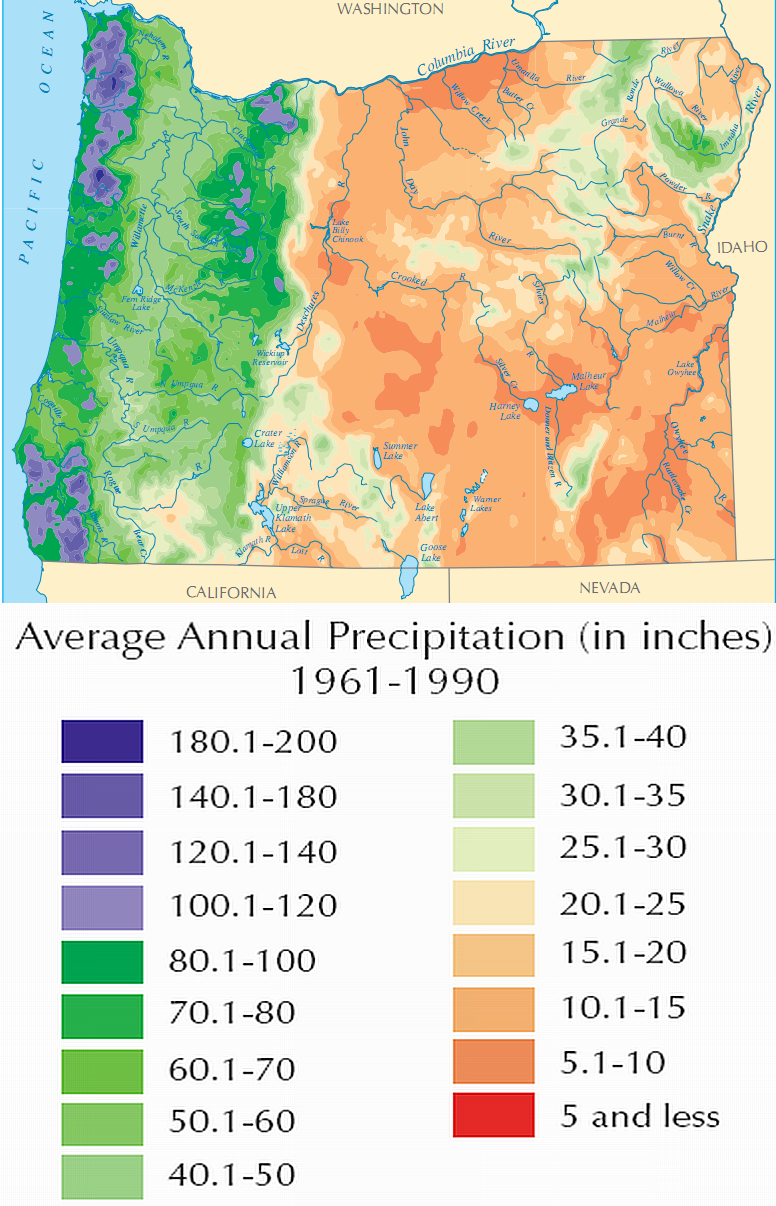
This maps shows no cities or roads, or counties. Redmond is in the dark orange (5.1″-10″) blob, just south of the confluence of the Crooked River with the Deschutes. Bend spreads out 15-20 miles to our south, in the ecotone where the 10″-15″ and 15″-20″ zones come together, where the Ponderosa Pine overlaps with the Juniper and begin to dominate (The eastern portion of Bend lies to the dry side of the ‘line’ in the Juniper forest). Sisters is 20 miles west of Redmond in the ecotone/edge it shares with Bend, getting quickly wetter/greener as you continue west. Prineville lies in the next zone drier about 20 miles east of Redmond.
We need to understand what desert conditions mean in terms of trees. Very few trees can grow under desert conditions. Deserts are largely treeless landscapes. Those areas that receive slightly more precipitation, are considered semi-arid. The number of tree species and the stand densities found within them increase with the amount of precipitation, especially when received in and around the summer growing season. A locally native tree, by definition, is one that can survive on its ‘own’, long term, on 10” or less of precipitation, over the year. Our one native is the Western Juniper, Juniperus occidentalis, and it is being ‘demonized’. There is no shade tree, grown by NW nurseries, grown anywhere, that can grow here without a long term commitment to significant levels of supplemental water over the entire life of the tree. There are no Maple, Ash, Birch or other commonly planted broadleaved shade tree, that meet this survival requirement. Such shade trees are a luxury item here, They require the regular application of a very limited resource, water. Yes, shade trees provide cooling shade and make the landscape more comfortable for us, but doing this broadly across the landscape, borrows dangerously from our groundwater and rivers. So, what do we do?
A list could be made of trees from similar arid and semi-arid parts of the Intermountain West, the Great Basin, the mountains of the SW, the Colorado Plateau and California’s eastern flank of its Sierra Nevada mountains and north country, that would add a few more trees to the mix. That’s the reality here. Our ‘desire’ for more, including those that clearly don’t belong, comes at a cost. Redmond averages around 9”. So called arid regions receive up to 10″ annually. This year we’ve received just over 8”. A semi-arid list of trees would include those that grow within an expanded range, receiving 10”- 15” annually. Some stretch this to 20”, more than double our local amount. These semi-arid trees could only survive locally, on their own, on particular sites near ponds, ditches, creeks, rivers, lakes and seeps, where their roots can find a ready water supply, through our dry summers. Many ‘desert’ trees are only ever found near such oases, not under arid, desert soil conditions.
Compared to most forest regions in North America, the Intermountain West has limited overstory tree diversity; many of the different forest zones have less than three different overstory species. Forests and woodlands east of the Mississippi were, historically, very diverse, with multiple broadleaved, deciduous tree species, occurring with or without a variety of conifers, and far wetter over the summer months. From these forests come many of our commonly available shade trees offered to us in the arid Western states. In contrast forest zones, from lower to upper elevations in the Intermountain West, include those where Western Juniper stands alone above a grasslands with a limited scattering of shrubs; Pinyon-Juniper woodlands; Ponderosa Pine, Douglas-fir, Lodgepole Pine, Spruce-Fir, and high elevation 5-needle Pines, with few co-dominants. The largest of all our native plant communities, regionally, is the so called, Sagebrush Sea, which in its several species dominates, about 175 million acres, making it the largest contiguous ecosystem in the continental United States, one-third of the land mass of the lower 48 states. Across its broad range it receives between 5″ and 40″ of precipitation, much of it as snow in its higher elevations, where the Sagebrush shares space with several Oak, Pine and Juniper species. The more precipitation, the more water dependent trees are found at higher elevations with the omnipresent Sagebrush. In eastern Oregon these higher elevations receive 15”- 30” and more rain and snowfall equivalent. Snow pack melts over time keeping their root zones more uniformly moist. These higher elevations are also cooler in summer and have shorter growing seasons. All of these factors lower the potential water deficit trees there might otherwise suffer. Including ‘alpine’ trees in desert conditions increases their demand for water with our longer, drier and warmer growing season. Again, more must be considered than the extremes of cold weather. Winter cold often isn’t the limiting factor in the West…water is.
Cold Hardiness
Obviously, cold hardiness is a factor in our choice. Climate and its particular patterns, all must be considered. When any system is subject to multiple variables, choices become much more complex. Choosing high elevation conifers will not be ‘automatic’. Mountain Hemlock, Sub-alpine Fir, Whitebark Pine, while growing nearby in the higher Cascades, require more careful placement, tried experimentally, where desert extremes are more moderate, if at all, with a commitment to irrigating. Evergreens in general possess characteristics shared by many arid country natives. It gives some of them an advantage in shorter, more extreme, arid climates, but again is no guarantee of success. If such trees are to be a recommended list, its suggestions should be pretty ‘bullet-proof’ with minimal and consistent additional demands made of the property owner/landscape manager.
Because of how and where they grow most of these choices will require full or nearly full-sun locations. If we limit the list to those trees with semi-arid water requirements, then pick a range, either 15” or 20” to define it. Then those trees on the list could be listed with the amount of water that must be added to our normal average to maintain them in good health. A tree requiring 15” would need to be supplemented with about 6” of additional water annually over the growing season, indefinitely. If that number is 20” of annual precipitation, then we would need to supplement it with an additional 11”. Each tree on the list should include its supplemental level.
 GardenRiots