Category Archives: Street Trees

Toward the Formation of The Central Oregon Tree Explorers

Paleontoiogists say that we first evolved as a species on the African savanna, that mixed landscape of grassland and scattered trees. Some argue that we were first a tree associated species. Be that as it may, most people have an affinity for trees today. We have our favorites. We plant them for food, as a source of material to meet various needs, for shade, for that inexplicable feeling we have when amongst them, in support of the life that came before, those dynamic communities, their complexity and the vitality, that define these places we now occupy, for their beauty. In Central Oregon with our arid to semi-arid climates, those with annual precipitation as high as 15”-20”, xeric referring to our dry summer growing season, our native trees serve as an indicator of the possible. Our local landscapes have curvilinear boundaries, that delineate areas with like moisture regimes. These go a long way in determining the native landscape (But not all of the way!).
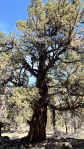
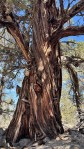
14” of precipitation locally is roughly the bottom limit for Ponderosa Pine. You can see this as you observe grouping and the massing of tree species, forming a line from south of Bend, west and north to Sisters, then along Green Ridge and north to the Columbia. There is an in-between landscape, an ecotone, where the Ponderosa intermingle with the Western Juniper, which dominate easterly, until the average drops below what even that reduced amount can support. The ecotone roughly bisects Bend. Continue reading

On the Creation of an Urban Tree Canopy Management Plan for Redmond, Oregon

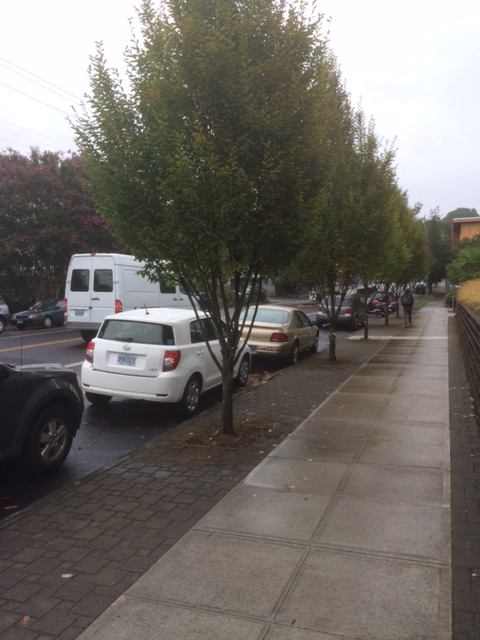
Trees can be a defining element of a community as a ‘success’ story, a failure or somewhere in-between. A community’s trees are of it, not some separate amenity provided by the City. Ideally, just as the canopy is part of a community, its care should be a part of the shared responsibility of the community, with the City providing the services the community cannot, in addition to their role of coordinating the care so that the tree canopy can provide the highest level of service while meeting aesthetic needs. The City is ideally situated to perform this role. Neither ‘group’, the community or the City can do this on their own. Training, education, outreach, project implementation (planting, tree care) are a joint responsibility. Leaving this as a City responsibility alone cannot result in the best product. Communication and partnerships should define the relationship and effort.

Picking numerical targets for increasing overall tree canopy misses the mark. We don’t just need numbers, we need site and species appropriate trees in order to grow out a healthy urban canopy that is neither water intensive, given our climate and declining aquifer, nor one that increases overall wildfire risk; one that helps us, a portion of the more powerful human residents, bridge the gap between the contrived landscape in which we spend most of our lives, and the wild, evolving landscape outside our communities, that operates in ways that balance all the competing and supportive needs, of all of the species that comprise it. Our ‘developed’ communities, heavily prioritize a narrow fraction of the lives within them.

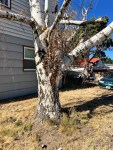
Tree selections should be supportive of local wildlife and pollinators in addition to providing the environmental services associated with urban tree canopies…not just those of the decision makers within the human community. Planting the wrong trees to get initial numbers up, as some kind of marker of success, will be relatively short lived at best. Trees are a long term, living and growing investment, that shape the future. However we slice it, they will demand water in larger amounts as they grow over time. So our choices should be thoughtful and considered. At issue is whether the normal growing conditions can adequately support the growth of chosen trees. We know that almost any other tree, beyond our Western Juniper, will require supplemental water. How much though we need to weigh. When tree and climate are a mismatch the result is evidenced locally by the increasing numbers of shade trees around town where owners have turned off the water leading to stressed and dying trees. Success is absolutely dependent upon well chosen trees, their ongoing care and the participation of an informed public.


Continue reading

On Ornamental Trees and the Remaking/Unmaking of Place: Revising the City of Redmond’s Tree List, part 2

How Much to Water?

Recommending trees from climates with significantly wetter growing seasons needs to stop if we are to continue growing our population. Landscapes as designed, and managed, are the single largest user of residential water. Recommending trees which ignore this problem is irresponsible. Lower water use residential landscapes are possible. Local codes and recommendations must, however, reflect this priority.

Additionally, how much to water is a bit of a mystery to all of us and especially so to non-gardeners. How much? How often? Our watering practices should be determined by the local precipitation and the tree’s needs. What is commonly done, however, is that we water for our lawns and that largely determines what our trees receive, unless we have separate drip systems. A tree’s root system doesn’t stay neatly between the lines. They quickly extend out well beyond the span of the tree’s leafy canopy. In many cases even 2-3 times as far, taking up water and nutrients. A roots of a tree, planted in a small bed, adjacent to an irrigated lawn area, will move out into the lawn. A tree isolated in a xeric bed with only a few drip emitters, will quickly demand more than such a meager system affords it and such a tree, if it requires summer moisture, will struggle while competing with its nearby  ground level growing neighbors. Again ‘neighbors’ should share compatible requirements so all can thrive on the same ‘diet’ and moisture regime. Continue reading

On Ornamental Trees and the Remaking/Unmaking of Place: Revising the City of Redmond’s Tree List, Part 1

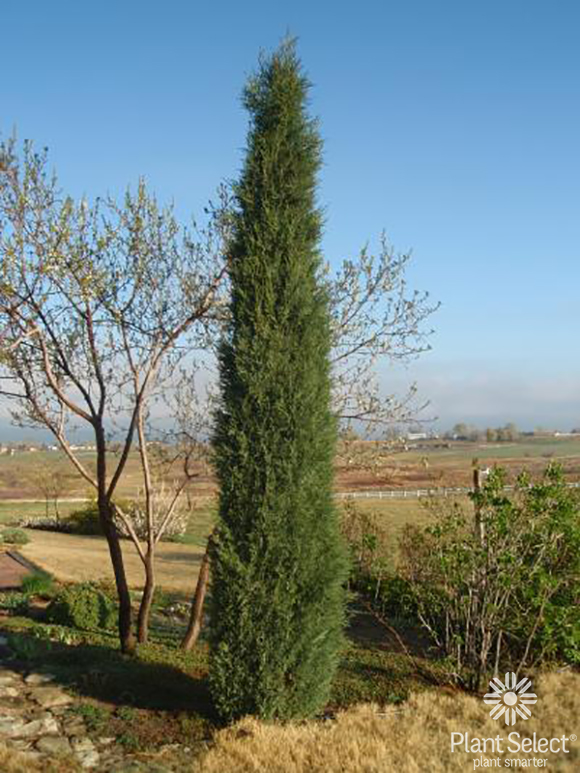
Perhaps an odd tree to start this with, Juniperus scopulorum ‘Woodward’, is not a ‘shade tree’. It is not deciduous. It is a narrow, fastigiate form of Rocky Mtn. Juniper that, growing to a height of 20′ with a 2′-3′ spread can serve as a formal accent in colder climates like ours, a ‘replacement’ for the more tender Italian Cyperss, and it can do quite well here with very little supplemental water.

Trees, specifically ornamental shade trees, have become an expected and desired part of our urban lives, at least util their leaves fall and await our cleanup. Many associate long tree lined streets and avenues with urban living. Broad Maples. Lofty Elms. Plane Trees and, in tighter spaces, perhaps Cherrys, Crabapples and flowering Plums. Urban trees provide several notable ‘environmental services’ increasing our comfort level with their cooling shade, their capacity to remove pollutants from the air, cover and nesting places for birds, food sources for the insects which the birds rely on and the sequestration of carbon. Trees are generally viewed as a public good, necessary even for our lives. We can get quite emotional about them. So it seems a bit ‘wrong’ to suggest that this ‘ideal’ may not always be ‘best’ or even desirable.

Broadleaved deciduous shade trees are ‘naturally’ members of mesic, temperate to cold-temperate regions of the world. That is where they evolved and where when we plant them out, where they do best. When we begin planting them outside of their historic natural ranges, especially when we ignore the conditions, the disparities and the extremes between their natural ranges and those where we choose to plant them, then we can have some serious problems. The trees may struggle along, or if we remain committed to making up for our local area’s lacking, usually in the form of supplying more water, they can do reasonably well. But this suggests possible real problems as one moves further away from the conditions of a tree’s natural limits and increase the numbers planted out. Where is this water coming from and what are the impacts of removing this water from its normal and healthy cycling of which it is a part? What will be going without? And, is that cost worth the losses it creates? Our selection and planting decisions depend on how we value that which is lost! In short, the typical deciduous shade tree of our imaginings do not belong here in a desert. Continue reading

Summer Tree Failure

IMG_6175

A failed Norway Maple on SE 49th. This picture was taken June 28th, five days after a big rain event. You can see that this tree has been struggling for some time as evidenced by the dead branches still in its crown and the stressed flagging leaves up there. The girth of the trunk is greater than the width of its planting space. It is pinched beneath the overhead lines and the requirements for street trees regarding road clearance. It’s height has been ‘controlled’ and limited over the years.

Trees fail all of the time and when they are older, this can be quite spectacular, or devastating, if your car, home or an individual have the misfortune of being in the its path.  Like most people I used to believe that most such failures happened as the result of storms, and many do, but it is relatively common for trees, or major limbs, to come crashing down with calm conditions in the Spring. The new flush of growth brings with it a great deal more tissue and water weight than a tree in active growth has previously supported or, for a tree struggling, compromised by the burden of significant rot in its core and/or limbs.  Look at any tree and look at its girth, its canopy spread and on many species, its long, often horizontal limbs and try to imagine their weight.  To help with this fill a couple of buckets with water, lift them and try to hold them horizontal away from your body.  Trees are static structures, comprised of countless overlapping fibrous layers, much of it hard and rigid with a great deal of compression and torsional strength.  The were ‘born’ for this.  Few of us would last for more than a few seconds trying to support so much of our own weight on extended arms.  We shouldn’t be surprised when they fail, even as elegant and as well ‘engineered’ as they are. Continue reading

Tri-Met’s Orange Line Landscapes: Clinton & SE 12th to Harold St.

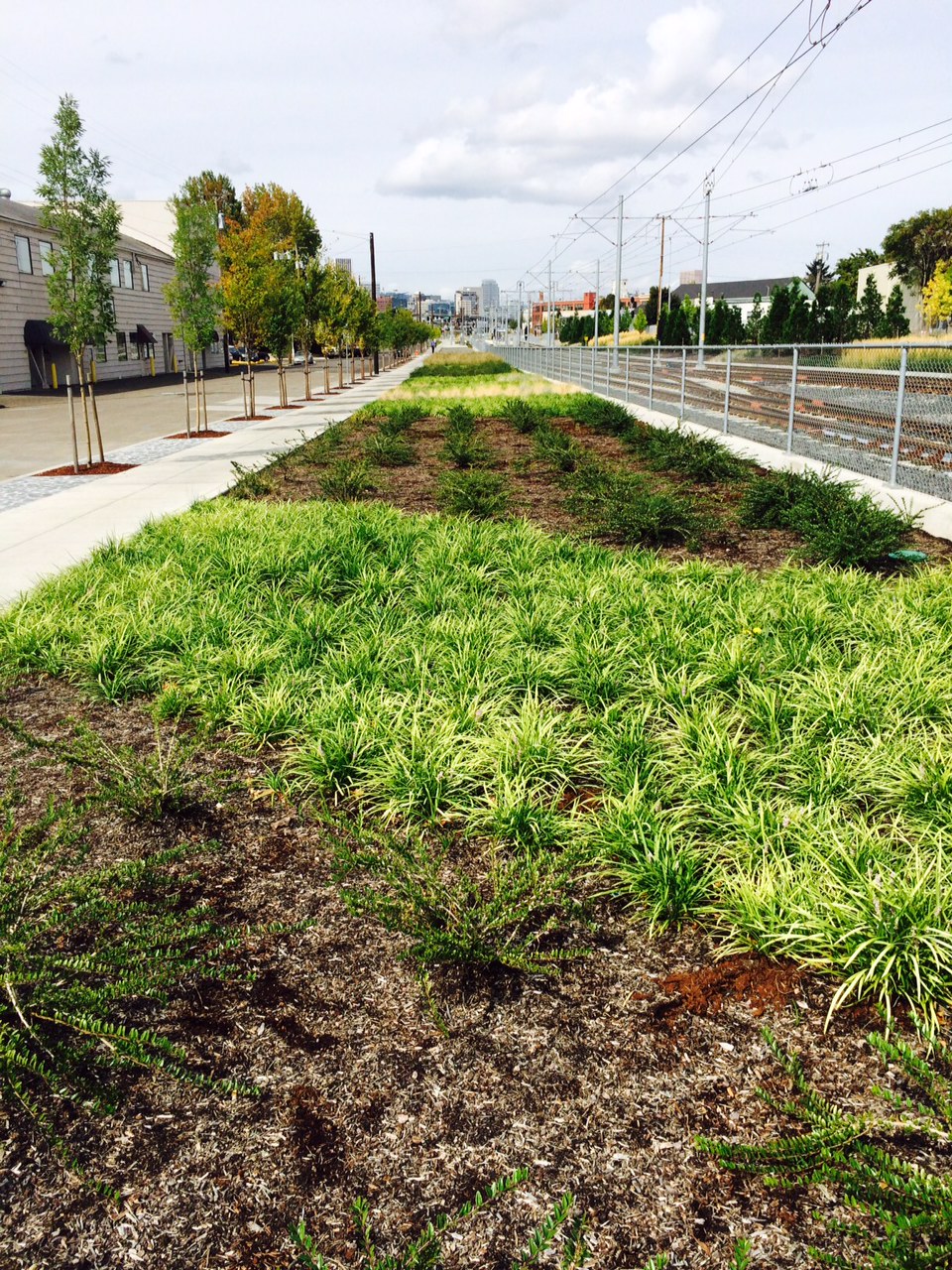
This shows the banded pattern common today in long mass plantings each swath a single species.

This shows the banded pattern common today in long mass plantings each swath a single species going for a kind of landscape scale ‘graphic’ pattern that is less concerned with ‘fit’.  This is near the Clinton/ SE 12th stop.

Size matters.  In horticulture it changes everything.  Things that are inconsequential, or maybe even enjoyable in the backyard garden, can quickly become daunting or onerous when the scale is ramped up.  Working at a commercial or institutional scale has to change your entire approach to the landscape.  In a small garden it is easier to accommodate mistakes, the conflicted combinations and those issues of horticultural ‘fit’ that we missed when we design or install.  Scale, however, rubs our faces in it everyday, makes us pay with aching backs as unintended consequences play out across the thousands of sq.ft. and acres.  It becomes a matter of physical survival and undermines your professionalism.  You become perforce part laborer, part diagnostician, designer, plantsman and critic….Out of necessity you sharpen your critical thinking skills and the last thing you ever wanted, your sales skills, as you work to sell your ideas to management who are absurdly ignorant of the problems you face everyday in the field.  And, then, eventually, you retire, but you don’t turn it off…you can’t.

Which brings me to the MAX Orange Line and its landscapes.  When I did horticultural design review for large capital Parks projects, it often felt like a dueling match.  I would pour over the design, whatever the stage it was in, match that with my particular knowledge of site conditions and my maintenance experience within Parks.  I would state my concerns on paper and in meetings with the Project Managers and Architects.  I was stubborn and consistently found myself up against a process that undervalued horticulture and my input.  Good horticultural practice was regularly placed in a losing position opposite not just that of the Landscape Architects but of a very political process that tried to give the public what it wanted as long as it fit within the Architect’s vision.  Horticulture always came out a poor third, even though good horticulture always saves money in the mid and long runs.  It was exasperating.  The public, by and large is ignorant of horticultural practice and no effort is made to educate them at any level. Continue reading

Choosing a Tree: Issues of Structure and Growth

Right Plant Right Place covers a lot. Usually when you hear it used the speaker is referring to matching the plant with the growing conditions: soil, sun, climatic conditions, size, etc. Here, I’m going to address the physical structure and growth of a tree as it relates to place, Carpinus betulus ‘Fastigiata’, in this case, as it is often used as a ‘street tree’. The Upright European Hornbeam has proven its value as a street tree. It is very adaptable to conditions in our region that exist at the curb. That being said there are questions of structure and growth that need to be asked if such a planting is going to be aesthetically successful over the longer term.

Hornbeams across the street from my house after pruning

Hornbeams across the street from my house after pruning

Continue reading

Katsuras as Street Trees: picking the right tree

photo 1

Sometimes it pains me to take walks.  I was on my way home from the Imperial Bottle Shop and Tap Room, walking down SE 26th south of Powell Blvd when I came across these four Katsura trees planted in a 4′ wide parking strip, no curb parking with a painted bike lane right next to the curb.  Katsura trees 24″ from the bike lane.  How is that going to work?  Trees grow.  Branches extend and caliper up.  Branches hit bicyclists and pedestrians in the face and people crash and or break branches. (Yes, I know these can be limbed up over time but we all know how often that doesn’t happen and what are these trees going to look like if all of the branches are cut off of the street side up to 14′ for traffic clearance.  Trucks regularly use this street.)  And then there’s the whole it’s just the wrong plant for the growing conditions thing.  Katsuras grow in the mixed woodlands of Japan with moderate temps and summer rainfall.  So that looks like 3 strikes out of 4 pitches.  Landscape architects still love these…so do I, but planting them in positions with reflected heat with limited root runs through compacted mineral soils!!!! It’s 90 degrees today, their foliage is stressed even with their water bags filled around their bases.  I have seen many more bad examples of Katsura use over the last 25 years than i’ve seen appropriate.  If you’re going to plant them plant them in a woodland or along the edge where they will be protected from intense direct  sun and make sure they have a long cool root run.  This is so wrong.  Now we’ll all have to watch these limp along getting by stressing until they die or become so damaged someone removes them. Continue reading