
Another less common slope dweller is Holodiscus microphyllus, or Bush Ocean Spray, a deceiving name, or Rock Spiarea, which is also somewhat confusing. Confusing because Spiarea is the genus name for an entirely different genera of shrubs. So I call it simply Holodiscus. ( Botanical names can be confounding to the uninitiated. I’m not a big user of mnemonics, but I still remember first learning this plant’s close relative, Holodiscus bicolor, and the phrase immediately came to mind, ‘Holy Discus, Batman!” I know, silly, but I doubt I will ever forget that plant.)
-
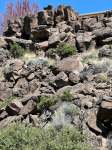
- The three darker shrubs, here are Holodiscus. There’s a Wax Current at the bottom of the pic still in flower just above it in light gray is some gray rabbit brush. more of each or scattered up slope. The tumbled boulders are part of the fragmenting canyon rim, originally deposited as a part of the Deschutes Formation around 5 million years ago, about 4.5 million years before the Deschutes River was redirected to its course here where it carved the canyon over a period of around 300,000 years.
-
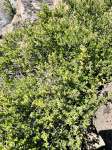
- The leaves are very small and relatively thick, both of these traits are common among plants native to arid country, while many desert plants also retain their leaves, conserving nutrients and water. Like all deciduous plants Holodiscus must spend a lot of energy, and material reproducing leaves, before they can begin photosynthesis and replenish their starch/energy stores. Evergreens/evergrays are always ready to grow and take advantage of moisture and unseasonably warm temperatures at any time of the year.
-
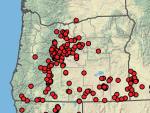
- The Oregon Flora project has been compiling a descriptive list of all of the native plants in Oregon. Each red dot represents where a sample was collected from by botanists. Many of these samples are preserved in herbaria for research purposes. As with all such maps, these dots don’t mean that the plant will not be found someplace else. Botanists have not examined every square inch of the state.
-
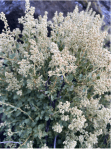
- This will all pop open as little 5 petalled, ‘rose’, flowers.
-
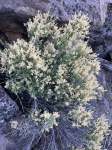
- Holodiscus on the eastside slope early July, their buds expanding.
This typically occurs on the eastern flank of the Cascades and in the mountains of SE Oregon. The common name, ‘rock’, suggests its preferred sites. I’ve not seen one in Dry Canyon bottomland. It seems most common below the east rim north of the Maple Bridge.
iNaturalist is a citizen science site also used by expert botanists. Here interested amateurs and professionals alike enter their ‘finds’ into a shared data base that anyone can examine. The link is to their page for this Holodiscus. You might notice that they have assigned a different name to this, Holodiscus discolor var. microhyllus. This is a synonym used by some. Nomenclature, the naming of plants, even at this level can be contentious, in part because plants, like people, ‘refuse’ to ‘behave’ uniformly as a whole. Variation and change in nature is never ending.
Check out their site. Each entry has a picture of the plant observed and a more or less precise location assigned by the gps in their camera/phone.
https://www.inaturalist.org/observations?taxon_id=80943
Both iNaturalist and the Oregon Flora sites are available to the public to help us learn and identify what grows here. The exact number of plant species native to Oregon is not known, but current estimates put the number at around 4,700 different species. This may seem like a lot, but isn’t really when you consider that there are 374,000 species worldwide.
 GardenRiots