
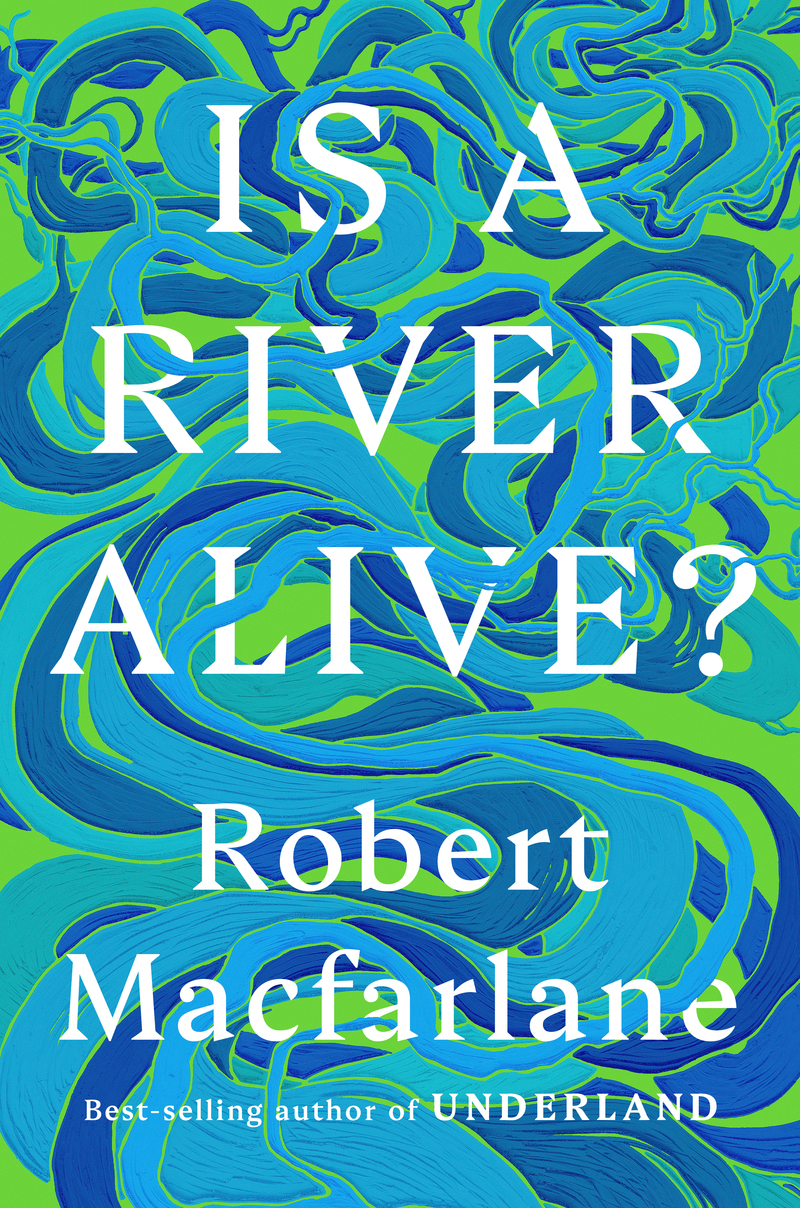
 Being a horticulturist, a student of ecology, evolution and all of the usual life science topics, my reading list is long with books I find and others recommended to me by friends. This most recent is one of the latter, “Is a River Alive?”, by British writer Robert MacFarlane. I hadn’t read any of his other books and my friend John thought I’d enjoy it…I did. I listened to it and, as it was read by MacFarlane himself, he added a bit of rhythm and emotion in his reading that would not have been there were I reading it in book form. This is particularly significant as you read the more emotionally driven sections, which, in this format, the ‘Canadian’ section, turns out to be a rollicking, adrenaline laced adventure story.
While focusing on rivers, this is a book about the rights of nature, legal and otherwise. Why, does the growing community of such thinkers and activists, seem to think nature, in all of its forms, from fungi to mountains, rivers to oceans, the grandest to the most minuscule living species, deserve rights comparable to we humans? What makes them so special? MacFarlane and his compatriots, would turn that around, instead asking what makes we humans so special as to deserve that which we deny literally all others? Their only value, in how they serve us….The rights of nature proponents do not argue simply for their own favorite species or place, many of those so advocating, and protesting, come from thousands of years old indigenous traditions, peoples who have always recognized the links between all living things and those places and forces which permit and support them. And this isn’t because they are simple, backwards, savages or naive. Such thinking is not born out of the heads of green patriots, earth firsters and narrowly focused academics. This is a movement based on memory, connection, of those living in relationship with, in which respect for all things comes first, a world in which life is a gift, to be treasured…all lives, all species, all places, it is a remembering that no one individual, species or place is so special that any and all others may be sacrificed for its needs, its demands, its hungers.
MacFarlane’s path here is a river bed and the water that flows through it, animating, literally, the landscape it penetrates, in ways and patterns much like our own circulatory system. The flow, the power and chaos of it, its eddies, infinite meanders and rapids, its unpredictability, what it carries and nourishes as bringer of water and life, just as ready to demand its toll of one’s life, should one dismiss it, enter in in ignorant relationship.
MacFarlane tells his story through three rivers and the stream that flows and wanes, nearly to death’s stillness near his Sussex home. He offers perspective, takes us to the mountains of Ecuador, the flood plain of Chennai, India and the remote and wild Magpie River of Quebec, taking the reader along showing us its meaning, its value to place and the horrors we inflict on them as we struggle and flail through late stage capitalism, to something more survivable, something more humane. The horrors are aplenty, the losses severe and continuing as larger societies keep their focus narrow and ‘ahead’, relationship free, in a consumptive rush that refuses to acknowledge our intimate connection to the world around us. Water is life, he writes, so what does it mean when we time after time, stymie its flow, contaminate its purity or ignore its essential nature as we put the landscape, and all things in it, to ‘good’ use, or as ‘Neo-cons’ once said, to wise use, in every way an oxymoron. He asks, is profit for the few, profit that keeps the economic beast powering ahead, consuming all that it can, disregarding whatever it can find no profitable use for, is that what we ought to be doing? If not how do we assess the balance, maintain the natural ledgers so that they do not fail? So that we, ultimately, do not fail?
Robert’s telling of this is direct and immersive. There is no feigning of objectivity here. His intent is to bring the story of these people he travels with to us the reader, his listener. He is a writer and artist, painting with words, building an image of action, often almost poetic, as he attempts to unlock, steer and motivate us. He is there at the spring with his son Will near their home; with Ecuadorian ecologist Agustín Bravo, biologist and fungal advocate Giuliana Furci, legal scholar César Rodríguez-Garavito, and a local guide named Ramiro, where we meet Josef DeCoux at his rough cabin, his home, where he serves as sentinel and defender, and later, while the small group struggles up the mountain through the always wet, and astonishingly diverse, cloud forest to the river’s beginning; with Yuvan digging in the sand for turtle eggs and later, carefully reburying them in the protected ‘nursery’, under watchful eyes to better ensure their survival so the hatchlings might at least make it back down the beach to the sea the sea where a polluted and dying river ends; and paddling, suspended, over everlasting seconds on the crest of a standing wave, before being violently cast down into its trough, he and friend, Wayne, talking about life and meaning on the edge of the gorge in the early dawn light. He does this to give them, the ‘champions’ of these places, of their people, the species which collectively make them up and the rivers themselves, voice. He cares deeply and this is what he found, through these journeys, that he can do…tell their stories, all of them, so that we might know them and like the waters of the rivers themselves, flow through us, become of us, so that we become part of the desperately needed healing. In these ‘segments’ we come to see the river not as an inert thing, but as an energetic process, a process without end or beginning, its crossing of land to lake and sea only its clearest manifestation, an endless cycling of water to the sea and back, purposeful and life giving.
The Ecuadoran, mountains, have withstood a long history of resource extraction, a rapacious Spanish invasion sacrificing local indigenous people in their taking of gold and silver. Over centuries, as the reach of technology and economics extended, this economic ‘rape’ has reached ever further back into the Andes from ports and roads, now to the headwaters of the Rio Los Cedros, a rugged land still populated by its local indigenous people who have lived there for thousands of years, side by side with it, taking what it offered, adapting to the land, respecting it, allowing it to continue prospering so that they too might. Other watersheds, throughout Ecuador, have suffered the greed of resource extraction for over 400 years, the Spanish first, and now international, faceless and efficient, mining companies, twisting and abusing local laws, consuming entire mountains in the process and all that lives upon them, the native people’s offered jobs, to participate in the destruction, of the land, its waters and all that has long sustained them, for a meager, life destroying existence, until the ore is exhausted and the company moves on leaving the people and remaining life to eke out a survival that is always less than, sometimes in a poisoned landscape, cyanide leach ponds, which no one has a cure for, leaking into and poisoning the land, the mining corporation, profits, firmly clenched, moving on to the next extraction point to repeat the endless taking.
This is the modern Ecuador, which is finding its people’s voice, the voice of the land and rivers, voices previously unheard, ignored. Ecuador, is the first country to rewrite its constitution to emphasize that nature too, the land, the rivers and species native to it, that are of it, have rights. The endless taking must stop. Corporations, created only a split second ago in geological terms, have seized the rights they emphatically deny to everything else, to all others, claiming the right to take what isn’t theirs, that is essential to the life of place. But this change, this claim for rights and the protections that flow from it, is becoming ever more highly contested, by people, thoughtful, passionate individuals in cooperation with indigenous communities still remarkably and powerfully tied to place, the place they share with everything that sustains each other. They battle in the courts and legislature, in the mountains of Ecuador and have historically suffered violence and death from their own armies and corporate thugs. The faceless corporations push back with legal papers, fraudulent contracts, boots and bulldozers on the ground, physically insistent, because unjustified power never simply yields of its own accord. From Ecuador this idea is taking broader legal form. It is becoming a battle. In the mountains, the legislatures and courts around the world, with the exception of the US, which is in a continuing state of denial, or betrayal depending on how you look at it. This contest is ongoing.
MacFarlane introduces the Ecuadorean actors, two courageous, unassuming judges who made the rulings that awarded protection to the Los Cedros, a mycologist in pursuit of rare fungi and her own healing, a sound artist recording the minute voices of the wild and the Rio Los Cedros’s fierce defender and recluse, an American who found his home and purpose here. MacFarlane illuminates their passions and writes of this work’s absolute necessity. He writes of the loss, what is at stake and the horror that the political and economic status quo demands. There is nothing so sacred to many as the desire and ‘right’ to their next dollar.
From Ecuador he takes us to Chennai, India, formerly know as Bombay, through it the once great River Adyar, drains the massive plateau, the tendrils and tributaries of its vast circulatory system, carrying and bringing life to the land it enlivens, the life it permits. This is location, the terrain, the remoteness, is the polar opposite of Ecuador’s Rio Cedros. is the most dispiriting of Macfarlane’s visits. Here the river is reeking and sewage-stricken, it is, he writes, “as close to death as any river I have seen in my life”. And the Ennore Creek, a site of heavy industry, hasn’t just been infilled, built over and surrendered to heavy industry, but has been erased from the official government map, as if it didn’t exist: annihilation cartography. Amid the toxins, hope for rivers is hard to find. Here, at the rivers end it naturally fragments, slows and spills into the sea, cutting and flooding through ignored wastes of undrained, some would say useless land, where society has discarded its own designated human ‘waste’, the economically unneeded, subsistence fishers of spoiled and polluted waters, of discarded and mostly ignored poor survivors. India has a long tradition, a well entrenched class system, where hierarchy dominates and lower classes barely ever effect the decisions of the powerful…but even in other advanced countries we are stratifying ourselves this way, more and more, as power and wealth accumulate at the top, leaving the rest of us poorer, deprived and ignored. A river’s story, the value of nature includes our own.
We meets local advocates of the river, Yuvan in particular, its sprawling delta and swamp lands where it pours into the sea, the Mangroves that shelter its edges from storms and filter out the pollutants at least until they can’t. This is an area almost wholly surrendered to the political machinations of those that see only dollar signs in ‘development’, utility and consumption, that literally, cartographically, politically defined a river out of existence even as it still flowed, so that heavy industry could occupy, consume and pollute it, poisoning the air and water that common people still try to eke out a living on as the pollution from petrochemical plants and oil refineries spew their effluent into air an water, poisoning the people, sowing cancer and taking their profits, the river channelized and contained, the delta and swamplands drained, no longer capable of serving as a necessary sponge to hold back flood waters, everything hardened, built on and drained, utterly transformed and reduced.
MacFarlane spends all of the hours of one night on the beach with neighbors and rescuers, attempting to soften the slaughter of sea turtles who have, for perhaps millions of years, used this beach as a nesting ground and nursery for their hatchlings. He describes the impediments to this necessary quest, the lines of nets off the coast which trap and drown pregnant females on their way to lay in the sandy beaches, the fishing boats and other obstacles on the beach they must traverse to lay and retreat, that their hatchlings must also negotiate, the dogs that roam the beach seeking out the nests and then devouring so many eggs. This river Adyar, this place, has a coterie of volunteers, of little people, who still manage to see a better future and despite all of the political and corporate players working so selfishly against them, persist, and somehow, miraculously, attain small, but significant victories.
In the book’s last section, MacFarlane takes us to the Mutehekau Shipu (also known as the Magpie River), in far northeastern Quebec, to a place few, but the Innu, the local native people have ever seen. Canada’s is a vast, little inhabited, landscape. Trekking westerly from the ‘Magpie’, clear across the country, one would only cross two highways, in 4,000 miles, This is an ‘unknown’ landscape and what is unknown, in our society, is often little valued, so the remoteness, that previously, has protected it from development, now potentially serves to leave it vulnerable. Who will care? Who will ever know this place other than from brief mentions in the media?
The Magpie is a place whose existence is threatened by the utility Quebec Hydro with plans to build massive hydro-electric dams that will flood the valley and gorges, their forests and wildlife, beneath billions of liters of stilled water, the sediments entrapped there, a river, whose transformative powers, have eroded down through the mountain’s base rock, Canadian Shield, the oldest, and hardest, rock yet discovered on Earth.
After meeting with local indigenous people and a poet, who takes the author and his questing American friend aside, for her own particular teaching on the meaning of the river, this land and our place in it, MacFarlane and friends, local outdoors men, some with unbelievable whitewater skills, strength and their own intimate ties to the land, fly into the remote location, paddle for several days across the lake, locals describe like an inland sea, before being buoyed and tossed down the Magpie through class 4 and 5 rapids, portaging what they must, and taking in a pristine landscape of forests, rapids and falls, narrow gorges. I am not a whitewater guy, but the descriptions of their passage, the physicality of the water, its unfathomable hydraulic power, the mad roller coaster run of rapids, drops, holes and eddies, swirling and breaking, engulfing them, simultaneously terrifying and exhilarating. MacFarlane is a superb wordsmith and is able to construct an abstraction of sound, that pushes, prods, overwhelms and threatens to drown the reader. If any river is ‘alive’ this one is, its seethes with power, demands respect, that others like Chennai’s Adyar, can’t…and that is probably why MacFarlane finishes with it.
This ‘last’ trip is meant to do just that, give the reader the idea of that experience, some sense of what is potentially to be lost…all of its exquisite beauty, wildness and terror. Each of his companions provide their own experience and the overall effect is other worldly…and that is what he intends to do. This is a wakeup call. Not intended to shame one into action, but to wake one up. This world is not here simply for us to experience, it has its own reasons for being, its own equally, or even more, valid reasons for being…and how much smaller our own lives would be should all the losses of, all of these lives, keep occurring, because we, all things, are intimately connected, related and dependent. If we don’t sense this, then that is on us, our own failure. If absence, if remaining unknown and distant, rather than connection, is the only thing staving off such terrible losses, then we have already lost something essential to ourselves and are at risk of losing everything. Ultimately, when we argue for the rights of a river, of nature, it is at its heart, still a selfish argument. When all things are connected, any loss is personal. Indifference, the pursuit of individual power, attainment, the endless consumption of…only ‘works’ when one is disconnected from the other. This is what we have done when we deny the rights of others, of nature. To do so is an unsupportable claim of not just our individuality, but of our estrangement from nature and others. In doing this we are condemned to spending the rest of our lives attempting to fill a void that cannot be filled, our own ‘wholeness’, this ‘simple’ act of recognition, of the inclusion of others, our only really true and satisfying option. We are all ‘of’ each other. One people. One life. We never had any ‘right’ to take that from others. These are the same inalienable rights described in our own Declaration of Independence, but then, when ‘we’ wrote this, our vision, our understanding, was incomplete. To ‘gift’ these to others now is a recognition of a previous failure, for it was never something we could honestly take. Having taken it, it is only in returning it to all, that we can heal and ‘regain’ ourselves. At the end of his book, MacFarlane writes, “I am rivered.” And so must we all be.
This is a book about paradigm change, about discovering and taking a new and healthier path in this life. To insist otherwise is to remain on our current pathway of loss and disease, of endless consumption and frustration when meaning and purpose lie close to hand. MacFarlane demands a lot of us, but nothing that will cause us hurt. He is suggesting a healing and return.
 GardenRiots