Category Archives: Evolution

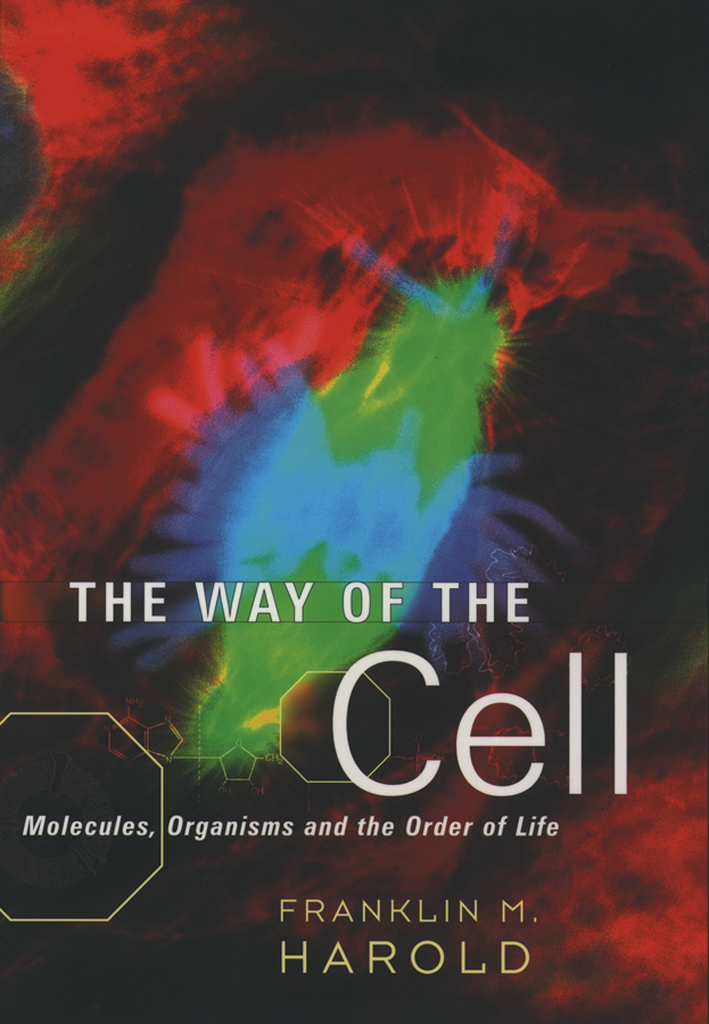
The Way of the Cell: Molecules, Organisms and the Order of Life – A Review (Read This Book if any of the Life Sciences are of even remote interest to you)

I’m an integrator, a contextual learner and a big picture kind of guy. I am willing to ‘slog’ through the details, the analyses of experts, to understand what is going on, when the details help me understand, in this case, the operation or ‘life’ of the whole organism. What are the processes, how do they influence one another and how does that result in the condition we recognize as the dynamic, animated phenomenon of living. Franklin Harold, a professor emeritus in biochemistry at Colorado State University when he wrote, “The Way of the Cell: Molecules, Organisms and the Order of Life”, in 2003, has produced the ‘best’, and most comprehensible, review I’ve found of the life in the cell, to date. This book does not require an advanced degree to follow. It requires an interest in biology. A botanist, horticulturist or even avid gardener pursuing a more thorough understanding of what life is and what is occurring within the plants and animals around will find much that is accessible to them here. This book is not a slog. It is readable and readily comprehensible, though for those with less of a science background, a little more challenging, but hey, nothing ventured, nothing gained. The jargon he uses I would say is necessary. Science can be very precise in how it views its subject, necessarily so, because meaning becomes lost when the precision of language is too generalized. I’m adding it to my own library. I include some extensive quotes here to give you a sense of his style and philosophy. I also gleaned much from these particular passages. In school I endured too many professors and lecturers who seemed more interested in impressing their students with their own brilliance, and our inferiority, and came to relish those who were true teachers, who were able to impart to their students, there own love and fascination with their topic. Harold is one of these. He set out to write a book that would reach out to the reader making his topic more accessible, more comprehensible and thus widen the circle of understanding…and he has succeeded.

The cell, scientists would agree, is the smallest fully functional unit of an organism, any organism. It is the basic structural unit that has been joined together to create larger, more complex organisms. If you attempt to reduce it any further, divide it into its component parts, which science typically does in its process of reduction to understand it in its parts, it loses functionality and dies. Single celled organisms, bacteria, archae, and the larger single celled eukaryotic organisms, like amoebas, comprise the majority of living species on earth, by both number of species and by sheer mass. They are as complete as any single organism, like ourselves, a Redwood or Blue Whale, can be. Whether a single celled organism or a massive multi celled organism made up of several billions of many thousand ‘types’ of different specialized cells, almost all cells are capable of all of their essential functions, as long as they are supplied with proper nutrients and flows of energy. Cells, as Harold describes them, are highly coordinated ‘societies’ comprised of many millions of individual proteins, enzymes, lipids and ions, with various forms of RNA, bound within a protective, limiting and self-regulating membrane, often with other internal membranes, which protect and allow other more specialized functions within the cell…and DNA, or in the cases of some bacteria, RNA, which contain the ‘code’ which prescribes the organism. It is within the cell membrane where the particular mixes of their constituent parts are held in dynamic flux, where the ‘work’ of living occurs. Within what was once described as a ‘soup’ of chemicals, suspended within a virtual sea of water, the cell conducts the ‘business’ of life. Today we understand that within a single cell water molecules far out number any other substance. Cells possess a complex internal structure, a cytoskeleton, grown from proteins, that is integral to the transport of metabolites, the regulation of its thousands of internal processes, the structure of the cell itself and essential to its ability to respond and move. The actions within the cell are largely self-regulating, influenced, certainly, by outside, and internal energy gradients. The various reactions influence the rate of other reactions in a complex system of feedback loops, with a ‘logic’ often compared to that utilized by a computer. Processes are chemical, electrical and ‘mechanical’ as one reaction induces a conformational change, a change in ‘shape’, of a particular protein or enzyme, which directly influences what it can do. These changes in ‘shape’ act as effective ‘switches’ within the cell, switches operating amongst thousands of other such switches, creating an intricate system of feedback loops which regulate just what the next step will be. Only functions tend not to be linear. They can be extremely complex, with a redundancy that also allows the cell to vary internally widely, while maintaining itself, overall, in a relatively stable state. Its internal complexity then accounts for its responsiveness and adaptability. It imparts a degree of flexibility, of adaptability to a system within the cell. All of this going on at a molecular level that plays out, with powerful effect, at the organismic level. Continue reading

Democracy, Inclusion and Full Citizenship as Biological Imperative: Arundhati Roy and the Politics of the World

When we open ourselves up to the world, travel to other regions and countries, see and live in different geographies, experience other cultures, climates and biomes, we have the opportunity to be intimate with and understand world’s very different than our own. The world is vast and its peoples and organisms, though astoundingly diverse, are closely related. Even if we could travel ‘everywhere’, having a meaningful experience with all of it is simply not possible. It is dangerously presumptuous to assume that anyone of us might understand all of this. Such travel, should we want to, isn’t possible for the large majority of us, which does not mean that there is therefore no point in traveling to where we can. If our goal is deeper than simply ticking off places and experiences, if we are seeking to understand, to ‘grow’ ourselves, our limited travels can still serve us. For the rest of us it is through reading and the sharing of stories that we can gain such insight, as long as the authors, our guides, are themselves astute observers who are engaged in the places and peoples of which they write. There are many such writers…I can think of none better than Arundhati Roy who writes so beautifully, imaginatively and painfully of her beloved home India. Continue reading

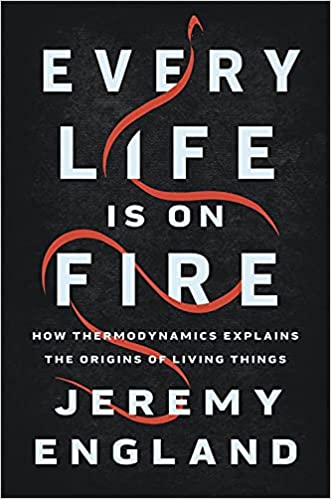
Every Life is on Fire: How Thermodynamics Explains the Origins of Living Things–A Review…and a Deeper Look Into the ‘Fire’ of Life..

This is a book about ‘life’, that which animates particular organic structures, organisms, while other, non-living, ‘structures’ remain fixed, but for the physical and chemical forces which wear them down. From our human perspective, this sets ourselves, and all other living things, apart from the inert, nonliving, matter that comprises our world and the universe. England, as a physicist, sees the world of nature and all matter within it, differently than most of us. Science has demonstrated that the universe tends to operates under consistent ‘laws’. Organisms, while a special ‘class’ of matter, are still ‘of’ matter, composed of the same atoms, only joined together in complex macromolecules not found outside of organisms, created wholly within organisms. They are a ‘family’ of complex, shared, organic structures. This complexity of structure goes to determining their functionality. Function increases and diversifies as complexity increases. Capacities are expanded with the flow of energy through them, an effective and sustaining agent in their ‘being’ and evolution. England’s view is consistent with the many other physicists who have looked into life and view it as an inevitable outcome of the processes, energies and materials that comprise Earth’s particular corner of the universe. Earth appears to be a relatively rare occurrence, but it is extremely doubtful that it is a singular one. The ‘ability’ of energy to organize and structure matter is universal. Given the particular mix of ‘ingredients’ and energies here on Earth, matter has come together over the course of over 4 billion years to form life as we know it, because it could, and whatever is possible/probable tends to happen with a degree of frequency. Particular patterns precede those to follow, not necessarily determining them, but increasing the likelihood that they will. The flow of energy through matter tends to ‘favor’ a range of outcomes. Those outcomes tend to favor the next, building from one ‘success’ to the next.


These patterns and energy flows occur at subatomic to molecular levels, well below our ability to observe and measure them. We can only directly observe the ‘results’. The underlying patterns are not generally obvious to us.  Our perceptions are shaped by our the physical limitations of our sense organs and our beliefs about the world. We tend to ‘see’ what we expect to see, not necessarily what is there. We shape our perceived world into the commonly shared story that has been passed on to us, a very human story. Our particular indoctrination, our educations, all go toward determining what we see, how we interpret it, and then taking our experience, we use it to reinforce that understanding. In a sense we ‘choose’ and make our reality. From the moment we each open our mouths or put word to page, we do this. Our language and knowledge limit us. It requires that we distill our perceptions, our experiences and our understanding into a comprehensible form. We are all at a ‘remove’ in this sense, apart from the world in which we live, although we are intimately immersed in it. And that is the source of much of our difficulty, for like fish swimming in a stream, we are ‘of’ this place, a part trying to understand its extended self, our boundaries, self-imposed, insistent upon our individuality and our misunderstanding of what that means in a world that fully integrated and interwoven.

As ‘western’ people we tend to see ourselves as separate from it. Independent agents. When in actuality, we can never be so. To be so independent, separate, would negate that which is essential to our lives, the flux and flow of energies through us, as parts of a larger, complex and whole system. England looks into this question of what life is by taking our modern and still developing theories of ‘thermodynamics’, our study of energy and the way that it ‘works’ on the stuff of the universe, on matter, as his way into this ‘story’. Energy is transformative. Matter, is arguably, a particular expression of energy. One can be translated into the other.


England is a theoretical physicist. You will not find in this book a detailed explanation of the living organism or description of the flow of energy through one. That is within the purview of the cell biologist, the biochemist, the quantum biologist. Thermodynamics, and his understanding of dissipative adaptation are larger concepts that can give us a framework for understanding the bigger picture of an almost unfathomably complex topic. England joins with those today who would argue that any living organism is not so much a thing as it is a process, in a state of continuous change, a process which both follows a probable, understandable, path, and is itself a part of the larger/longer process of evolution, of becoming, building on itself and life’s many patterns, as it moves ahead through time toward something unknowable to us. We exist from moment to moment, a ‘response’. Fall out of that moment and we are dead. Through us, the flux and flow of matter and energy, drive an organism, along a path, a path that follows one of a particular and massive set of more or less likely probabilities, each which influences what will follow, within a universe of definable ‘law’. Here England gives us an intellectual framework for understanding the processes at play in this process of living. Living organisms are conductors of a continuous flow of energy through themselves, from outside and back, after it has degraded. This flow of energy acts in very particular ways on the molecules, cells, tissues and organs of an organism…until it no longer can. An organism, is in a sense, a conductor, a channel through which energy flows from a higher, more available state, to a lower, less available state. Energy drives them, permits them and enables them, so that they are in this sense ‘self’ sustaining…as long as the energy flows and the organism can maintain the integrity of its structure at all levels.


The following is an extensive quote from his book: Every Life is on Fire: How Thermodynamics Explains the Origins of Living Organisms, pp. 113-116.


“…a plant—for example—has to be thought of as holding steady on a steep [energy] hillside in a constant state of free fall. Much like the chemicals in a battery powering a flashlight, many molecules in a plant are constantly undergoing reactions that convert them into other, lower-energy forms. At the same time, randomizing thermal fluctuations are taking the specially ordered components of each cell that have been assembled in a particular fashion and wreaking havoc with them, either through chemical damage or via larger-scale physical rearrangements. In permanent darkness, a plant is therefore on a slow road to death, for dying in physical terms is nothing more than sliding downhill in a variety of chemical and physical ways. Of course, plants can survive just fine for a while in the dark, but not forever. [Animals, for the most part exist in a much more precarious balance requiring much higher energy flows for a given mass.] Eventually, the twin tendencies to lower energy and higher disorder that are required by the fall to thermal equilibrium will win out, and the pile of matter that was originally a live organism will start to look less and less like one.
Continue reading

A Review and thoughts on Peter Hoffmann’s book, “Life’s Ratchet: How Molecular Machines Extract Order from  Chaos”, Basic Books, 2012. 

This is a relatively technical book, one whose title, with its definite mechanistic spin, nearly stopped me from reading it. In this Hoffmann begins with a history of science and how we have looked at life as a remarkable process from the days of Aristotle to today and how that has shaped our inquiry and our capacity to understand it. Is life possible only because of some inexplicable, and yet unknown, ‘vital’ force? Are organisms endowed with this gift of life by a creator? or are there physical laws which shape and determine life? There has been a long ‘battle’ waged between the various ‘vitalists’ and mechanists, the later who once viewed an organism as a special machine, popularly comparable to a watch or clock, animated by a ‘vital’ force, who over time evolved their search into that of more recent times of seemingly fantastical molecular mechanisms, ‘engines’, within an organism which, because of their nano-scale can perform and behave in ways that appear incredible to the layperson. Continue reading

Musella lasiocarpa: An Adaptable, Smaller Banana for Warm to Mild Temperate Gardens

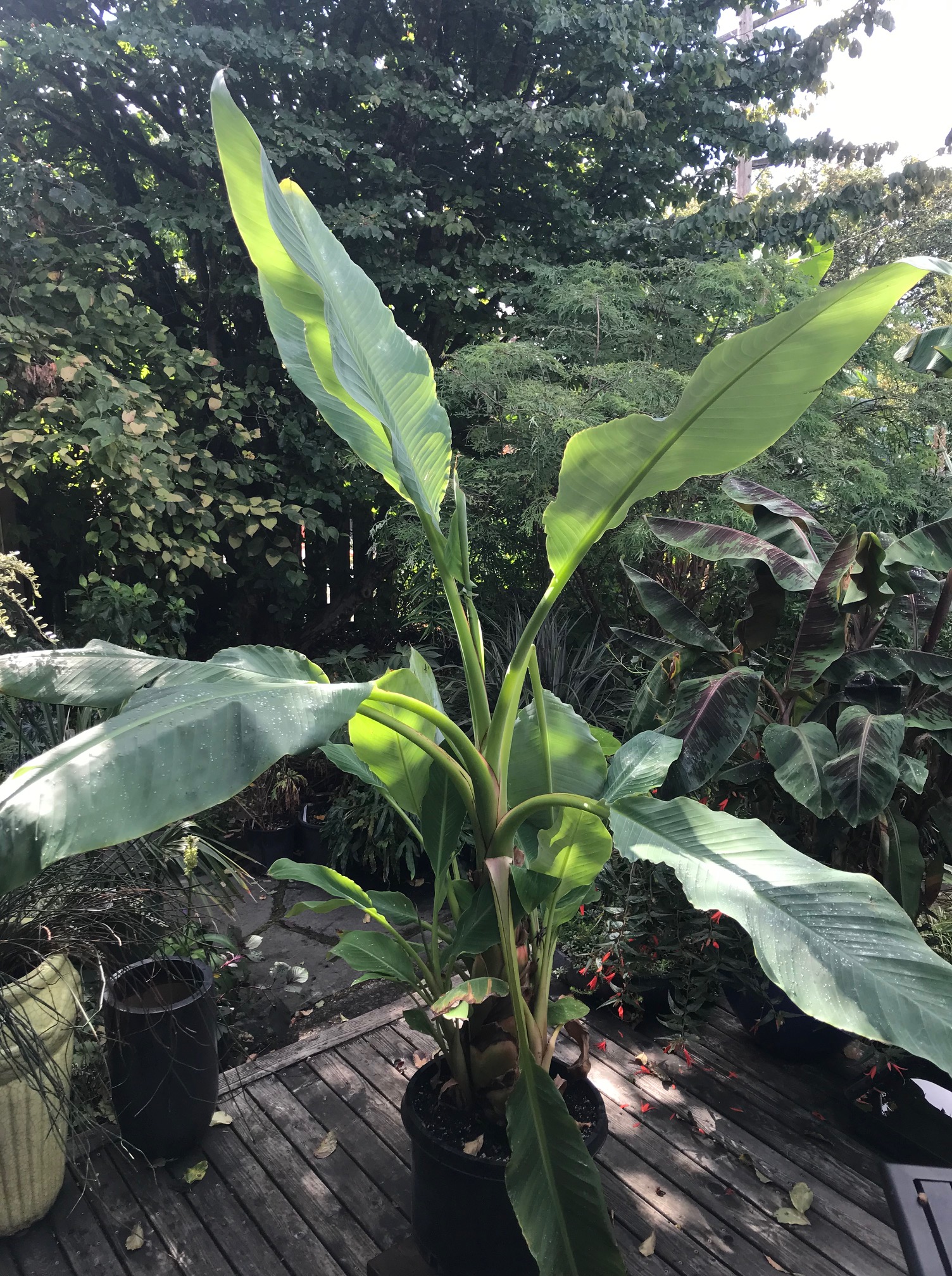
I’ve been growing Musella in a larger pot as well. It performs much as it does in the ground reaching similar size, getting along with comparatively little water. This plant suffered no leaf scorch even during our record breaking streak of 108º, 110º and 116º in late June ’21. It was protected in shade in the afternoon. Here it sits on the deck next to my Musa accuminata ‘Zebrina’, a Malaysian tropical, which did suffer a lot of marginal leaf burn, losing several of its softer, newer, leaves, even with daily watering of its pot during the hottest stretch (It quickly recovered after the temps settled down.).

Musella lasiocarpa may be the most easily recognized of the 48 species within the small but economically important Banana family, Musaceae. It is distinguished from all others by its small size, its congested, quickly tapering pseudo-stem, which is nearly bulbous at its base, its leaf blades extending upward from its relatively long petioles, shaped much like the traditional blades of Aleut kayak paddles and its unique flowering structure. Like all bananas the pseudo-stem is made up of tightly clasping, channeled, petioles, and its inflorescence which resembles a golden lotus flower in bud, with tightly held yellow to orange bracts having very little separation from one to the next, shielding its later emerging flowers tightly held beneath.  The shape of this plant and its texture lies somewhere between the more commonly grown ,and proven, hardy members of its Order Zingiberales, the Hedychium spp. and both Musa Basjoo and Musa sikkimensis, which often fill a role in providing many mild to cool temperate gardens with their ‘tropicalesque’ characteristics. If your garden resides in climatically colder areas than those experienced by topical plants in the wild, then any of these may succeed as permanent contributors to a tropical ‘feel’ in your garden. Of course you can also choose to grow true tropical and subtropical species if you are committed to the necessary protections they will require over your cold season. Continue reading

“Entangled Life: How Fungi Make our Worlds, Change our Minds & Shape our Futures”: A Review

Sheldrake, Melvin, “Entangled Life: How Fungi Make our Worlds, Change our Minds & Shape our Futures”, Random House, 2020.

I have spent most of my life outside amongst, growing, observing or studying plants and yet, every page here has caused me to take at least a moment to reconsider the life I’ve been so involved with. Everything here underscores what I’ve read and learned elsewhere, sometimes casting it in an entirely different ‘light’. While we learn to think of organisms as discrete individuals, fungi, a class of organism separate from the bacteria, plants, animals, even viruses which I’ve been examining, are impossible to consider on their own without looking into their vital relationships with the other forms of life.  While all organisms depend in many ways, great and small, upon other organisms for their support and sustenance, fungi are nearly impossible to imagine separately, their ‘bodies’ being literally intertwined in and around those of others.

Relatively early in the book, Sheldrake describes the difference between fungi and animals in this way, animals put food into their own bodies, fungi put their bodies in their food, digesting what they require by secreting acids and then drawing the broken down nutrients back into their mycelial bodies and transporting them to where needed. Continue reading

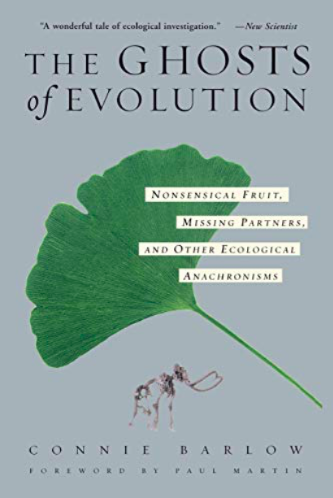
“The Ghosts of Evolution: Nonsensical Fruit, Missing Partners and Other Ecological Anachronisms” – A Review and Thoughts on this Life

“The Ghosts of Evolution: Nonsensical Fruit, Missing Partners and Other Ecological Anachronisms”, Connie Barlow, Basic Books, 2000.

The titular ghosts here are the long extinct mega-fauna species that once roamed the continents for millions of years shaping the plant species in question here and, in their interactions, shaped the landscapes themselves. Now absent their animal partners, these plants still retain the characteristic structures that evolved in their long dance together, the genetic inertia contained within their DNA. These plants remain today as anachronisms, seemingly misplaced curiosities with no existing, obvious, reason for ever being, mysteries of form and function, that only begin to make sense when we look far enough back.

I only recently came across this book while doing research into my continuing interest and focus on what exactly is ‘life’ and what is it that distinguishes living organisms from other matter. This book is a little outside of this topic, but not by much. Barlow here is concerned with the process of natural selection and how species have come to acquire and retain their physical and functional characteristics, how they’ve retained them long after the shaping forces have disappeared. While there is a somewhat random element in the process of evolution, organic forms follow patterns and particular patterns are ‘selected’ over time through the ‘working’ of shaping forces. Forms are supported or not,  Once acquired they remain disappearing with a particular species when it is no longer supported enough and goes extinct. This ‘opens’ a niche for possible other species to fill.  Each species is time limited. Each is a process or event that continues so long as it is adequately supported.  It in turn fills roles in the lives of other organisms, other species. Natural selection is not some process relegated to the past, but an active, ongoing, one, though we tend to fail to see it around us. We have a tendency to expand the ‘now’ and attribute to it a precedence and persistence that it doesn’t have and so we also fail to see our own role in the continuing ‘work’ of evolution. We all know something of the concept of the ‘survival of the fittest’, a process that suggests that today’s species are the ‘best’ fit given the conditions in the world today.  Barlow, and the scientists who support this idea, argue instead that today’s species are the best fit for the past as a result of thousands, even millions of years of evolution. Today is just a moment in time. Our imagining of it as something broader and more stable is a problem. Continue reading

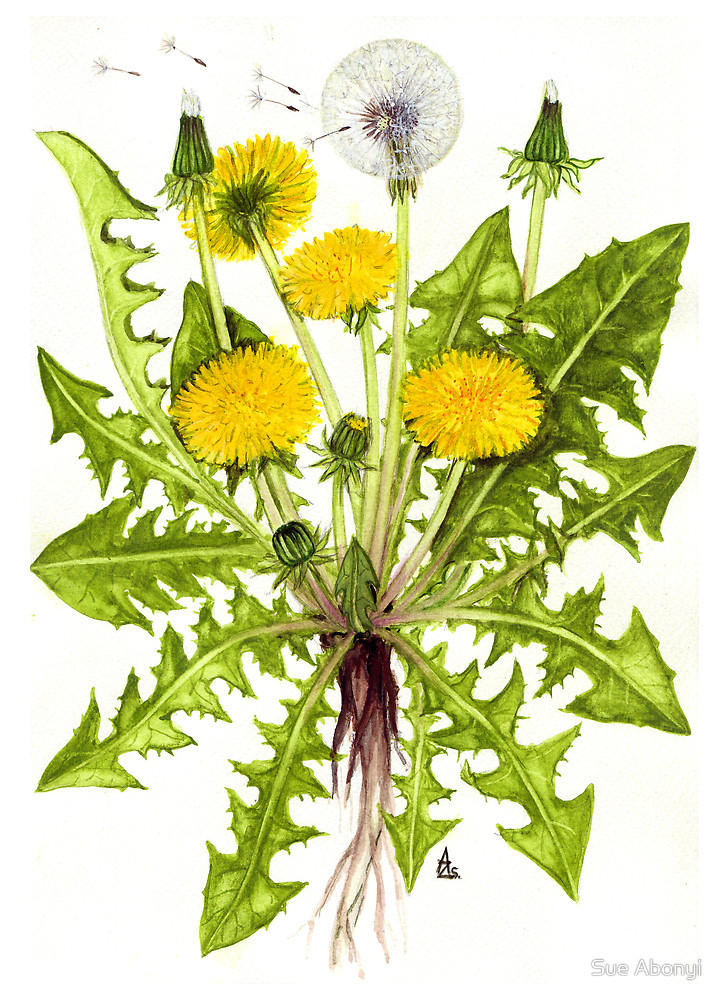
Sex, Evolution and Form: Clarifying the Relationship Between Dandelion and the European Honey Bee

With the artist’s, Sue Abonyi’s, permission.

The European Honeybee, EHB, and the Common Dandelion, are both ubiquitous in our modern urban lives though the one is portrayed as being both essential to our lives while its future is threatened and dependent upon our constant support. The Dandelion in contrast is a product of our disruption of the natural world and our very way of life and continues on as a pest species despite our efforts to ‘control’ it. They viability of the EHB is often linked to the continuation of a large population of Dandelion individuals. The EHB certainly benefits from the Common Dandelion finding ready individuals across our lawns and gardens, but the dandelion isn’t particularly dependent upon the EHB. The common dandelion, Taraxacum officinalis, is apomictic and doesn’t require pollinators at all. Apomixis isn’t a fancy word for ‘selfing’ or wind pollination either…what it means is that it, in lieu of an available pollinator, possess the capacity to skip over meiosis, the entire part of sexual reproduction in which an organism’s typical double, pair of chromosomes, which exist normally in all cells, and are known as diploid, ‘di’ for two sets of chromosomes, are reduced by half, to one set in ‘sexual’ cells, known as gametes, the sperm and egg cells, their chromosomes now ‘haploid’. Then, after pollination, the two haploid chromosomes are reunited uniquely through the process of fertilization. This is is the process skipped over in an apomictic plant. While it possess all of the ‘accoutrements’ of all flowering plants, stamen with their filaments and anthers, pistils with their stigma, style and fused carpels or ovaries, Dandelions are able to ‘short-circuit’ the process and produce viable seed on their own from their undivided, diploid, cells. Ever noticed how Dandelion seed heads always tend to be filled out? Perfectly spherical? Continue reading

Physics, Evolution, Natural Selection and the Generative Power of Far Out of Equilibrium Dissipative Structures (Organisms), part 2

Chemists have often argued that everything is chemistry and if you don’t know about it, what can you really know of the world? A current Periodic Table, one with considerably more elements than were contained in the table from my high school chemistry days, this one including many of those transient elements created in particle accelerators. These ‘new’ elements are very unstable and breakdown rapidly. Some are thought to have existed only at the beginnings of the universe…sometimes in its first moments or during vanishingly rare exceptions. I know, this is very ‘nerdy’, but I go to the interactive table on the linked site frequently to learn about the particularities of elements of interest to me. That table responds to your questions about changing ambient conditions and their physical ‘behaviors’ and capacities for particular reactions. Check it out.

On Pattern, Chemistry and Life

Pattern builds upon pattern.  Whatever you start with effects and limits everything that follows whether we are talking about masonry bricks and stone or Eukaryotic cells and organic molecules.  A different starting point or ‘decision’ at any point in the process, effects every ‘decision’, or even possibility, there after, effects the likelihood of what is to follow, shapes the possibilities, the future, through the evolutionary process…but does not determine it.  To speculate whether other amino acid groups are theoretically possible does nothing to change the course we are on.  The capacities and characteristics of your most basic components set the stage for all that follows, the brick analogy only takes you so far.  Bricks, no matter what you do with them, are very limited in what they can create…how they will ‘behave’ when structured as a wall.  They do not, when combined into a structure, acquire properties that no single brick had before their assembly…their futures were ‘decided’ the moment they were made into bricks.  They remain bricks. Continue reading

On the Chaotic Unreality of the Real and How We Redefine It: Reimagining Reality in a Probable Universe

Jean Auguste Dominique Ingres, The Grand Odalisque. Ingres was a Neo-Classicist, who attempted to create images that mimicked ‘reality’ even as it distorted it for effect, lengthening her spine and her impossible twist of pelvis. Ingres began painting at the beginning of the 1800’s in a world coming to be dominated by Newton’s mechanical view of the universe. Realism would become a dominant style by the end of Ingres’ career. The solidity of reality. What is, is!

Because the pace of change in our scientific understanding of our world, and the technology which follows it, is increasing at greater rates in recent decades than at any other time in our history, it has become ever so more important that we have at least some basic understanding of that science and technology, that we as a society wield in this world…without this, we are literally blundering in the dark, blindly upsetting systems and cycles, upon which our lives depend, with little understanding of our responsibility for the decline or grasp of our own agency in setting the world back to rights.  The advancement of science is an outgrowth of our curiosity as a society.  It is a look behind the ‘curtain’ that too many of us take for granted.  The technologies that spring from these scientific advances carry with them consequences which amplify our individual impacts while providing us with promised advantages through a marketplace that too often only wants to sell and profit from its latest innovation, with little concern for its overall impacts.  As long as our basic world view, our grasp of science, remains stuck in the past, in the more ‘simple’ classical world of its roots, we are more easily swayed by advertisers and pitchmen who’s business demands that we not look too deeply.  We are not, and can never be, ‘experts’ in every field.  The demands and rigors of scientific advancement have a very high bar, but it is essential, especially in these days, that we understand basic concepts, that we have some grasp of how science has redefined the world making possible those technologies which we either wield clumsily, like a weapon of destruction, or more tactfully and respectfully like a surgeon and healer.  As long as science remains esoteric and remote, ourselves ignorant of its ‘message’ and, by extension, ignorant of our own impact on the world, we place all things at risk. Continue reading