Category Archives: Horticulture

Observations on the Cold: Leonotis, Salvia and Rhodocoma – Pot Culture & Hardiness

Leonotis menthafolia x 'Savannah Sunset'

Leonotis menthafolia x ‘Savannah Sunset’ after Christmas still displaying its robust foliage.

Monday – Dec. 29, ’14 – low 33° – high 43°

Tuesday – Dec. 30, ’14 – low 28° – high 34°

Here’s one of my little experiments of ‘neglect’.  Sometimes the pots are just too big and heavy to haul down to my basement storage, not to mention the limited space there, so I position them up against my house, under roof overhangs, out of the wind and rain.  Many things I grow in pots, can take a few degrees of freeze overnight, but when we are supposed to have a period of prolonged freezing, when highs are forecasted to remain below the mark, I haul many of them in, otherwise outside they stay.   Then, out they go when it warms back up above freezing to a protected spot.  The pots in question, the biggest/heaviest, have been out all winter so far, sequestered under the roof on our deck.  They were not pulled in or covered during the first substantial cold snap and I’ve been surprised so far.  This is Tuesday noon-ish and it’s 34deg.

The Leonotis menthafolia ‘Savannah Sunset’, zn 8a, a name recognized by Annie’s Annuals, my source, but known by others as Leonotis ocymifolia var. ocymifolia, looks perfect and is still blooming at 5 1/2′ tall !!! silly plant.  Last year, with our two significant winter cold snaps, I lost one of these in the ground in a sunny exposed site.  That one received infrequent summer water and so was probably stressed going into last winter.  This Leonotis ranges from Kenya south into South Africa in the eastern half of the continent so it is somewhat more expectant of summer rains.  It prefers well drained soils.  This one shares a pot with a Cuphea ignea, zn 8, 9 or 10, (hmmm what’s the dealio?) which too is still green and blooming along with an unhappy Aeonium ‘Zwartkop’, zn 9, not blooming and looking a little peaked, no doubt suffering from too much shade in addition to the cold/dry provided by the roof overhang. Continue reading
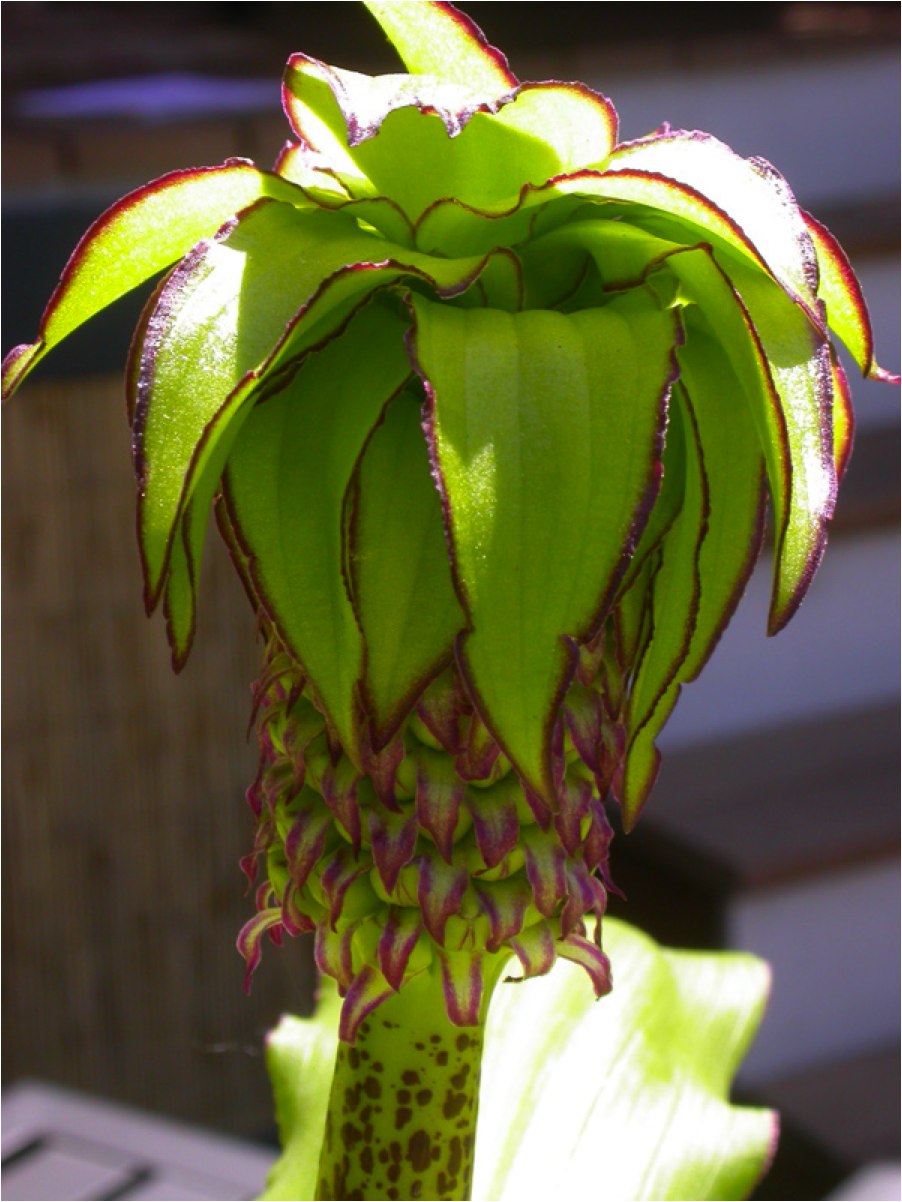
Eucomis: Pineapple Lilies– Exotic Looks/Common Tastes

This posting was first published in the HPSO Bulletin Spring 2010 and is here revised

Eucomis bicolor

Eucomis bicolor

South Africa is one of the most botanically rich regions of the world. Within its boundaries is the Cape Floristic Region (with 0.08% of the world’s land and 3% of all plant species), containing some 8,700 species, two-thirds of which are endemic, existing nowhere else in the world. It is one of only six such regions in the world. By comparison, the Boreal Floristic Region includes all of North America, Europe, and the northern portions of Asia and Africa, and is thus considerably larger. Each region has a distinctive “suite” of plants with particular families that are endemic to them. One would feel a familiarity when exploring anywhere within one’s own region. Outside it, you might feel the world was populated with the alien plants of other star systems. For example, forests are not to be found in the Cape (though nonnative species have been introduced and have spread); instead, these areas are characterized by heaths, proteas, and restios. Included in the region are 2,700 species of bulbs in 15 different families. These include gladioli, freesias, amaryllis, agapanthus, and many others, most of which would be unrecognizable to the average temperate area gardener. One such genus of bulbs is Eucomis. Continue reading

Weeding in a Dynamic Landscape: A Goal Oriented Strategy

The Over Thinking Series, part two

Weeding seems simple enough, but that’s the problem with simple things…they often aren’t.

Ugh! Gronk see weed??? !!!Gronk pull weed!!!

It isn’t rocket science, but we’re not stamping out widgets on a production line either…the first one the same as the 13,649th one. Landscapes are living systems containing many complex relationships and feedback loops. Just because most people don’t pay attention doesn’t mean that it’s simple. Continue reading

Gardening Is Not for Wimps!

I’ve been spending a lot of time lately schlepping plants around, dug a large Taro, my Red Banana, a Heliconia, dug and divided a large Bromeliad, moved a 5 year old Furcraea in a large ceramic pot downstairs to the basement, planted a 20 gal Palm, a 10 gal Astelia and a 4′ b&b Golden Irish Yew that felt like its root ball was full of lead …doing the Fall drill…and feeling it.  I’m getting older.  I retired last spring and, though still active, I’m not as active as I was even recently.  I laid down my scooter two months ago at about 30mph…my shoulder is still not the same after having slammed into the asphalt.  I’m not swimming or doing my other stretches and exercises as much because it causes me shoulder pain….Shit!  I’m still trying to learn patience, maybe that’s the problem…the ‘trying’ part. I looked up an article I wrote and had published in the HPSO Bulletin Fall 2009, reread it, and decided to post it here again, as is.  I, hope that it will be helpful to all of you.  It’s about our bodies and this thing that we do, gardening, coping and things we can do to improve the relationship they share. Continue reading

Wintering over your Red Abyssinian Banana (Ensete ventricosum ‘Maureli’)

My Ensete mid-summer, still a baby

My Ensete mid-summer, still a baby

Ensete ventricosum comes from the Ethiopian highlands, the country which was once known as Abyssinia, conditions considerably more mild than the zn 8a or 8b I experience here in inner SE Portland, so here’s what I do:

Fall weather here can be very volatile.  The stable, dry, monotonous even days of summer are shifting and the swings can occur quickly, so I suggest that you pay attention.  In general, I like to limit the time my plants spend in storage so I will often leave these in the ground up until the night before a predicted hard freeze when the temperature is expected to drop into the mid to upper 20’s F.  Repeated and scattered low temps into the upper 20’s  can accumulate and do damage, so keep this in mind.  Storage doesn’t improve a plant’s health.  In fact, once dug and stored it is a period of decline until once again they can be replanted outside and put on new growth.  Many of my containerized plants shuffle back and forth, spending only periods of sustained freezing weather in the ‘warmest’ storage place, the basement.  Plants acclimate slowly so putting them in and out only works if they are protected for relatively brief periods…too long in a ‘warmer’ place and their metabolism is awakened, their ‘hardiness’ reduced, thus increasing the likelihood that their return to outside will be damaging.  With plants like the Ensete, the tropicals I grow, once I bring them in, they stay in until I determine to put them out. Continue reading

Tool’s of the Trade: Shovels, Implements of Construction…and Maintenance

(I wrote this piece a few years ago. It was last printed in the Fall 2012 HPSO Bulletin.  It is updated here for my Blog.)

Cut from a piece of sheet metal the failure point is at the bottom of the 'arrow'

Cut from a piece of sheet metal the failure point is at the bottom of the ‘arrow’. Yes, I know this is a square point, but the are built using the same process.

I broke my shovel at home last week digging out a smaller-growing bamboo, Semiarundinaria yashadake ‘Kimmei’. It was at least ten years old, the shovel that is, and I broke it the way most people do, prying with it. I’m not nearly as hard on shovels as I used to be; I know their limits, but I was tired of this shovel. It was one of those thin-gauge “stamped” shovels that hardware stores sell these days to consumers, inexpensive and cheaply made; the kind of tool a person could buy many times over the course of their gardening life. I have broken several in the past jumping on them, with two booted feet, while trying to cut through heavy soil and roots, or like I did here, levering to hard before the object of my attention was adequately cut free of its earthly ties. Stamped shovels flex due to their thinness. Any flexion causes an inefficient transfer of energy when attempting to drive the blade against resistance. Think wasted energy and more effort. Stamped shovels have a soft fold where the smooth curve of its bowl bends into the vee that becomes the sleeve that then wraps around the shovel handle. This shaping of the blade adds some rigidity that the same material flat doesn’t possess. Any such bend in a piece of metal, however, becomes the weak point. This is where the metal breaks. Finding a quality replacement requires special ordering or buying through someone who serves the nursery or landscape trades.

Continue reading

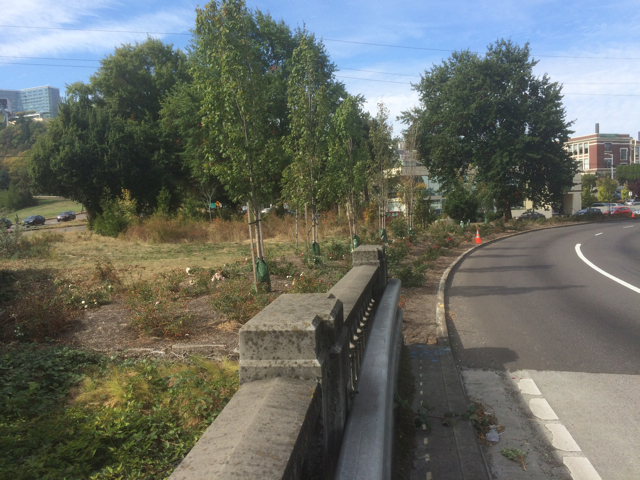
Gardening as a Political Act: Growing a Better Public Landscape – The Ross Island Bridge West Approach

Peeling off towards downtown from the bridge westbound

Peeling off towards downtown from the bridge westbound.  The little landscape Roses and new trees…one mown down by a car further down.

I’ve said it before that everything we choose to do is a political act. Politics is not something practiced by ‘politicians’ exclusively. We are social animals. What we choose to do effects those around us…gardening is political. We have chosen to invest our time and energies into growing plants and maintaining our gardens. We do this as individuals. They feed our spirits and those of our friends and families. Beyond this are our neighbors and, to some degree, commuters passing by. I’ve had people I don’t know stop by and tell me, “I’ve been walking/riding/driving by your house for years and I just wanted to tell you how much I’ve enjoyed it.” There’s the bus driver who used to stop in his turn at our corner, open the doors and tell me how much he loved my Wisteria (now gone…Sad for him, good for me), the guy from BES who stopped one day to quiz me about a Grevillea and many others. People, gardeners or not, may be buoyed by your gardens. We change the world for the better. Politics need not be limited to the big divisive social, economic and environmental issues of the day. In fact, if we want to make a positive difference we better start on the little things that we can.

Continue reading

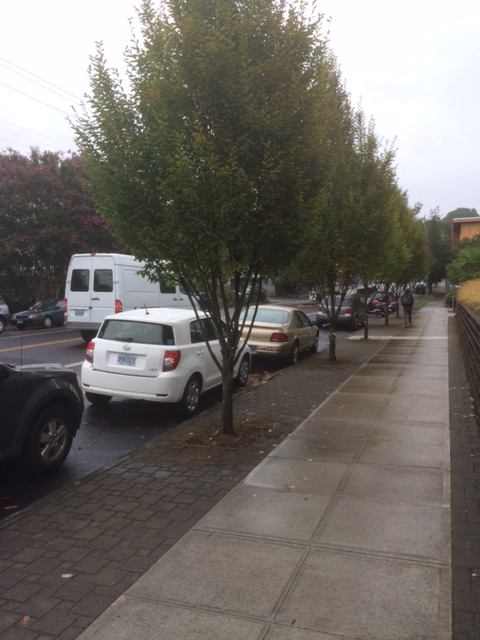
Choosing a Tree: Issues of Structure and Growth

Right Plant Right Place covers a lot. Usually when you hear it used the speaker is referring to matching the plant with the growing conditions: soil, sun, climatic conditions, size, etc. Here, I’m going to address the physical structure and growth of a tree as it relates to place, Carpinus betulus ‘Fastigiata’, in this case, as it is often used as a ‘street tree’. The Upright European Hornbeam has proven its value as a street tree. It is very adaptable to conditions in our region that exist at the curb. That being said there are questions of structure and growth that need to be asked if such a planting is going to be aesthetically successful over the longer term.

Hornbeams across the street from my house after pruning

Hornbeams across the street from my house after pruning

Continue reading

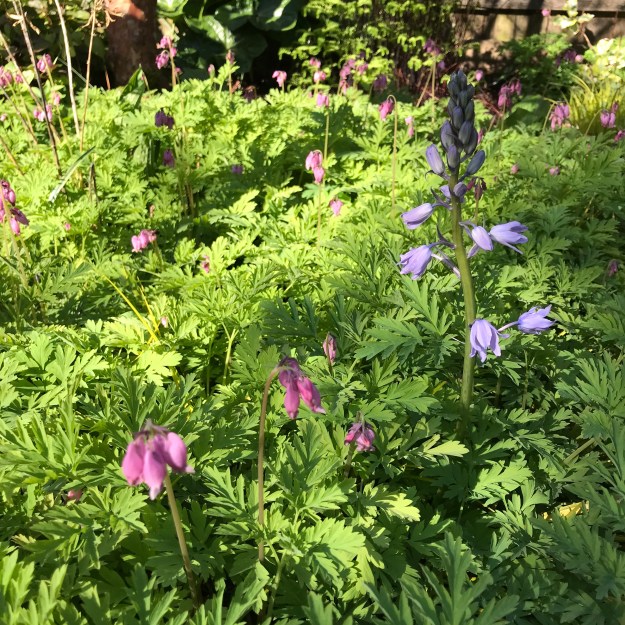
Desirable Plants, Thugs and Weeds: The Fine Line Between Good and Bad

Our native Bleeding Heart, Dicentra formosa with Siberian Squill, Scilla siberica…both of these are ‘weedy’ in my garden, the Dicentra spreading quickly from its brittle rhizome while the Squill, an extremely ‘successful’ old fashioned garden plant, persists and increases even in long neglected gardens and homesteads. While neither of these are technically ‘weeds’ they both possess degrees of vigor and adaptability that have allowed them to persist, often in spite of our efforts to limit or eliminate them.

The first in the critically acclaimed ‘Over-Thinking Series’

What is a weed? What differentiates it from any other plant? What about plants like Golden Creeping Jenny? I know those who call it a weed. Is it a matter of generally accepted horticultural opinion? One is on the list and the other isn’t? Is it more than simply a plant we did not plant? We all have those fortuitous seedling volunteers that appear bringing with them a little garden magic. Some of these prove themselves to be quite remarkable and, if found by the right person, if they retain their desirable characteristics when propagated and are stable over time, may become the next rage among the garden fashionistas. They aren’t weeds are they? While not planned for we may choose to welcome certain such plants. To just define weeds as plants out of place, is to render the word almost useless as an aid to understanding our problem.

There is no conspiracy going on in the garden. No malignant intelligence plots and schemes to upset our plans. Not every seed germinates. Not every bit of rhizome or tuber will take over the garden/world without our intervention. Weeds are plants and within the limits of their own genetics they either grow or die. If a seed of Calypso bulbosa finds itself on the ground in the desert. It will not germinate. Eventually it will lose its viability. No one will notice its absence because it never belonged there. All plants possess a degree of vigor. All plants have within themselves a range of conditions they can grow and prosper in. Weeds, are plants that possess the vigor and adaptability to be successful under the range of conditions that we as humans typically occupy. Because we occupy these places, disturb them, because we move about and conduct trade with those elsewhere, we have ‘weeds’. These are merely the plants that do well in the places that we habitually have created. What we should be talking about instead is the quality of ‘weediness’, that blend of adaptability and vigor, that these plants possess.

(Readers should be aware that there are no pretty pictures to either break up the following text or to graphically ‘hammer the lesson home’. Continue reading

Butia x Jubaea: A Pinnate Palm for Portland – First Test…for me

Butia capitata at my front stairs along with a new Beschorneria yuccoides 'Flamingo Glow' and a Agave parryi 'Hauchucense'

Butia capitata at my front stairs with a new Beschorneria yuccoides ‘Flamingo Glow’ (I had just removed a Beschornieria septentrionalis, divided and potted the starts up. The replacement has more flamboyant foliage.) Iris douglasiana ‘Canyon Snow’, various low Sedum, Asarina procumbens, x Halmiocistus ‘Merrist Wood Cream’ and an Agave parryi ‘Hauchuca Blue’

My friend Steve has urged me to periodically write about my experiences in the Denial  Zone…so here’s a little something:  We all know you can only go so far with the whole tropical thing in Portland if you’re not going to invest in a greenhouse.  Those of us who try to mimic the tropical look realize that we have to seek out the temperate and a few sub-tropicals that give us that ‘feel’.  Bold foliages are key.  Architectural plants, and just as important strong foliage contrast.  This is not the place for subtlety.  Strappy, fuzzy, split and dissected, compound pinnate and palmate, glossy, drip tipped, bold variegation and wild patterns…over the years observant nurseryman and plant hunters have brought us a smorgasbord of unusually foliaged plants.  Plant breeders have pushed the limits crossing hardy species in ways that mimic their tropical cousins, I’m thinking Hibiscus here.  But still there are certain plants, certain forms and silhouettes, that are hard to replace.

Palms are one of these.  Many of us grow various palmate forms like genus Trachycarpus, T. fortunei, most commonly, while others have used T. wagnerianus, T. takil and T. princeps.  There are many others but of unproven hardiness.  Another form of Palm are those with costapalmate fronds, of these I have a Sabal minor doing fine at home slowly getting bigger in the ground for the last four years, (It’s more than ten years old.  I’m of the age now where I just say something is ten years old because it’s easier than checking.  It may actually be 12-15.) and a Sabal x ‘Birmingham’ I have high hopes for probably destined for a few more years in the pot before I try it out in the ground.  (The genus Sabal includes the Palmetto Palm native to the coastal southeastern US. They tend to be slower growing than Trachys, preferring more heat, often with larger more deeply segmented fronds. For those of you who don’t know, costapalmate are intermediate between palmate and pinnate.  The stem extends into the frond where the segments separate and fan out.  This extension may be slight as it is in Sabal minor. Instead of having the segments radiating evenly from one point at the base, the ‘base’ is slightly elongated stretching it as if it were briefly considering being pinnate.  A casual look might leave the observer thinking that something is slightly off with what appears to be a palmate leaf.) Perhaps others will be found growing in the extremes of their home ranges that can take zn7 and 8 consistently with smiles.  I planted the aforementioned Trachys over the last several years in and near Waterfront Park’s bowl.  (Actually, the T. princeps is new this spring.  Cross your fingers.) They are consistent and durable performers…even through last winter.

Continue reading