Category Archives: Plant Choice

Weeding in a Dynamic Landscape: A Goal Oriented Strategy

The Over Thinking Series, part two

Weeding seems simple enough, but that’s the problem with simple things…they often aren’t.

Ugh! Gronk see weed??? !!!Gronk pull weed!!!

It isn’t rocket science, but we’re not stamping out widgets on a production line either…the first one the same as the 13,649th one. Landscapes are living systems containing many complex relationships and feedback loops. Just because most people don’t pay attention doesn’t mean that it’s simple. Continue reading

Choosing a Tree: Issues of Structure and Growth

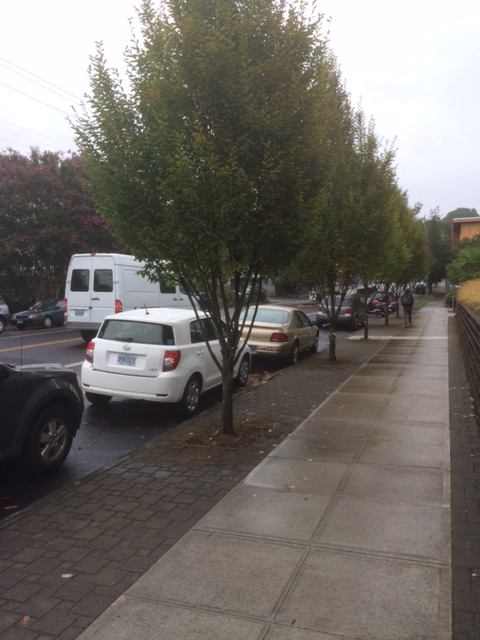
Right Plant Right Place covers a lot. Usually when you hear it used the speaker is referring to matching the plant with the growing conditions: soil, sun, climatic conditions, size, etc. Here, I’m going to address the physical structure and growth of a tree as it relates to place, Carpinus betulus ‘Fastigiata’, in this case, as it is often used as a ‘street tree’. The Upright European Hornbeam has proven its value as a street tree. It is very adaptable to conditions in our region that exist at the curb. That being said there are questions of structure and growth that need to be asked if such a planting is going to be aesthetically successful over the longer term.

Hornbeams across the street from my house after pruning

Hornbeams across the street from my house after pruning

Continue reading

Butia x Jubaea: A Pinnate Palm for Portland – First Test…for me

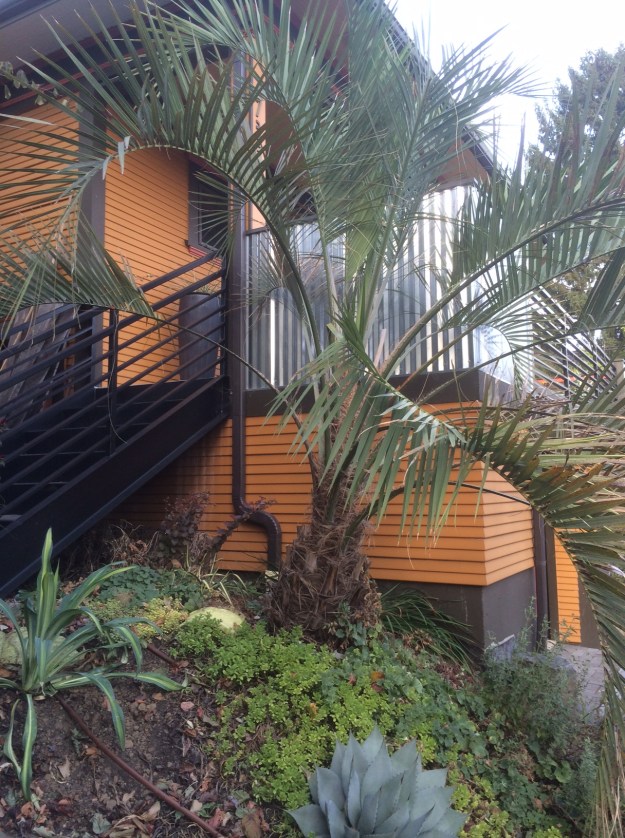
Butia capitata at my front stairs along with a new Beschorneria yuccoides 'Flamingo Glow' and a Agave parryi 'Hauchucense'

Butia capitata at my front stairs with a new Beschorneria yuccoides ‘Flamingo Glow’ (I had just removed a Beschornieria septentrionalis, divided and potted the starts up. The replacement has more flamboyant foliage.) Iris douglasiana ‘Canyon Snow’, various low Sedum, Asarina procumbens, x Halmiocistus ‘Merrist Wood Cream’ and an Agave parryi ‘Hauchuca Blue’

My friend Steve has urged me to periodically write about my experiences in the Denial  Zone…so here’s a little something:  We all know you can only go so far with the whole tropical thing in Portland if you’re not going to invest in a greenhouse.  Those of us who try to mimic the tropical look realize that we have to seek out the temperate and a few sub-tropicals that give us that ‘feel’.  Bold foliages are key.  Architectural plants, and just as important strong foliage contrast.  This is not the place for subtlety.  Strappy, fuzzy, split and dissected, compound pinnate and palmate, glossy, drip tipped, bold variegation and wild patterns…over the years observant nurseryman and plant hunters have brought us a smorgasbord of unusually foliaged plants.  Plant breeders have pushed the limits crossing hardy species in ways that mimic their tropical cousins, I’m thinking Hibiscus here.  But still there are certain plants, certain forms and silhouettes, that are hard to replace.

Palms are one of these.  Many of us grow various palmate forms like genus Trachycarpus, T. fortunei, most commonly, while others have used T. wagnerianus, T. takil and T. princeps.  There are many others but of unproven hardiness.  Another form of Palm are those with costapalmate fronds, of these I have a Sabal minor doing fine at home slowly getting bigger in the ground for the last four years, (It’s more than ten years old.  I’m of the age now where I just say something is ten years old because it’s easier than checking.  It may actually be 12-15.) and a Sabal x ‘Birmingham’ I have high hopes for probably destined for a few more years in the pot before I try it out in the ground.  (The genus Sabal includes the Palmetto Palm native to the coastal southeastern US. They tend to be slower growing than Trachys, preferring more heat, often with larger more deeply segmented fronds. For those of you who don’t know, costapalmate are intermediate between palmate and pinnate.  The stem extends into the frond where the segments separate and fan out.  This extension may be slight as it is in Sabal minor. Instead of having the segments radiating evenly from one point at the base, the ‘base’ is slightly elongated stretching it as if it were briefly considering being pinnate.  A casual look might leave the observer thinking that something is slightly off with what appears to be a palmate leaf.) Perhaps others will be found growing in the extremes of their home ranges that can take zn7 and 8 consistently with smiles.  I planted the aforementioned Trachys over the last several years in and near Waterfront Park’s bowl.  (Actually, the T. princeps is new this spring.  Cross your fingers.) They are consistent and durable performers…even through last winter.

Continue reading

Katsuras as Street Trees: picking the right tree

photo 1

Sometimes it pains me to take walks.  I was on my way home from the Imperial Bottle Shop and Tap Room, walking down SE 26th south of Powell Blvd when I came across these four Katsura trees planted in a 4′ wide parking strip, no curb parking with a painted bike lane right next to the curb.  Katsura trees 24″ from the bike lane.  How is that going to work?  Trees grow.  Branches extend and caliper up.  Branches hit bicyclists and pedestrians in the face and people crash and or break branches. (Yes, I know these can be limbed up over time but we all know how often that doesn’t happen and what are these trees going to look like if all of the branches are cut off of the street side up to 14′ for traffic clearance.  Trucks regularly use this street.)  And then there’s the whole it’s just the wrong plant for the growing conditions thing.  Katsuras grow in the mixed woodlands of Japan with moderate temps and summer rainfall.  So that looks like 3 strikes out of 4 pitches.  Landscape architects still love these…so do I, but planting them in positions with reflected heat with limited root runs through compacted mineral soils!!!! It’s 90 degrees today, their foliage is stressed even with their water bags filled around their bases.  I have seen many more bad examples of Katsura use over the last 25 years than i’ve seen appropriate.  If you’re going to plant them plant them in a woodland or along the edge where they will be protected from intense direct  sun and make sure they have a long cool root run.  This is so wrong.  Now we’ll all have to watch these limp along getting by stressing until they die or become so damaged someone removes them. Continue reading

Evaluating Your Garden Site

Perhaps the most important question any gardener can ask is, “Where do I garden.” While this may not be as sexy as choosing the plants we’ve always wanted or re-creating a spectacular garden we’ve seen, it is absolutely essential over the long term for the health and success of your garden or landscape. While we can stray from the limitations of our sites, it will cost us. So it is still important to know our sites, to make the necessary modifications whether they be protection from winter winds, improving soil drainage to whether or not we will even need to irrigate, how often and how long. If you go to considerable expense to install your landscape and it fails to meet your expectations, you will need to re-evaluate either your site, your expectations or both.

There is more to gardening than locating yourself on the Sunset zone map and simply plugging in plants, though this is where many of us start. Continue reading