
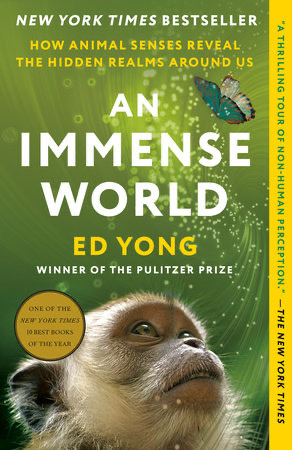
 I’m a member of a natural sciences book group. We all share a mixed range of personal experiences as hikers, Gardners, horticulturists, ecologists, wildlife biologist and a fascination with the natural world. There are always so many good titles to choose from. I’ve written of several in the past. Our current book is Ed Yong’s, “An Immense World”, a look into the senses and perceptions of organisms, to understand how an animal ‘sees’ its world. of course, we can only do this from our own limited, human biased vision heavy view of the world. We should never assume animals ‘see’ the world as we do. Many animals primary sense isn’t vision at all. In this book Yong writes of how even when we share particular sense organs with other animals, our perception is very different. Perception is something beyond the senses. It occurs after sensing, an attempt to make sense of the world around us in a way that works for us with our needs and limitations…It is not the world itself. Perception gives us our personal understanding of the world. It is shaped by the combination of our several senses and our need to understand. In evolution what ‘works’ shapes us. We, the biological we, that is, all organisms, are in turn shaped by the world around us…our bodies, our sense organs and our understanding of the world around us. We are shaped by necessity and possibility. While discussing this Yong writes repeatedly of a species’ and an individual’s ‘Umwelt’, our individual view of the world around US. Each is distinct. Individual and limited, making it near impossible for us to imagine another’s, but this does not give us permission to dismiss that of others…any others. Continue reading
An Immense World: A Review of Ed Yong’s Latest Book
Leave a reply

 GardenRiots