
Science is the study of life and the world around us, an exploration of the reality of the universe conducted from different ‘directions’ with the intent of understanding its endless aspects. Today, however, science in seeking to ‘peel back its layers, in attempting to clarify our place in it and improve the conditions within which we live along with our relationship with it, and each other, many have dismissed the effort and our effort to continue ‘doing’ science has become contentious. Knowing and its pursuit, has become a kind of ‘blasphemy’. Science has become politicized along with so much else. Many completely dismiss it as a wasteful effort, an attempt by elites to purposely complicate our lives with distractive and destructive nonsense, the value of expertise dismissed. For them life seems simple and obvious. Science, many claim, is an effort by ‘elites’ to obfuscate and to remove decision making ever further from the ‘people’…in doing this we are replacing curiosity and understanding with a willful ignorance, generalized fear and a ‘trust’ in those who simply, and loudly, claim to hold the answers, who demean all others and promise to return us to some ‘golden age’ fantasy of the past. They ‘reduce’ language, surrender clarity, replacing it with volume and repetition, shrink both what is acceptable for discussion and the lexicon with which we do so, rendering communications more open to confusion and misinterpretation, to manipulation. Language and speech, limited, regulated. Science can’t afford this. (Nor can any vital society.) Doubt and insecurity will overwhelm us, until we reclaim our right to knowledge. Reason, science and critical thinking, offer us a way out, a way to reclaim our agency, without destroying the world.
The ‘language’ of science, with its specialized jargon, permits a more clearly understood discussion, making one’s points and conditions more understandable. Science demands clarity. Language is a tool, which can be refined and wielded in such away that knowledge can be deepened or, alternatively, lost. Doing science is about the details. Blurring them together, or ignoring them, makes conducting science, understanding and applying it to our lives, impossible. There is commonly, and necessarily, a gap between the layman and the scientist who is working on understanding the processes responsible for, and underlying the world around us. One cannot be ‘expert’ in all things, but to then deny the value of expertise….It is far too easy to dismiss what one doesn’t understand, hasn’t bothered to learn about. Things don’t simply ‘happen’ in the world. There are relationships, processes, limitations, thresholds, requirements and inevitabilities. We cannot each fully understand all of science, we haven’t the time, but we must trust in it. A successful society requires this. We must commit to the rigor it demands…if we ever hope to understand…if we ever hope to clearly communicate with one another. It is the best set of tools available to us in this life…and, to trust in it, we must have the courage to open ourselves to one another, exercise the logic that separates fact from fiction, understanding from fantasy, honesty from manipulation; a basic understanding of both the process of science, how it accomplishes what it claims to, and the conditions and relationships which define our and the universe’s existence…To do that, will take effort. Nothing truly worthwhile comes easily. Those who say otherwise are deceivers. If we reject this elementary demand of us, that we must ‘learn’ to understand/advance/solve problems, then we have chosen a fixed, stagnant course, and whatever our trajectory is, and ours currently is collectively headed toward multiple crises, we are so ‘doomed’. Science, and its methods, gives us the opportunity to learn, to reconsider, and change our trajectory, to choose a more positive future and make ‘course’ corrections. But we have to choose to do so.
Having said all this, I offer the following short reading list for those curious about this thing we call life, the processes most of which we share collectively with other organisms. In examining life in this, many of our collective and individual errors become more apparent, along with the opportunity to choose a different path.
We have a tendency to see ourselves as unique, superior, as a species and too often as individual actors, disconnected, entirely independent, and ‘free’ in doing so. In doing this we dismiss our relationships with the living world around us with which we are role players, all of us related, in a complex self-sustaining system. The health of ANY one of us IS connected to that of others, all of which work toward determining the conditions under which all things live.
The list of books below are the more accessible titles I’ve read, in recent years, written mostly by scientists, deeply involved in the world of which they write. They are in a class by themselves, able to translate their work and thoughts into a form that an interested layman, a non-expert, can understand. Many are excellent writers or have cooperated with other skilled writers to make their work more accessible and digestible. These aren’t the only authors and books that offer us this, but one must start somewhere.
A few are written by journalists immersed in the science of which they write, not engaged directly in ‘doing’ the science. Scientists typically write for scientific journals, where their work is reviewed and tested by their peers to exclude poorly supported work and ‘answers’ they claim is correct. The format and writing is necessarily rigid and technical. To read articles in these journals requires a commitment, a deeper familiarity with the science itself, the technologies used in the experiments described, the jargon and the details of what the current accepted science is. Context, established theories, upon which their work depends are not generally included. The intended audience is expert in the topic and explanation of foundational ideas is not generally necessary.
These more ‘popular’ books I include here focus more on concepts and providing a clearer and more concise description of where the science is without all of the details of proof necessary for science to advance. Science is nothing if not a rigorous process. These books provide an entry point for the non-expert and a way to go deeper if you choose, through following the suggestions made in their notes and bibliographies. You will find, as I have, that although sometimes difficult, as we expose ourselves to new ideas, they become more familiar, the work less intimidating and our own knowledge and interest, deeper.
I recently came across a reel, posted by Dr. Becky Kennedy, a clinical psychologist, that I found enlightening and encouraging, that in opening ourselves to learning, we become more resilient in this life and regain some of the agency we had earlier given up to a self imposed ‘fate’. There will always be a ‘gap’ between what we currently know and accept and ‘new’ ideas, that are unfamiliar to us. The ‘space’ in between not knowing and knowing, is frustrating and it is in staying with this process that we develop a resilience and give ourselves the opportunity to learn and grow. Retreating in the face of such frustration only assures that we stay stuck. Insisting that the ‘new to us’ is wrong or unnecessary, does not make it so, but it does condemn us to a smaller life. With learning, comes growth and increasing opportunity.The link, here, is to a short video in which she discusses this: https://www.instagram.com/reels/DGG5nMcyXD4/
Previously, I’ve written larger ‘reviews’ of most of these and posted them on my blog, ‘Garden Riots’. These are capsules and lures written with the intent of encouraging you to explore them.
“Plant Sapiens: The New Science of Plant Intelligence”, Paco Calvo, Natalie Lawrence, 2023.
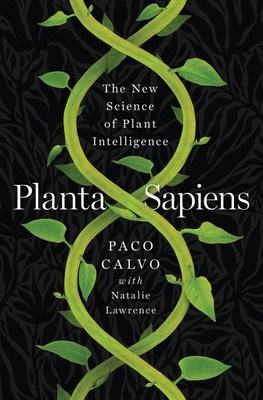 Paco Calvo runs a lab in Spain at the Universidad de Murcia, that is focused on the study of ‘plant intelligence’ and is a leader in this field. Lawrence, his co-author, is a free-lance writer who helped him ‘polish’ his prose and make it more accessible for the general reader. The book commits a lot of space to addressing the concerns of those who take issue with the very idea of ‘plant intelligence’, who reject it out right because plants lack an animal brain and a nervous system. Their arguments often seem to be only semantic. Sentience, awareness, even responsiveness, these critics complain simply is impossible due to this lack of particular anatomy. Alternative ways of knowing are rejected outrigh. Calvo focuses on what plants can do, how they respond to their environments and ‘remember’/learn over time. I enjoyed this book and its ideas and found it nesting very nicely with several of the other titles below.
“Light Eaters: How the Unseen World of Plant Intelligence Offers a New Understanding of Life on Earth”, Zoe Schlanger, 2024.
This is a great companion to Calvo’s book. Schlanger is a science writer, not a scientist. I found it engaging. As humans we have a very narrow view of communication and intelligence. Schlanger spends some time dissecting how our insistence that because plants accomplish many of their functions/actions differently than do animals and us, with our nervous systems, that plants do this via comparable ways through chemical signaling and a kind of dispersed ‘nervous system like’ network of roots and vascular tissues. Like Calvo, she writes of plant’s slower metabolic processes and how these necessarily slow their responses. They live and function at a different pace and they accomplish this in ways different than animals. Both argue that difference does not translate into an existence of limited, dumb, reflexive, or merely instinctive, fixed responses. Both, along with other authors here like Chamovitz below, see sentience, responsiveness as absolutely necessary for life and the sensitive regulation of one’s own systems and abilities to negotiate the world in which they find themselves.
“What a Plant Knows: A Field Guide to the Sciences”, Daniel Chamovitz, 2017
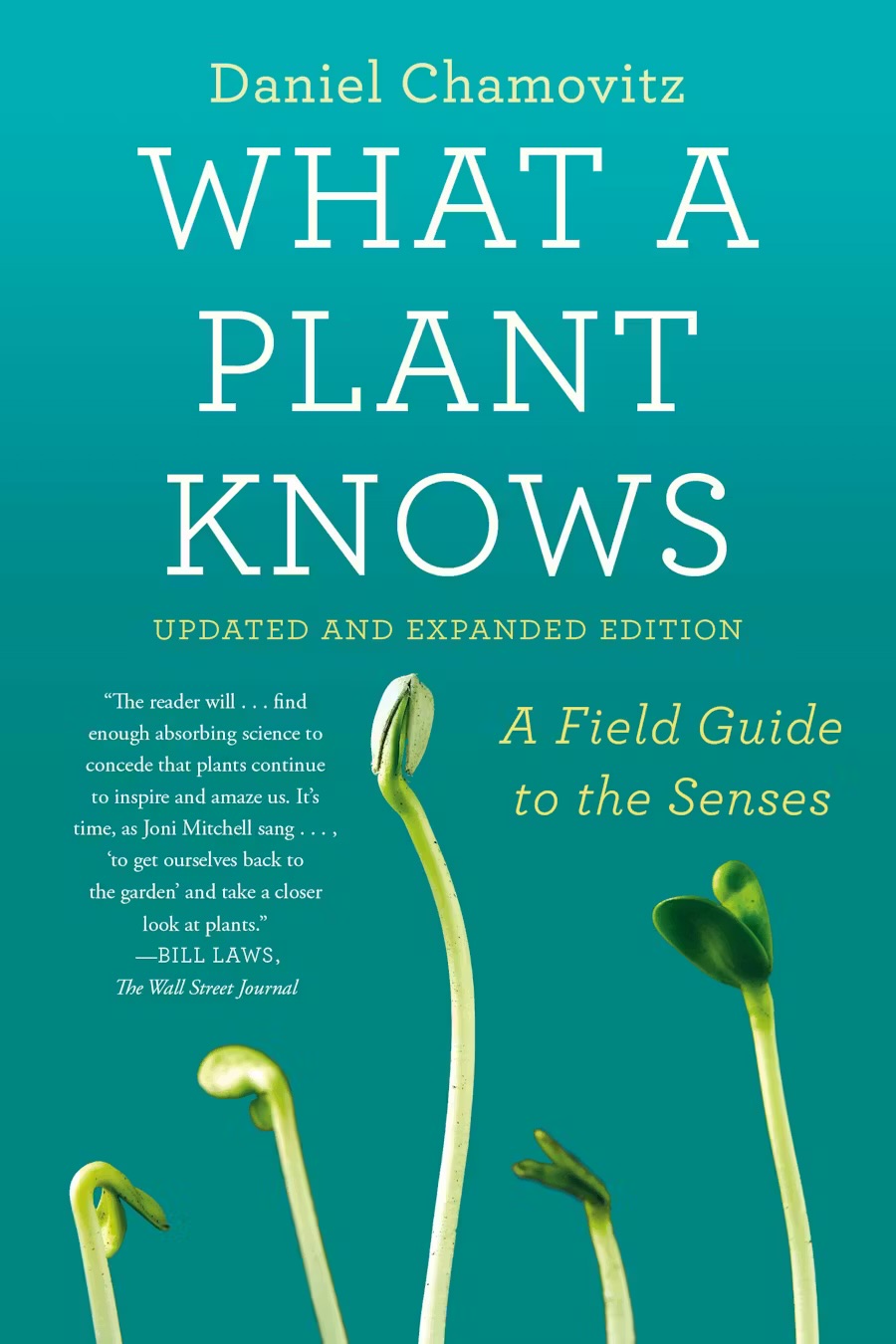 Chamovitz is a scientist working at Tel Aviv University. I’m finishing this one as I write this. As the shortest book here it represents an ‘easy’ starting place, which lead me to the idea that it held less substance. At first I thought this would be a basic summary tour through the topic of plant sentience and responsiveness. As I read it though he keeps introducing little nuggets that cause this reader to pause and think about how while plants may take alternate paths, their capacity to sense their environments, given that their tissues and organs are different than those of animals, nevertheless accomplish parallel sensory functions that animals do…and that doing so, is essential to their existence. Though they don’t possess eyes, they do possess photoreceptors that respond to different wavelengths of light which produce a range of chemicals that go to determining how and when a plant grows, when it flowers and fruits and it does this with a very dispersed system. Light, which is the energy source powering plants growth, plays a central role in how and when a plant can grow, so plants have devised strategies and ‘tools’ to do this overtime. ‘Sight’, ‘smell’, ‘taste’, ‘feeling’, plants do these in very plant like ways within the context of their particular needs, physical limitations and their environments. Chamovitz provides a kind of summary list of plant’s sensing, presenting the basic ‘bones’ of these operations and doing so side by side with those of animals. Again, he does this compactly. This is an introductory volume. They ‘smell’ volatile compounds in the air around them, often which are released by others around them allowing them to ‘prepare’ themselves for changing conditions and oncoming threats. They ‘taste’ the soil with their roots which allows them to seek out and select specific needed minerals and water. They respond to ‘touch’ to forces reinforcing themselves over time to withstand them and in the case of insect attack and herbivory, chemically signal others around them of a threat so that they can marshal their chemical defense. Some of their receptor cells are remarkably similar to ours as is some of the chemicals essential to their internal communications. While they don’t have brains that can translate their ‘vision’ into images, they don’t really have any need to do this, but they do ‘know’ from which direction the light is coming, what it’s wavelength is, what its seasonal duration is so that they can coordinate and direct their growth. In terms of light what is important for a plant is quite different than our own needs and they have evolved the ‘tools’ they have to survive and adapt over a period far longer than we as animals have. In fact our own capacity to perceive are born from them, animals having branched off from plants several hundred million years ago, after plants had already developed many of these capacities. We as animals then began the process of radiation and adaptation reshaping and specializing the rudimentary senses we inherited. The capacity to sense and respond to one’s environment is essential for ALL organisms. This is a great little book!
“Finding the Mother Tree: Discovering the Wisdom of the Forest”, Suzanne Simard, 2021.
This book speaks to the existence and essential services provided by a healthy, naturally formed, living community, the network of supportive interactions between related plants, animals and fungi. I was a little disappointed in this book, but nevertheless I think it’s important. Simard is a forest ecologist working in British Columbia’s PNW conifer forests. She was one of the first researchers to begin publishing, in academic journals, on the topic that has sometimes been referred to as the Wood Wide Web, the network of roots and mycorrhiza that connect trees of the same species in a naturally formed local forest community through which the trees chemically signal each other, communicating threats so that trees can prepare for stress, share water and nutrients so that the network of connected trees can better tolerate their conditions, ‘nursing’ younger trees along that might otherwise perish with the competition on their own. She discusses some of the relationships between species as well. The title refers to these local communities, as lineages, connected through ‘mother trees’ which link the progeny. In intact forest communities, then it is not simply the competition of the dog eat dog world, a human fantasy and projection, but one of community and ‘family’ in which members also support one another as well as sacrifice for each other when necessary. In human planted forests, from selected seed sources, logged sites, where these relationships are ignored when replanting and managing, this functional community does not exist and individual trees are on their own, diversity lost and overall productivity and health, lost. Intact, healthy plant communities, in this way share much with healthy human communities, themselves something which has been in steady decline in the Western World, as the ‘individual’ and his singular life, becomes the dominant, often even the only standard, by which success is measured, in which decision making has become progressively selfish, more extractive and profit oriented. My disappointment in this book, however, comes from her injection of her own family story into the book which feels disjointed. I don’t mean to discount her families painful history, it just doesn’t seem to fit here.
“I Contain Multitudes: The Microbes Within Us and a Grander View of Life”, Ed Yong, 2016.
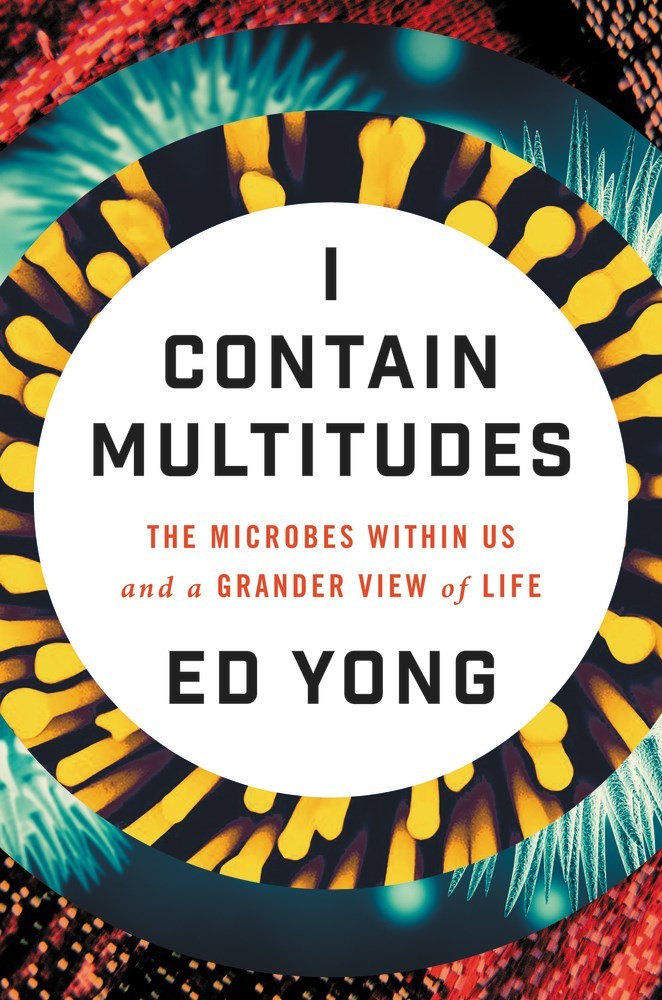 Yong, another science writer, addresses the question of what we, any organism is, or more specifically, what any multi-cellular organism is. We are all collectives, several trillion of our human cells are joined in a very cooperative relationship with each other in very complex, supportive, competitive and essential ways. At the same time Yong examines how dependent we are upon the many other billions and billions of other organisms which live in dependent relationships within and upon us, within our guts and upon our skin. As individuals we are truly collectives, our mitochondria within our cells which are absolutely essential for the life of every cell which composes us, billions of years ago were themselves independent organisms which over time were engulfed by other single celled organisms and became intimately joined to them. These ‘homunculi’ to this day still contain some of their own DNA which is not encoded in our own. The individual, which we are continually encouraged to see as independent, singular, is in fact, not. At any level, from the cell to local biotic communities, we are plural, complex, competitive and coordinated. Yong is a wonderful writer. His work should be accessible to anyone. The only requirement is that you be curious.
“An Immense World: How Animal Senses Reveal the Hidden Realms Around Us”, Ed Yong, 2022.
Another, very accessible and engaging book from Yong, this time on animal perception and how it can vary in its particulars from our own. Other authors I’ve included here focus on plant sensing, awareness and responsiveness, here Yong looks at a range of ‘higher’ animals, and in so doing reveals a world that is much ‘richer’ than the one that we humans can directly perceive. Our perceptions both open the world to us, while they at the same time can limit our understanding of it. We have a tendency to understand the world narrowly, defined by the limits of our own senses. We tend to project our own limited ‘view’ of the world on other animals and generally find them wanting. Through example after example Yong describes the world as experienced by other animal species, their capacities to sense different wavelengths of light, smell, hearing, feeling and taste, in ways other than our own, even those with the capacity to physically sense various electromagnetic fields produced by other animals. He discusses how these capacities may have evolved, given the demands on the organism and the limitations of their environment; the bat’s ability to echolocate at frequencies well beyond ours, with which the create ‘mental images’ as they navigate through darkened space, at speed, honing in on moving targets. He also takes pains to discuss how our modification of the sensory landscape by the addition of noise and light, shifting of temperatures, which seem minimal to us, can be catastrophic to other animals. The world that each of us experience is not the world other species, or even individuals of our own species, may experience. The world, as he title suggests, is far greater and richer than the one we perceive.
“Forest Euphoria: The Abounding Queerness of Nature”, Patricia Onioniwu Kaishian, 2025.
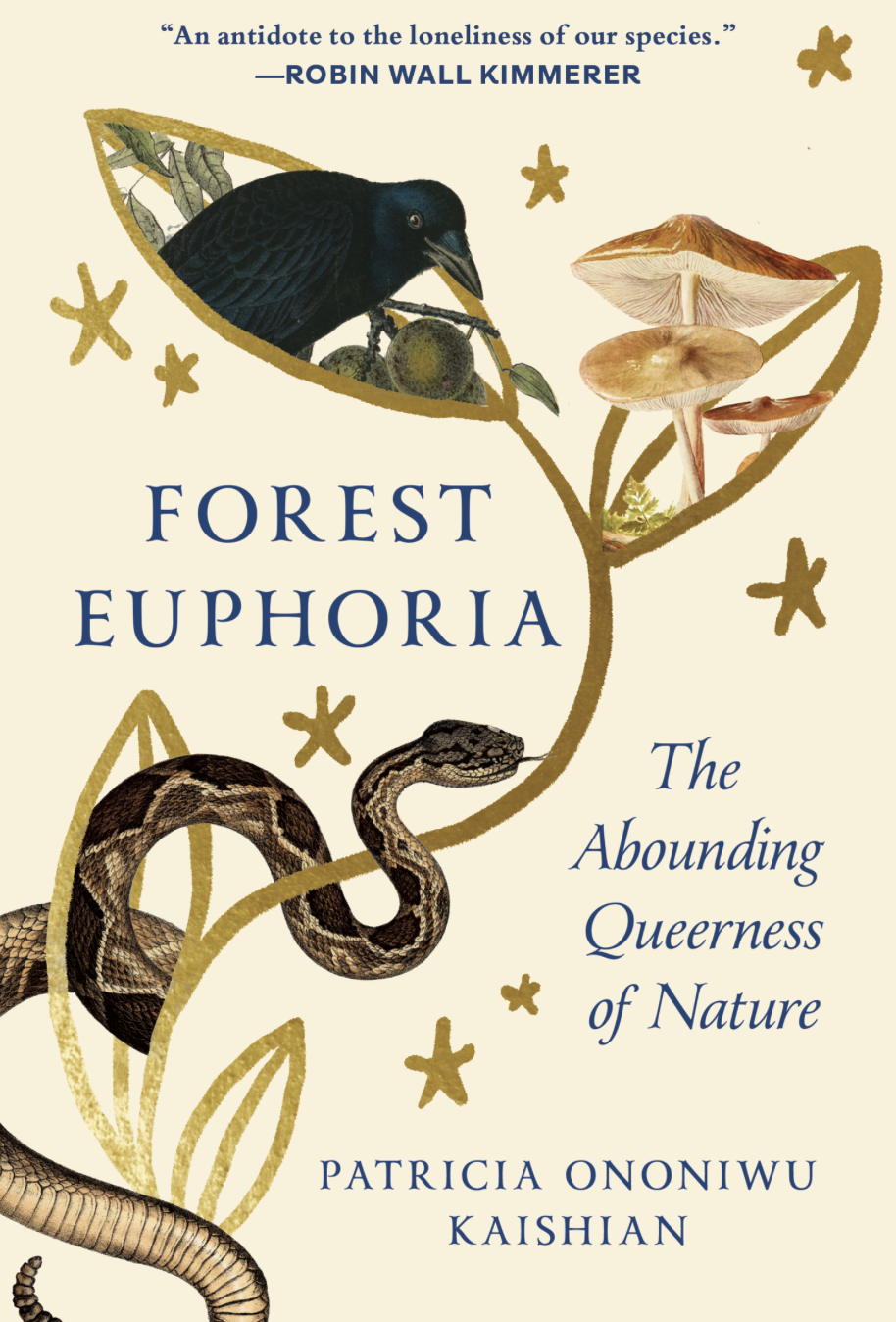 Dr. Kaishian is the Curator of Mycology at the New York State Museum and like Sheldrake included here, Kaishian specializes in the world of fungi. This was a very enjoyable read. Having taken pains myself over the last 3 years to educate myself on issues of import to the LGBTQ+ community, I found Kaishian’s approach in her book here interesting. The author identifies as non-binary and tells her ‘story’ here from a viewpoint as an ‘outsider’ who identified herself (not sure about the pronouns here.) as ‘amphibious’, seeing herself as sharing an affinity with the creepy crawlies in the wet places she often retreated to as a child in rural New York. This shapes her approach to science and its, in many cases, non-binary quality in which sex is more fluid along with gender. She introduces readers to the queerness, literal and otherwise, of all the life around us. Fungi, we learn, commonly have more than two biological sexes—and some as many as twenty-three thousand. Some intersex slugs mutually fire calcium carbonate “love darts” at each other during courtship. Glass eels are sexually undetermined until their last year of life, which stumped scientists once dubbed “the eel question.” Nature, Kaishian shows us, is filled with the unusual, the overlooked, and the marginalized—and they have lessons for us all.” [The previous from her website.] Her book is a call to open exploration, to lay aside rigid categories and ideas. It is a critique of how we do science, how we, collectively, look at and live in this world, and in the doing, do damage to ourselves and the world. Her book is a wakeup call, for a return to a science and an appreciation for life that we have moved away from. It is in part a rediscovery, a paen to the world she knew as a child, once lost, now found her way back to. A world which western science and culture has largely turned its back on. Science lags behind, necessarily, the ‘new’ thinking. It is inherently conservative. Demanding proof. It is often linear and direct. Either/or. Binary. If this then that. But science is reteaching itself now to think in terms of wholes, setting aside our preconceptions, to look at what is actually there and ‘see’ it.
“Braiding Sweetgrass: Indigenous Wisdom, Scientific Knowledge, and the Teachings of Plants”, Robin Wall Kimmerer, 2013.
Anyone interested in gardening, biology, ecology at all needs to read this book. Kimmerer is a Professor of Environmental and Forest Biology at the State University of New York College of Environmental Science and Forestry (SUNY-ESF). She injects her topic with the lessons she learned from her own indigenous person’s experience and culture. Her love of nature, its intricate relationships and unique beauties, along with our own responsibility to it as caretaker and dependent, are central to her lesson and these are clearly translated through here writing. This is both critique of Western culture and a call for reform, not necessarily to stave off some doomsday scenario, but out of love. For me this is her best book. It continues to inspire me. She writes of the ‘gift economy’, of gratitude, for the gifts of this world upon which we depend, and the necessity of nourishing the world if we expect it to continue its giving. The concept of reciprocity is essential to this relationship and it is everywhere exhibited in the unfolding of the natural world and entirely consistent with our deepening understanding of the world through science as it continues its exploration.
“Fire Weather: A True Story from a Hotter World”, John Vaillant, 2023.
 This one isn’t biology, it is the story of a changing world, and the changing nature of fire itself as the planet heats up. Complex, closed systems, like the Earth, normally tend toward stability, through the countless cycling of energy, resources and organisms that have made and found a life here. All operate in system that tends toward balance, homeostasis, through an unimaginable number of feedback looks…until it doesn’t. All of them, biotic and abiotic, combine under stable conditions to ensure the continuation of the system and its conditions. Minor changes will be absorbed back into the system, much as the spinning wheel of a bicycle tends to keep itself and the rider upright, unless pushed too far out of equilibrium. This is the story of the world as it is pushed further, passed its heat thresholds, to tipping points, into a world in which cascading events pushes the world more chaotically out of balance, its normally supportive cycles and responses, pushed into the unknown, margins and limits violated. In this case, a hotter drier world is developing, where whether patterns change, fire intensity and scale moves beyond ‘normal’ limits, literally creating its own weather with pyro-cumulonimbus clouds, ‘fire storms’, of such intensity that the only strategy is escape and relying on time alone to let the fire burn all available fuels and it exhausts itself. This is the biology and the physics of chaotic complex energized systems replacing what were once stable and fixed conditions. A world in which earlier fire ‘seasons’ can extend around the year, the massively increasing levels of carbon in the atmosphere accelerating creating an increasing cascade of now out of control conditions. Vaillant does this in his telling of the great fire that swept through northern Alberta that burned for over a year destroying and its surroundings causing the evacuation of a city of 100,000 people. He writes of the massive Carr fire in northern California that consumed acres going out only when it exhausted its own fuel supply. He addresses fire science and how the ‘rules’ that once applied no longer do once a threshold is crossed. He discusses the now increasingly regular drought condition of the northern Boreal Forest and how any carbon based material, dry enough, heated, gasifies, and creates a fire that can consume literally everything in its path ‘ahead’ of the fire itself. In biology, individual actors can put themselves at risk through poorly considered activities. Natural selection can step in and that individual dies. At the scale of the collective, when individuals behave as a whole in such a way, their collective impact, when large enough, and pushed far enough, can potentially push ‘conditions’ far enough, that our once stable conditions, are pushed well passed their limits. Over the course of geological time a handful of natural events have been of the scale that such massive and global extinction events occurred. Never before in Earth’s history has the collective effects of Man been great enough to push this complex, self-stabilizing system far enough out of balance to put the entire system under threat. We have been too long in denial of our collective potential for such destruction and have not learned that just because something hasn’t happened before, doesn’t mean that it can’t. The world is an energized complex system, much like that of a single organism. In health its systems work to support its continuation. In disease it, we, are compromised and our ability to maintain balance, homeostasis, is with it. In any organism, any complex system, collapse is sudden. Linear decline is a human fantasy. Whether you accept Lovelock and Margulis’ Gaia hypothesis, it is responding much as any individual does as it begins to move outside its supportive margins.
“The Song of the Cell: An Exploration of Medicine and the New Human”, Siddartha Mukerhejee, 2022.
 Mukerhejee is a cancer physician and researcher, an assistant professor of medicine at Columbia University and a staff cancer physician at Columbia University Medical Center, a Rhodes scholar, husband and father of two daughters…he’s also an amazing writer and has done speaking tours where he presents to general audiences. I haven’t yet read his, “The Emperor of All Maladies: A Biography of Cancer”, but it’s on my list. The “Song of the Cell” and his ‘middle’ book, “The Gene: An Intimate History” are linked to stories of his family, his own experience, disease and their treatment, often describing how our understanding of the body, disease and the cell, has change our medical approach. Like other writers here, Mukerhejee understands that the cell is at the core of life and that keeping it in metabolic balance is the key to health. Medical treatment is increasingly looking into the life of the cell. “Song of the Cell” doesn’t require a great deal of knowledge specific to cell biology to follow, but it certainly helps.
I lift the following from the Good Reads website:
Filled with writing so vivid, lucid, and suspenseful that complex science becomes thrilling, The Song of the Cell tells the story of how scientists discovered cells, began to understand them, and are now using that knowledge to create ‘new humans’ (This isn’t referring about efforts to genetically engineer, embryos and humans, rather it is considering more how such methods are making new treatments possible so that we might be better able to maintain our health). Told in six parts, and laced with Mukherjee’s own experience as a researcher, a doctor, and a prolific reader, The Song of the Cell is both panoramic and intimate—a masterpiece on what it means to be human.
The discovery of cells—and the reframing of the human body as a cellular ecosystem—announced the birth of a new kind of medicine based on the therapeutic manipulations of cells. A hip fracture, a cardiac arrest, Alzheimer’s dementia, AIDS, pneumonia, lung cancer, kidney failure, arthritis, COVID pneumonia—all could be reconceived as the results of cells, or systems of cells, functioning abnormally. And all could be perceived as loci of cellular therapies.
“The Dance of Life: The New Science of how a Single Cell Becomes a Human Being”, Magdalena Zernicka-Goetz & Roger Highfield, 2020.
 I’d earlier read the book, “The Master Builder: How the New Science of the Cell Is Rewriting the Story of Life”, by Alfonso Martinez-Arias and both books fit well together, each discussing how growth of the an individual organism is determined by the cell and the developing organism itself…not the individual’s DNA. When first being explored DNA was believed to contain the secrets of life and an instruction manual for the developing individual, its operation and repair. For quite a few years now this view has been replaced by one in which DNA is more of a catalog of ‘recipes’ for cells a toolbox of proteins, to use to construct the many cells and structures that comprise an individual. In it are the recipes the cells ‘call’ for to create as needed, which the cell delivers to the proper location in correct location utilizing the several forms of RNA to call for, transport and interpret the necessary genes. Both of these authors discuss our understanding of how this happens to the best of their ability. I suggest Zernicka-Goetz’s book as it is the least intimidating. Highfield as a science journalist shaped this book and is probably responsible for its approachability. Zernicka-Goetz is the mind and drive behind much of the important research into human embryology, the study of development from the single fertilized cell, through the process of gastrulation, when the individual begins to develop from a blastula, a ‘ball’ of undifferentiated cells into a bilateral structure as it first begins to differentiate important basic structures and organs. Martinez-Arias’ discussion is more biochemically and microbiologically oriented where Zernicka-Goetz, while not ignoring them, focuses more on the overall process, the concepts and the difficulty of the experiments they had to develop along the way. She mixes in the personal with the advances while also discussing the difficulties of conducting science in a competitive world that often ignores women. The book’s title, The Dance of Life, suggests the elegant unfolding of the process, as each ‘part’ is called for, created and placed, the developing whole then requesting the next, a process of switching, selecting and growth that is precisely timed, seamlessly, in a process marked by simultaneity and spontaneity, much like other authors here have described the flux of cellular metabolism. Beautiful and wholistic. (I didn’t do a full review of her book on my blog earlier…perhaps later. I did do one for Martinez-Arias’ book.)
“Wonderful Life: The Burgess Shale and the Nature of History”, Stephen Jay Gould, 1989.
To understand life today, or of any period, it is necessary to have some understanding of the vast expanse of time over which life has come into being and evolved into today’s forms and species. This book takes us back to the so called Cambrian Explosion, that period 500 million years ago when complex multi-celled organisms first ‘burst’ on to the scene, and then, ‘shortly’ thereafter, in geological terms, disappeared, their only record preserved in fossil form found in a handful of sites, such as the Burgess Shale in the Canadian Rockies. There are discussions of anatomy and structures completely absent from the countless thousands of animals since. Soft bodied organisms are largely absent from the fossil record and here the author discusses the unique conditions that had to exist to preserve these rare and highly select troves of fossils we’ve found. Gould includes the state of the science itself at the time, the competing egos, and an elaboration of the questions many of which still stand unanswered. Evolution, adaptation and radiation which were themselves still evolving concepts at the time of the Burgess Shale fossil discoveries, unearthed over the first quarter century of the 1900’s, are all discussed’
“Entangled Life: How Fungi Make our Worlds, Change our Minds & Shape our Futures”, Melvin Sheldrake, 2020.
The author received a Ph.D. in tropical ecology from Cambridge University for his work on underground fungal networks in tropical forests in Panama. He is passionate in his work and writing about the fungal world. This work corresponds with Simard’s book in its examination of fungal networks and their essential roles virtually everywhere. Fungi go largely unobserved until their spore producing bodies emerge, but the vast majority of their body exist underground as mycelium. Neither plant nor animal, fungi or in their own Kingdom. Where plants mostly produce the carbohydrates they require for life from the water their roots draw from the soil and carbon they collect from the air through their stomata, while gathering at least some of their essential minerals from the soil. Animals ingest, consume food and water, digest them and convert them into forms they can use. Fungi grow through the soil ‘digesting’ living and dying organisms as they grow through it, ‘digesting’ their ‘food’ outside of their fungal bodies and drawing in what they require to continue their growth, leaving what is left for others in the soil behind or penetrating the roots of plants, conducting commerce with them, trading what the plants need for what they need in return, in a unique ecological economy. Fungi are the ultimate and absolutely recyclers of organic materials, breaking them done into usable forms other organisms can ‘build’ from. Fungi perform absolutely essential functions for any kind of living community on Earth. Sheldrake explains this beautifully. He also lays out several potential contributions fungi can make more directly to our human economy, resources and products that we currently provide via energy and resource extractive and ‘expensive’ technologies. As with so much of the work being done in biology today here too lay many opportunities we could utilize to improve the quality of our lives as well as lessons we should attend to if we want to continue our occupancy here. They all go to cooperative and supportive relationships that as Kimmerer points out support the ‘gift economy’ and the practice of acts which are mutually beneficial. We have largely put into practice the singular lesson of competition that Darwin laid out years ago, while neglecting his call to supportive relationships and the idea that ‘fitness’ involves far more than physical strength and dominance, that it is essential that are relationships are collectively supportive of the whole. The individual will always be in service to the whole, lest the entire system collapse.
____________________________________________________________
There is so much more to discover about life. Among them them for me are the role of Lichen, which among other things ‘mine’ minerals ‘pulling’ them from rock and abiotic soil that makes those essential minerals available to plants which would otherwise remain locked away…and life as we know it, impossible. This is the world of Lichens, those amazing cooperative symbiotic organisms which occur in countless combinations of fungi, mosses and bacteria, which reportedly can form spontaneously under supportive conditions, and are acutely sensitive to water and airborne pollutants. Key to life’s survival, they should be yet another reminder, another prompt for us to change our collective behavior in this life.
 GardenRiots