Trees can be a defining element of a community as a ‘success’ story, a failure or somewhere in-between. A community’s trees are of it, not some separate amenity provided by the City. Ideally, just as the canopy is part of a community, its care should be a part of the shared responsibility of the community, with the City providing the services the community cannot, in addition to their role of coordinating the care so that the tree canopy can provide the highest level of service while meeting aesthetic needs. The City is ideally situated to perform this role. Neither ‘group’, the community or the City can do this on their own. Training, education, outreach, project implementation (planting, tree care) are a joint responsibility. Leaving this as a City responsibility alone cannot result in the best product. Communication and partnerships should define the relationship and effort.
Picking numerical targets for increasing overall tree canopy misses the mark. We don’t just need numbers, we need site and species appropriate trees in order to grow out a healthy urban canopy that is neither water intensive, given our climate and declining aquifer, nor one that increases overall wildfire risk; one that helps us, a portion of the more powerful human residents, bridge the gap between the contrived landscape in which we spend most of our lives, and the wild, evolving landscape outside our communities, that operates in ways that balance all the competing and supportive needs, of all of the species that comprise it. Our ‘developed’ communities, heavily prioritize a narrow fraction of the lives within them.
Tree selections should be supportive of local wildlife and pollinators in addition to providing the environmental services associated with urban tree canopies…not just those of the decision makers within the human community. Planting the wrong trees to get initial numbers up, as some kind of marker of success, will be relatively short lived at best. Trees are a long term, living and growing investment, that shape the future. However we slice it, they will demand water in larger amounts as they grow over time. So our choices should be thoughtful and considered. At issue is whether the normal growing conditions can adequately support the growth of chosen trees. We know that almost any other tree, beyond our Western Juniper, will require supplemental water. How much though we need to weigh. When tree and climate are a mismatch the result is evidenced locally by the increasing numbers of shade trees around town where owners have turned off the water leading to stressed and dying trees. Success is absolutely dependent upon well chosen trees, their ongoing care and the participation of an informed public.
-

- A dead Birch tree in an unirrigated yard. These are native to the northern Midwest and eastern North America. They are very cold tolerant, but require moist soils.
-
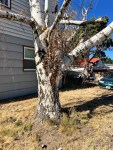
- I didn’t have a tape, but the DBH on this dead Birch must be at least 24 inches. It was very well established. Birch trees have been declining and dying for several years as a result of infestation by the Birch Borer although I didn’t see any of the exit holes that characterize infested trees.
-
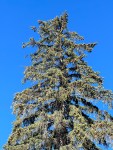
- The spruce is showing a much heavier production of cones than is normal. More than a few of these middle-aged conifers around town we’re planted in the late 50s and 60s by school children over a series of Arbor Day programs. Well many were native to Oregon. They are not to the desert.