
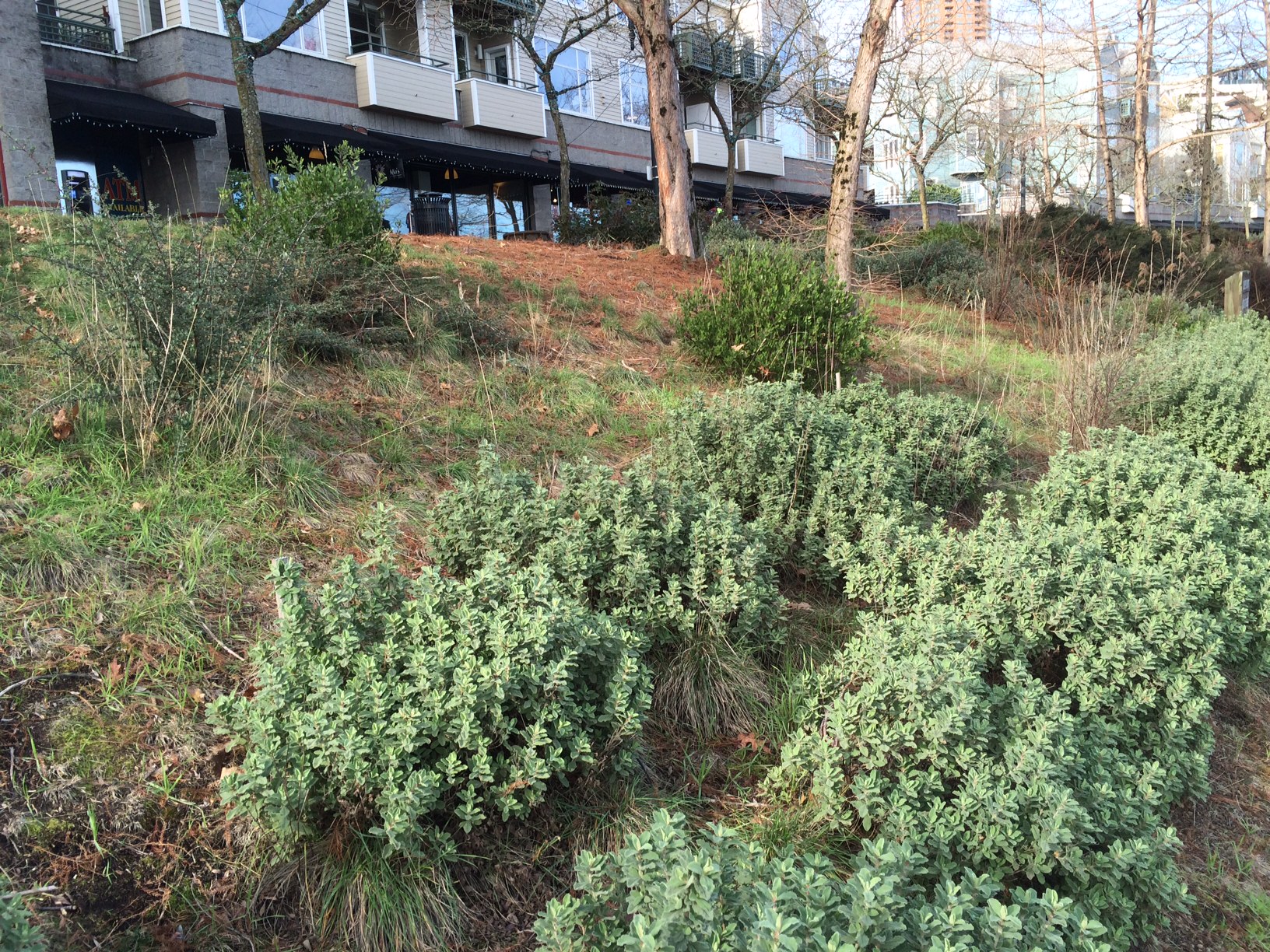
The second grassy bay from the south end, below the Harborside Restaurant at Riverplace, above the marina, between the Taxodium clumps. The ’04 planting included no shrubs or perennial forbs in this area. It was a monoculture of Koeleria macrantha, a native early season bunch grass that goes dormant by mid-July leaving the entire area vulnerable to invasion by weeds and offering no ‘barrier’ to either people or dogs, which enter frequently. A sweep of Cistus pulverulentus ‘Sunset’ at the bottom, Ceanothus cuneatus ‘Blue Sierra’ at the left and Arctostaphylos x ‘Harmony’ have been added to this site along with Festuca rubra var. commutata a low, fine textured spreader to help fill in the spaces and scattered native perennials.
We, all of us, are part of the landscape. Just as individual plants belong to a local native plant community, and its place, so do we. That we live in highly disturbed and contrived landscapes does not change the fact that we live in relationship with it, that we are a functioning part of it. Deny this as we may, many of us as a group likely admit to very little connection to our ‘place’. It’s just where we live, for now. Our understanding of it and any involvement with our landscape, other than as a simple stage for our lives, is minimal, a condition which has become pervasive in modern society. Some professionals, who work with children have come to refer to this state as NDD, or Nature Deficit Disorder, a dissociative relationship now that was once basic to human survival. Today this condition is pervasive and our landscapes, as a result, severely disturbed, damaged and compromised, lack the capacity to return to their former state. There is a general ignorance amongst the public and our leaders of the severity of the problem and our necessary role and responsibility to correct it. We are locked into a strategy that views landscape as incidental, the natural world as backdrop for our activities, not central to our well-being. Today landscapes, as long as they meet our grossly simplified idea of our needs, a modern minimalist aesthetic, that does not over tax our ‘pocketbook’, are forgettable. From a horticultural viewpoint this is becoming an increasingly deteriorating disaster, something that not only we can do something about, but one that is imperative that we do so. Adaptive Management describes a responsive relationship between people and the place in which they live. It is centered on a positive and workable strategy we can adopt that addresses this situation and turns it around, reengaging us with our landscape. Continue reading →

 GardenRiots