Category Archives: Plant profile

Podophyllum and the Sometime Quixotic Life of Plants in My Garden

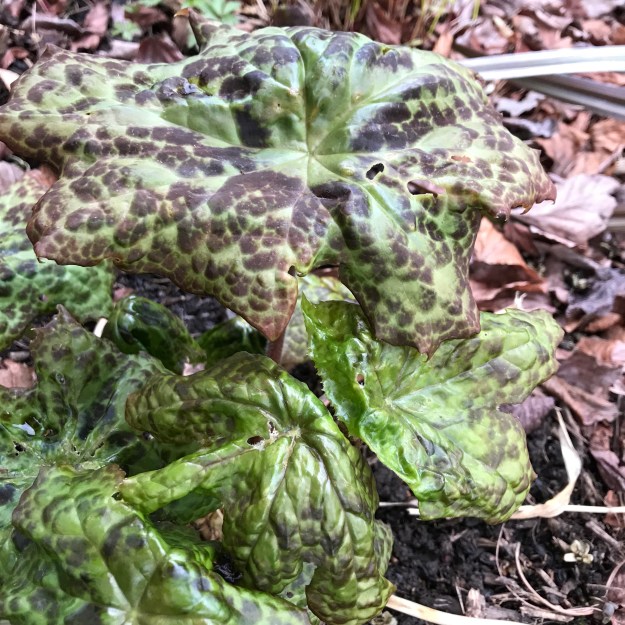
IMG_0207

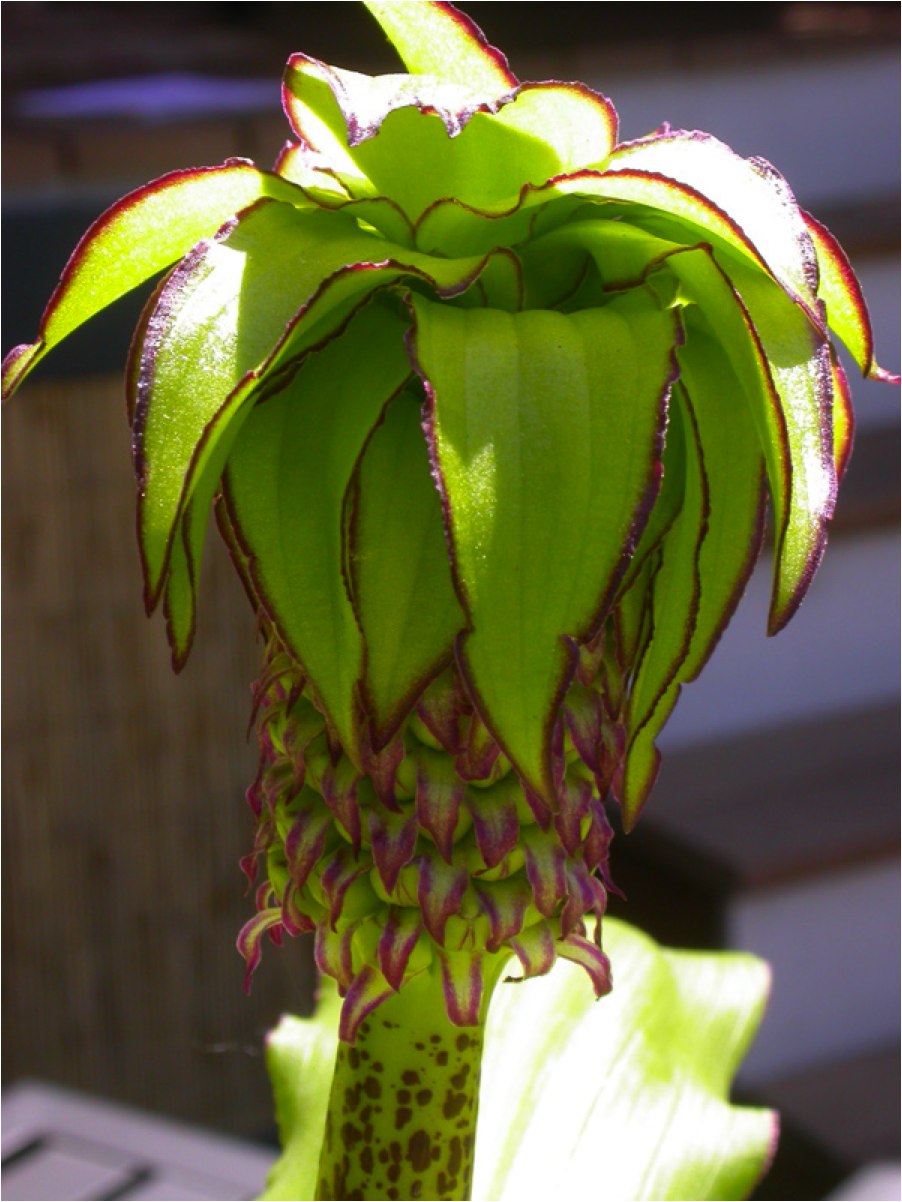
Podophyllum x ‘Spotty Dotty’ emerging this Spring.  Remember that these leaves aren’t small.  When they open to their mature size, at about 18″ across,  they’ll absolutely dwarf the vari-colored leaves of your Pelargoniums.

People will often ask me how I grow something, generally when its something they’ve killed, when our conditions, exposure etc, seem pretty close. I’ll shrug, because I may not have done anything special for my plants beyond, hopefully siting them appropriately. Then, there are all of the plants I’ve killed, sometimes repeatedly, that others seem to have success with while doing little more than ‘dropping’ them in the dirt.

I have a bit of a thing for the members of the Podophyllum…and almost everyone I know, who grows them, does so more successfully.  I do have a very ‘happy’ clump of P. pleianthum, and I’ve grown it in Park beds very successfully downtown, but until now I’ve had very little success with any of the others.  Most have lead short, tragic lives….P. delavayi…dead; an unnamed P. delavayi hybrid…dead; P. versipelle…dead; P. x ‘Kaleidoscope’…dead; P.(Sinopodophyllum) hexandrum…dead; P. x ‘Spotty Dotty’…dead; even P. peltatum...dead.  Some of these I’ve killed more than once.  These are usually relatively costly plants to acquire and their loss is more than emotional.  Sometimes I’ve grown them on in their pots for a year before I’ve thrown them into my garden to their deaths.  I’ve lost several other plants from the Barberry family as well, having consistent success only with the shrub forming species and Epimedium spp..  I’ve lost both NW species of Vancouveria as well as Achlys triphylla, one of my favorite ground covers, all of which I’ve grown successfully when I worked in Parks. These shouldn’t be hard.  I’ve grown quite a few different Epimedium spp. and varieties at home and several in Parks, all of which have been consistent and dependable performers.  For a long time, my failures with Podophyllum and assorted woodlanders,  was an embarrassment.  I couldn’t figure out why I kept losing them.  I have a hard time with many Himalayan plants in my garden and a lot of woodlanders in general, I think because it may just get too soggy over the winter.  They’ve taught me to shrug when they fail to emerge in spring.

Epimedium g. Lilafee4362

A cluster of flowers on Epimedium x ‘Lilifee’
Continue reading

Flowering…A Reason of Their Own:  A Look at Agave Flowers, Structure and Relationships

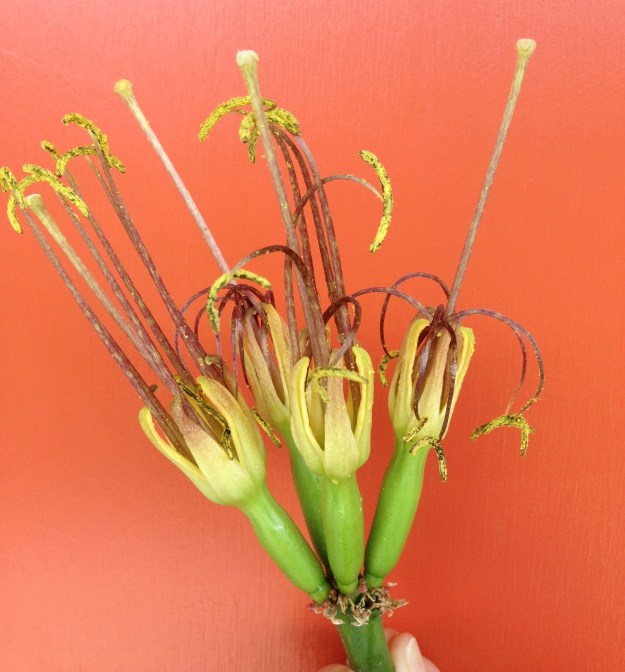
IMG_1712

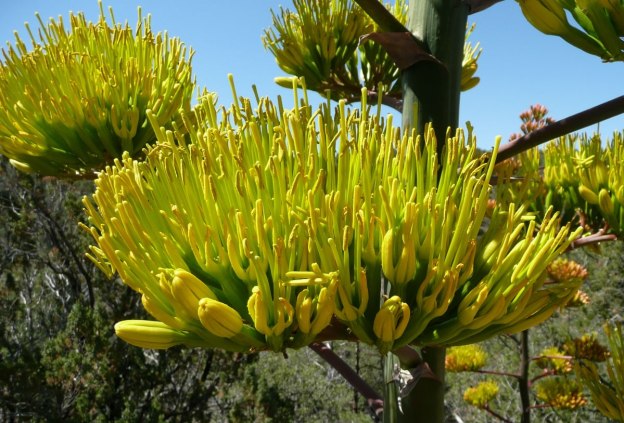
This is one of the lower umbels, the second peduncle from the bottom. The others contain more individual flowers. This umbel was caught in the stage where the filaments are collapsing and the styles extending. Nectar has spilled to many surfaces. The tepals have begun to shrivel as well. Coarse pollen grains show on the anthers with some ‘spilled’ to other surfaces. Individual flowers aren’t particularly pretty.

Flowers can be ‘incidentally’ beautiful.  We often selfishly view them as products of nature intended to fulfill our own hunger for beauty, failing to recognize them for what they are, living organic structures evolved over time to continue their own species, organs and tissues meant to attract the necessary attentions of pollinators, to produce the seed of generations to follow. We, as a society, have learned to view a select few of these as beautiful.  We respond to them in a way not unlike the pollinators themselves do, and by either ignoring them or focusing our attention upon them, we too alter their future form and their very existence.  Sometimes we do this more directly through choosing the plants we want around us.  Other times it is our indifference that seals the fate of a plant or landscape, especially when the flora is unable to grab our often preoccupied attention and we clear land for development wasting all of the ‘lesser’ weedy natives we’ve learned to undervalue, or, through our efforts to ‘improve’ plants by controlled breeding and hybridization, intentionally altering their form even the conditions under which they will grow.  Sometimes, in our desire, for fashion and an idealized beauty, we attempt to control and remove that which we don’t want, creating sterile flowers, the antithesis of what a plant would ‘want’.  We select for bloom size, scent and color, for period of bloom, we seek to increase the number of petals and alter the pattern they may be held in, even the lifespan of the individual flower, the height of the plant so that it doesn’t flop over, the ability to grow it in more sun or shade, the shape and color of leaves and the form of the whole plant.  We attempt to control all of this and crank out a uniform product that can be ‘plugged’ into landscapes and gardens as desired.  Plants with dependable performance characteristics, a pedigree.

We need to remember that this is what we ‘want’, not what the plants ‘want’, nor is it necessarily in their best interest as either a species or a member of a plant community.  These days most of ‘us’ aren’t gardeners.  Our relationships with nature were broken long ago.  It is difficult to see the critical connections in nature, between plants and the organisms they have evolved with, upon which they are dependent, especially if someone is not looking.  It is even more difficult to see where we ourselves fit into this in our materialistic, consumer society where so many of us measure ourselves and others by the things and property we own…and are quick to ‘take’ from others.  I’m going to paraphrase a snarky rejoinder I’ve heard these last several years, ‘Yeah, you’re special, just like everything else!’ and I mean this in the broadest sense. Continue reading

Flowering and Its Trigger in Genus Agave

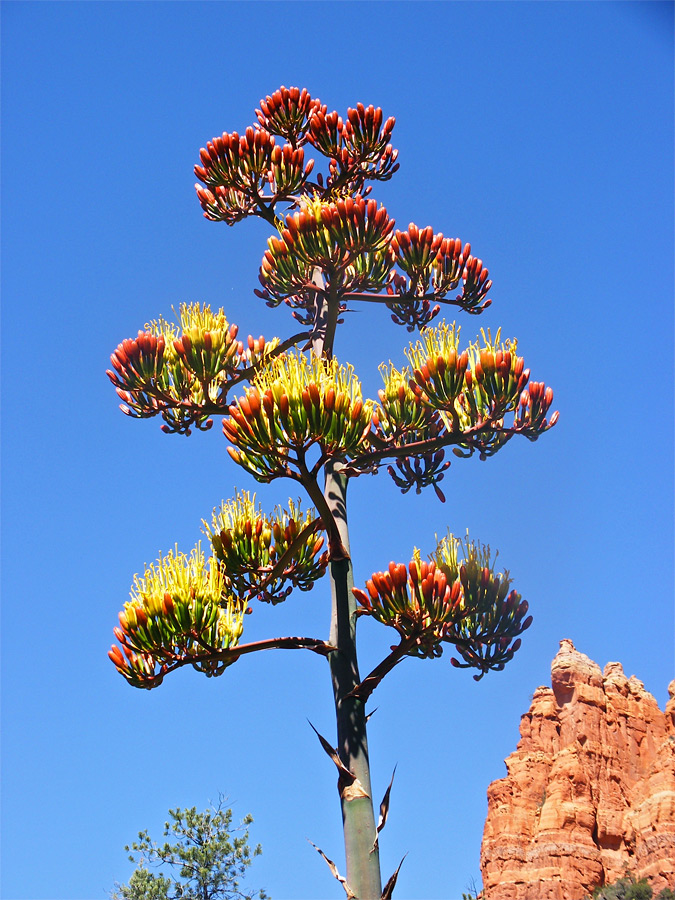
Agave parryi with both secondary and tertiary peduncles and the elongated yellow anthers 'floating' above.

Agave parryi with both secondary and tertiary peduncles and the elongated yellow anthers ‘floating’ above, in Sedona, Arizona.  From  americansouthwest.net.


As gardeners we come to know our plants, what to expect from them over time, how we can better meet their requirements,  and their contributions to the garden.  If we watch we learn when to expect their spring time resurgence, the extension of stems and unfurling of leaves.  We anticipate their flowering often recomposing vignettes to best display them.  They teach us over time.  But with Agaves their flowering is so infrequent, that if we don’t study them in mass over a span of years, we won’t know what to expect.  With some it can take as few as six years, some even less, while others will keep us waiting for 30 or more.  When we buy a year old grafted Magnolia we are told to be patient and we understand that the tree will take some time to grow and mature.  So we wait knowing that once it begins a Magnolia will increase in both size and floral performance rewarding us for many years to come…but with Agave, it is once and done.

Agaves are flowering plants, Angiosperms.  Angiosperms all share a broad survival strategy forming complete flowers which produce seed which grow into juvenile plants.  If you follow plants back in time you’ll that find that plants can be broken down into a few large groups.  The largest such group, the Angiosperms or flowering plants, are also the most recent of these…and the most successful.   Angiosperms have seeds encased in a ‘fruit’ that formed within the flower from the ovary.  Gymnosperms, produce seed as well, though their’s are ‘naked’ without a covering fruit, as the plants have no ovary nor true flower. There are other differences between them as well both structural and in the details of their reproductive cycles.  Other plants like ferns don’t produce seeds at all and instead rely on the more ancient process of reproducing directly from spores which grow into an intermediate form, a gametophyte, with one set of chromosomes.  This is the ‘sexual’ stage, either male or female, which mature independently, the male form later fertilizing the female, the product of which grows into the sporophyte, with two sets of chromosomes.   The sporophyte later releases the single sex, single chromosome spore that will grow into the gametophyte, continuing the cycle.  Agave, as a genus, share much with other Angiosperms, they have several distinct peculiarities they share amongst themselves as well.  They are all perennial taking more than a year to mature and flower.  This is a very common attribute.  What sets them apart is that they are monocarpic, they die after flowering once, and, they can take up to 30 years or better, depending on species and growing conditions, to flower.. Continue reading

Growing Agave in My Maritime NW Garden

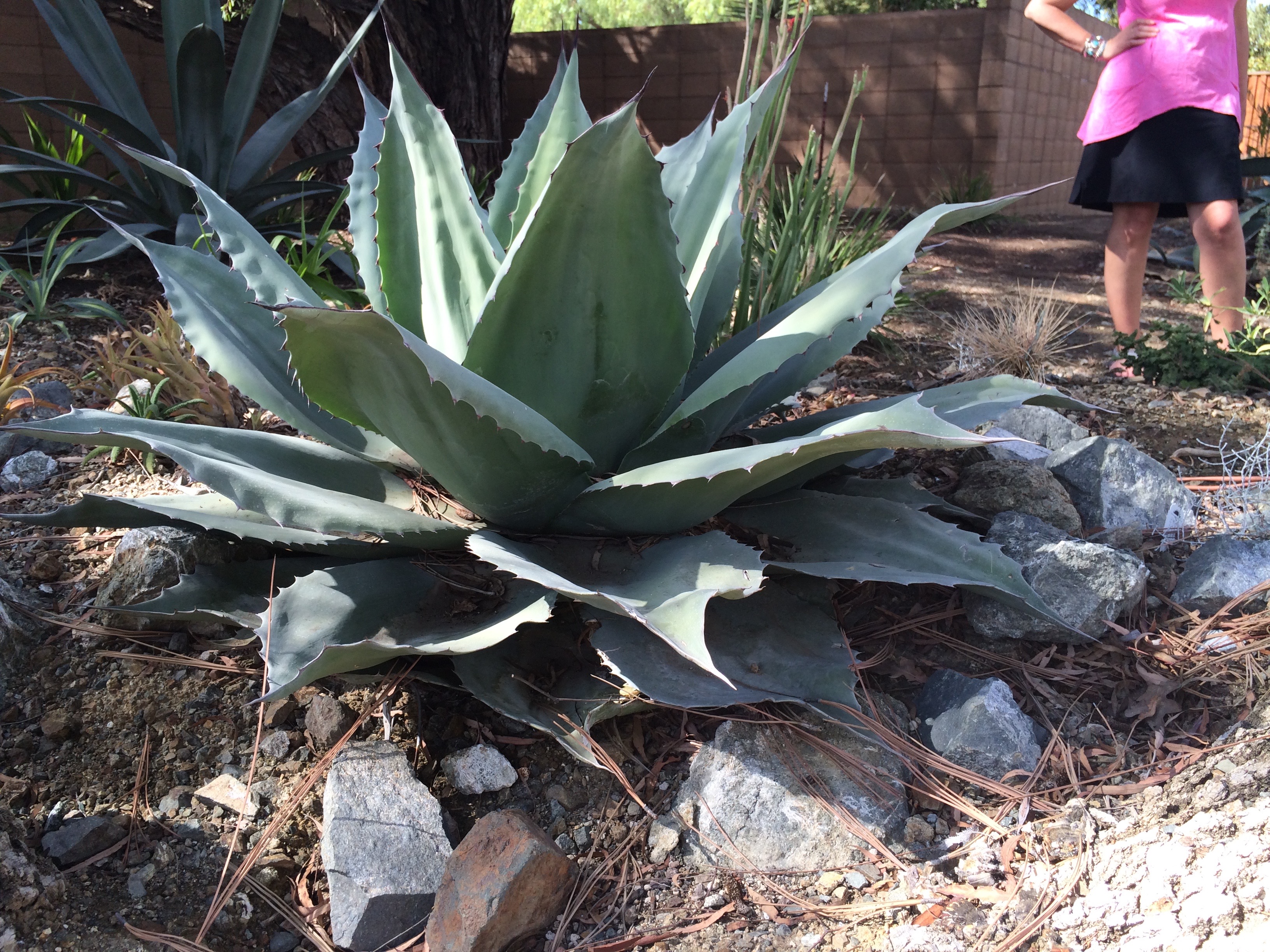
My picture, but not my plant. Alas! I just potted my start up to a 1gal purchased from Sean at Cistus. Agave ovatifolia 'Vanzie'. Several of these big beautiful cultivars are growing in the Bancroft Garden. It is distinguished from the species by its undulating longitudinal waves across the wide guttered leaves.

My picture, but not my plant. Alas! I just potted my start up to a 1gal purchased from Sean at Cistus. Agave ovatifolia ‘Vanzie’. Several of these big beautiful cultivars are growing in the Ruth Bancroft Garden, in Walnut Creek, CA.  We visited on a nice 80F+ day last October.  It is distinguished from the species by its undulating longitudinal waves across the wide guttered leaves.  Each leaf can be over 10″ across.

When we garden in the public view, and most of us do, at least where we front along the street, or even when we invite others into its more private and inner sanctum, and we grow plants successfully, people are going to ask you: ‘What’s that?’  ‘I didn’t know you could grow those here!’ and, ‘What did you do? they always die for me!’  In short, if you’re successful, people will regard you with respect and assign to you the attributes and position of ‘expert’…when all you did was try to follow the gardening maxim of ‘Right Plant, Right Place!’  In short, you tried not to kill it.  Genuine expertise requires broader experience, study even, that the simple buying and planting of one particular plant cannot earn you.  If you’re like me such easy success and adulation, can be embarrassing and often serves as a prompt, to look through books, search the internet and ask others, that you know who have way more practical growing experience than you yourself do, and gradually, the assignation of ‘expert’ feels a bit less flimsy, maybe even ‘earned’.  I often tell gardening friends that I consider myself to be more of a dilettante, flitting from one plant or group of plants to the next.  Inquisitiveness has always been a part of me and growing one Penstemon, one Banana or one Agave, never adequately ‘grounds’ me.  Grow a few more and I feel a little more comfortable with it.  Look into some of its ‘cousins’ and the particulars of where something grows, its climate and soils particularly, and I feel ‘better’, much like I did when I was preparing for mid-terms at school.  And then I move on, my interest sated for the time being, somewhat comfortable in what I know and curious about the next group.  Over time they all start forming a bigger picture out of what once seemed like a massive, unknowable puzzle and I enjoy solving puzzles.  Having said this, I still don’t consider myself to be an expert, just an avid and focused gardener. Continue reading

Iris x pacifica: Hybrids & Jewels of the West Coast

PCH Native Warrior w: Stachys Primrose Heron DSCN2479

Iris x pacifica ‘Native Warrior’ next to Stachys byzantina ‘Primrose Heron’  These Iris are very garden worthy and can combine beautifully with plants  with similar cultural requirements

(I wrote this several years ago for the HPSO Bulletin, when it was actually printed on paper, and thought re-issuing it today, edited and expanded, might be helpful to some as we are about to enter their flowering season.  The iris pictured on my Blog’s masthead is Iris x pacifica ‘Simply Wild’ poking out from the base of the Chilean shrub Fabiana imbricata ‘Violacea’)

Gardening is no more or less subject to the vagaries of fad and fashion than the other activities we dabble in.  Marketers prey on us luring us with plants possessing new and alluring characteristics, promises of larger flowers, more disease resistant, floriferous, more exotic or environmentally responsible, less maintenance intensive… the list goes on.  Gardening is a very personal endeavor and as such we will always be subject to such Siren calls.  There will be the righteous amongst us convinced of their own focused vision who seem to be immune (but what, we might ask, are they missing?) and there will be those who simply surrender completely to the beauty and bounty around them making themselves easy prey.  In the long run, who is to say who is right?   Our knowledge is imperfect and we are weak…. The act of gardening strengthens us, provides us with the opportunity to learn and in so doing puts us into relationship with the living world around us.  We become better gardeners capable of making better, though still imperfect, decisions.  Whether we garden to augment our own diets with what we grow or are trying our hand at healing a small piece of a damaged earth, or building a place of respite for ourselves and friends or trying to model ‘right’ behavior for our children and neighbors, we are out in our gardens and landscapes learning something of how incredibly complex this earth is…and that is all good. Continue reading

Eucomis: Pineapple Lilies– Exotic Looks/Common Tastes

This posting was first published in the HPSO Bulletin Spring 2010 and is here revised

Eucomis bicolor

Eucomis bicolor

South Africa is one of the most botanically rich regions of the world. Within its boundaries is the Cape Floristic Region (with 0.08% of the world’s land and 3% of all plant species), containing some 8,700 species, two-thirds of which are endemic, existing nowhere else in the world. It is one of only six such regions in the world. By comparison, the Boreal Floristic Region includes all of North America, Europe, and the northern portions of Asia and Africa, and is thus considerably larger. Each region has a distinctive “suite” of plants with particular families that are endemic to them. One would feel a familiarity when exploring anywhere within one’s own region. Outside it, you might feel the world was populated with the alien plants of other star systems. For example, forests are not to be found in the Cape (though nonnative species have been introduced and have spread); instead, these areas are characterized by heaths, proteas, and restios. Included in the region are 2,700 species of bulbs in 15 different families. These include gladioli, freesias, amaryllis, agapanthus, and many others, most of which would be unrecognizable to the average temperate area gardener. One such genus of bulbs is Eucomis. Continue reading

Erythrina x bidwillii: Coral Bean Shrub


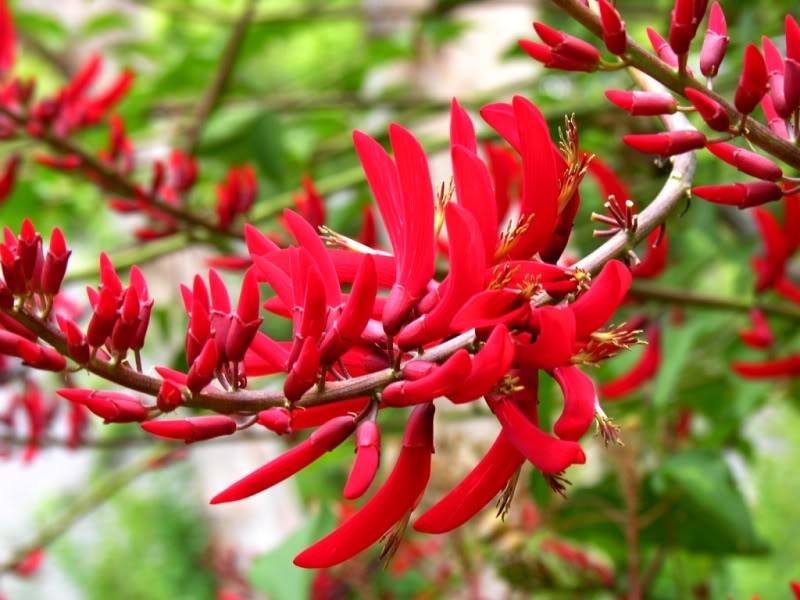
Erythrina x bidwillii from Piece of Eden

Erythrina x bidwillii from Piece of Eden

Every gardener makes decisions about which plants to buy, which to increase, limit or get rid of. It’s part of gardening. We each have our biases that cause us to tolerate plant ‘behavior’ that an otherwise ‘rational’ person would never choose. A ‘rational’ gardener would not knowingly acquire plants they knew to be tender in their zone nor would they collect plants with growing requirements they cannot provide. Who said gardeners were rational?  Much of our lives as gardeners we spend learning just these things about ourselves and our little plats of earth. Most gardeners are hopeless optimists and find themselves constantly tempering their runaway excitement for a never ending parade of plants, after all we have limited budgets for replacements and only so much energy to deal with too much attrition. Besides, all of that plant death can get kind of depressing.

The reality is that we each draw this line differently. Continue reading