
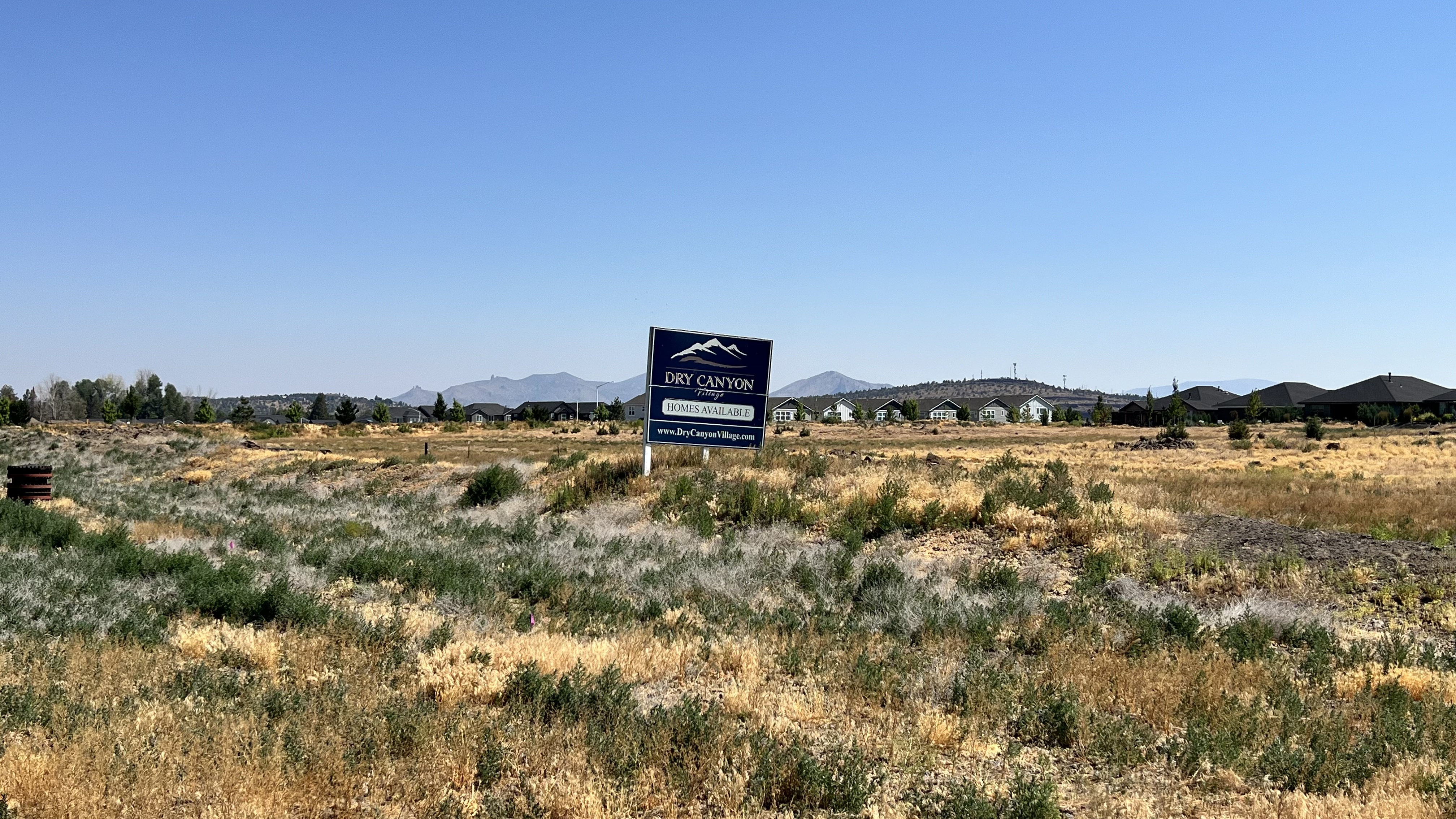
Looking NE from the gate at Northwest Way, other than a handful of juvenile Juniper there is literally nothing native of value across this roughly 9 acre spread. The other two undeveloped phases are equally bad, having a similar mix of weeds.
The question I keep hearing is, ‘What do we do?’ Many, if not most people living here now, have expressed frustration and more about the Dry Canyon Village South, DCVS’s, landscapes, specifically the berm, the mini-parks, the Circle and the 25+ acres of undeveloped, uncared, for property we share space with. They ask me because they know I cared for Park landscapes, as a field horticulturist, for almost 30 years, Parks which often included natural areas of over 100 acres, to little neighborhood parks and intensively developed and used urban parks in the downtown core. I also haven’t been shy about my criticism of the lack of care, or of even a plan, for the neglected property we are saddled with. Anyone who has cared for a landscape can see the problem here. Leaving disturbed and neglected properties on their own is not a plan and can lead only to their further deterioration and continuing, worsening, ‘weed pressure on the adjacent developed landscapes.
I have mentioned this several times to the developer, receiving a smile and assurances that they understand landscapes and are acting responsibly, deflecting the problem saying little more than about how easy it is to control weeds with a little spraying….Anyone who cares for landscapes quickly learns that if you want to stay on top of weed problems you must control/limit the production of weeds and the seed they will deliver to your property while also doing what you can to limit that coming from adjacent properties. Without this you face a never ending battle, or at minimum one you have no control over, as you are confronted with wave after wave of weeds as you cycle through the growing season, while ‘new’ weeds arrive and proliferate in your vicinity. Weeds are supremely well adapted to the conditions on a site, possess great vigor and will take every opportunity to invade and occupy an open compatible site. The problem is dynamic changing over time, rarely or never in your favor if you choose to do nothing, but continue the conditions that support the weeds.
As western peoples we rarely ever do ‘nothing’. We continually ‘disturb’ our landscapes in ways that don’t respect the plant communities or their loss. What we do, and don’t do, is a major factor in determining both which plants will be weeds and whether in the limited sense that we view them, our landscapes are successful or not. We tend to ‘expect’ our built/contrived landscapes to be relatively short lived, and readily tear them out to begin again or live with them in a degraded state. What we so easily forget or dismiss are the cycles and energies inherent to a place, any place, over the course of thousands of years, which ‘created’ our native landscapes as unique complex, intimately connected ‘systems’. ‘Nature’ over time, left alone or ‘supported’ creates these complex systems, each element playing its role. Health being the result. Homeostasis. When we build purposeful landscapes that meet our ‘limited’ expectations or demands, the ‘centering’ focus of nature, is abandoned. Our actions, determine the fate of these landscapes and go to helping ‘select’ the weeds we are confronted with. When we apply the same kind of thinking, demands and actions to nature, the ‘system’, invariably begins to break down. Our approach is ‘wrong’ from the start.
Gardening, Weeds and the Ecology of the Landscape
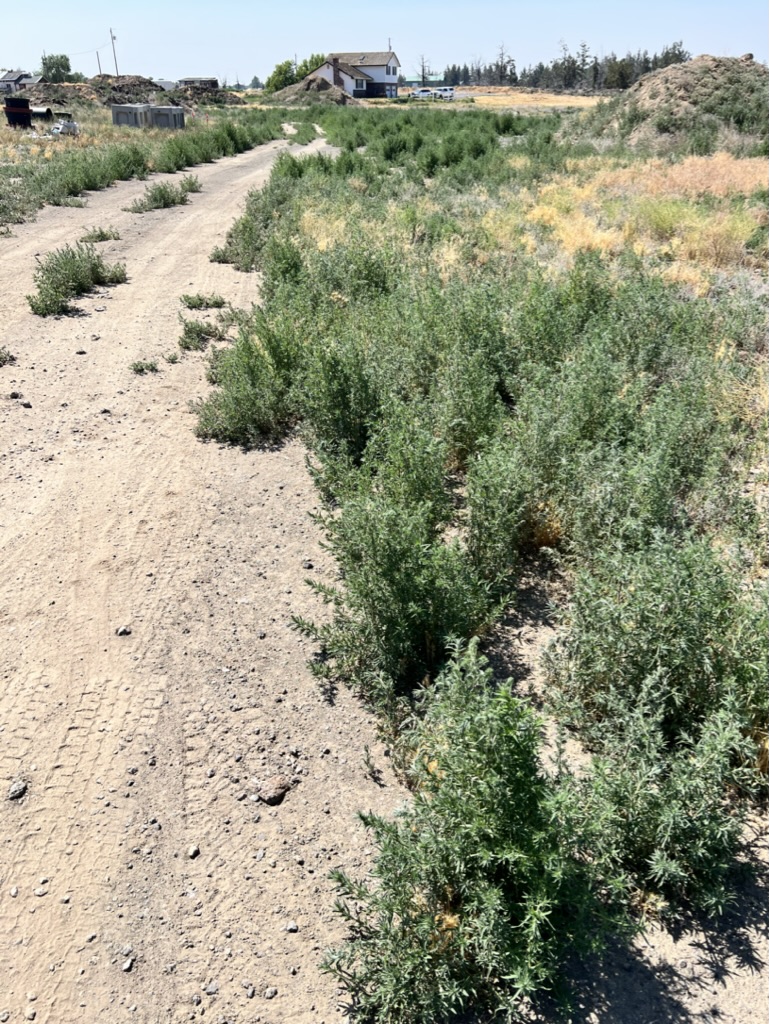
Kochia, Bassia scoparia, this pattern of distribution is common. The previous years weeds tumbling along roads and open ground their seed concentrated around the edges where they begin germinating about mid-spring. All of the green here is Kochia.
To be effective your weed control efforts require an understanding of how landscapes ‘work’ and a plan that respects it. To manage a landscape ignoring this is to court failure and require far more resources than would otherwise be necessary. Nor can random, uncoordinated efforts succeed. What grew here before should serve as a ‘road map’ of sorts for achieving a healthy landscape requiring minimal resources and efforts. So to devise a plan you need to understand the conditions on your site, both the natural and manmade; understand which weeds you have, how they grow, how they proliferate and the conditions which favor them as well as the methods by which you can control them; you need to have people on the ground who understand this, have the training and support they need to monitor and effect the controls in a timely manner; and realistic goals they can work toward and accomplish. To do this you must ‘value’ the landscape enough to invest in the effort and in understanding it, what it requires to be healthy. A ‘healthy’ landscape is not under ‘attack’ by more ‘forces’ than it can tolerate from outside. A healthy landscape can ‘absorb’ and respond to attack in ways which are supportive of its long term health. They should require only minimal intervention. Landscapes are complex living communities whose members exist in dynamic relationships with one another. Members respond to each other. It is a continuous dance of adjustment which remains, always, within supportable parameters. Every action ‘measured’. The collective response, bringing the ‘whole’ back to stasis, like a healthy body responding to infection. When we ignore this and grossly simplify landscapes in ways which ignore the plants themselves and the conditions under which they live, we open them up to invasion and poor health. We compromise them. Key to one’s success then is having a landscape design that respects this, is realistic and workable. You cannot ‘ask’ for more than a system can deliver. You must always assure that system’s health. The further any landscape is from this ideal, the more the intervention required of us in order to be ‘successful’. Leaving a ‘broken’ landscape ‘alone’ will always fail. We don’t ever actually do this. We continue to ‘tinker’ with them and take from them, use them, to get what we want, while ignoring their needs and limits, tolerating the weeds and maintaining them only to the extent which serves our limited purpose.
A healthy landscape is a beautiful landscape. Equating a landscape with beauty that only meets our own aesthetic, while ignoring its ‘health’, contributes to the problem. A level of ‘health’ which ignores the disturbance it has suffered, is not a healthy state at all and is unsustainable. Such landscapes will always require a high level of intervention, continuously, into the future, in order to keep it in its unbalanced state.
One of the first rules of successful gardening is, right plant, right place. Translated, this means that the plants you intend to grow are appropriately selected for the given site’s conditions and the demands we put on it. The closer the needs of the plants you choose are to matching the conditions on your site, the less work is required of you to grow them successfully. We must also respect the limits of a site and its landscape to deliver what it can and still remain in a healthy state. Our use, our expectations, place demands beyond the physical and biotic conditions operable across a site without our intervention. Also, the plants you choose should have compatible requirements, so that what one needs does not harm or conflict with another. Not that they are identical, but that together they form a supportive and dynamic, stable, community. Homeostasis. Not all plants are created equal. Not all can be successfully grown in any given landscape…despite what the plant’s marketers or a garden center’s staff may claim. Plants may tolerate relatively widely varying conditions, but only thrive under much narrower conditions.
There are some 300,000 different species of flowering plants in the world, a great many more cultivars, hybrids and other ‘non-flowering’ species such as conifers and ferns. The vast majority of them will die here without a great deal of modifications to your site and their conditions, including irrigation, soil composition, depth and texture, length of growing season, precipitation, humidity, shade conditions, cold and heat, even ‘aspect’, the particular direction the slope upon which they grow faces…as well as the other plants and living organisms they share space with. In fact most of them will die in spite of your efforts. What the nursery industry provides is a narrow sliver of all the possibilities…and what it does supply is not always the ‘best’ choice. Producers and sellers can have other priorities.
Weeds have been ‘selected’ for success. As a people, moving around the planet, we have brought the plants we want with us, scraped away the pre-existing native landscape, and attempted to grow what we want, often with little or no regard for what was here before. Along with the plants and the seed we’ve brought intentionally, have come the weeds, plants that have demonstrated their adaptability and vigor over many generations. Those that couldn’t make the ‘cut’ dropped out. They travel with us sometimes as chosen garden plants, as contaminants in the seed we bring along, in the feed of animals we’ve brought with us and on the animals themselves; carried on our persons and our vehicles; and once established in the areas we’ve occupied, moving freely along established corridors, primarily by rivers, railroads, roadways and paths. Our tendency to move supports the various mechanisms and relationships the plants have developed to aid in their survival and dispersal as a species. Weeds are not a random selection of what’s out there. They are in a sense, a mirror, of our intention. Intimately partnered. They exist in spite and because of us.
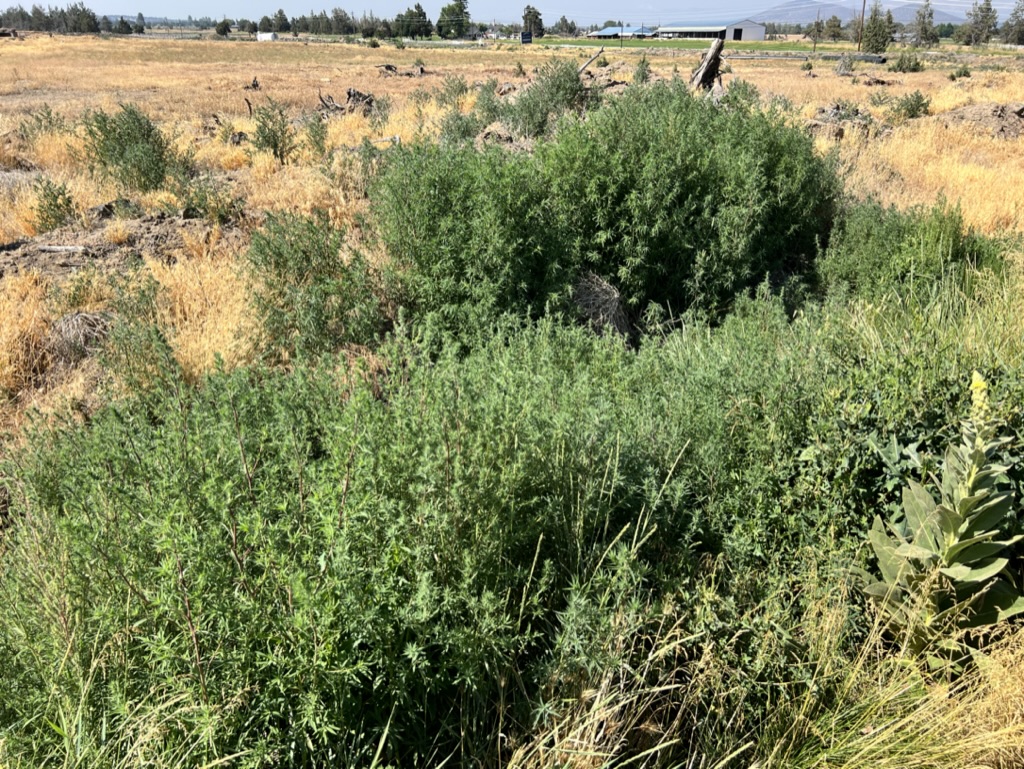
Bassia scoparia, Kochia, an annual that can grow over 6′ tall with a commensurately deep tap root. One of the ‘tumble weeds’ that break off, tumble and distribute seed. These are largest near the base of the berm where the poorly functioning irrigation system concentrates the water and so receive extra water. Elsewhere, due to our drier than normal spring these are much smaller.
Invasive plants are weeds that perform at an entirely other level, one that doesn’t even require the removal or physical disturbance of the pre-existing landscape. They are supremely well adapted for an area’s local conditions and can invade and dominate given intact native landscapes, when their requirements align, disrupting all of the existing relationships including those they have with area wildlife. Weeds and their invasive members, are particularly well suited to the conditions we seek and create. Our disturbance of native landscapes provide the conditions in which they can thrive although their specific membership and proportions will vary with place and their local conditions. What is a weed in one place will vary, what is invasive will as well. Weed invasion of a site is not the part of the process of healing many claim it to be, but a symptom of our continuing disturbance of the land. I suppose, if left alone long enough, without any additional disturbance, a new plant community will come about, but we are talking about a period which would be many generations long, of both the plants and ourselves, over which we will need to live in supportive relationship with one another, ourselves and the plants around us…but this isn’t our current relationship and won’t magically change, so….Our native landscape here has used the previous 10,000 years plus to evolve into what it was before the European invasion. We exist on top of, out of relationship with our landscapes, landscapes in which the plants and other organisms which comprise them are recognized as having limited and subordinate value.
In a landscape such as ours, which is extremely ‘disturbed’, its native plant community disrupted decades ago in favor of other exotic plants, most commonly here, pasture grasses, which in our desert environment are entirely dependent upon regular irrigation, we are commonly confronted by two groups of weeds, with some overlap. The first, I will call common garden weeds, Dandelions, Clovers, the Plaintains and a host of others which commonly infest our lawns and garden beds. As ‘western’ people we have a particular garden aesthetic which we attempt to recreate wherever we find ourselves with lush lawns, flower and veggie gardens and shade trees common to the mid-west, eastern US and other verdant regions of the world such as Western Europe, Japan and China, regions which receive significant and often a large proportion of their precipitation during the growing season, very unlike here. We water, fertilize, add compost, spray pesticides in an effort to recreate these conditions supportive of such lush and productive landscapes. The weeds that enjoy these follow, infesting these created and contrived landscapes, however out of place they may be.
So which weeds are problematic here. This is a pretty extensive list. I’m not going to present them all here, instead I’ll discuss only the most common as well as the worst, most aggressive, of the bunch I’ve found on the property with a few others I’ve seen near by, within a quarter mile or so, which is nothing for a seed to traverse given the right conditions and a ‘carrier’.
Ours is a ‘high desert’, sagebrush scrub, steppe landscape. These are various terms used to identify our conditions with varying degrees of overlap. Sagebrush Scrub refers to a more specific range of plant community, while ‘high desert’ and ‘Steppe’ are broader geographical descriptors. We are high, dry and continental with the attendant widely varying temperature patterns, both daily and seasonally, when compared to those areas under a maritime influence, which tend to be more moderate and moist. Our soils are of volcanic origin, locally young geologically, relatively coarse, fast draining, underlaid by various lava, volcanic ash, pumice layers and products of the erosion of these. Oregon’s landscapes are the ‘youngest’, most dynamic, geologically speaking, in North America. Our growing season is short. Several of our most common and aggressive weeds come from other Steppe regions of the world such as Russia, eastern Europe and the Stans. Some, with enough cold tolerance, come from the hot, summer dry, region around the Mediterranean Sea. Our typical garden/irrigated landscape weeds are more widely varied as water is not as big of a limiting factor, so, yes, when we irrigate we increase the number of weed species which can be problematic here. Where these two sets of conditions exist side by side there is a greater assortment of weeds in our landscape. My focus here is the Spruce St. berm and the phase two area between us and Northwest Way. This presents this ‘edge’ condition.
Survey and Analysis
-
- Scotch Thistle, Onopordum altissimum, 8’+ tall at the base of the west Berm with its stiff sharp spines.
-

- Scotch Thistle, Onopordum altissimum, flower and bud.
On Saturday, July 12, I walked this area observing and assessing it, taking pictures. On Sunday, the 13th, I spent 2 1/2 hours in the late morning pulling, spading and chopping up weeds, a select group, not all of them. On any landscape one has to prioritize especially when dealing with such a poorly designed landscape adjacent to one whose native community is devastated with almost no natives remaining. Other than a few widely scattered plants of Blue Bunch Wheatgrass, Pseudoroegeneria spicata, which is native and a half dozen or so scrawny remaining Western Junipers, Juniperus occidentalis, everything else are exotic weeds.
Looking across the Phase II ‘landscape’ which has much surface rock, it appears relatively uniform. At this time of year most of the broadleaf weeds and grasses have gone through their growth cycle, sped up by our abnormally dry spring. If one looks close enough there is an assortment of ground hugging, prostrate, broadleaved weeds still growing in areas, but overall it is a landscape of buff and straw colors…other than for the large and rapidly expanding sweeps of Kochia, Bassia scoparia, with its elliptical, fuzzy blue-gray inch to 3 inch leaves. This is an annual, and while I didn’t survey it last year I would estimate that it covers ten times the ground that it did last year. These can grow up to 6’ or better tall in one season, maturing their seed by fall when they are subject to breaking off at ground level and then ‘tumbling’ with the wind scattering their seed as they go. This accounts for their dense populations along fence lines where the mature tops get hung up in the fence wire and their tendency to produce ‘strips’ across the landscape where they roll and tumble unimpeded.
In my 2 1/2 hours of weeding I didn’t pull any of these, although I have pulled and hoed them literally by the thousands from my own yard over the summer. This and other areas have many thousands of these maturing, now entering their flowering stage. These are tap rooted plants and once they exceed a foot in height are already establishing their root system which can extend several feet down requiring the aid of a shovel to extract them. Merely breaking them off or cutting them back doesn’t kill them, it only causes them to branch lower and more densely before flowering at a lower height. This is true for most annual weeds once they get established. On the other hand annuals can be easily killed in their earliest stages of growth by hoeing or pulling. At such a stage it is not necessary to remove all of the root. Pulling later, in addition to being physically demanding, often results in merely tearing the top growth off from which they can recover. Pulling any large plant results in greater disturbance of the soil which aids the continuing occupation by weeds.
The same can be said for Prickly Lettuce, Lactuca serriola, another annual with its prickly stems. Under supportive conditions these can easily top out over 4’ tall. Not as common as the Kochia here I pulled many of these primarily at the base and on irrigated portions of the berm. They perform much better here with irrigation. Many of these required that I first loosen the soil at their base with my spade before pulling. The landscape contractor, when he has string trimmed down the grass has also done the same to the Prickly Lettuce, which causes them to ‘stool’ branch and broaden lower down. Cutting such vigorous plants down like this doesn’t really weaken them much and they rebound quickly because of their large root system which was unaffected by the cutting.
My original goal for pulling was the several Scotch Thistle plants, Onopordum acanthium, one of which was over 8’ tall with many flowering branches. This is a class A weed in Deschutes County. It’s a bad one with an extremely strong tendency to increase. Because it isn’t yet widely established in the area the state and county, by law requires land owners to control or eliminate it whenever found on their property. This is a biennial. It grows a large spiny rosette the first year from which it flowers generally the second year. This plant was crowded with multiple smaller, but still large individuals around it, all in flower. Most thistles have the capacity to ripen seed once they’ve been pollinated even if cut down, they contain enough energy, moisture and nutrients to do the job. To be effective one must also collect and bag the flower heads and dispose of them in a landfill where they can be safely buried away. I didn’t do this. I uprooted the plants. Chopped them into bits and left the buds and flowers on the ground. Many of these will produce viable seed for next year. Somebody better be watching. Had this task been done a couple weeks earlier there would have been no flowers and no chance of seed being produced. The developers have no plan or program to manage even the worst weeds on their property. (Two weeks ago I trespassed on to the 40 acres adjacent to and south of DCVS, the pasture being grazed, and extracted and cut up probably 40 Scotch Thistle plants. The county has no enforcement arm, so if the owners aren’t interested and engaged, nothing is done. A group of us have also been doing this in Dry Canyon Park where the City has no weed management program.)
Across this property are also scattered plants of Bull Thistle, Cirsium vulgare, another spiny biennial. I removed some down by the ‘pond’/mosquito breeding area and a handful on the berm west of the main gate where I was working. There were also a few east of the Spruce entrance. While much smaller than the Scotch Thistle these too can ripen seed when cut after pollination.
A third species, Canada Thistle, Cirsium arvense, occurs in patches on the western berm, mostly on the southern, inside face of it. I didn’t touch these. Unlike the other two these are perennial quickly developing an extensive and deep root system from which the colony can quickly expand. Cut the stems done and they are soon replaced with new stems. I’m told that if one is diligent about regularly and frequently cutting these back, over a period of years, you can get rid of them. I’ve never seen this actually done successfully. We killed/controlled them by spraying them with an appropriate herbicide as the new shoots were forming flower buds. Wait too long and they produced seed anyway. Spray too soon and an insufficient amount of the chemical is translocated down to the roots to kill them, so you at best stalled them a bit. These are already passed bud or ‘boot’ stage and so it is too late to successfully spray them this year. They should be immediately string trimmed down! Then, provided someone is paying attention, they should spray them at the appropriate time when the new shoots bud. Given that these have been here a while, flowering and producing seed unchecked, monitoring and management will need to continue for several years so that the seed already in the soil, as well as any surviving root segments, are not allowed to re-establish the colony and others elsewhere.
-

- Common Mullein, Verbascum thapsus. The thick stems of the inflorescences contain enough moisture and nutrients to ripen the seed when cut down after pollination. Mullein doesn’t require supplemental water here. It has no problem spreading and outcompeting many natives here on arid sites. Friends groups have targeted these for pulls in protected natural areas.
-

- An entire rosette of Common Mullein with Red Fescue
-

- There were several hundred Common Mullein rosettes this year in the Circle prior to their being dug. Last year their were a couple dozen which flowered and matured. Currently, after removal, many new rosettes have appeared in the Circle particularly around its edge. Weed control is never a one and done task.
Another target of my pulling was Common Mullein, Verbascum thapsus, this is the weed a contracted worker bee extracted by the hundreds from the Circle earlier this spring. These are also on the berms, Phase II and other property here. Another biennial rosette forming species, this one has broad, felty leaves, before its second year when it sends one or more flowering spikes up 2’-6’ capable of producing many thousands of seeds. The crowded, thick flowering spikes can also ripen seed, if already pollinated, before being cut down and removed.
Tumble Mustard, Sisymbrium altissimum, grows everywhere in Central and Eastern Oregon, one of several weedy mustard species common on our property, Dry Canyon Park and really, locally everywhere. On the berm, particularly at its southern base these often grow thickly and over large. Like the other ‘tumbling weeds’ these too break off in the fall, blow with the wind and catch in fence lines and beneath other barriers, like the berm, in shrubs and below low branched trees. There is lots of evidence of previous years growth caught here where it is ideal for these. Like the other weeds here, these do really well because of the irrigation. A row of sprinkler heads line its base and with all of the growth here blocking the heads, which then end up flooding the base of the berm as the heads are unable to spray upslope, a problem really for the entire berm, especially because these, as 6″ pop-ups, can’t begin to rise above the surrounding plants and foliage. All of the weeds near these heads are robust and much larger and more productive than those plants found far from irrigation where they must struggle to grow. Lest you think Tumble Mustard is alone here Phase II also includes other Mustards like Flixweed, Purple Mustard and Clasping Pepperweed, all of which given the conditions and competition can dominate areas.
Yellow Salsify, Tragopogon dubius, I sometimes here called Giant Dandelion, locally, is only very distantly related to that weed, the plant itself growing into a structure nothing like the prostrate Dandelion. These are widely scattered on the berm and property going from flower to the large dandelion like seed heads quickly. Tap rooted these are usually fairly easy to pull although when small they can easily break off, an injury they overcome. While not a horrible weed these add to the onslaught and rob desirable plants of available water and nutrients.
I found only a few Queen Anne’s Lace, Dacus carota, on the berm itself and pulled most of them. This is usually a ditch weed here as it benefits highly from the extra water it receives from the flowing water. I’ll not cover other potential ditch weeds as our irrigation water traverses the property underground in a pipe and so doesn’t support such.
Dandelions and others like Sweet Clover, Melilotus officinalis, Dutch White Clover, grow only in the heavily irrigated pockets like those that frame the entry gates as they require moister soils.
I didn’t mention any of the weedy grasses here mostly because these dominate much of the landscape and pulling them would be a huge labor commitment. Spraying them, which would be effective if properly timed, would require repeat applications over a period of a few years to exhaust the dormant seed in the soil seed bank. Solarizing is also effective, which essentially sterilizes the soil. On a site like this which is likely 99.9% covered by weedy, exotic species, eradication is pointless without a larger plan as creating a clean slate will likely be just preparing it for another invasion of weeds supplied by the seed bank and from surrounding un- or poorly managed properties. As they say, nature abhors a vacuum. Something will occupy the space. For such a plan to work, seed sources must be strictly monitored and controlled, the entire site will require timely and sensitive management and a viable, healthy plant community established and supported. The only other alternative is to manage it as a ‘dead zone’ where herbicides are use to keep the entire space ‘clear’ of all plants, this, of course would require vigilance as well.
On Tuesday the 16th, I walked the berm east of the Spruce Gate and in some ways it is in worse shape with much larger patches of Dutch White Clover and Canada Thistle spreading. While the Kochia and Tumble Mustard are not nearly as widespread, and Scotch Thistle is thankfully absent. Several other weeds are more common on the east berm including the Common Mullein, Lambsquarters, Sow Thistle, Ground Mallow and Yellow Salsify. Also present in large patches were the grass and Yellow Clover, Trifolium dubium. Even less common weeds, left on their own, irrigated, will continue from flowering to producing seed posing an ongoing and an increasing threat into the future. Providing them with everything they need, allowing them to flower and set seed pretty much guarantees problems for the foreseeable future. It is unrealistic and naive to believe that the problem will go away unaddressed.
Aesthetically the east berm is worse because it has large dead/dried patches of grass on top sometimes extending to the bottom on the south side, and is readily observable from both sides. I’m assuming this is a sprinkler problem and the contractor didn’t actually spray everything out. Again the heads are ill chosen for this kind of planting because they don’t reach above the obstructing plants. Another aesthetic issue is the shearing/meatballing of many of the shrubs along the entire berm and the string trimming of the Genista which I assume occurs when the grasses are string trimmed down. This is a direct conflict the plants not fitting the design intent (if there was one?) (The west berm, adjacent to Phase II, is under heavier weed pressure as the entire side is undeveloped, full of nothing but weeds which also serves as a corridor for weeds.)
Action Plan

Dry Canyon Village South. Currently only Phase I is completed, the NE quadrant and homes around the Circle. The green shows the common landscape areas. The Spruce St. berm is installed, the Northwest Way and Quince St berm to the south are not. The Clubhouse and Circle landscape are unbuilt. The eastern border is a fence line demarcating our border with the adjacent neighborhood.
This brings us back to our opening question, ‘What are we to do?’ It is absolutely essential that we work to control, limit, the production and spread of weed seed on our properties. Without this commitment, nothing will work. Our weed problems will worsen and the landscapes we have will suffer in spite of our best efforts on our individual residential properties. This is the current state of things on the undeveloped and neglected landscape around us. The longer weeds dominate any area, the longer we will be under invasion. Seeds will continue accumulating in the soil around us and cause immediate and greater problems when those lots are developed and that contaminated soil is graded, planted and irrigated. Weed seed will continue to find its way into our developed landscapes where it can insinuate itself into the crowns of our plants where they will be difficult or impossible to spray or pull, period! How do we do this? We must stop seed production and out last the seed lying dormant in wait.
If we don’t start we are doomed to fail. This will require that we educate ourselves and whether we ourselves do the work or not, understand what must be done and expect it to be done by those responsible and/or contracted to do the work. We must be at least a part of the eyes on the ground monitoring the progress or deterioration of our landscape. It is a large site and regularly monitoring it is necessary and time consuming. Regular monitoring will allow us to act before problems worsen and become entrenched. It will forewarn us, allow us to target our efforts, and help minimize our out of pocket costs, especially if the problems are limited enough that we can ‘deal’ with them ourselves. This of course will also require that we communicate with each other. It we choose to hire the monitoring and control work all or largely out, we still need to be informed and actively engaged. It is difficult to hire someone, to lay out the scope of work and expectations if we ourselves are ignorant of what is needed or have conflicting expectations for our landscape. Not wanting to be bothered is expensive. Not acting at all assures expensive failure. We must understand that this will require an adjustment to our aesthetic. Historically, our expectations for our landscapes have been at the root of the problem. We can’t simply keep doing the same thing and expect a different result. Our collective expectations and practices are out of balance with the reality of how landscapes, as living communities, function and evolve. So first, we must stop doing those things which contribute to the problem and work with the forces and cycles naturally in effect here.
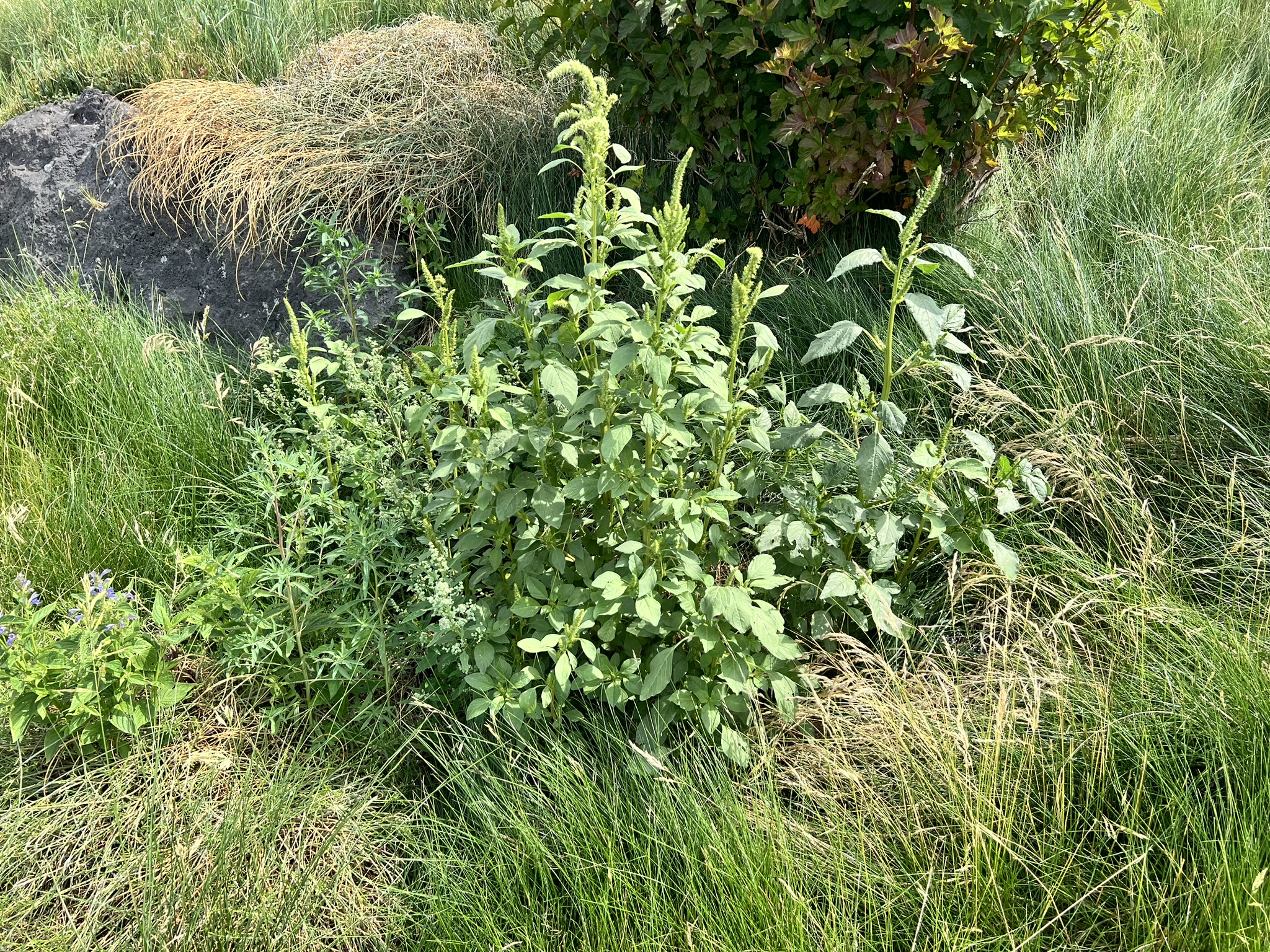
Redroot pigweed; Amaranthus retroflexus growing on the east berm. This is a common pasture weed which requires supplemental water, which it gets plenty of here. Also in this pic to the left are a smaller Kochia and a Lambsquarters beginning to flower.
Just as a healthy body protects us from disease, slows the ravages of time and aging, a healthy plant community defends its members and itself through its supportive relationships. Such a community fills niches otherwise available to opportunistic weeds which compete directly with desirable plants. Healthy growing plants growing in healthy relationships do compete with one another, but do so as a part of the process of maintaining the community’s ‘balance’ or homeostasis. Such communities also benefit from their neighbor’s presence. Communities work together to cycle needed resources and energies, mining and holding water and nutrients that would otherwise be lost. They are highly conservative. Waste is a loss which threatens health/wholeness. This is one reason why turf monocultures are so inherently inefficient and demanding of water and nutrients. There is no supportive community. The existence of turf is thus unnatural…a contrivance. Nutrients are held in living tissues and are regularly shed, decay and are thus released over time to their neighbors of both like and different species. A healthy plant community is a fully integrated organic system. Members have their different and distinct growth rates, life cycles, requirements, depth and breadth of root systems, mycorrhizal associations, with their capacities to collect and hold nutrients which would otherwise leech away, recycling nutrients as they each shed tissues which later are converted back to forms available to their neighbors. A stronger/healthier community is thus maintained. All of this works toward reducing the amount of weed seed produced to reinfect a landscape.
The second must is then to begin to transform our existing landscapes, which require regular outside supports, with compatible, well adapted plants, that can fill these needed roles and functions. This will require informed input from knowledgeable people who understand arid plant communities. If we demand a more exotic landscape, then we must understand and commit to whatever is necessary to both maintain it and reduce whatever potential threat it might pose for others.
The third thing is to understand that this is a process, which will never end. Healthy landscapes demand that all members live in healthy relationship with one another. We cannot have healthy landscapes in which we ‘act’ without also taking on an ongoing supportive, stewardship role. Any landscape will require our healthy engagement. Landscape matters. We, like any organism, are a part of its functioning whole. Rejecting the role does not remove our role and responsibility. To do so is how we got here in the first place.
Simply turning off the water and stepping back while nature magically heals itself, delivering to us a healthy landscape…’ain’t gonna happen’. We already live in a landscape which was treated this way, once an intact native landscape, converted into pasture, populated with mostly Eurasian grasses and forbes, the water then shutoff a few years ago, essentially signing the pasture plants’ death warrant, only to be subsequently over taken by a changing assortment of weeds. Consideration, thought, monitoring, adaptation and a dynamic plan are necessary…in short, engagement ‘with’ the landscape. There is limited experience here for us to rely on to do this, but we must seek it out. Will mistakes be made? Most assuredly! That is hardly a reason for not trying. As we act, the conditions themselves will change and what may once have been a good strategy, even with tweaking, may have to be abandoned and a new tack taken.
Sustainability, in its purest sense, is a landscape or system, which is sustained wholly by the natural cycles and conditions that operate on a site. Too often a sustainable solution is one presented as one which excludes people. Our role and responsibilities in this must be included. The standard needs to remain the same, that we minimize what we take from a landscape/system and we actively work to maintain its health with the fewest resources from outside of its bounds. Sustainability as a word is much abused and over used, attacked by political hacks and misused by marketers, its meaning and importance diminished. That does not, however, negate its centrality to any workable solution.
What then would I do right now with regard to the berm and undeveloped landscapes here:
1, I would target the highest threat weeds right now for control, eradication, specifically those upon which we can have a significant impact. This includes the aggressive, quickly spreading annuals like Kochia, the biennial Thistles, Prickly Lettuce, Tumble Mustard and Tumbleweed, sometimes called Russian Thistle, the Salsola tragus, a weed I haven’t discussed which is here, but not yet in great numbers (I start pulling seedlings of this here in June on my property.) This needs to be done before flowering and seed ripening, so right now!
Those weeds which are thoroughly established across the entire undeveloped site and are so throughout the region, like Cheatgrass and Hare Barely, whose control have proven extremely difficult, should at least be limited in terms of their seed production to reduce their ‘pressure’ on the rest of the development, primarily through timely mowing.
2, While our biggest problem is currently with annuals, invasion is still in its relatively early stages here, so we must keep an eye out for and be vigilant about controlling, eradicating, aggressive perennial weeds, before they increase their foothold. In many ways these are more difficult to control after they are widely spread and established. Prevention is always the best strategy. I am specifically talking about Canada Thistle here. I do not know whether the contractor has a spray license or not, but at minimum they need to be cutting all of this down regularly several times a year so that these patches are slowed in their spread. At some point, as I mentioned above, these need to be sprayed at the proper stage. These need to be cut right now!
3, All other undeveloped areas need to be mowed to reduce seed production. We were ‘lucky’ this year in that our dry spring reduced the amount of weed growth. Mowing ‘now’ will reduce that seed production in addition to reducing the fire hazard to residents. The Kochia in particular is just now beginning to flower. It would be a huge mistake to leave it alone and allow maturing plants to continue ripening seed. The developers should be held accountable for this cost as it is their property, not ours and it has been their choice to do no control exacerbating the problem. Had this been a more normal, wetter spring an earlier mowing would also have been necessary especially to reduce the production of seed from the Cheatgrass and Hare Barley which I’ve not discussed above. Much of the seed production from these areas blows or is tracked into our individual lots and the drainage/rock swales where they germinate and we are held accountable for their control. Turn about is not just fair play, but by ignoring their responsibility this is an active ‘taking’ from us, the homeowners, one that allows them to defray their genuine cost of operation by pushing it on to us.
4, An audit of the irrigation system is essential. It is currently failing, not that it doesn’t work, but that it is unable to appropriately irrigate the landscape it is intended for. It’s failure is in large part due to a gross mismatch between it and the plantings themselves. Running the heads longer, pumping more water on to the site won’t solve the design problem. A reassessment of the landscape is necessary. What do we want it to look like? What are we willing to do to properly maintain it? The expectations of current residents are in conflict. The requirements of the plants themselves are in conflict. There is no ‘quick fix’.
5, Homeowners could lower some of these costs by participating in the care and management of the berms and mini-parks ourselves. This does not include the developer’s responsibilities. I have considered doing some of their work and submitting a bill to them on their property directly adjacent to my south and east property lines. Property owners (the developer in this case), under state and county law, are responsible for the control of listed noxious weeds on their properties. Because these laws seem to be rarely locally enforced does not change the requirement. These are ‘good neighbor laws’, putting in law the responsibilities that any good neighbor should do in a healthy human community. One could make a strong case for demanding compensation for weed control on our individual home sites as most of the weed load is a direct result of their lack of management of their own properties.
6, As work continues to complete the development, unmanaged lands should be minimized and buffers created that will help minimize ‘reinfection’ from weed sources outside the development. By this I mean treatments like the turf strip separating us from Spruce St. In well managed turf, weeds are not afforded space from which they can expand into the development. Other landscape types could serve the same purpose but their management as ‘clear’ no weed zones will be more labor intensive.
7, As work proceeds on Phases II, III and IV their bordering berms need a more integrated design which will be easier to maintain than the current Spruce St. berm. Given their function and the abrupt slope of the berms, they should be relatively low water use so that the blockage of sprinkler heads and the problem of too dry areas and pooling is minimized as the resultant ‘spotty’ performance detracts aesthetically from the entire development and can create conditions upon which weed control will be problematic and continuous.
8, A ‘redesign’ of the Spruce St berm is necessary as it has conflicting elements as described above which make management more difficult. A more experienced designer should be engaged in a consulting status and new plants gradually phased in, a design which should be consistent with that of the ‘new’ berms going in. Irrigation should be minimized as it increases the range of potential weeds on and adjacent to the berms. A knowledgable and experienced contractor in this type of landscape should be hired to manage these and other common spaces such as the berms. A survey of landscapes in newer ‘local’ developments, with these same criteria, should be reviewed to better determine the design and management possibilities….One size definitely does not fit all and our more traditional expectations and practices have proven to be ill fitting in Central Oregon given the general lack of commitment to effectively manage them.
9, The designs for the ‘mini-parks’ and the landscape around the to be built Club House should follow the same theme in their bed areas, turf on the flat areas for our use and more climate appropriate trees. Neighbors should play a role in design. Again we will be the inheritors of the development.
Simply insisting that these weedy areas aren’t a problem of concern and that one is expert in landscapes in the face of all of these problems, is not helpful and is more than a little disingenuous. The weed problems I’ve sited above will continue and worsen over time as conditions continue. The weed seed burden new buyers will acquire with their properties will be heavier than ours as they continue to accumulate seed at a high rate. There is absolutely no reason to believe that the same berm treatment, extended around our expanding development, the same lack of design in the additional mini-parks and in the Circle, will result in anything better than what exists now, unless we address the problems.
As residents and owners in DCVS, we currently have no representation in the development process. The HOA is unformed. We do, however, expect that our voices be heard and that our concerns be taken into account as the development moves ahead. It will become our responsibility entirely. There is language in the contract that provides us a place, in an advisory capacity and we expect that role and opportunity be made for us now. Even if we don’t have an effective vote, having a voice and chance to participate constructively can improve the development and certainly improve owner’s outlook for the future of the development, the place we live. Currently our only avenue is through individual complaint and this serves neither us nor the development. The standards of the developers are obviously not the same as ours. It is common that ‘adjustments’ to a design, especially one such as this, which is phased in over several years, are made along the way, as long as the project still meets its original purpose. Adjustments are typically made not only because of potential cost over runs, but because of problems discovered along the way. It makes zero sense to continue with a plan that has demonstrable problems, when an alternative is at hand. Ultimately it is much less costly to do a job ‘correctly’ at the outset than to come back later and attempt to correct problems which were foreseen.
 GardenRiots