


Probability and uncertainty pervade in this world…not the chance and randomness of the gambling and gaming worlds, but the unfettered randomness of life. In gaming there are fixed/limited odds of an occurrence…in life, not so much. In the world of the geneticist, patterns prevail, but certainties of structure, function and character, don’t. For the theoretical quantum physicist, uncertainty dominates all things. They speak in terms of possibilities and probabilities. Literally nothing is fixed or truly solid, not the air you breathe, your very body, nor the ground on which you stand. Fixity, certainty, is illusory, only apparent as a function of scale, of perspective, of knowledge. As humans, with our limited lifespans, we crave it, behave as if it were so and, with regards to our future, seek to predict it or even determine it. But there is so much beyond our control. Beyond our knowledge.
In the field of knowledge, there is what we know and what we know that we don’t know. There is also an another level, that which we don’t know, that we don’t know. No, that is not a nonsensical statement, it is a statement about reality, its immensity, that in and of the universe that is above and below our capacity to perceive and comprehend, of countless variables in complex relationships binding them all, which we can never fully understand. Predicting the future with specificity, becomes an impossibility. ‘Predicting’ the past becomes an exercised marred by our inability to fully understand. We exist in a universe of probability. Uncertainty does not just reign at the minute scale of the quantum universe, it is central to the unpredictability of life. When we look ahead toward what is coming, with each advancing increment of time, after each consecutive event, however we might define it, predictability vanishes. Being predictable and probable are not the same thing. They carry very different connotations. What is probable is within our grasp, providing we accept a degree of error and the possibility, in many cases, of world changing errors. As the old bumper sticker presciently states, ‘shit happens’…and it always will.
I’ve recently finished reading Nassim Nicholas Taleb’s book, “Black Swans: the impact of the highly improbable”, 2010, his examination, and warning, of what can go wrong when we behave as if the future is knowable, and Benjamin Labatut’s, “When We Cease to Understand the World”, 2021, a historical novel that examines the lives of several of the most important players in the ‘creation’ of what we struggle with as the field of quantum physics and its companion field of complex mathematics.
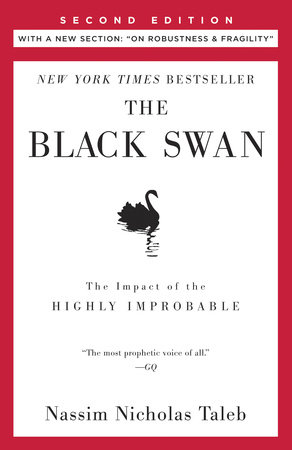 From the publisher: “A black swan is a highly improbable event with three principal characteristics: It is unpredictable; it carries a massive impact; and, after the fact, we concoct an explanation that makes it appear less random, and more predictable, than it was. The astonishing success of Google was a black swan; so was 9/11. For Nassim Nicholas Taleb, black swans underlie almost everything about our world, from the rise of religions to events in our own personal lives.”
Taleb comes at the question from that of a stock trader and a statistician who has made ‘chance’ the center of his studies and, in doing this, pulls back the curtain on economics and the financial experts who claim special knowledge, an expertise that gives them the capacity to foresee the future of financial markets (NOT). His critique is devastating as he undermines the premises on which their ‘expertise’ is founded. Randomness reigns. It is only when markets are constrained, and then only over very short time frames, that the ‘future’ of the market can be predicted with any accuracy. Economists and financial advisors, are full of excuses. Their failures are always due to exceptional circumstances. They base their theories and work on a world Taleb terms, ‘Mediocristan’, a world of averages, of the mediocre, the okay, where what has happened follows what has happened. It is an abstraction, a world that excludes extremes, the unknown, or packages it within the confines of sameness, that predicts within the range of the ‘bell curve’, a contrivance that excludes outliers, and it is the outliers, because of their capacity to have such a tremendous impact in terms of both devastating possibilities, and world changing innovations, that profoundly shape our world. In Taleb’s Mediocristan, change is incremental, even inconsequential, and in this way the future it anticipates is a limited version of the past. All events are expected to fit within the ‘Bell Curve’ or they are excused as improbable outliers. Taleb argues that we live in a version of ‘Extremistan’. our large population, our technologies, our tendencies toward the safe that ‘clusters’ our collective behaviors, is pushing us up against the margins. Our self imposed ‘blindness’ to the exceptional, to Black Swans, leaves us totally unprepared for them. ‘Extremistan’, is a world in which the frequency and impact of extreme outcomes, is greatly increased.
Remember Taleb’s three definers of a Black Swan: their unpredictability, their extreme impacts and our tendency to gloss them over with retrospective explanations that don’t acknowledge what actually happened. He asks us to be wary of those events, however improbable, that would have devastating impacts. If they don’t occur, no big deal, but if they do and we go into them ignorant and ill prepared, well, it can be game over. Consider this in our preparedness, or lack there of, while the warnings of climatologists go unheeded by so many governments and corporations. Awareness, preparedness, won’t eliminate Black Swan events, but they can reduce their impacts, turning them into the less devastating form of a Gray Swan….
Taleb’s Black Swans are not just a feature of the financial world. In Extremistan, pushed up against the limits of any system, the chances of Black Swan events are all increased. This is just as true in the world of politics and biology, in which our insistence of knowing the outcomes, based often on our own biases, our desires and our limited understanding of history, possibility, our concentration on the short term and our refusal to consider the possibilities inherent in the system, that, because something has not occurred within our own memory, we refuse to consider it at all, opens the ‘door’ for Black Swan events. Black Swans will always remain beyond our ken, but by remaining open to their possibility we may reduce their impacts when they occur…we can be more prepared.
Earlier, I read Taleb’s more recent book, ‘Antifragile’ an examination of those systems that don’t just thrive on randomness, but require it. The two books go together. It goes to the heart of the Black Swan effect and the dynamic stability of living, economic and social systems…and what can go wrong when we ignore this and seek to limit/control the outcome of systems that are not built around our desires and expectations. Even those systems of our own invention, because they exist in the wider world, are in more extensive relationships. Our intent doesn’t negate such relationships. In doing this, we put the larger system, and ourselves, at greater risk. As Darwin pointed out long ago, randomness is at the heart of natural selection, it is inherent in many natural systems, serving as a driver of evolution, essential to the complex functioning of any living system.
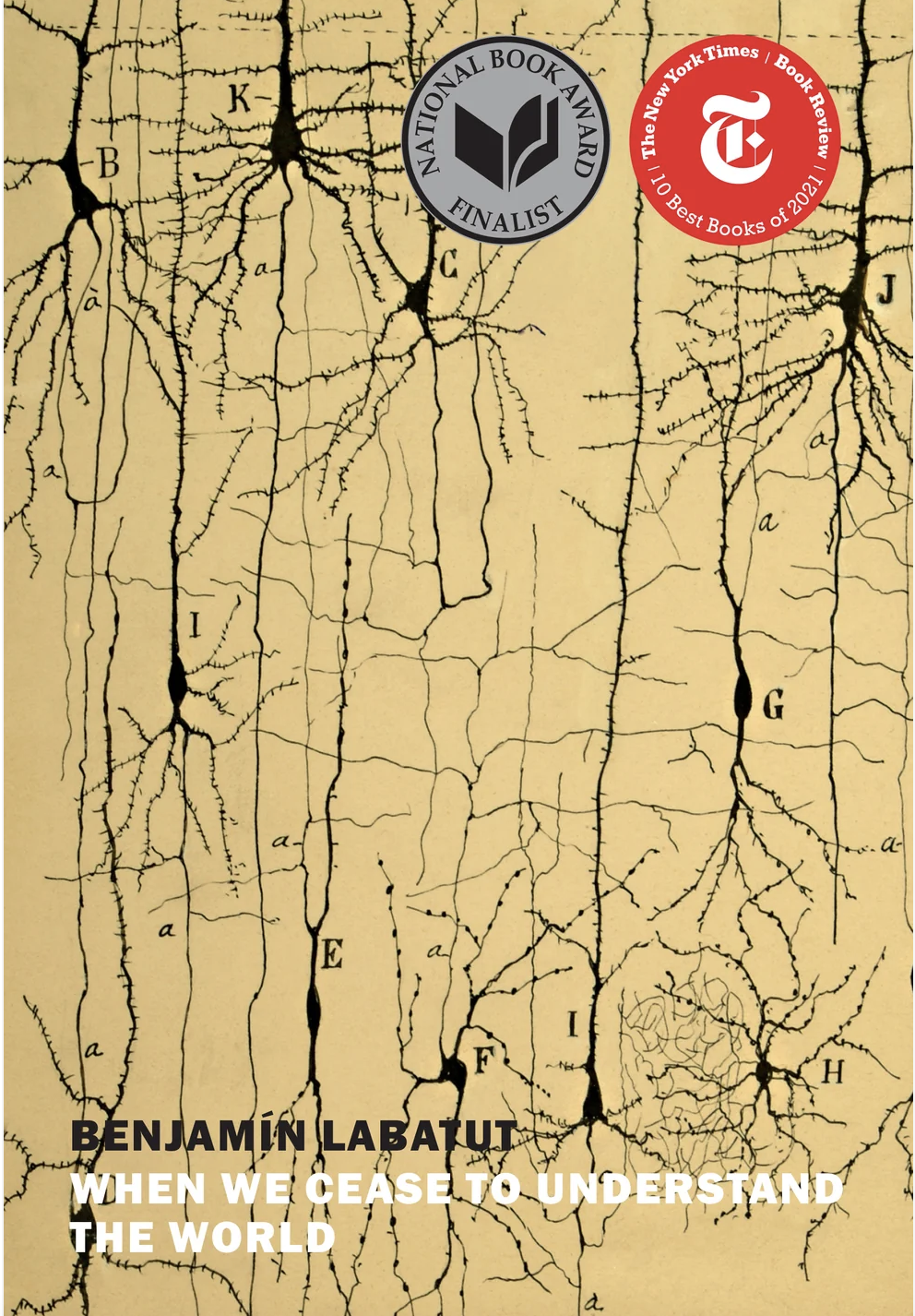 Labatut’s book presents a view of several of the key players in the formation of the science of Quantum Mechanics and its replacement, of Newtonian, Classical Mechanics, at the quantum scale of subatomic particles, but also, as Heisenberg points out, as a major determining factor in the life of organisms and all matter. Uncertainty is at its core. Reality, what humans typically refer to as the world which we inhabit, this particular human reality, is a manifestation of our inability to perceive the universe at its most basic level. Our understood reality, is a blurring of events over time at a ‘macro’ scale. Matter, of which reality is given body, is ultimately in continual flux. Matter is a construction of subatomic particles each with its own particular characteristic ‘structure’ and energy, each element formed under the intense conditions of stars, with its own resultant characteristics enabling the formation of molecules, with their own affinities and characteristic structures which go on to form the visible matter which comprise both our bodies and the world we experience as ‘real’. A state of uncertainty prevails in all of this. matter, and our conception of reality, are both a product of these countless collective relationships, expressed over time, of repeating patterns within a given context. Patterns tend to repeat. They are the more likely outcomes, given a starting point and the ‘players’. Subatomic particles enter and leave these likely constructs, patterns rendered and re-rendered continuously. All things are possible, though vanishingly rare events, are much less so and are in ways consistent with their own makeup. Possibilities are thus limited. Over vast stretches of time, their range changes. The more likely occurring more frequently. The universe at our human scale, appearing relatively ‘fixed’. The less probable occurring at time and size scales below and beyond our ability to perceive until they cross that threshold and alter our reality.
He begins with the German chemist Fritz Haber the man who discovered how nitrogen could be ‘fixed’ in such a way that made it accessible for plant growth at a time when population growth and agricultural practices were exhausting soils. This was a ‘magic bullet’ that would transform farming…Ammonium nitrate was also a product that became used as an explosive at a time of the onset of WWI. Haber went on to develop chlorine gas and the methods to use it as a weapon of war responsible for the deaths of tens of thousands of soldiers and noncombatants, human and otherwise. Science, in the pursuit of knowledge, is neither good or bad. Technology, and the willingness to implement it in exclusion of all things…is where danger enters. Taleb and other authors have written of how technologies often emerge first, and their explanation, the science behind them, afterwards. Taleb also argues that new technologies, their failure and successes, are unpredictable, that they are generally the product of chance, chance and readiness, when the unlooked for presents itself, in the search for something else, while the experimenter, the observer, is there and astute enough to question what is before them. While Labatut doesn’t discuss this part of the work, discovery itself is a matter of uncertainty. Pasteur wasn’t looking for penicillin, but he was aware enough to perceive what he had stumbled upon. In this way society’s pursuit of knowledge lurches ahead, many wrong ideas being considered, before suddenly, fortuitously, somebody comes across an idea, tests a new theory, conceives a new technology…and it doesn’t ‘die’, known only to them. In this way author Labatut sets the stage for his book, an examination of the men, undoubtedly there were women involved, among the Madame Curie who attended the conference in Copenhagen that would prove pivotal in the acceptance of Quantum Mechanics, who through their genius, came to redefine the world, expand the range of possibility and the threats of damage that always accompany the technological ‘progress’ that advances with the new science.
From here Labatut moves into the work of several central characters in the development of quantum theory and mechanics, the working of the universe at the subatomic level…an unimaginable universe for the untrained mind. Complex maths were created, and continue to be, to explain much in the quantum world, as it is not only impossible to visualize a universe at such a scale with its multiple dimensions beyond our ability to perceive, but necessary to describe the universe’s ‘behaviors’. This creates a huge barrier to the layperson’s understanding. Other author’s attempt this with the use of metaphor, which in translation by the lay public often gets converted into some nonsensical physical reality, further clouding our understanding.
When Schrodinger, Bohr, Dirac, Heisenberg, Einstein, Louis de Broglie and others met in Copenhagen and argued about the quantum nature of the universe, rifts opened and the questions they raised are still being argued, at the time causing Einstein, the most vehement opponent of quantum mechanics to quip, “God doesn’t play dice”, insisting that there are fixed and knowable laws governing the universe: Schrodinger was caused to write of a cat as both alive and dead at the same time as an illustration of the impossibility of such a proposal…and it is the classical 4 dimensional world of Newton and those physicists living before the Quantum revolution. Previously physicists were aware of many of the contradictions, the failures of classical mechanics in explaining the behavior of the universe, but they weren’t prepared for a new science that would upset the very roots of their science. The universe followed definable, knowable rules, by which God controlled it. Or does it?
The reality of a quantum universe is no longer contested, by theoretical physcists, only its details and they remain so due to our own limits of perception, our capacity to imagine and the limits of our technologies to analyze them. The maths by which it might be described are yet to be invented. Even so, its reality is already manifested in our burgeoning technologies that work despite our inability to completely understand them. The universe is in a very real sense unknowable. It is alive and evolving at scales and in ways beyond our knowing, no matter how much we understand. This is not reason to stop looking, to end asking, but a caution when we consider acting. What is inherent to the operation of complex systems, to life, to this universe, is this freedom of action at all levels. Not the freedom fantasized about by libertarians, of no limits, no controls, no regulation, there ae limits to all things in the universe, but a freedom to act within the constraints of the system and beyond its edges. The freedom to ‘fail’ when those limits are exceeded.
I found Labatut’s discussion of the questions, facing physics and society, of their unfolding, enlightening and the frailties of their discoverers…so human. When one lives at the limits of existence, at the limits of knowledge, one is bound to overstep and tread across that fine line that divides us from madness. Genius can come at great cost especially when one’s peer’s dispute your ideas, but even the ideas being examined, when they question the accepted reality, challenge the individual in ways that can undermine one’s self, cause them to not just question who they are and what they are doing, but their very sanity. His is a book, an imagining, of the extremes his subjects found themselves in. Like all historical novels the reader is benefited by understanding the established ‘facts’ while the author’s task is to present them and their ideas in a way that we can understand. Genius is unique. Not all of those who’ve been anointed with that sobriquet, were recluses or fell into states of profound doubt, but there is a cost most have to pay.
Of all of Labatut’s subject characters, it is the mathematician, Alexander Grothendieck, who died in 2014, I found to be the most interesting as a person, a man I was previously unaware of. Grothendieck expanded the world of geometry, pushing our common understanding of Euclidian space into hither to unknown dimensions, asking questions never conceived before, and with them, opening doors to possibility. At the height of his career, he left his university position and ‘disappeared’ for decades writing, thinking, living on the edge…rejecting his previous work and living a monkish life. Many attributed it to a descent into madness. Mathematics, had seemingly opened doors to him, that he feared, if entered by others, would lead to the end of life on Earth. It is the mathematician, not the quantum physicist, that Labatut asserts that Grothendieck believed presented the most danger, an idea the author returns to at the book’s end with an interchange, presumably between him and the ‘night gardener’, a neighbor of his, a former mathematics professor, who himself quit his studies after reading of Grothendieck’s work. It is not entirely clear to me where the fiction of the novel, creates and takes the place of the actual ‘history’. This is the realm of the historical novelist, filling in the gaps, humanizing the characters via devices to draw in and retain the reader while making statements of his own. This device adds another level of uncertainty to the telling, not so much casting doubt on Quantum Mechanics, but illustrating yet again the precariousness of knowledge and the danger of rejecting it. There is a fine live separating the work of actual historians and historical novelists.
The stories of each of the author’s subjects interweave. Labatut contrives a meeting between Grothendieck and Shinichi Mochizuki, himself a brilliant mathematician, another recluse, that occurs at the former’s death bed in which over the course of several days Grothendieck details his ideas to Mochizuki, ideas that kremained beyond most mathematicians. In this telling, early on in the book, Mochizuki, studies what is published of his work. What he gleans from it is unknown. After this ‘final’ meeting, Labatut takes the reader to a place where Mochizuki travels to Grothendieck’s old university, where he is intercepted before he can destroy all of Grothendieck’s remaining papers, papers he had left to the university with the caveat that no one look at them.
The overlap between Taleb and Labatut’s books may not seem readily obvious, but the same kind of uncertainty, of probability, underlie them. As a life sciences nerd, I found Taleb’s later book, ‘Antifragile’ entirely consistent and supportive of our own evolving understanding of Darwinian evolution and natural selection. It put “Black Swan” on my must read book list, to more fully understand his subject. Its focus on the largely overlooked role of rare and highly impactful events on life and history and our collective difficulty in considering them, is central to society’s growth, its understanding of the universe in which we find ourselves. Outliers. Mutants. It is not the oatmeal sameness of existence that drives us. It is randomness. Natural selection, even our own health is driven, maintained by its ability to generate, to follow patterns, to innovate/mutate in ways that allow life to continue in its never ending process of becoming and failing.
That is what is happening. Stasis. Mediocrity. Lead to inevitable decline and death. Homeostasis, that dynamic interval in which life is most heartily expressed, is a feature of all complex systems, of all things, living as well as those systems that accompany them, whether of our own creation or more broad characteristics of the system itself. In such a system this kind of narrowly defined ‘success’ walks that line between life and death, success and failure. Narrowing it. Limiting the possibilities, putting the entire system at risk of failure, to the inevitable occurrences of destructive ‘Black Swans’. They too are of the system. Part of the ‘testing’ of it. Generators. Chance ‘mutant’ events.
While our habit is still to isolate one science from another, to treat the sciences as discreet and independent fields, they are not. Chance and uncertainty are central to all existence. Separating things is one way in which we have sought to understand this complex world, not the way of the world. The world itself, all of its systems continue to evolve despite the efforts of those many others who attempt to freeze it, divide it up into more manageable parts or in advancing their own perceived advantage in it. There is no going ‘back’…ever. Going back, is a loss of possility, a loss of vitality, a weakening.
Labatut’s fictionalized account of the lives of these several important players in the development of Quantum Mechanics is both informative and telling. Their lives themselves were ‘flashpoints’, sparks of brilliance, ‘prophets’ of the possible, diviners of certain ‘truths’ and sometimes, they were wrong. When exploring never imagined territory one is bound to make errors, to misinterpret. One is influenced, limited, by one’s own past, one’s personal biases, the ‘accepted’ ‘truth’ of one’s time of the milieu to which they belong, and their own physical limits and in this ‘story’ all of these come to the fore. As humans we are all flawed, subject to conceit and so can become invested in our own beliefs, our own found ‘truths’ to a blinding degree. And we defend them. At this level the practice of science shares much with those explorers entering lands without a map, with inaccurate or incomplete information, a situation which exists for us all. This is a property of ignorance and the way out is with open eyes capable of perceiving that never seen before, not simply insisting that there is nothing new here, forcing it into a mold, our understanding of the world remaining unchanged. Life has never flourished on denial. Knowledge by definition must be expansive and inclusive. Be doubtful, sure, but never reflexively rejecting. Labatut’s subjects were driven participants with vision, clear and strong enough to challenge the status quo and each paid the price. Taleb cautions us to be careful about what we ‘see’, as do the practitioners of several Eastern belief systems, because it is not the whole picture. What we accept today is shaped by what we believe and how we’ve interpreted our past experiences. There is more than any one of us can ‘see’…a lesson we have yet to learn. Knowledge, when considered from a position of humility, can lead us to wisdom, without it, leaves us liable of falling into the trap of hubris and disaster.

