
Trees can be a defining element of a community as a ‘success’ story, a failure or somewhere in-between. A community’s trees are of it, not some separate amenity provided by the City. Ideally, just as the canopy is part of a community, its care should be a part of the shared responsibility of the community, with the City providing the services the community cannot, in addition to their role of coordinating the care so that the tree canopy can provide the highest level of service while meeting aesthetic needs. The City is ideally situated to perform this role. Neither ‘group’, the community or the City can do this on their own. Training, education, outreach, project implementation (planting, tree care) are a joint responsibility. Leaving this as a City responsibility alone cannot result in the best product. Communication and partnerships should define the relationship and effort.
Picking numerical targets for increasing overall tree canopy misses the mark. We don’t just need numbers, we need site and species appropriate trees in order to grow out a healthy urban canopy that is neither water intensive, given our climate and declining aquifer, nor one that increases overall wildfire risk; one that helps us, a portion of the more powerful human residents, bridge the gap between the contrived landscape in which we spend most of our lives, and the wild, evolving landscape outside our communities, that operates in ways that balance all the competing and supportive needs, of all of the species that comprise it. Our ‘developed’ communities, heavily prioritize a narrow fraction of the lives within them.
Tree selections should be supportive of local wildlife and pollinators in addition to providing the environmental services associated with urban tree canopies…not just those of the decision makers within the human community. Planting the wrong trees to get initial numbers up, as some kind of marker of success, will be relatively short lived at best. Trees are a long term, living and growing investment, that shape the future. However we slice it, they will demand water in larger amounts as they grow over time. So our choices should be thoughtful and considered. At issue is whether the normal growing conditions can adequately support the growth of chosen trees. We know that almost any other tree, beyond our Western Juniper, will require supplemental water. How much though we need to weigh. When tree and climate are a mismatch the result is evidenced locally by the increasing numbers of shade trees around town where owners have turned off the water leading to stressed and dying trees. Success is absolutely dependent upon well chosen trees, their ongoing care and the participation of an informed public.
-

- A dead Birch tree in an unirrigated yard. These are native to the northern Midwest and eastern North America. They are very cold tolerant, but require moist soils.
-
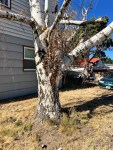
- I didn’t have a tape, but the DBH on this dead Birch must be at least 24 inches. It was very well established. Birch trees have been declining and dying for several years as a result of infestation by the Birch Borer although I didn’t see any of the exit holes that characterize infested trees.
-
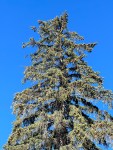
- The spruce is showing a much heavier production of cones than is normal. More than a few of these middle-aged conifers around town we’re planted in the late 50s and 60s by school children over a series of Arbor Day programs. Well many were native to Oregon. They are not to the desert.
We cannot ignore the fact that we live in a desert. We receive less than 9” of precipitation, on average, annually, the majority of that when most deciduous trees aren’t actively growing over our relatively long winter season. Trees grow in response to when and how they are supported. Those conditions, over many generations go to shaping the tree and how it grows, as it does all life forms. Being of a place shapes all species. Plants are not itinerant. They are bound to place. In developing our towns and cities, we run into danger when we ignore this basic relationship.
We need a new model for what the urban canopy of a ‘desert’ looks like. The ‘cost’ of making Redmond a green oasis, comes at the expense of other places, other ‘times’ and species, depriving them of that which is their due. Ultimately, that is not ours to take, whether we have the power to do so or not. The cost will always come back to bite us, or our children.
Residents are dependent upon local government, agencies and organizations to implement more appropriate programs and change. We are a society, a structured collective in relationship. Without this all potential benefits derived from the interlocking and overlapping relationships of a community, are lost. Individuality is great, but it can’t accomplish anything without the cooperation of others in our complex world. The ‘ship’ that represents our collective lives here, requires a course correction. You cannot get to where you want by only throwing more resources at a problem…that just gets you to the end quicker. You have to assess what you’ve been doing wrong and change that, otherwise much/most of your efforts will be wasted. This is hard. But one of the most important things to do is to stop doing those things that are ‘wrong’, that work against you, first. Our practices become entrenched over time, habitual. We have to be able to see this, redirect our efforts and resources and be open to positive changes….and always, always, keep monitoring and learning. There is no recipe for where we’re going. We’re going to have to create it along the way…and that ‘recipe’ is going to change over time, as conditions change, as new problems arise and others cease, as opportunities arise and our understanding widens.
Targeted plans with different trees for different situations.
1. Tree lists should be tailored to site conditions, not based simply on mature size and cold hardiness, important as those are. Their natural soil moisture regime, moist or dry summer growing conditions, should match those on their site.
Residential street trees in grassy/irrigated parking strips are distinct from others. These could be from summer wet regions which also meet cold hardiness and mature size limitations. They can share conditions with those in irrigated Parks.
Park trees
-In large irrigated lawns. These would include those large, traditional shade trees from mesic, ‘summer wet’, regions.
-In ‘natural’ beds/areas. These should be more limited to trees from the Intermountain Arid West and comparable regions.
-Residential street trees in ‘graveled’ strips, such as those commonly planted around planned unit developments, with limited irrigation (a few drip emitters near the trunk) should be from drier regions.
-Industrial/warehouse, business ‘parks’ tend to have limited landscapes. Lawns if they exist, are primarily decorative and their use limited. Trees should ‘match’ the irrigation practices of the immediate landscape. Along with this would be the use of trees from arid or semi-arid regions with their lower water requirements since overall area soil moisture levels will be at a low level.
-Downtown street trees in limited soil volumes should be trees with deeper root systems so as not to heave sidewalks and be more tolerant or arid conditions due to their limited soil volume.
2. Tree trials program to test more appropriate, historically unavailable trees.
Test plots on accessible public lands (with access to water): schools, parks (passive use areas) and other municipal properties such as the new wetlands complex, open areas at the Fairgrounds each ‘adopted’ by various groups.
Do a thorough review of tree lists of the several Great Basin and Intermountain West cities with significant tree programs and a comparison of their conditions with ours to determine which of these trees may be of best use by us locally. This could also supply as with regional growers who could provide us with trees, most of which are NOT grown by Oregon’s Willamette Valley industry.
3. Outreach and education
-There should be two levels of training for Parks staff, a basic/rudimentary level so that they can be the City’s eyes and ears reporting problems and opportunities to management, while being able to provide informed support for in-house City projects as well as for projects carried out by City partners.
-The higher level would be for staff that focuses on tree work so that the care provided is professional as well as species and site specific. The currently absent City arborist positions need to be filled with professional staff, with arid land tree experience whenever possible.
-Outreach and education programs are essential to both instill the values supportive of a beautiful and healthy urban canopy so that it doesn’t create an adversarial/punitive relationship. Instead, cultivate a viewpoint/valuing of trees to better assure a more informed, standard of care, i.e., planting, watering, establishment and pruning. The City needs an informed list of BMPs (Best Management Practices) to ensure a healthy and productive urban canopy. These should be promoted by the City, Schools and the various friends groups. . Garden centers and local retailers of trees, need to be included so that information and practice are consistent…less conflicting/confusing.
4. Partnerships
-Redmond and Ridgeview High Schools, the Redmond Proficiency Academy go do similarly on other public properties)could be both an organized work force to get much of the testing and monitoring work done while providing essential community outreach educating them about trees, their needs and values, things that our curriculums, for years have ignored. With their properties, biology/botany programs and perhaps the Ag program, they could be a great resource for establishing mini-arboreta on their campuses, and perhaps around other school grounds and public lands, where trees could be tested with students gaining hands on experience of arboriculture, basic horticulture and testing protocols.
-A tree curriculum could be found/developed for the schools that would nest with their biology/Ag courses. Course world would provide basic education covering propagation, nursery production practices, tree growth, regional and site differences in conditions, natural plant communities, planting, establishment and ongoing maintenance with an emphasis on pruning for health and structure and growth response to maintenance and injury.
-Ideally this would carry through all four high school grades with students given more autonomy as they gain knowledge and experience to do their own projects.
Mentors from the tree care industry, Ag extension, Forestry, C.O. Tree Adventurers.
5. A friends group, call them the Central Oregon Tree Adventurers, they would be a group of area residents and business partners interested in trees who plant, care for and monitor ‘experimental’ trees on their own property, on those of friends, helping with the City’s and School’s efforts to build a database of trees to be used in the future. Members would be encouraged to search out possible species and varieties in their own travels, conducting research on them, finding possible suppliers to help all of Redmond improve and broaden the choices of trees available to residents. They would be supported by the City. They could aid the City in monitoring the City’s trees and extending, voluntarily, the program to include those trees on resident’s properties ‘not’ in the street ROW.
-An education program could be put together that would give Friends members a solid base for tree work, somewhat like the Master Gardeners program, but don’t call it Masters as that implies much more than the program, as good as it is, gives its members…perhaps a Tree Apprenticeship program.
6. Buying/brokerage program that residents and commercial property owners could piggy-back on to going through local broker(?)
The program would locate tree sources around the arid West and consolidate orders. This would assure a consistent quality of tree and a better price than individual buyers could obtain on their own.
This could work with a local ‘Friends’ group that could help coordinate the program and support planting, minimizing planting delays and the need for ‘holding’ trees.
7. An educated ‘Friends’ group would then be an important component in public education and support of property owners for newly planted and establishing trees.
8. Ordinances should not be punitive. Trees are an asset. They serve community wide interests and those of the property/home owner. If we want trees to be viewed as positive we cannot turn them into points of conflict and force a standard on residents/owners.
9. A dedicated City tree committee of citizen volunteers would include members who are professionals, educators, students and citizen advocates. The current arrangement, rolling duties into the Parks Committee, is perfunctory, meeting the requirement to be enrolled in the Tree City USA program while not really meeting the needs of our trees or community. It minimizes trees. Even with a master plan in place there is still a need for an informed group to help guide the City to its goals of an improved tree canopy that enhances community quality and values. Having various friends groups alone doesn’t always work…they are the volunteer boots on the ground to get needed work done. This is new for Redmond and requires the City to ‘stretch’ to cover new responsibilities. A dedicated tree committee also demonstrates more of a commitment by the City to work for its trees and can help direct and coordinate public and private efforts, I.e., testing/trials programs, education and outreach, planting programs, maintenance, all of the things that go toward producing a healthier urban tree canopy, including what that means in a desert community with arid, continental, growing conditions and a limited water supply.
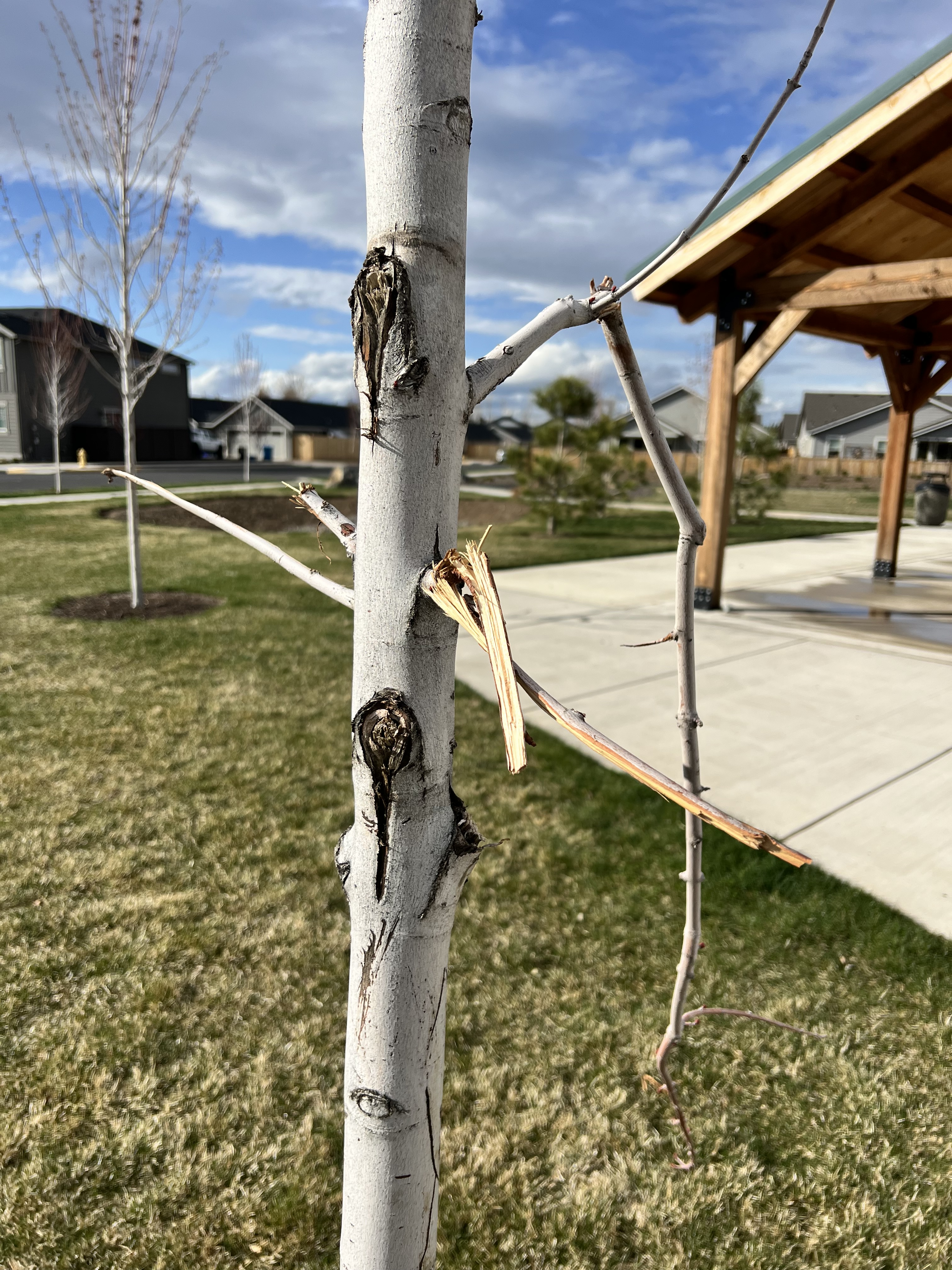
This sad Maple tree in Spruce Park is the result of neighborhood boys who have periodically ripped branches and otherwise damaged trunks of multiple young trees in the Park, not just because they lack ‘supervision’, but likely because children grow up largely removed from the value of nature and lack the necessary respect of it for a healthy world. The outreach and education programs, the school program, can all work to begin turning this around.
10. Most Americans are relatively uneducated about tree biology and growth. This leads to many problems, failures and disappointments over time. We need help. Standards and guidelines for the choosing, planting, establishment and maintenance of the City’s trees those in ROW and those on participating resident’s properties. The City should have brochures and on line information for residents. City arborists, Tree committee members and members of Friends groups, participating students need to staff information tables at community events, farmer’s markets, etc. to distribute information and educate the public. The urban tree canopy needs to be understood to be a public issue/responsibility, which includes all of us. The City will never have the staff to do this on their own and if they did, the lack of knowledge, valuing and participation by residents would greatly limit success.
Again, these can’t be punitive! We need informed, voluntary compliance. These should be written as Best Management Practices (BMPs).
While it is common for municipalities to require minimum tree caliper (measured above the root flare at the base of the tree) this greatly limits tree choice. Requiring, for example 2” caliper for street trees will eliminate almost all the trees listed above in the first list. It is commonly thought that larger trees have a greater survival rate, this is debatable. Smaller trees, however, with proper establishment care, are quicker to establish and more likely to have fewer structural and root problems. Larger tree sizes require nurseries to commit more nursery space over more years to produce a salable product. Purchasing costs are considerably higher. This was a major point of conflict between nursery growers early on and the imposition of governmental requirements regarding tree size. If the longevity of planted trees and species diversity are important, the selection of more site appropriate trees in smaller sizes will aid our efforts. Larger trees going in aren’t immune from vandalism. Vandalism is a function of community ignorance, indifference and the under valuing of trees. Losing larger trees to vandalism, or leaving them in place to limp along compromised is a greater loss than planting a smaller tree and losing it.
-
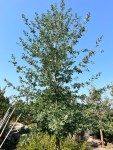
- This Autumn Blaze Male has good structure, a strong central leader and evenly spaced branching. It will, however, still require structural pruning over several years as it grows, selectively removing branches whose placement, as they grow, begin to compromise the overall strength of the tree and branching. This cannot all be done at once. Trees grow over time and removing too much all at once can stress the tree.
-
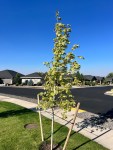
- Acer platanoides ‘Drummondii’, or variegated Norway Maple, are all suffering on this site, likely due to several factors, their variation makes them being subject to burning of the leaf margins by desiccating winds, intense sunlight and the fact that the soil is over wet, which compromises the trees ability to grow and take up water, resulting in cell damage to the leaves. More water, can’t solve this problem.
Selecting well structured trees to begin with, with healthy root systems is also important. Bargain trees may not be bargains over the long term as their treatment in the nursery can lead to serious structural problems and girdling roots which can both inhibit proper rooting later as well as actually girdling the tree which can lead to its catastrophic failure, toppling or breaking off at ground level. Poor branching structure can lead to structural failures over time.
Right tree, right place. Trees should be selected based on expected growing conditions to ensure success including expected future irrigation practices and site uses.
Irrigation practice is essential for success both for establishment and long term for any tree. Residents need to understand their tree’s requirements
Proper planting practice, what to do with your new tree to ensure success.
Disentangling the woody girdling roots. Root hairs, the finest of roots, are continuously shed and replaced and, along with mycorrhiza, seek out and supply most of what a plant requires from the soil. Trees and shrug have a permanent wood root structure from which these finer roots grow. These woody roots aren’t abandoned and replaced. They grow in time in caliper so if they are poorly arrayed around the tree, if they are circling because of their handling in the nursery while up-potting or planting out in the field, those structures will remain and will compromise the tree’s growth and health. Containers should be examined for this, not bought or at least have the roots disentangled when planting out or putting into a larger container. Some growers have a history of inadequate practice and should be avoided. Other nurseries will offer trees at low prices because they are compromised. Such plants aren’t bargains.
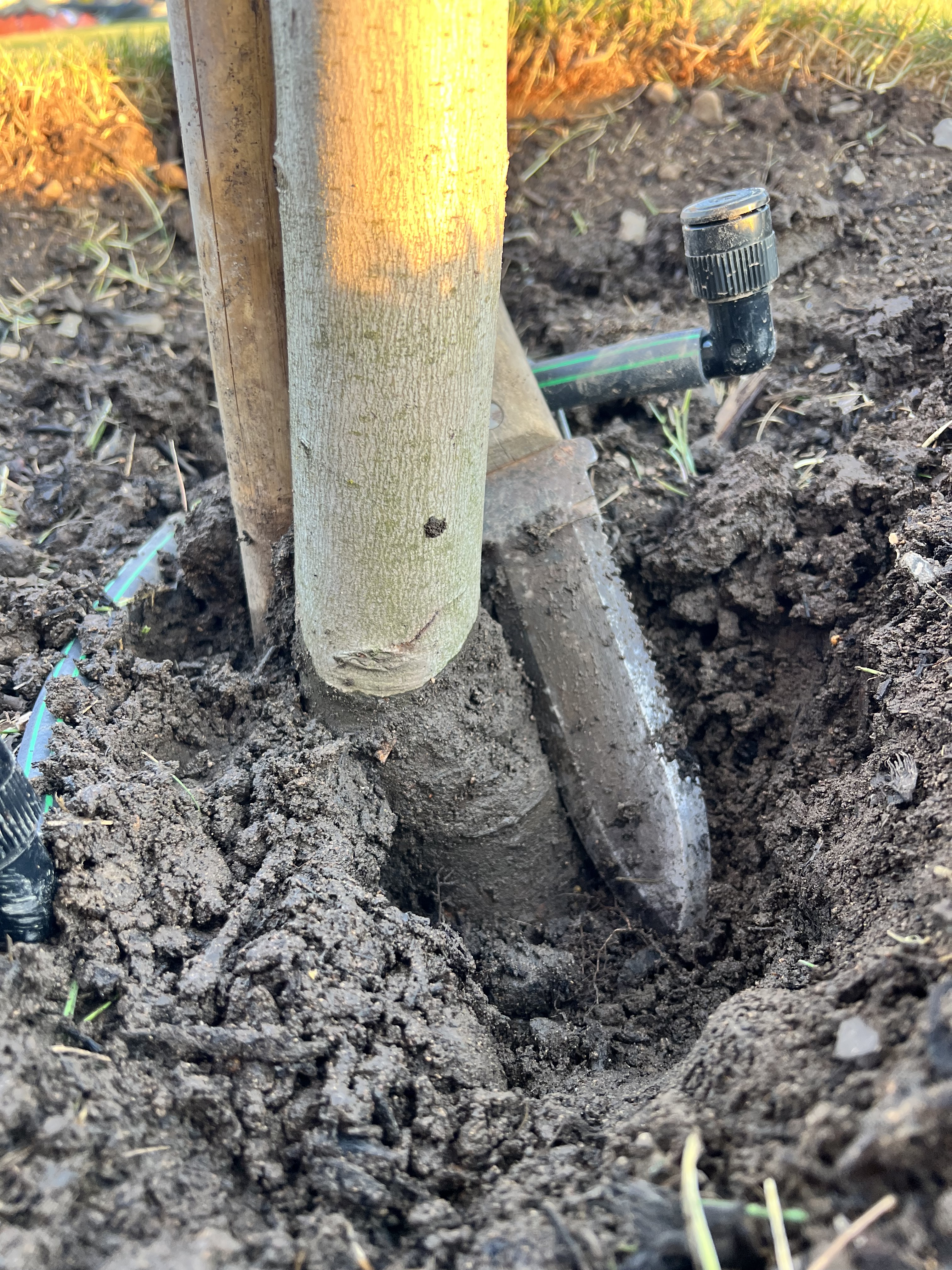
This grafted Maple tree was planted with the graft union below the soil surface, the tree’s root flare, which should be at the surface, deeper still. This puts the tree under immediate stress. Stress compromises health and the longevity of the tree. This particular tree is also being heavily over-watered by the contract which drives out the needed Oxygen for root respiration which can completely stop root growth while encouraging rot.
Planting depth (roots require oxygen in addition to nutrients and water, to facility the respiration necessary for root growth.) Planting deeply in a container or in the ground limits available oxygen.
Site prep. Trees can’t move to a better site. Their roots must be able to grow, seek out supportive conditions within the reach of their roots most of which are located in the top foot of soil, extending out, where they can, typically two or three times the canopy’s diameter. Breakup compacted soil freeing the roots to explore the soil on their own, improve anchorage and drought resistance. Compacted, dry, nutrient poor soil cannot support root growth (These poor conditions are often what newly planted trees on developed sites must contend with, their soils heavily compacted to support the structures built upon the and the hard surfaces installed to connect us all. Trees from arid and semi-arid regions are adapted to harsher conditions and will root out into soils that mesic, trees that require moist summer soils, can’t…but they do, however, still require them, just not in such abundance.
Soil amendments. Amending the planting hole can back fire encouraging growth only there, discouraging growth out into the surrounding soil, thereby compromising its ‘anchorage’ and drought resistance, creating what is sometimes called tea cup conditions. Amend the entire area moderately if at all.
Proper staking (Nursery trees are often ‘pushed’ with water and fertilizers to grow to a salable size more quickly resulting in a weaker structure that necessitates staking. Strong, healthy stem growth, requires movement, stress, from wind. This stress slows the extension of leaders and branches, forcing them to add to their caliper, stiffening, strengthening them.
Basic tree growth, how a tree responds to its site conditions, wounds and your pruning is important to understand in the care and development of any tree.
A word about tree growth rates, ultimate size and choosing your trees. Many nurseries will list a tree’s mature height at that of one ten years, or some ‘reasonable’ age, not their ultimate size. Ultimate size will vary depending on site conditions. Some will never reach the size they can in their home range. The same tree planted here compared to one grown in the Willamette Valley will be much smaller over time given the shorter growing season and harsher conditions. The same is true of growth rates. We often plant for instant effect, wanting landscapes to look ‘full’ or finished upon planting. That is a setup for problems as the landscape will become ‘crowded’ relatively quickly, compromising future growth and health…or the tree ‘pushed’ under nursery conditions, is planted as a structurally weaker tree. Over-planting necessitates removals to avoid this. Landscapes are dynamic. You cannot plant a finished landscape unless you are committed to a heavy load of maintenance to maintain it in a compact, unnatural state.
Newly planted trees, having been grown in nurseries, will always require structural pruning over time, years to attain a strong healthy structure. Forests and woodlands, self-prune over time by shading out lower branches, wind and low intensity ground fires and tree leaders tend to stretch, when growing in ‘communities’, growing upright to reach the sun, all combining to attain their ‘ultimate’ form. Planting a tree out in the open prevents this and such trees will require our informed intervention to attain a strong and desired form.
Our Native Western Juniper
-
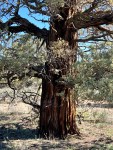
- An old growth Juniper in the Cline Buttes area hundreds of years old and at least 3′ in diameter. On such sites ground level fuels are relatively scarce protecting the trees from ‘death by fire’ often with little more than Idaho Fescue growing scattered beneath with some really lovely annual wildflowers interspersed inbetween.
-
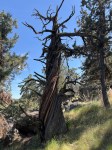
- The spiraling trunk of an old growth Juniper in Redmond’s Dry Canyon. These can stand for decades if not hundreds of years providing beauty and nesting sites for birds, bats and insects….They aren’t simply ‘fuel’ that threaten the existence of rim to homes.
-
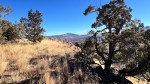
- This site is along the Deschutes River Canyon rim in the Maston area on BLM land with thin rocky soils. Fire has been suppressed in this area two and the many hundreds of years old Junipers are becoming more threatened as younger trees graduall infill.
-
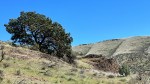
- Old-growth Western Juniper trees are some of the most picturesque features on our landscape, this one in a side canyon off of the John Day River.
Our much maligned native Juniper demands mention and inclusion in the City’s tree management plan. Dismissing one’s regional native plants seems to be wide spread habit of western peoples. We seem attracted to the exotic while we underestimating the local, at least until it has received a ‘pedigree’ from elsewhere, Native is to often dismissed as common, something to be controlled and replaced by what is more desirable…but Western Juniper belongs here and should be considered respectfully. These trees can live over 1,000 years. They are only a problem where ‘we’ have interrupted the natural cycles that once freely shaped the native landscape. We have done this first through grazing, greatly altering the ground level plant community; our suppression of fire which is a natural part of the cycle here, burning many areas in 20 to 50 year cycles curbing the incursion of Juniper into deeper areas with deeper soils and allowing over dense Juniper communities to form presenting much more flammable conditions especially with the invasion of non-native Cheatgrass which is easily ignitable and tends to outcompete many natives. Junipers for thousands of years were generally restricted to thin soiled and rocky landscapes where ground level fuels were few, only there could they dominate as they are extremely susceptible to fire damage, which historically lead to much more restricted ranges. The advent of irrigation also has aided the Juniper’s spread by providing water for young germinating and establishing trees which normally would have failed to establish. Juniper are survivors and are very well adapted to survival on available water. In irrigated pastures, along ditch lines, Junipers can grow rank and quickly sucking up water intended for pasture, hay and crops…but they don’t need it as the trees we’ve imported from mesic regions do.
The plan should provide clear guidelines on Juniper management, based on the natural conditions of the site upon which they are growing. Deeper soiled landscapes can be responsibly managed by removing the Junipers and encouraging native and other arid region desirable plants. On thin soiled and rocky sites, those with a lot of natural surface rock with rock extending well below, the product of lava flows, should be protected from removal, while the ‘recruitment’ of young trees that will grow into overly dense Juniper stands, should be removed. Simply limbing Juniper up doesn’t solve the fire problem and creates a unnatural and ‘ugly’ landscape. Property owners need to be clear on this. Soil and stand density should be determining factors in our decision making. How close should Juniper trees be allowed to grow? How best does an owner manage ground level fuels. Creating dead zones around developed properties is a poor response and will lead to other problems, giving invasive plants greater opportunity to invade and dominate. The goal should be healthy Juniper stands where possible/desirable along with a healthy/manageable ground layer.
Redmond does not support natural healthy stands of native Pine species. If it did a similar prescription should be created and supported for it. Lodgepole Pine is a fire dependent species. They are easily killed even by relatively low intensity fires beginning the next cycle, the fire releasing the seed sealed safely away in cones, protected by resins. A favorable wet cycle following a burn results in a ‘new’ even age Lodgepole forest growing thickly. Such woodlands are problematic to build human communities in.
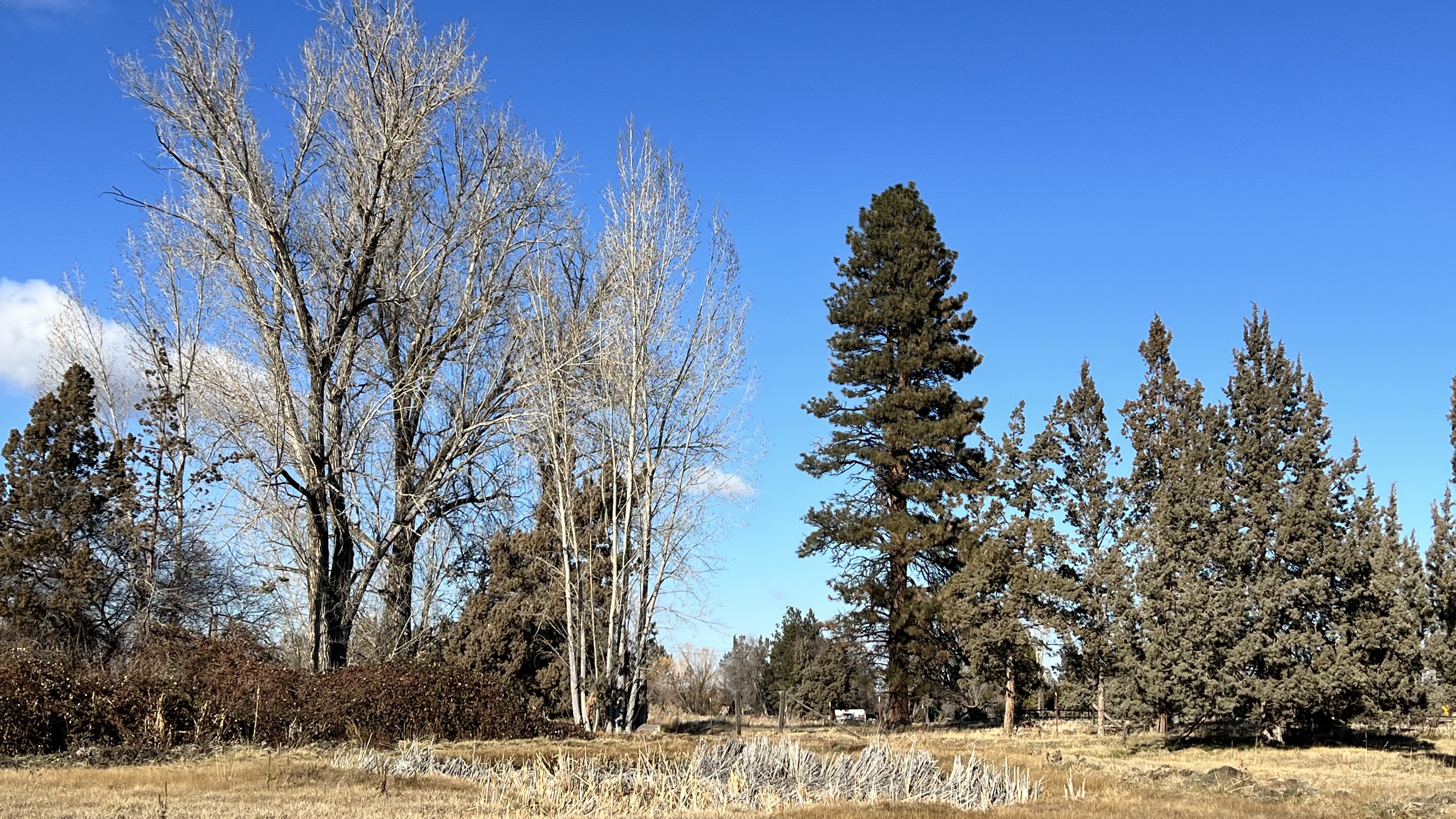
This lone, large Ponderosa Pine stands on private property waiting ‘development’ and, along with the several large Black Cottonwoods adjacent to it, will likely be cut down to make room for the pending project. Trees, are largely viewed as background, as decoration, that when we have development plans, are reduced to being impediments, not assets. Our tree problem is related to a larger undervaluing of the living world around us.
Ponderosa Pine would have a different prescription as they are much longer lived and much more resistant to low intensity fire.
The point here is that a tree plan must be tailored to growing conditions AND the species that comprise it. There is no ‘one size fits all’ program that can deliver a healthy desirable product.
A Working List of Trees to Evaluate/Test Under Varying Conditions
Trees of the Great Basin, Texas, the SW and California
-
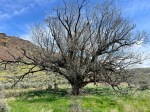
- This large, old, Black Walnut tree is another exception, growing in the bottom land of the John Day River Canyon where its roots can access subsurface water. Non-native, and a singular tree in the area, it was probably planted by the rancher who once worked the Canyon.
-
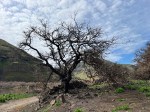
- Semi-arid deciduous broad leafed native trees are very few east of the Cascades, until you get into higher/wetter mountain landscapes such the Ochocos, Blues and Wallowas, and even there they are often restricted to where there roots have access to streams and near surface ground water. This tree, our native Hackberry, Celtis reticulata, suffered a fire in 2025. It is one of the exceptions on the broad-leaf list, here growing in the John Day River Canyon where its roots can access subsurface water.
Many species with a wide native range, exhibit significant differences in cold hardiness and so their provenance, the specific location from which they come, can exhibit relatively wide variations in cold hardiness….Not all trees of the same species are ‘equal’. Provenance can be important.
Rocky Mountain Maple (Acer glabrum)
Rocky Mountain Sugar Maple (Acer saccharum ssp. grandidentatum)
Saskatoon Serviceberry (Amelanchier alnifolia) taller varieties including ’Standing Ovation’
California Buckeye (Aesculus californica)
Incense Cedar (Calocedrus decurrens)
Northern Catalpa (Catalpa speciosa)
Western Hackberry (Celtis reticulata)
Eastern Redbud (Cercis canadense) varieties
Western Redbud (Cercis occidentalis)
Mountain Mahogany (Cercocarpus ledifolius)
Bubba Desert Willow (Chilopsis linearis)
Morning Cloud (x Chitalpa tashkentensis)
Desert Ash ( Fraxinus anomala)
Western Juniper (Juniperus occidentalis)
Utah Single Seed Juniper (Juniperus osteospermum)
Texas Red Oak (Quercus buckleyi)
Canby Oak (Quercus canbyi)
Canyon Live Oak (Quercus chrysolepis)
California Blue Oak (Quercus douglasii)
Emory Oak (Quercus emoryi)
Escarpment Oak (Quercus fusiformis)
Gamble Oak (Quercus gambelii
Gray Oak (Quercus grisea) Colorado/New Mexico
Oregon White Oak (Quercus garryana)
Mexican Silver Oak (Quercus hypoleucoides)
California Black Oak (Quercus kellogii)
California Valley Oak (Quercus lobata)
Chinquapin Oak (Quercus muhlenbergia)
Desert Scrub Oak (Quercus turbinella)
Colorado Blue Spruce (Picea pungens)
Bristlecone Pine (Pinus aristata)
Lodgepole Pine (Pinus contorta var. latifolia)
Sierra Lodgepole Pine (Pinus contorta var. murrayana)
Great Basin bristlecone pine (Pinus longaeva)
Limber Pine (Pinus flexilis)
Pinyon Pine (Pinus edulis)
Single leaf Pinyon Pine (Pinus monophylla)
Ponderosa Pine (Pinus ponderosa)
Giant Sequoia (Sequoiadendron gigantea)
California Snowdrop (Styrax redivivus) A single small test tree died
Others Worth Testing (This list could be greatly expanded and could be added to the lists for ‘testing’ for inclusion in Parks and other areas dedicated to continual irrigation because they will require some irrigation indefinitely.)
Ginkgo taller varieties (Ginkgo biloba)
Chinese Pistache (Pistatacia chinensis)
Chinese Mahogany (Toona sinensis) Pink Flamingo
Sources (This needs to be greatly expanded as many/most of these ‘new’ trees are not locally available. Helping residents locate them is essential as is some kind of accessible brokering program.)
Cistus Nursery, Portland, OR.
Devil Mountain Wholesale Nursery, (Formerly limited to California locations now includes Patterson’s) Eagle Creek, Oregon
Green Things, 3384 E River Rd, Tucson AZ,
Seven Oaks, Oregon
Other Cities’ Tree Programs in the Intermountain West
Salt Lake City, appears to have a very limited selection of trees and while the City provides many/most services a street tree might need, including the tree, planting, pruning, removal, etc. it retains a great deal of control and limitations over the adjacent property owner. The trees listed are mostly native to the Intermountain West, but, apparently the City, reserves the right to substitute trees, as they make the planting decisions. While appearing to favor regional natives, there is relatively little choice and no mention of outreach, education, partnerships, friends groups, etc. Trees are treated as a City provided ‘utility’.
https://www.slc.gov/urban-forestry/2024/06/14/best-tree-care-practices/
Boise, While I like much of the information in their region’s Treasure Valley Tree Selection Guide, the actual tree choices, particularly the deciduous broad-leaf trees, are those typically offered by the large Willamette Valley nurseries, note that many of the pictures come straight out of the J. Frank Schmidt catalog, and these aren’t attuned to our growing conditions. Most of the trees suggested for the Treasure Valley region will require substantial supplemental irrigation over their lifetimes as they come from mesic regions or occur near streams etc. Boise’s climate appears slightly warmer than ours and for precipitation lies somewhere between Redmond’s, 9”, and Bend’s which varies across town to around 14”-15” at the highest, Boise receiving 11.5” on average. There is no emphasis on trees from the arid and semi-arid Intermountain West.
Denver, comparing theirs with our climate is a stretch as their winter months are their driest, the opposite of ours. Where we have a relatively dry summer growing season, Denver receives 5” of its just over 14” of annual rainfall during June, July and August. Their total is similar to Bend’s west side that supports Ponderosa Pine and Manzanita. Redmond’s doesn’t with a good 5” less rainfall. I like Denver’s language, their effort to educate their public. Their tree list is more expansive by far than ours and their foresters appear open to experimentation. Their website indicates an active education/outreach programMuch like our region, the Denver area is naturally only sparsely populated with trees and most of them along water courses. Staff actively pursue partnerships in the community and with friends groups. They are even working with others developing an arborist apprenticeship program to prepare young residents for careers in the tree world. Yes, Denver has a large metropolitan population and a much larger tax base, but it points out a direction even a small municipality like Redmond could take. I’m impressed!
Wet Westside Municipalities
We should be careful not to copy programs from such places because of the huge difference in growing conditions, including their lists of recommended street trees. We should also be careful not to create programs that are overly restrictive, even punitive as some cities have done in their zeal to protect their tree canopy. This has in some cases created a negative atmosphere around municipalities regulation of trees. Positive outreach, education and supportive partnerships should be preferred.


Pingback: Toward the Formation of The Central Oregon Tree Explorers | GardenRiots
As one who has been involved in updating the mandated Street Tree List for my small but growing town (with no arborist let alone gardener on staff), I really appreciate this post! It’s FULL of good ideas and vision. It is all SO TRUE.
As you’ve laid it all out, I realize why my work on our own Street Tree List was so frustrating. The solutions were more complex, and went deeper, than anyone could help with that blessing/curse List alone!
I hope the City of Redmond begins to embrace pieces of your management plan–one step at a time. Building toward your outlined vision. Leadership is needed.
I like your overall concepts, some new (such as the trialing needed because of your climate), and the details (such as the ideas about not being punitive–brilliant point).
Separately, I find your notes about the high desert climate enlightening. In this post, I’m gobbling up your take on the trees.
Redmond only gets 9″ of water annually? Well, that shocked me! That makes a huge difference and I hope the City is REALLY paying attention. For example, the explanation why no amount of irrigation is the “solution” to planting inappropriate trees– biological reasons which are somewhat counter-intuitive.
I haven’t read into it all, but those links to the Denver’s “The Park People” are inspiring.
As you maybe can tell, I’m passionate about this topic. ☺️
LikeLike