
-
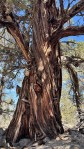
- This old Western Juniper (Juniperus occidentalis) resides in north Dry Canyon and is around 8 1/2′ in circumference making it several hundred years old. Recently ‘brushed’ up in an attempt to reduce the likelihood of its catching fire, a cause that would be greatly improved by the removal of nearby overly dense younger trees, once trails are better established and off trail activity is curbed.
-
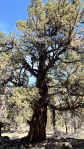
- This pic better shows its overall form, squat, which is indicative of harsh conditions and very slow overall growth, which makes sense as its growing on top of a narrow, raised, portion of one of the Canyon’s later lava flows that partially filled it some 75.000 years ago.
Paleontoiogists say that we first evolved as a species on the African savanna, that mixed landscape of grassland and scattered trees. Some argue that we were first a tree associated species. Be that as it may, most people have an affinity for trees today. We have our favorites. We plant them for food, as a source of material to meet various needs, for shade, for that inexplicable feeling we have when amongst them, in support of the life that came before, those dynamic communities, their complexity and the vitality, that define these places we now occupy, for their beauty. In Central Oregon with our arid to semi-arid climates, those with annual precipitation as high as 15”-20”, xeric referring to our dry summer growing season, our native trees serve as an indicator of the possible. Our local landscapes have curvilinear boundaries, that delineate areas with like moisture regimes. These go a long way in determining the native landscape (But not all of the way!).
14” of precipitation locally is roughly the bottom limit for Ponderosa Pine. You can see this as you observe grouping and the massing of tree species, forming a line from south of Bend, west and north to Sisters, then along Green Ridge and north to the Columbia. There is an in-between landscape, an ecotone, where the Ponderosa intermingle with the Western Juniper, which dominate easterly, until the average drops below what even that reduced amount can support. The ecotone roughly bisects Bend.
For those of us east of this line, it is Juniper country. Where soils are deep enough, ground level growth of shrubs, grass and herbaceous species high enough, our dry summers result in relatively frequent cycle of fires. On rocky outcrops and thousands of years old exposed lava flows, with their thin soils, this ground level plant density thins out considerably and fires are far less frequent. When they do occur, they flash quickly and are of low enough intensity that the fire sensitive Western Junipers can survive for hundreds of years. Within this arid and semi-arid zone, where Junipers persist, it is only along streams and seeps in canyons where our native deciduous tree species are found and can persist. These are dormant over our winter ‘wet’ season, initiating growth in the spring as the ‘desert’ dries out. They require that water source to thrive or even survive.
When considering what we plant locally we should keep this in mind. Winter deciduous trees, shut down in winter, a response they developed long ago to persist over sustained and regular periods of freezing weather, when liquid water is bound up as ice and unavailable and when their above ground live tissues have to defend themselves against the cellular damage done when water phases from liquid to ice, forming expanded, sharp edged crystals, that can rupture essential cell walls.
Western Juniper and Pines are evergreen conifers. They retain their modified leaves, their needles and scales, and so are capable of photosynthesizing any time of year, when temperatures allow and soil water is available. Their needs are relatively low, their structures, generally more rigid, tougher, containing less water. In spring when they push out their new growth, evergreens still retain their older leaves and so aren’t so reliant on stored starch/energy reserves to initiate growth. Deciduous trees/plants must start from zero, expending large amounts of their reserves. Our Juniper and Pines also contain other chemicals they metabolize themselves which serve as a kind of anti-freeze allowing their leaves, their photosynthetic tissues, to await growth periods, in the ready. Collectively these allow these evergreen conifers to grow whenever they can and wait in readiness over drought periods…to a point.
When you do find native broad-leafed deciduous trees and shrubs here, it is in places where water is more available. The leaves of shrubs of the Sagebrush Steppe, in which Redmond, Prineville and Madras are located, tend to be smaller, tougher, possessing protective coatings and dense ‘hairs’ that help insulate, reduce their internal temperatures as well as their use of water. Large, luscious leaves indicate high water use. Not providing this stresses such plants and can cause their leaves and soft new growth to wilt. If drought conditions persists, such a plant will go into ‘permanent wilt’, a ‘non-recoverable’ state. When water does become available, tissues in ‘permanent wilt’ are unable to recover. They crisp and die, in their entirety, clinging by their dead stems to the branch or crisp along the edges and margins where the damage occurred.
This kind of drought stress causes the plant to put out danger signals, in the form of releasing particular chemicals, that are attractive to particular damaging insects or provide opportunity for infection by disease organisms, that they would otherwise be relatively immune to, but so weakened, are less able to defend themselves. The other problem is that the weakened plant, if it has survived, will go into the following winter weakened. This effectively lessens its resistance to winter cold and the assault presented by particular soil organisms that occur in cooler, winter wet soil, which may attack and rot the essential root hairs, also weakening the associated soil mycorrhizae compromising both. Then, after surviving that, it goes into the repeating stress of summer drought. These problems are avoidable, or manageable, in a consistently supportive landscape such as one that receives adequate and consistent supplemental water over our dry summers, such as those on which a healthy grass turf lawn is maintained. The alternative, of course, is to plant local native species and those from regions presenting like or similar conditions.
Central Oregon is located in the Intermountain West, that massive region stretching broadly from the Rocky Mountains west to the coastal mountains and Pacific. This is dry country, except for those strips under maritime influence closer to the coast, especially when compared to the regions that support the majority of our commonly used deciduous broad leafed shade trees. The southern extent tends to have a monsoonal/summer rain pattern. The northern is more mediterranean with winter ‘wet’ and summer ‘dry’ seasons. Earlier explorers and geographers once defined this region as one demarcated by the 100th meridian. Summer wet to the east. Summer dry to the west, the dry continental air from Canada forming a climatic barrier of sorts. It is a region dominated by evergreens. Steppe and grasslands, where trees in the form of conifers, tough deeply rooted Oaks and those smaller leafed trees found near seeps, streams and vernal meadows, predominate, along with massive expanses of what is sometimes referred to as the ‘Sagebrush Ocean’. The exceptions are those higher elevation foothill and mountainous regions whose elevation wrings out higher precipitation amounts than the basins and relatively lower lands that surround them. From these places we can find trees worth ‘testing’ locally to determine what they might require to persist in a healthy condition. Almost all of these will require supplemental irrigation in local areas of the Juniper-Sagebrush Steppe to ‘make up’ the difference.
-
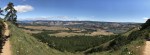
- The dark green foliage below in this view toward the Columbia River, between Mosier and The Dalles, Oregon, above Rowena Plateau, is a grove of Oregon White Oak, Quercus garryana, that most people associate with the Willamette Valley, growing northward through the Puget Trough to the southern tip of Vancouver Island, BC and southward into northern California.
-
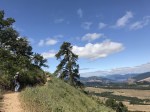
- These Oaks survive the tough, dry and windy conditions that prevail here east of Mt. Hood, from the foothills above the Wamic area, east in the Columbia Gorge and south into the gulleys, canyon’s and ravines of the Deschutes River and the Warm Springs Reservation and north into Washington’s Yakima area. They are often found in mixed open woodlands associated with Ponderosa Pine.
These trees won’t require the relatively lush conditions of a grass turf lawn, but they will require something over the length of their lives. This will include those California, Southwestern and Rocky Mountain region Oaks some of which reach out east from the Rockies. These can provide more of the ‘feel’ of our more traditional residential shade tree line streets without their high water requirement. Other trees, native to some of these wetter, high elevation locales, such as Aspen, our western Water Birch and Vine Maple, are in the mesic catagory, requiring consistent summer soil moisture. Native, is a ‘broad’ category, including trees and many other plants, with much higher water demands. The trick will be in determining how much they need and how best to deliver it.
-
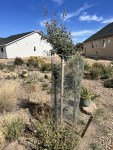
- This is my Mexican Silver Oak, Quercus hypoleucoides, growing in my Redmond backyard. This is its fourth year in the ground, so it has survived 4 winters and is working its way through its 4th summer. Oaks as a group are relatively slow to establish, spending their first few years establishing their root systems with minimal to moderate top growth. It is currently around 7′ tall.
-
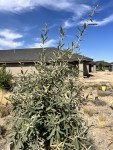
- Growing somewhat like a bush on a stick now, I’ll be pruning it over the next several years into more of a strong central leader form. Forcing it into that form early on means removing a lot of branches which slows overall growth, that’s why the selective strategy I’ve chosen. This summer has seen by far the most top growth with a few branches adding 2′.
-
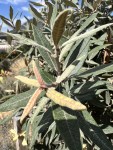
- New growth emerges this buff color with hints of pink and red, fading to the olive green of the mature leaves. This is listed as a Zn 7a plant, hardy down to OF, but several nurseryman have suggested that it will take considerably lower. So far it has endured three winters with minimums around -5F, the last winter remained on the + side. Responsible nurseryman are conservative in their hardiness estimates. It is up to us to test those limits and let others know how they fair.
-
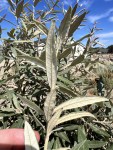
- One of my reasons for choosing this tree for this spot was my desire to have a tree that mimicked a true Olive. this one does with its dull, olive green leaves. The silver in its common name comes from the bright white undersides of the leaves. Olives aren’t very freeze tolerant. The seeds of this Oak were collected originally from the Madrean Sky Islands, those scattered mountains in southern Arizona growing at high elevation. Hardiness often varies with your source’s provenance, more northerly and higher elevation populations, tend to produce trees with better cold tolerance than those from lower elevations and more southern latitudes.
To do this will require a small army of volunteers with the support of local agencies and municipalities, because not only are not all trees ‘equal’, neither are the conditions that prevail across Central Oregon. The adage of ‘Right Plant, Right Place’ still applies, only I would add,’With the Right Support’. Drought tolerant plants adapted to arid conditions such as exist here, can be literally, ‘loved to death’ with too rich of soil conditions and too much water, conditions that the many ill-fitted trees on municipal lists today, will readily suck up and utilize. To implement such a program requires a commitment by the community and its various agencies and actors. This isn’t going to happen just because a particular garden center begins providing these options, a few new trees alongside those long familiar, ill-fitted choices. It requires long term testing and monitoring, education and outreach, community participation and government support. We have been repeating a plan, a proscription, followed by communities across the West, without adequate consideration. This isn’t anyone in particular’s ‘fault’. It is a matter of habit, available opportunity and rapid population growth…and it is also unsustainable over time..a fact that is becoming rapidly more obvious every year. Now is the time for a new approach…a new paradigm, a new relationship with each other and the places in which WE live. A place we share with our trees. It’s a time to refocus and develop a more intentional purpose. Our ‘urban’ tree canopy isn’t just a simple collection of trees. It is a part of a larger community of which we are a part, a largely detached part, that is far too fragmented for long term survival….We are living in a time that cries for a ‘reboot’, a set of reexamined expectations and new relationships.
An organization like the Central Oregon Tree Explorers could be involved in a variety of activities from planting trees on members own properties, to cataloging them, including descriptions of their conditions, irrigation schedules, to create a helpful data base for the City and interested residents, make comparisons of the performance of the same or different species, varieties and selections growing throughout the region; searching out new trees to try, defining the conditions in which their source material was collected, locating potential sources for planting projects, or growing them on ourselves for later planting out; some might choose to act as ‘brokers’ to facilitate group tree orders from local and more distant wholesalers; others could staff information booths at public events; while others might choose to serve as mentors for local students who are participating in related tree projects taking place through the schools; including setting up and monitoring test plots on school property and other public sites. The opportunities are many. Others could be involved in writing grant proposals to help fund operations, funding projects on public sites, taking on some of the ‘risk’ of trying ‘new’, untrailed, trees, helping defray the cost of needed irrigation equipment on public sites and ‘publishing’ the results of the group.
Partners could include area cities, local schools and the Oregon State Extension, the local Soil and Water Conservation Districts and other tree focused entities, e.g., Oregon State Forestry, the National Forest Service, the Bureau of Land Management and the East Cascades Oak Partnership.
For a ‘beginning’ list of trees to try out, and to see some of the possible organizational possibilities helpful to see this endeavor through, see my previous post.

