Category Archives: Weed Control

On Healing the ‘Broken’ Urban Landscape: Portland’s Holgate Overpass & the Brooklyn Yards

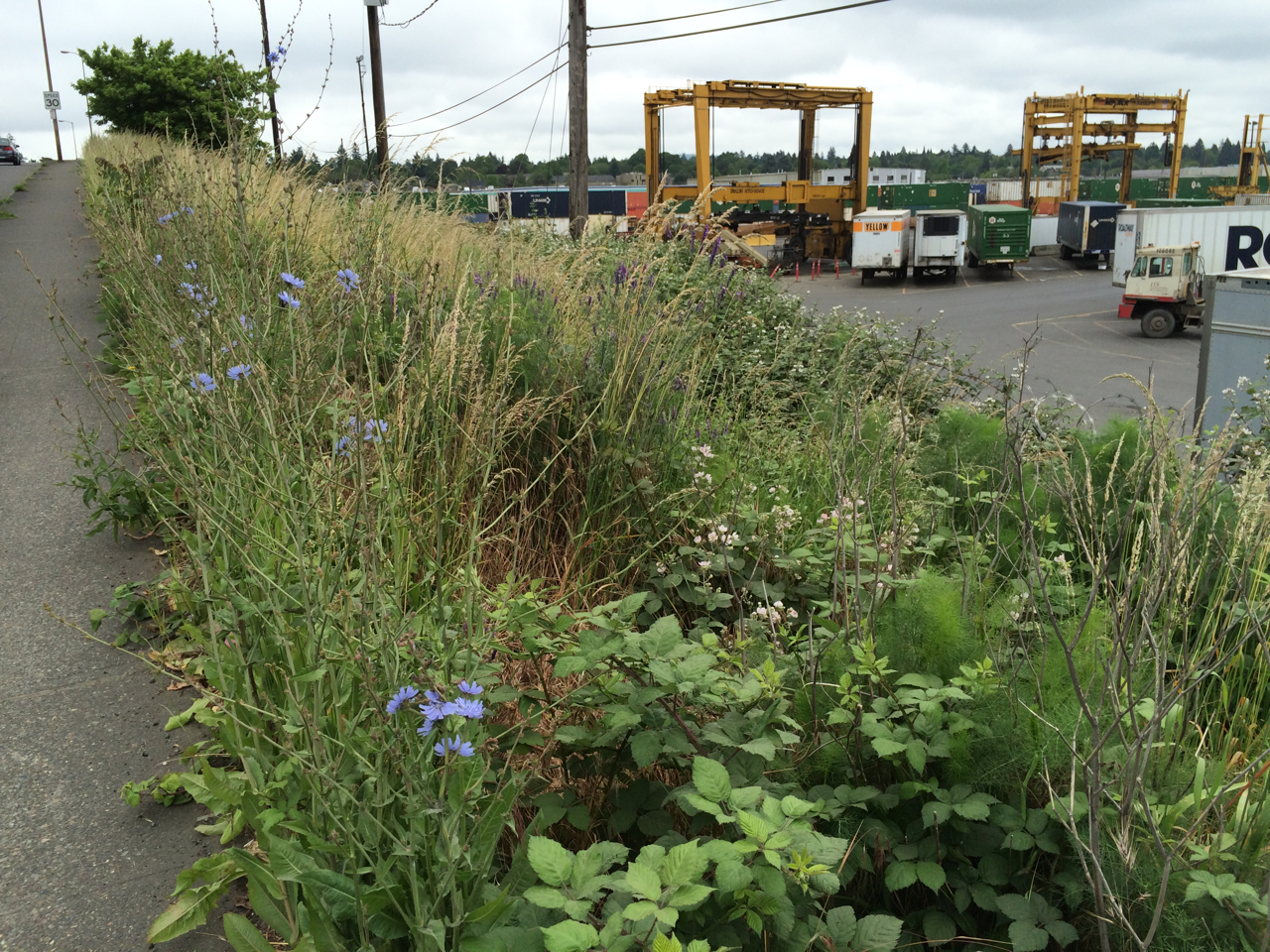
This is the section south and adjacent to the west approach. It was rough mown in early June down slope to the Blackberries and east to the Box Elder in the background.  You can see the blue flowers of the Chickory.

This is the section south and adjacent to the west approach. It was rough mown in early June down slope to the Blackberries and east to the Box Elder in the background. You can see the blue flowers of the Chickory and the Fennel.

Walking the Holgate overpass across the Brooklyn Switching Yard, with its adjacent container operation, is anything but pleasant. Trucks, trains, blasting horns and the four lanes of traffic whizzing by next to the 5′ wide sidewalks wipe away the positives of the views across the river and to downtown.  Most people probably don’t think of places like this as ‘landscapes’, but in the broader sense they are. Landscapes, most simply, are the places that we occupy, whether they are artfully designed, narrowly utilitarian, neglected, forgotten or simply dismissed. They become ‘landscapes’ through our occupying them or merely perceiving them. They are places we are in relationship with. Holgate is a traffic corridor for automobiles. Here is where it crosses the north south railroad line and the region’s major container handling yard. Car and truck traffic are heavy, at times, nearly non-stop. This is the only east-west route between Powell Blvd. and Bybee, and Bybee is intended for, and used by, more local traffic. It is loud. Traffic typically is moving a 35-45 mph although it’s posted 30.  The sidewalk is relatively narrow and this zone of unpleasantness is over a third of a mile long, an expanse from which there is no ‘escape’ for the pedestrian beyond enduring it. Since I retired, and weather permitting, I walk it once or twice a week on my way to the gym for a swim. Continue reading

Adaptive Management and the Dynamic Maintenance of Sustainable Landscapes


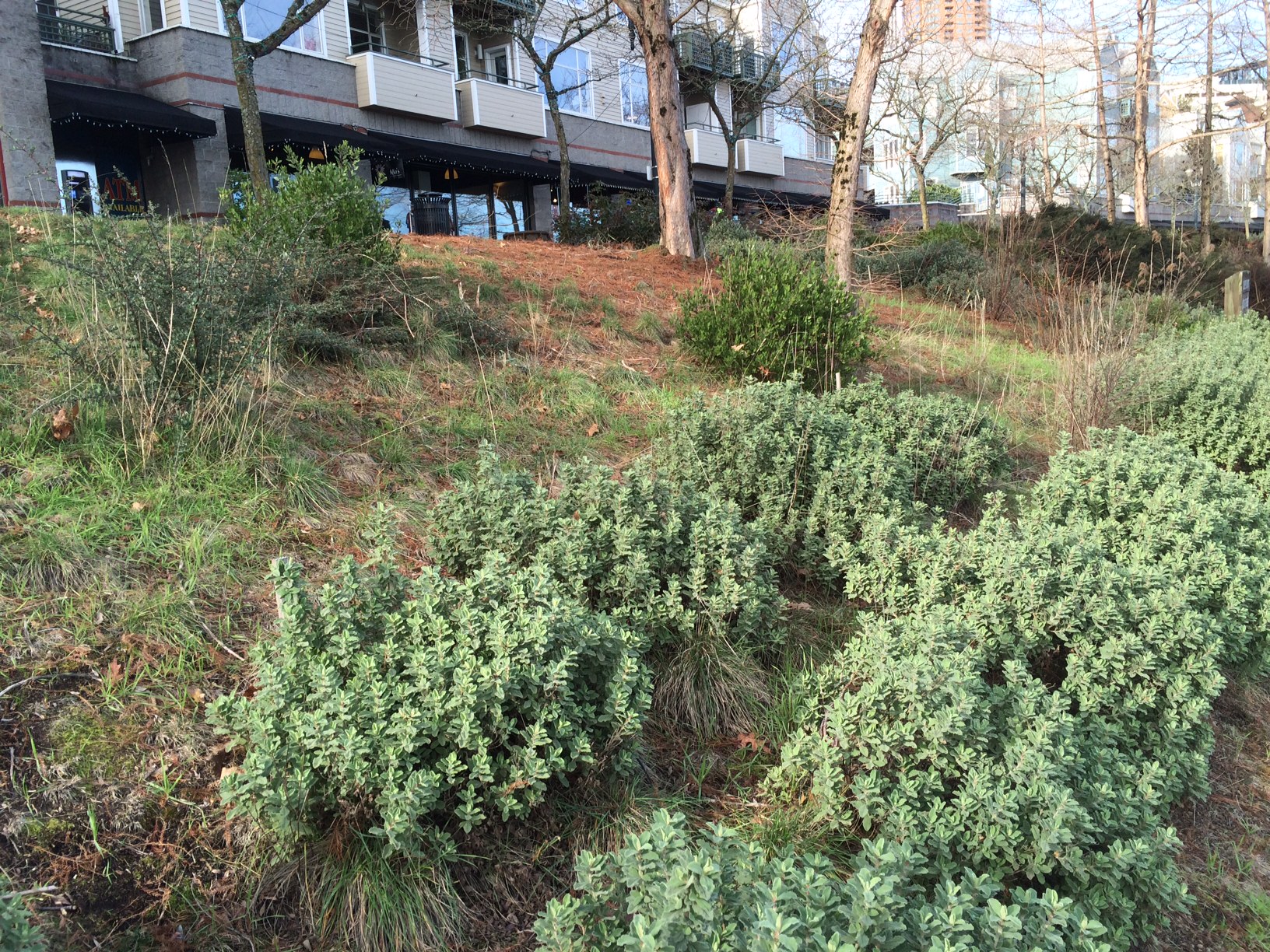
The second grassy bay, below the Harborside Restaurant, between the Taxodium clumps from the south end. A sweep of Cistus pulverulentus 'Sunset' at the bottom, Ceanothus cuneatus 'Blue Sierra' at the left and two Arctostaphylos x 'Harmony'. The grasses are Kohleria macrantha, native, Festuca rubra commutatta and a few nasty invaders.

The second grassy bay from the south end, below the Harborside Restaurant at Riverplace, above the marina, between the Taxodium clumps. The ’04 planting included no shrubs or perennial forbs in this area.  It was a monoculture of Koeleria macrantha, a native early season bunch grass that goes dormant by mid-July leaving the entire area vulnerable to invasion by weeds and offering no ‘barrier’ to either people or dogs, which enter frequently. A sweep of Cistus pulverulentus ‘Sunset’ at the bottom, Ceanothus cuneatus ‘Blue Sierra’ at the left and Arctostaphylos x ‘Harmony’ have been added to this site along with Festuca rubra var. commutata a low, fine textured spreader to help fill in the spaces and scattered native perennials.

We, all of us, are part of the landscape.  Just as individual plants belong to a local native plant community, and its place, so do we. That we live in highly disturbed and contrived landscapes does not change the fact that we live in relationship with it, that we are a functioning part of it. Deny this as we may, many of us as a group likely admit to very little connection to our ‘place’. It’s just where we live, for now. Our understanding of it and any involvement with our landscape, other than as a simple stage for our lives, is minimal, a condition which has become pervasive in modern society. Some professionals, who work with children have come to refer to this state as NDD, or Nature Deficit Disorder, a dissociative relationship now that was once basic to human survival. Today this condition is pervasive and our landscapes, as a result, severely disturbed, damaged and compromised, lack the capacity to return to their former state. There is a general ignorance amongst the public and our leaders of the severity of the problem and our necessary role and responsibility to correct it.  We are locked into a strategy that views landscape as incidental, the natural world as backdrop for our activities, not central to our well-being.  Today landscapes, as long as they meet our grossly simplified idea of our needs, a modern minimalist aesthetic, that does not over tax our ‘pocketbook’, are forgettable. From a horticultural viewpoint this is becoming an increasingly deteriorating disaster, something that not only we can do something about, but one that is imperative that we do so.  Adaptive Management describes a responsive relationship between people and the place in which they live. It is centered on a positive and workable strategy we can adopt that addresses this situation and turns it around, reengaging us with our landscape. Continue reading

Seed Banks and the Future of our Gardens and Landscapes

Another article in the ‘Over Thinking Series’

Old growth coastal Douglas Fir forest biome, the Ponderosa Pine – Juniper Sagebrush ecotone, your meticulously cared for back garden and the neglected median strip running down a divided street all occupy our ‘landscape’ and include soil unique to their sites.  The soil type and structure is relatively easy to describe as it is defined by its physical properties…its biological components are considerably more complex and change over time in the long and short term as a landscape ages and/or suffers human disruption…and, can, in turn, affect some of the physical properties. (see:  The Biology of Soil Compaction.) Continue reading

Weeding in a Dynamic Landscape: A Goal Oriented Strategy

The Over Thinking Series, part two

Weeding seems simple enough, but that’s the problem with simple things…they often aren’t.

Ugh! Gronk see weed??? !!!Gronk pull weed!!!

It isn’t rocket science, but we’re not stamping out widgets on a production line either…the first one the same as the 13,649th one. Landscapes are living systems containing many complex relationships and feedback loops. Just because most people don’t pay attention doesn’t mean that it’s simple. Continue reading

Gardening as a Political Act: Growing a Better Public Landscape – The Ross Island Bridge West Approach

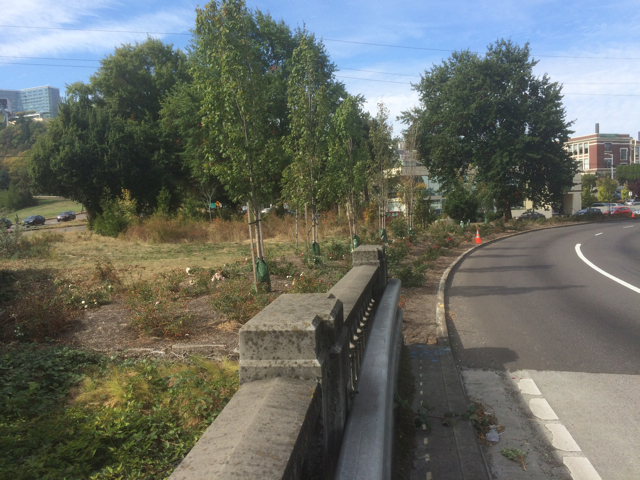
Peeling off towards downtown from the bridge westbound

Peeling off towards downtown from the bridge westbound.  The little landscape Roses and new trees…one mown down by a car further down.

I’ve said it before that everything we choose to do is a political act. Politics is not something practiced by ‘politicians’ exclusively. We are social animals. What we choose to do effects those around us…gardening is political. We have chosen to invest our time and energies into growing plants and maintaining our gardens. We do this as individuals. They feed our spirits and those of our friends and families. Beyond this are our neighbors and, to some degree, commuters passing by. I’ve had people I don’t know stop by and tell me, “I’ve been walking/riding/driving by your house for years and I just wanted to tell you how much I’ve enjoyed it.” There’s the bus driver who used to stop in his turn at our corner, open the doors and tell me how much he loved my Wisteria (now gone…Sad for him, good for me), the guy from BES who stopped one day to quiz me about a Grevillea and many others. People, gardeners or not, may be buoyed by your gardens. We change the world for the better. Politics need not be limited to the big divisive social, economic and environmental issues of the day. In fact, if we want to make a positive difference we better start on the little things that we can.

Continue reading

Landscape and Culture: Redefining the Urban Landscape – Single Use Corridors – Railroads

R x R below Division St. and 9th

R x R below Division St. and 7th

Landscape, is a human concept. It is more than simply a place, or the land that we occupy. Land becomes landscape when it passes through the lens of our eyes and we ascribe to it not only our own values and emotions, but also the value and emotions of the culture we share as members of this society. Just as we are shaped by the laws and culture of our society so to is the landscape. Without, sometimes, considerable conscious effort we cannot see the landscape free of this ‘cultural looking-glass’. As individuals I don’t think it’s ever possible to look at the landscape neutrally, though over time, our experiences can change us, and so, also, how we value and view the landscape. This is important if we ever want to change our relationship with the landscape we live in, if our role as an actor in the landscape is to change, if we are to, individually and collectively, become responsible stewards of the places within which we live…because it is one thing to say we are good stewards and something else entirely to actually be one.

People continue to be drawn here to the landscape of the Pacific Northwest. We all have our favorite places that hold us, and, unfortunately, over time, can come to sadden us as we see them degraded and homogenized by the momentum of our culture, the economic engine we all depend on, that is still systematically converting our landscape into one that can be found almost anywhere with the exception sometimes of a geography too expensive to alter. Even climate, we are beginning to realize, is within our ability to change, though we are finding, such changes are likely beyond our control. Continue reading