Category Archives: Parks

Horticulture: Gardening in Portland Parks

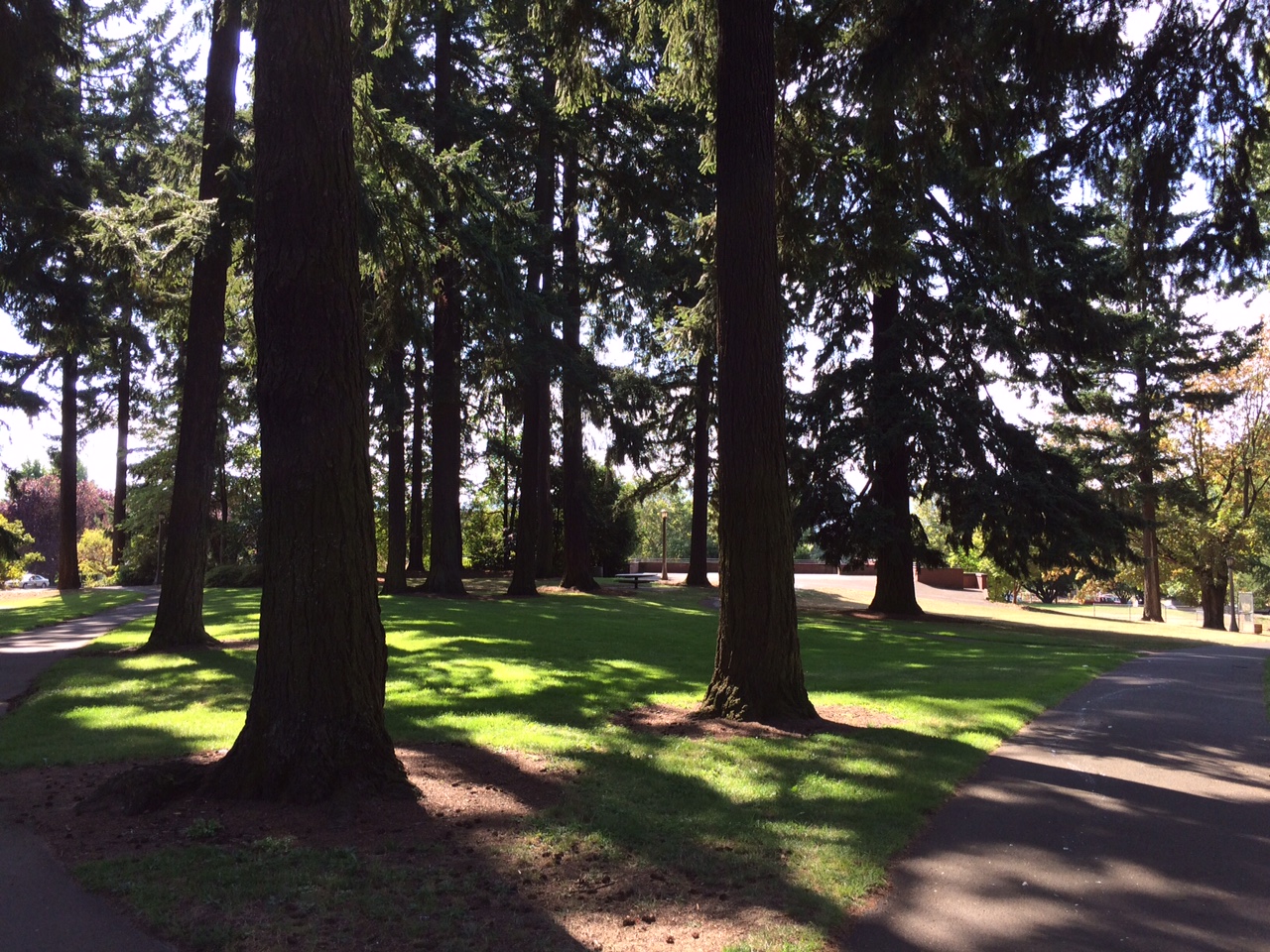
The land occupied by Kenilworth Park and most of the Kenilworth neighborhood was part of the land claim owned by Clinton Kelly, a Methodist minister from Kentucky who settled in the area in 1848. In 1909 the Portland Park Board purchased 9 acres from Kelly with funds from a 1908 bond measure created specifically to acquire land for parks in Portland. In 1910, Park Superintendent Emanuel Mische created a design for the park that was inspired by the park's natural topography and vegetation. The design included a bandstand, tennis courts, sports field, wading pool and play area, sand courts, walkways, and vista points. Today, the basic layout of the park remains intact and is indicative of the strength and appeal of Mische's original design.

One of my favorite neighborhood parks is just a few blocks from my house.  The land occupied by Kenilworth Park and most of the Kenilworth neighborhood was part of the land claim owned by Clinton Kelly, a Methodist minister from Kentucky who settled in the area in 1848. In 1909 the Portland Park Board purchased 9 acres from Kelly with funds from a 1908 bond measure created specifically to acquire land for parks in Portland.
In 1910, Park Superintendent Emanuel Mische, a contemporary of the Olmsteads who conceived the overall plans for Portland’s Park system, created a design for the park that was inspired by the park’s natural topography and vegetation. The design included a bandstand, tennis courts, sports field, wading pool and play area, sand courts, walkways, and vista points. Today, the basic layout of the park remains intact and is indicative of the strength and appeal of Mische’s original design.

Gardening in Public – Full Frontal Gardening

Preface to the series. I worked 27 years for Portland Parks and Recreation as a Gardener later upgraded to Horticulturist, a change in title only. I loved my work and job. I can count as friends many of the people who still work there. I have the utmost respect for the many there who remain positively engaged in their work. It is a wonderful place to work and grow. I also found the organization a continuous source of aggravation. I don’t think this should be interpreted to be damning of the organization or its people. It simply speaks to the nature of the ‘beast’. Like any organization it takes considerable effort and focus to address one’s shortcomings. It is all too easy for any of us to become complacent, because it is difficult and there is little reward when what you seek others interpret as threatening to themselves. It is what it is. I would do nothing different except perhaps had more confidence earlier on to pursue what I thought was both creative and healthy for myself and Portland Parks. I don’t mind being taken to task. It hones my own practice and I try to rise above the personal and wish the same for others. Growth is difficult it does not mean that we should not pursue it. Continue reading

Gardening in Public: The Duniway Park Experiment

Portland Parks: horticultural profiles series

I’m almost a little embarrassed to post this article….  Most of my earlier project were much smaller, more like bandaids.  This is the first Park I went through more systematically assessing, horticulturally, and trying to correct landscape ‘problems’ with entirely different plantings. We generally weren’t expected to do more than little fixes and bandaids.  Larger issues were considered beyond our scope and should be addressed by our Planning Division, with master plans and all of that.  The Bureau was, however, neither staffed nor funded to do master plans which is a laborious and time consuming process.  They were few and far between.  So, as I said, this was my first go at it, though I don’t claim to have created a master plan in the process.  My time was even more limited. Continue reading

Turf in Public Parks – a note

The upper portion of Duniway Park.  A Nyssa sylvatica growing at the toe of the slope below OHSU.  The turf is completely unirrigated, is very compacted and has poor drainage.  In much of it is dominated by a few broad leaf weeds while most of the grasses that survive are weedy as well.  The whole Park is built over one of Portland's first dumps.

The upper portion of Duniway Park. A Nyssa sylvatica growing at the toe of the slope below OHSU. The turf is completely unirrigated, is very compacted and has poor drainage. Much of this turf is dominated by a few broad leaf weeds while most of the grasses that survive are weedy as well. The whole Park is built over one of Portland’s first dumps.

I wrote what follows a couple of years ago while still a horticulturist with Portland Parks and Recreation.  It was an addendum to a piece I wrote addressing a different approach for prioritizing work in Park landscapes and is reproduced here, with slight changes, as i originally wrote it.  I thought of it more recently as I’ve watched Portland bake this summer and observed, consequently, the decline of residential and Parks lawns. I am a big proponent of ‘sustainable’ landscapes.  That does not prevent me from seeing the necessity for grass lawns in urban areas especially in cities as they follow the path to increased density for sustainability issues as well.  People ‘need’ open space and as we all ‘suffer’ from our own shrinking of private outdoor space, the need for such public spaces increases.  But turf cannot fill the need if it is poorly maintained.  Dormant, dry, compacted weed dominated lawns are both unattractive and less functional.  Open spaces are not all the same.  Ugliness can degrade them to the point of rendering them almost useless in terms of their human value (We often speak of habitat value for wildlife and in terms of water quality.  We spend less public time discussing what is of basic human value.  What we require to meet our very real and ‘animal’ needs.  Not all of our legitimate needs can be met by buying products and services.)

Vigorous grass based turf is not sustainable. It is a monoculture susceptible to weed invasion that requires regular care, including, irrigation, mowing, fertilization, aeration to reduce compaction, occasional dethatching, control of moles and, for the best stands, the occasional well timed application of an herbicide and insecticide. Having said this, I still see it as a vital component of our Parks.  Portland Parks and Recreation has other priorities making exceptions Park by Park, though select athletic fields for playability and safety reasons are still irrigated. (Other Parks Districts, notably places like Bend, OR, with a desert environment, have prioritized having good quality turf in public areas). No other surface provides the functionality and value of turf grass in an urban environment. It absorbs rainfall; reduces the problems of mud and dust and helps control the erosion that accompanies bare soil; provides a firm, but shock absorbing surface for activities; aids with cooling the urban heat island; provides a restful carpet of green that helps calm a potentially chaotic visual world; and, provides a surface for young children to play on or family and friends to relax or picnic on. As urban density increases, the need for public open space increases. We need lawn. Concrete, pavers and asphalt will never fill all of this need. An argument can easily be made that rich healthy lawns better fill this human need when they are in Parks than scattered thinly through residential neighborhoods in front and backyards where they are individually too small or inaccessible to meet the public need. Continue reading

Himalayan Cloud Forest Garden: Update…Plant Pilfering

Hmmm.  Sadly, someone has decided that, once again, plants planted in public places are available for the taking.  I’ve been informed the a few Arisaema, among other perennials have disappeared after they began to bloom.  Having gardened myself for many years in the public sphere, it is aggrevating, and disturbing, how some people decide they can take plants, because, after all, they pay taxes.  I’ve actually had people tell this to me when they were confronted.  Others, I imagine see it simply as an opportunity to get ‘free’ plants.  The worst times have been when I’ve had plants pulled up that I find elsewhere, broken, dried and dead.  Once, I had a Fejoa sellowiana, now Acca, dragged across the lawn at Waterfront Park, they left a dirt trail, to where they tossed it into the Willamette over the seawall!  Several years back, I came back the next day to finish a planting and all of the Spiarea I had planted the day before was gone, more than 20 plants, so probably by a landscape company, and this was from a utility planting to shield a parking area.  Many public gardens, maybe most, around the world, are protected by fencing and locked gates after hours.  This adds more costs upfront and can often make regular maintenance more difficult for access reasons.  One alternative is to plant ‘unattractive’ plants that no one will want…, but what’s the point of that.  We can’t ‘nail’ every plant down, so in Parks we would just go back and do it again.  Don’t get me started on the just stupid vandalism of broken trees….

Adaptive Management and the Dynamic Maintenance of Sustainable Landscapes


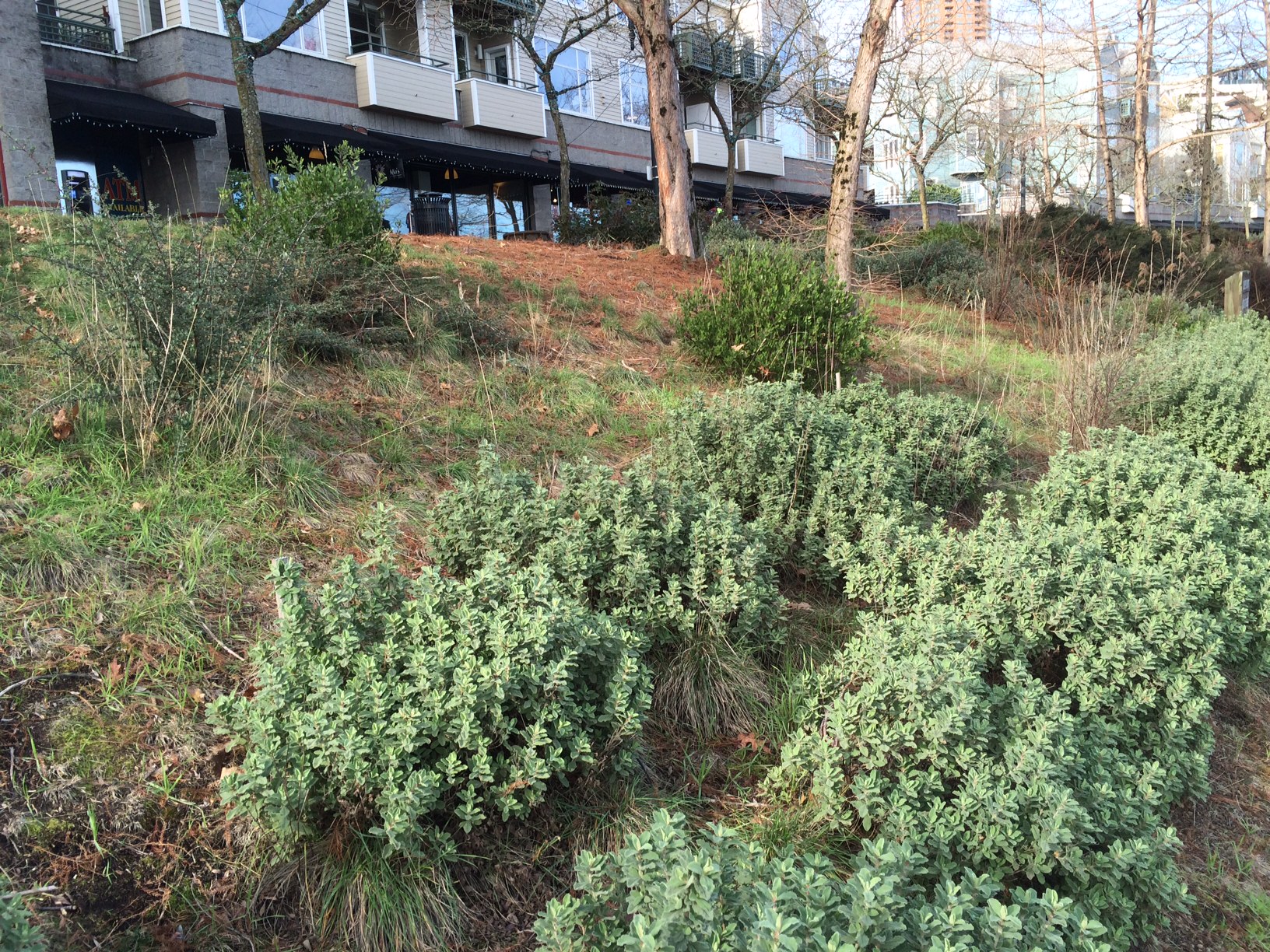
The second grassy bay, below the Harborside Restaurant, between the Taxodium clumps from the south end. A sweep of Cistus pulverulentus 'Sunset' at the bottom, Ceanothus cuneatus 'Blue Sierra' at the left and two Arctostaphylos x 'Harmony'. The grasses are Kohleria macrantha, native, Festuca rubra commutatta and a few nasty invaders.

The second grassy bay from the south end, below the Harborside Restaurant at Riverplace, above the marina, between the Taxodium clumps. The ’04 planting included no shrubs or perennial forbs in this area.  It was a monoculture of Koeleria macrantha, a native early season bunch grass that goes dormant by mid-July leaving the entire area vulnerable to invasion by weeds and offering no ‘barrier’ to either people or dogs, which enter frequently. A sweep of Cistus pulverulentus ‘Sunset’ at the bottom, Ceanothus cuneatus ‘Blue Sierra’ at the left and Arctostaphylos x ‘Harmony’ have been added to this site along with Festuca rubra var. commutata a low, fine textured spreader to help fill in the spaces and scattered native perennials.

We, all of us, are part of the landscape.  Just as individual plants belong to a local native plant community, and its place, so do we. That we live in highly disturbed and contrived landscapes does not change the fact that we live in relationship with it, that we are a functioning part of it. Deny this as we may, many of us as a group likely admit to very little connection to our ‘place’. It’s just where we live, for now. Our understanding of it and any involvement with our landscape, other than as a simple stage for our lives, is minimal, a condition which has become pervasive in modern society. Some professionals, who work with children have come to refer to this state as NDD, or Nature Deficit Disorder, a dissociative relationship now that was once basic to human survival. Today this condition is pervasive and our landscapes, as a result, severely disturbed, damaged and compromised, lack the capacity to return to their former state. There is a general ignorance amongst the public and our leaders of the severity of the problem and our necessary role and responsibility to correct it.  We are locked into a strategy that views landscape as incidental, the natural world as backdrop for our activities, not central to our well-being.  Today landscapes, as long as they meet our grossly simplified idea of our needs, a modern minimalist aesthetic, that does not over tax our ‘pocketbook’, are forgettable. From a horticultural viewpoint this is becoming an increasingly deteriorating disaster, something that not only we can do something about, but one that is imperative that we do so.  Adaptive Management describes a responsive relationship between people and the place in which they live. It is centered on a positive and workable strategy we can adopt that addresses this situation and turns it around, reengaging us with our landscape. Continue reading

The Himalayan Cloud Forest Garden in Washington Park: A Collection of Species Rhododendron & Asian Companions

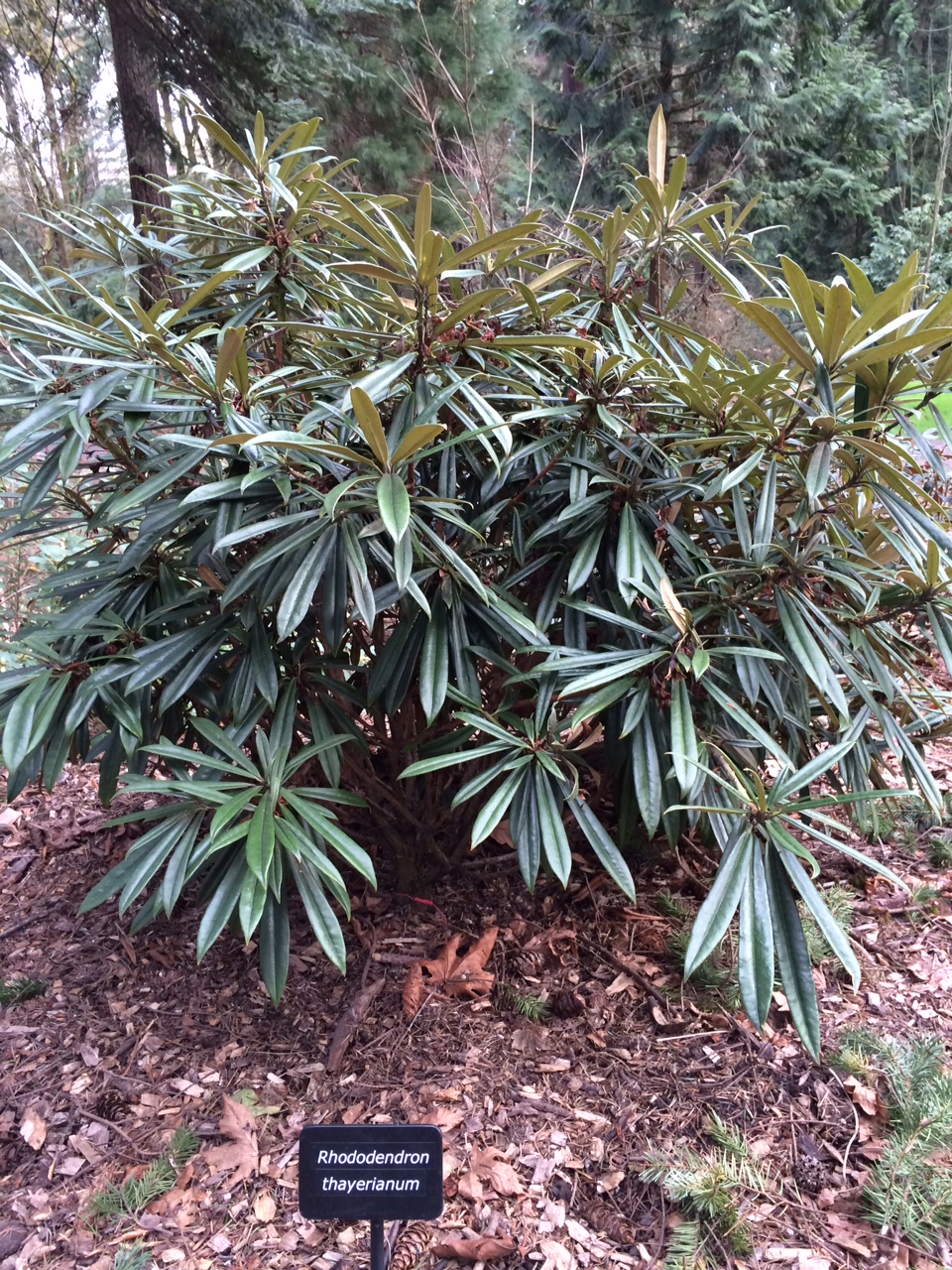
R. thayerianum has wonderful glossy narrow leaves with a prominent mid-rib. The leaves stand out in whorls to great effect!

R. thayerianum has wonderful glossy narrow leaves with a prominent mid-rib. The leaves stand out in whorls to great effect!

A few years ago the Washington Park crew started to joke about their new ‘Himalayan Cloud Forest Garden’ on the north slope of the Park above west Burnside. I was still working in the Downtown Parks and though not part of the project, was greatly excited by its creation. What began as an Ivy removal/ restoration project had quickly morphed into an idea for a species Rhododendron display garden (Or, perhaps, the idea came first!). Washington Park, minus the Zoo/ Arboretum acreage is about 160 acres. Much of the terrain is rough and undeveloped. For years, due to budget constraints, maintenance has been focused on the high use impact areas.   Neglected areas included the ‘Cloud Forest’ portion above the ‘Canyon Walk’ which follows the draw down to the old Stearn’s entrance on Burnside where it begins to carve its way through the trees. Over the years English Ivy built up to a smothering blanket. Other plants, like English Holly had reached mature size and were seeding in alarmingly. While on the crew myself, some years earlier, I spent many hours cutting, treating stumps and dragging the Holly trees off. That effort accelerated in recent years when the two staff ‘Rhody-philes’ began feeding off each other’s energy.

Continue reading

Public Portraits of Xeric Plantings at Riverplace and South Waterfront, part 2

This little tour begins from the traffic circle at the intersection of SW Montgomery St. and River Dr, by the sign to South Waterfront Park and Garden.  It has you walking north along the esplanade in front of the shops and restaurants.  It concludes about 900′ to the north at the Riverplace Hotel.

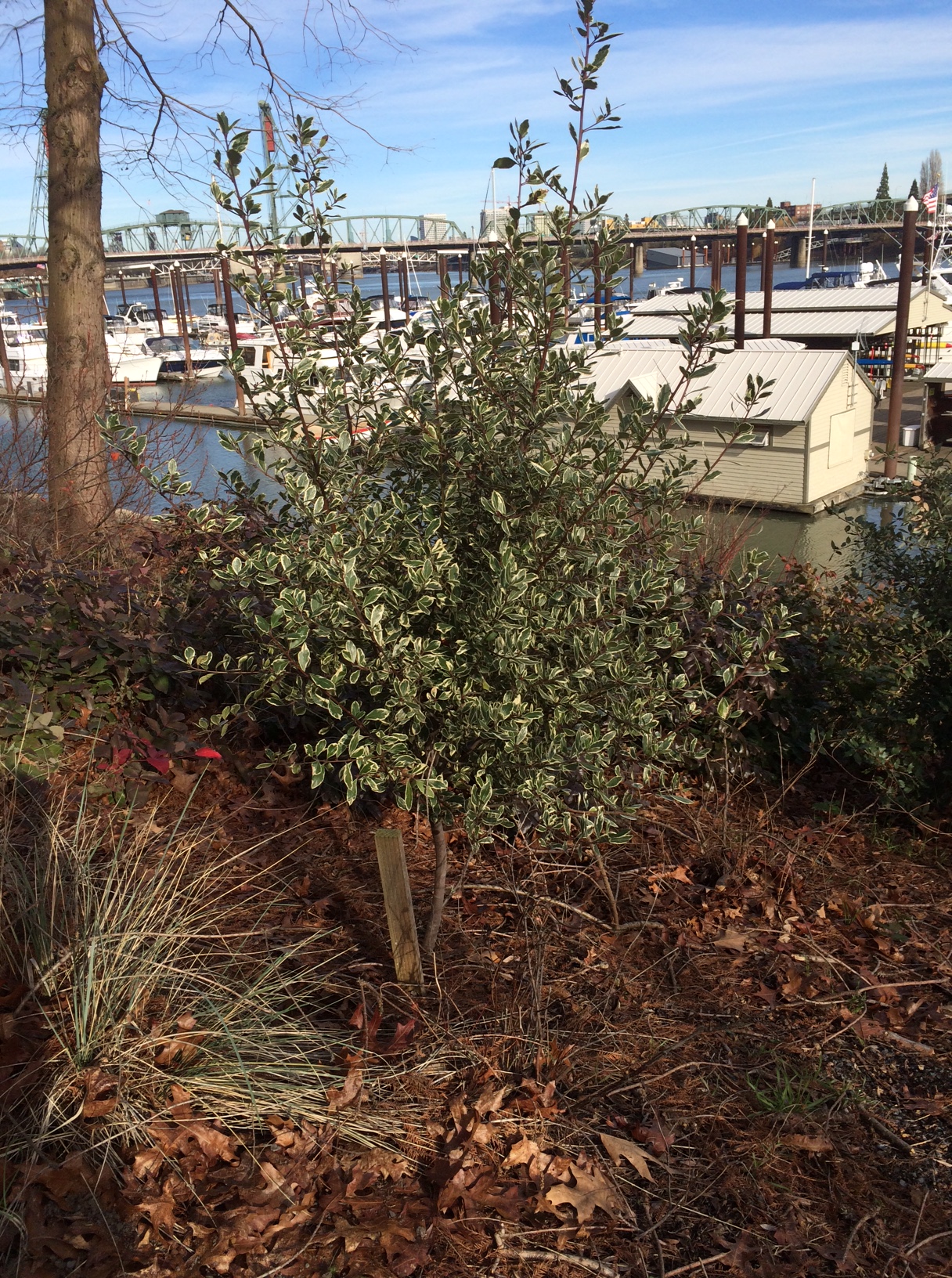
Rhamnus alaternus 'Variegatus' planted between the Blue Oat Grass and gradually dying out Cornus 'Kelseyii'.  It has been very slow. Understandable given the horrendous fill soil conditions.

Rhamnus alaternus ‘Variegatus’ planted between the Blue Oat Grass and gradually dying out Cornus ‘Kelseyii’. It has been very slow. Understandable given the horrendous fill soil conditions. In the immediate area are also a young Quercus chrysolepis, Arbutus menziesii, Arctostaphylos x ‘Pacific Mist’, Cistus x ‘Blanche’, Philadelphus lewisii, Cotinus coggygria ‘Golden Spirit’ and Holodiscus discolor

Continue reading

Drought Tolerant Plantings: A Review of Riverplace and South Waterfront, Summer ‘12 (updated Aug. ’14)


Riverplace Esplanade Bank looking south along the Marina toward the Marquam Bridge

Riverplace Esplanade Bank looking south along the Marina toward the Marquam Bridge.  My last big xeriscape experiment.

The following is an evaluation I initially did while still working for Portland Parks and Recreation.  I’ve edited it a bit and added a few things to make it more current.  I think it’s important for people to know what others are doing, what they’ve tried and what were the successes and failures.  While kind of long it is still a brief look at the conditions on a few sites that were under my care and my observations concerning their performance.  As Downtown area Parks these landscapes are very accessible for those curious to see how these plants have done on the ground.  Now, most of you if your gardening is limited to your own backyards will never have to deal with landscapes so large, nor will your growing conditions, specifically your soil, be the same, I thought that it would be interesting to share this anyway, in addition to letting you know where you can come see how these plants can look in a landscape.  All were planted small as they tend to better adapt to their sites when small, but some are beginning to mature and show what they can do.  Anyway, I view our Parks as a public asset.  There are many valuable and important plantings around us, that the public is largely unaware of.  Part of my role here is to change this situation through promotions like this and by continuing to work with horticulturist to create some kind of database of public and private plantings that is accessible for viewing by the general public. Continue reading