Portland Sustainable Landscapes: Toward Health and Diversity – Creating an Organizational Structure for Implementation


img_5221

Urban landscapes can and must vary across a wide spectrum of types from natural to highly contrived display and educational beds. All will require their own maintenance regime that should minimize impacts while supporting the expression of the particular landscape. Good horticultural practice will minimize negative impacts and costs and is largely ‘determined’ by the design.

Introduction

An Office of Sustainable Landscapes that oversees all landscapes within the City and provides active leadership to both private and commercial property owners through the following:

Public Landscapes (active urban contrived) Horticultural Management

Public Landscapes (urban plant communities)

Corridor Management: Transportation and Riverine

Division of State Lands

Tri-Met

P-BoT

O-DoT

Multnomah County Bridges

Outreach and Education

‘Regulatory’

Introduction

Landscape is the setting, matrix and backdrop for everything that we do as humans.  It is where we live, work and play, the places, on which the infrastructure that enables our modern day life, exists.  It is both essential and peripheral, always present and, too often, taken for granted, so much so that we often view it incidentally.  Like many other things in our lives it may go unnoticed until it is so degraded that we can no longer ignore it.  Overall, our care of it, reflects a similar low priority.  It becomes largely ‘invisible’, behind the more recognized needs of a modern City.  Individual mobility, food, water, shelter, energy, economic opportunity and growth, the transportation infrastructure that keep us supplied with these things, all and more take precedence, the landscape subsumed and secondary, inferior and problematic.  Overall, it is not generally viewed today as having inherent value.  Its value, as a living system that allows and enriches biological life, seems almost irrelevant as we are able to satisfy our needs and desires via the economic engine that propels us along.  The landscape, nature, seems relevant only in so far as it can meet our recreational needs providing us a base on which to build and resources that we can manipulate/convert to satisfy our ‘needs’.  Lost in all of this is our relationship with nature, with the landscape, its essential role in the creation and sustenance of all of the resources upon which we and the rest of life depends, and so, it has suffered.  We have lost the ability, or willingness, to use nature as a gauge that shapes all of the other decisions we routinely make in order to meet our ‘economic’ needs.  As both a society and as individuals we have learned to see these as separate and unrelated, so we routinely neglect the landscape.  The problem is pervasive and integrated with how we live our lives.  To correct this we must first acknowledge this and address it on many fronts. Continue reading

What Really is a Sustainable Landscape & Why it Matters

IMG_2603

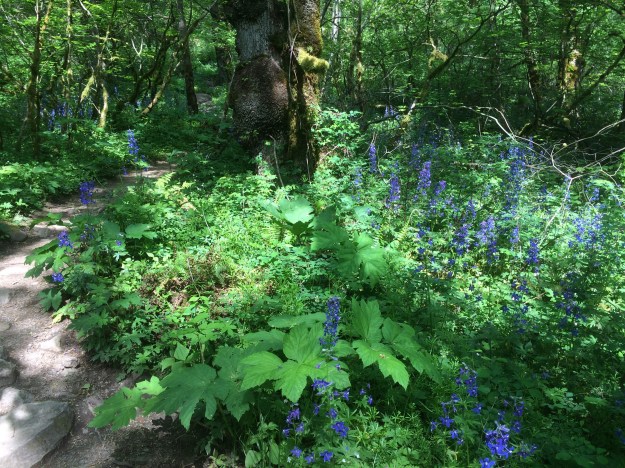
I took this at Cape Horn in early May ’15 in one of the ‘wet’ woodland ‘terraces’. The native Delphinium gives it a fantastical appearance. If we could create this landscape anywhere in the City I can’t imagine that it would withstand the level of use and inevitable abuse it would receive let alone the ‘weed pressure’ it would suffer. Perhaps there are a few places that such a landscape could work but it would require that we have all of the surrounding landscapes ‘under control’ and that we educate the public so that they would understand and respect it enough to stay away. Our numbers alone even if most behaved themselves would make its survival difficult.  Ultimately, this is just what is necessary, re-establishing the public’s relationship with nature and the wild world.

(I’ve made earlier postings on this topic, but this piece actually predates those.  I wrote this in 2013 while still working as a horticulturist for the City of Portland Parks and Recreation as a member of a Bureau committee that was working to define ‘sustainable landscapes’ so that we could begin to make our policies and practices more consistent with our ‘desire’ to create sustainable landscapes and protect the relatively intact ones that remain.  This was a difficult process.  We spent a lot of time discussing/arguing about what constitutes a sustainable landscape and ultimately the direction that Parks should be headed.

There was a large divide between those of us who saw ultimately, that the only truly sustainable landscape was one that recreated those native landscapes that preceded the massive changes that European Americans brought with them, so that our efforts should be on these, and those of us who, having spent much of our professional lives in the field doing maintenance in created/urban landscapes, arguing that these new landscapes played a necessary role in the modern world and that our designs and maintenance of them could be moved in a more ‘sustainable’ direction.  These urban/functional landscapes, whether for active sports, community gardens or even many passive uses, provide places and venues for activities that native landscapes cannot.

IMG_0408

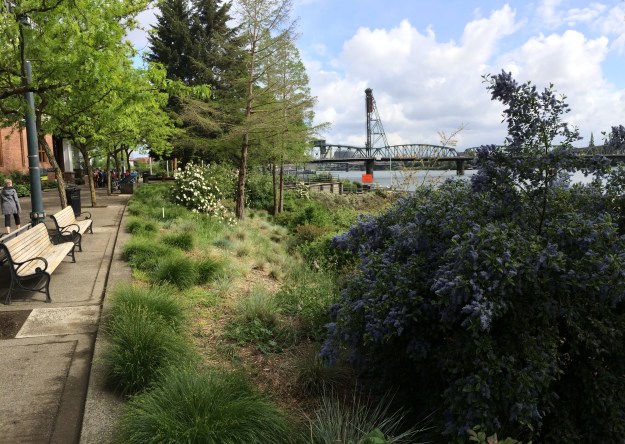
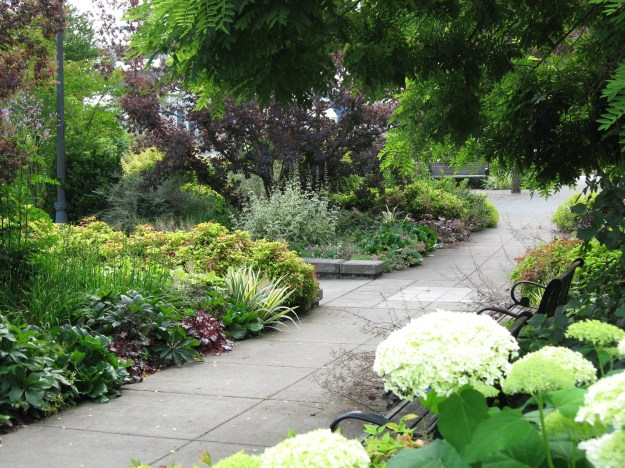
There is space and need for many different landscapes in an urban area. This is in the garden at South Waterfront Park along the Willamette River and is intended to be a contemplative refuge from the business of the city. It is layered and carefully orchestrated though its goal is more aesthetic than to be a ‘natural’ plant community. It requires considerable regular ‘grooming’ and editing to maintain in order to show off the plants to their best advantage. This garden was designed for multi-season interest especially through the summer when our native Willamette prairie landscape slides into dormancy.

The organizational structure of the Bureau has been built around three primary landscape ‘types’: ‘natural landscapes’ which tend to be larger and border more densely populated sectors of the City, ‘contrived landscapes’ that are dispersed throughout the City and serve the more traditional Park functions for sports and more casual social use and the ‘enterprise landscapes’ of Golf and PIR that serve very narrow functions and depend on those uses for much of the revenue that supports them.  These are operated and maintained by discrete groups within the Bureau, have different cultures and priorities and view sustainability very differently.   Because these are all in a highly urbanized area the degree of historical disturbance and the continuous pressures that a concentrated population apply to them, they can never by truly ‘sustainable’ in that they will always require our active stewardship to counterbalance these pressures.  This is not to say that we give up on the idea of balanced/dynamic landscapes of appropriately chosen plant communities.  We just need to remember that these are urban areas and be good stewards of the land.  We can even move ‘high use’ landscapes in a more sustainable direction, both in their design and in their maintenance.  It is incumbent upon us to do this to ultimately minimize the pressures put upon them and natural areas by weeds, invasives and human use.) Continue reading

Flowering…A Reason of Their Own:  A Look at Agave Flowers, Structure and Relationships

IMG_1712

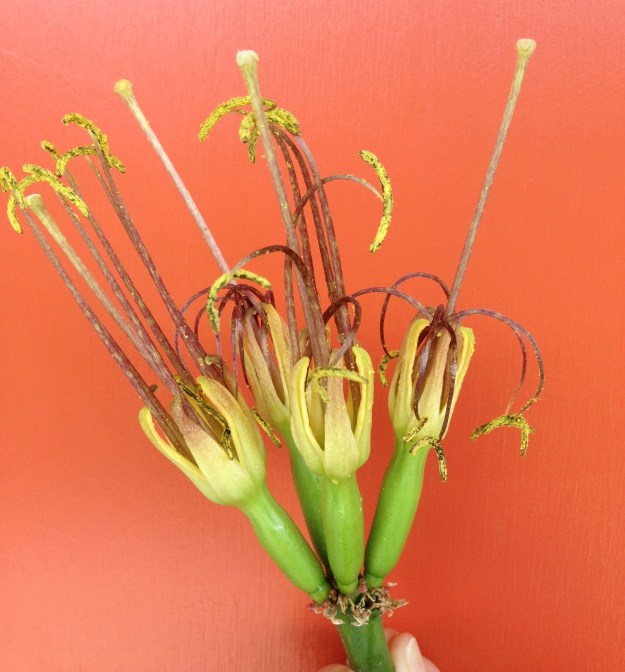
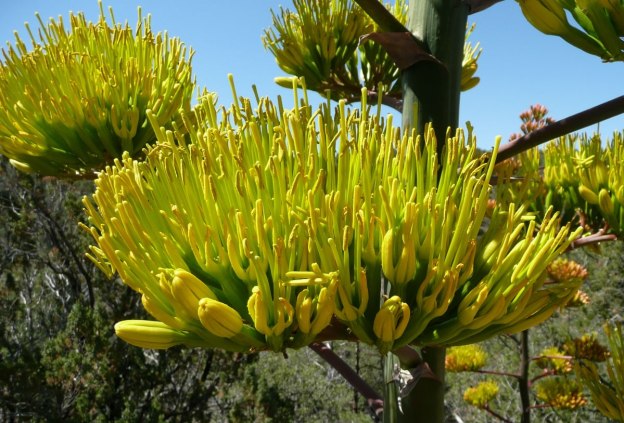
This is one of the lower umbels, the second peduncle from the bottom. The others contain more individual flowers. This umbel was caught in the stage where the filaments are collapsing and the styles extending. Nectar has spilled to many surfaces. The tepals have begun to shrivel as well. Coarse pollen grains show on the anthers with some ‘spilled’ to other surfaces. Individual flowers aren’t particularly pretty.

Flowers can be ‘incidentally’ beautiful.  We often selfishly view them as products of nature intended to fulfill our own hunger for beauty, failing to recognize them for what they are, living organic structures evolved over time to continue their own species, organs and tissues meant to attract the necessary attentions of pollinators, to produce the seed of generations to follow. We, as a society, have learned to view a select few of these as beautiful.  We respond to them in a way not unlike the pollinators themselves do, and by either ignoring them or focusing our attention upon them, we too alter their future form and their very existence.  Sometimes we do this more directly through choosing the plants we want around us.  Other times it is our indifference that seals the fate of a plant or landscape, especially when the flora is unable to grab our often preoccupied attention and we clear land for development wasting all of the ‘lesser’ weedy natives we’ve learned to undervalue, or, through our efforts to ‘improve’ plants by controlled breeding and hybridization, intentionally altering their form even the conditions under which they will grow.  Sometimes, in our desire, for fashion and an idealized beauty, we attempt to control and remove that which we don’t want, creating sterile flowers, the antithesis of what a plant would ‘want’.  We select for bloom size, scent and color, for period of bloom, we seek to increase the number of petals and alter the pattern they may be held in, even the lifespan of the individual flower, the height of the plant so that it doesn’t flop over, the ability to grow it in more sun or shade, the shape and color of leaves and the form of the whole plant.  We attempt to control all of this and crank out a uniform product that can be ‘plugged’ into landscapes and gardens as desired.  Plants with dependable performance characteristics, a pedigree.

We need to remember that this is what we ‘want’, not what the plants ‘want’, nor is it necessarily in their best interest as either a species or a member of a plant community.  These days most of ‘us’ aren’t gardeners.  Our relationships with nature were broken long ago.  It is difficult to see the critical connections in nature, between plants and the organisms they have evolved with, upon which they are dependent, especially if someone is not looking.  It is even more difficult to see where we ourselves fit into this in our materialistic, consumer society where so many of us measure ourselves and others by the things and property we own…and are quick to ‘take’ from others.  I’m going to paraphrase a snarky rejoinder I’ve heard these last several years, ‘Yeah, you’re special, just like everything else!’ and I mean this in the broadest sense. Continue reading

Losing Our Urban Landscapes: Sustainable Goals and Our Crisis in Leadership

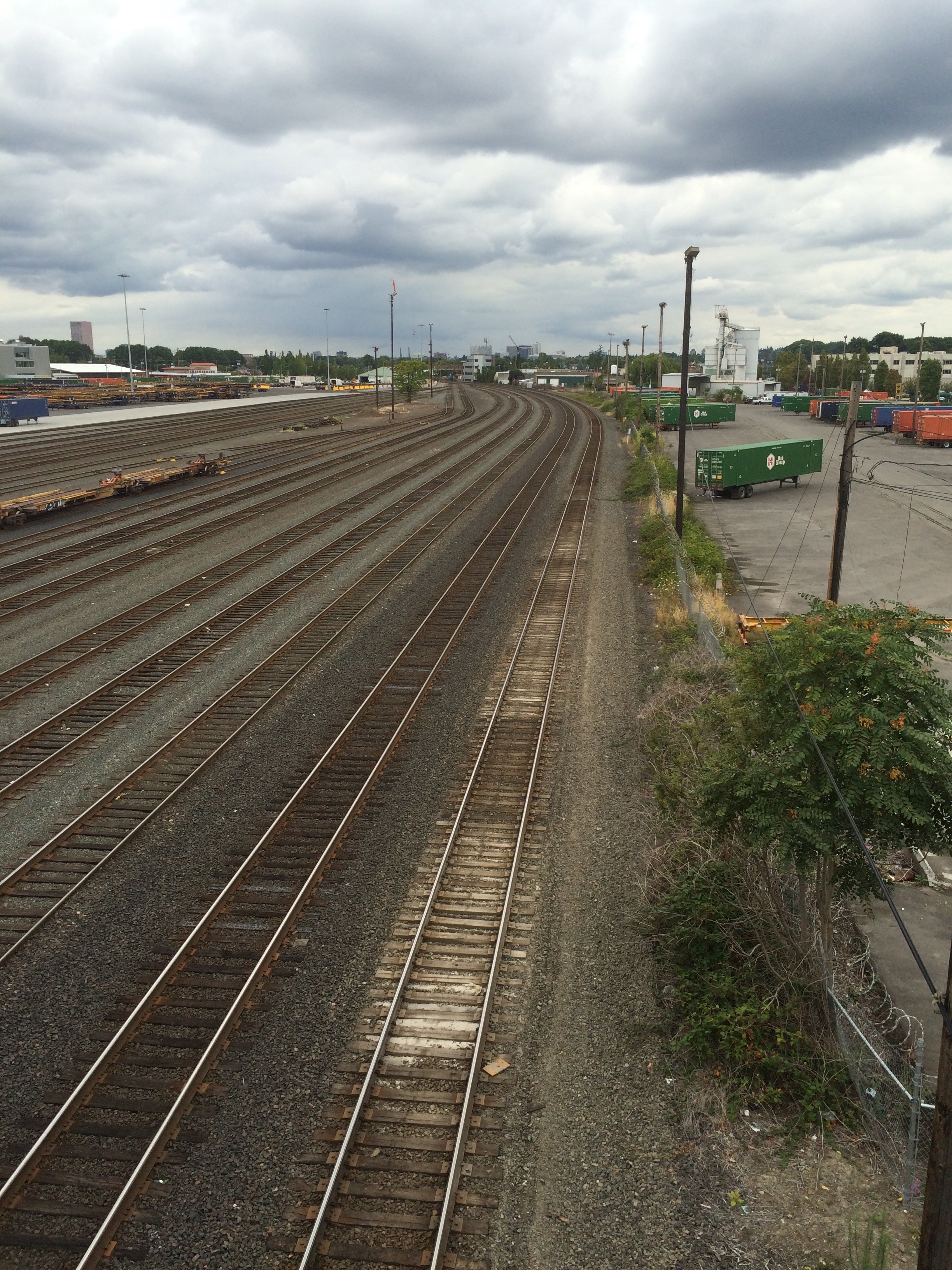
The Brooklyn switching yard. These areas must be kept clear. The fence line to the right, next to the container yard, is typical, here filled with common weeds, aggressive invasives and Tree of Heaven.

The Brooklyn switching yard. This ‘landscape’, in a modern utilitarian sense, is ideal.  These areas must be kept clear. The fence line to the right, next to the container yard, is typical, here filled with common weeds, aggressive invasives and Tree of Heaven…and it doesn’t matter.  It works and that is the priority.  Whatever results elsewhere…is not.

The following is intended as a template for action or a beginning point for a discussion that is long overdue.

Landscapes are more complex than most people realize.  They can go seriously awry in a very short time.  Undisturbed native plant communities are relatively stable and are able to respond on their own, as they have for millions of years…if the disturbances they suffer are relatively small.  Unfortunately these plant communities have been decimated in urban and most rural agricultural areas severely compromising their abilities to respond in a positive and effective manner.  The addition of invasive species to the region puts even stable, undisturbed plant communities at risk.  Because we are not all ecologists, or even gardeners, what can we realistically do to stop or reverse this process of landscape degradation?  The decline of our landscapes is linked to a long history of practices that have ignored the value of both our native and contrived landscapes, a belief in a right to ‘dispose’ of the land in whatever way we so choose and our denial that this destruction matters.  We have done this through our land management practices, our designs and the uses of the land itself even those that may seem unrelated, many that have become automatic in our society and are directly related to how we live, work and play today in the modern world.  Our active threat is inherent in the way that we do business.  Our attempts at correction are, too often, limited to only slight modifications that do not put any undue ‘pressure’ on our local economy, business or the privileges that we have come to see as ours.  We are a society that has, in short, become disconnected from the realities of life at the local level and what is required to support it.  We see a limitless nature that is there for our use.  Whatever we may need, we believe that we may merely buy from elsewhere, an elsewhere that is limitless though undefined.

To turn this situation around, or to make significant improvements, requires that we examine what we are doing now, that may be working against the goals that support life and landscape,…and stop.  We have to stop doing the things that are working to continuously disrupt the ‘healthy’ functioning of the landscape.  If we don’t do that then all of our attempts at improvement, all of our tweaking of our system, will come to nothing.  We cannot ‘save the patient’ with good thoughts while they bleed out. Continue reading

Summer Tree Failure

IMG_6175

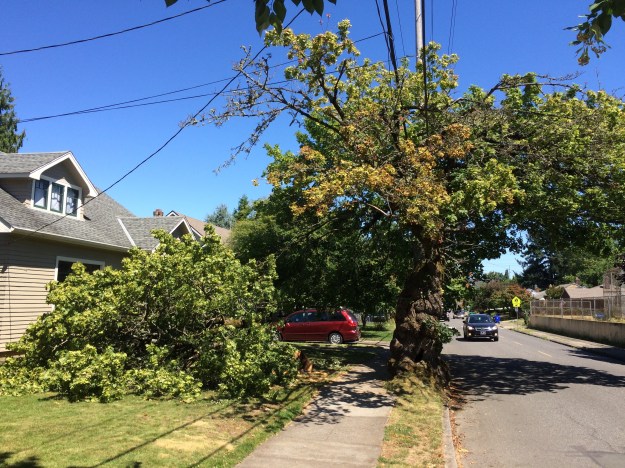
A failed Norway Maple on SE 49th. This picture was taken June 28th, five days after a big rain event. You can see that this tree has been struggling for some time as evidenced by the dead branches still in its crown and the stressed flagging leaves up there. The girth of the trunk is greater than the width of its planting space. It is pinched beneath the overhead lines and the requirements for street trees regarding road clearance. It’s height has been ‘controlled’ and limited over the years.

Trees fail all of the time and when they are older, this can be quite spectacular, or devastating, if your car, home or an individual have the misfortune of being in the its path.  Like most people I used to believe that most such failures happened as the result of storms, and many do, but it is relatively common for trees, or major limbs, to come crashing down with calm conditions in the Spring. The new flush of growth brings with it a great deal more tissue and water weight than a tree in active growth has previously supported or, for a tree struggling, compromised by the burden of significant rot in its core and/or limbs.  Look at any tree and look at its girth, its canopy spread and on many species, its long, often horizontal limbs and try to imagine their weight.  To help with this fill a couple of buckets with water, lift them and try to hold them horizontal away from your body.  Trees are static structures, comprised of countless overlapping fibrous layers, much of it hard and rigid with a great deal of compression and torsional strength.  The were ‘born’ for this.  Few of us would last for more than a few seconds trying to support so much of our own weight on extended arms.  We shouldn’t be surprised when they fail, even as elegant and as well ‘engineered’ as they are. Continue reading

Agaves, Hybrids and Our Role as Gardeners & Stewards


Sharkskin bracketed by its parents, A. scabra left and A. victorian-reginae on the right

Hybridizing is always a bit of a crap shoot!  Cross two species and the progeny will range all across the morphological map!  Hybridizers grow on their seedlings and select those that share the characteristics that they’re looking for or individuals with startling and unusual features.  They toss the rest.  They in effect are giving their selections an advantage, an advantage they would never receive in nature on their own.  In nature hybrids can only occur when the natural ranges of the two parent species overlap and their proclivities align with the possibilities.  Plant breeders are not limited by this.  Pollen can be collected and stored from anywhere and used to pollinate selected plants.  In nature, survival is a numbers game.  Seedlings must be competitive in an existing plant community with limited available niches.  They have to possess a certain robustness.  Those that survive, grow on and perpetuate themselves, possessing survival characteristics that allow them to do so and have been blessed with the conditions that favor them.  Hybrid creations of nursery people and breeding programs may be lacking in these survival features.  They are pampered, lined out in nursery rows and flats. The result of their intentions may actually put their selections at a competitive disadvantage if they were to be left on their own in nature. Continue reading

Flowering and Its Trigger in Genus Agave

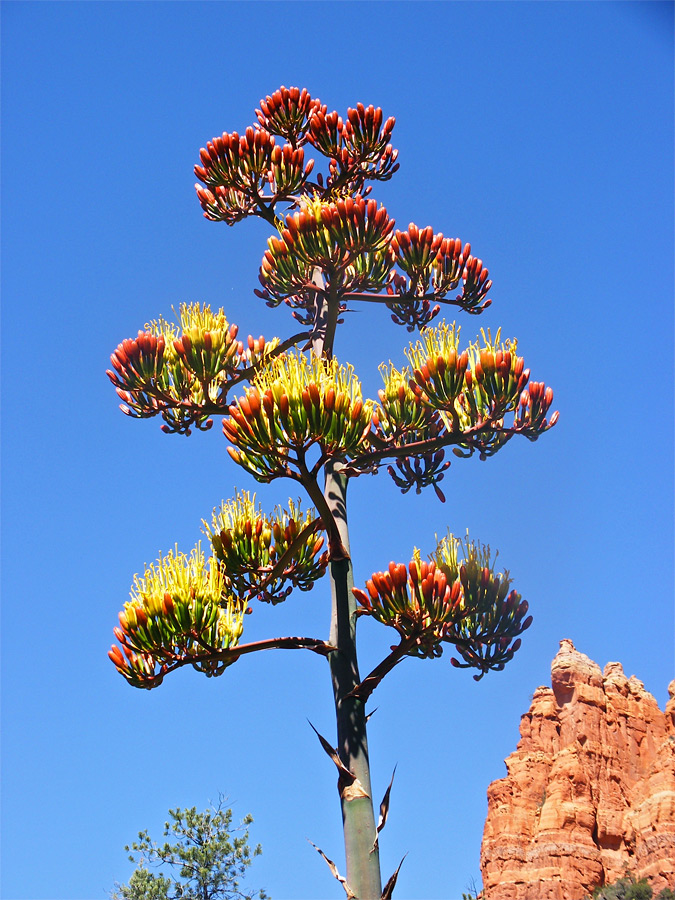
Agave parryi with both secondary and tertiary peduncles and the elongated yellow anthers 'floating' above.

Agave parryi with both secondary and tertiary peduncles and the elongated yellow anthers ‘floating’ above, in Sedona, Arizona.  From  americansouthwest.net.


As gardeners we come to know our plants, what to expect from them over time, how we can better meet their requirements,  and their contributions to the garden.  If we watch we learn when to expect their spring time resurgence, the extension of stems and unfurling of leaves.  We anticipate their flowering often recomposing vignettes to best display them.  They teach us over time.  But with Agaves their flowering is so infrequent, that if we don’t study them in mass over a span of years, we won’t know what to expect.  With some it can take as few as six years, some even less, while others will keep us waiting for 30 or more.  When we buy a year old grafted Magnolia we are told to be patient and we understand that the tree will take some time to grow and mature.  So we wait knowing that once it begins a Magnolia will increase in both size and floral performance rewarding us for many years to come…but with Agave, it is once and done.

Agaves are flowering plants, Angiosperms.  Angiosperms all share a broad survival strategy forming complete flowers which produce seed which grow into juvenile plants.  If you follow plants back in time you’ll that find that plants can be broken down into a few large groups.  The largest such group, the Angiosperms or flowering plants, are also the most recent of these…and the most successful.   Angiosperms have seeds encased in a ‘fruit’ that formed within the flower from the ovary.  Gymnosperms, produce seed as well, though their’s are ‘naked’ without a covering fruit, as the plants have no ovary nor true flower. There are other differences between them as well both structural and in the details of their reproductive cycles.  Other plants like ferns don’t produce seeds at all and instead rely on the more ancient process of reproducing directly from spores which grow into an intermediate form, a gametophyte, with one set of chromosomes.  This is the ‘sexual’ stage, either male or female, which mature independently, the male form later fertilizing the female, the product of which grows into the sporophyte, with two sets of chromosomes.   The sporophyte later releases the single sex, single chromosome spore that will grow into the gametophyte, continuing the cycle.  Agave, as a genus, share much with other Angiosperms, they have several distinct peculiarities they share amongst themselves as well.  They are all perennial taking more than a year to mature and flower.  This is a very common attribute.  What sets them apart is that they are monocarpic, they die after flowering once, and, they can take up to 30 years or better, depending on species and growing conditions, to flower.. Continue reading

Growing Agave in My Maritime NW Garden

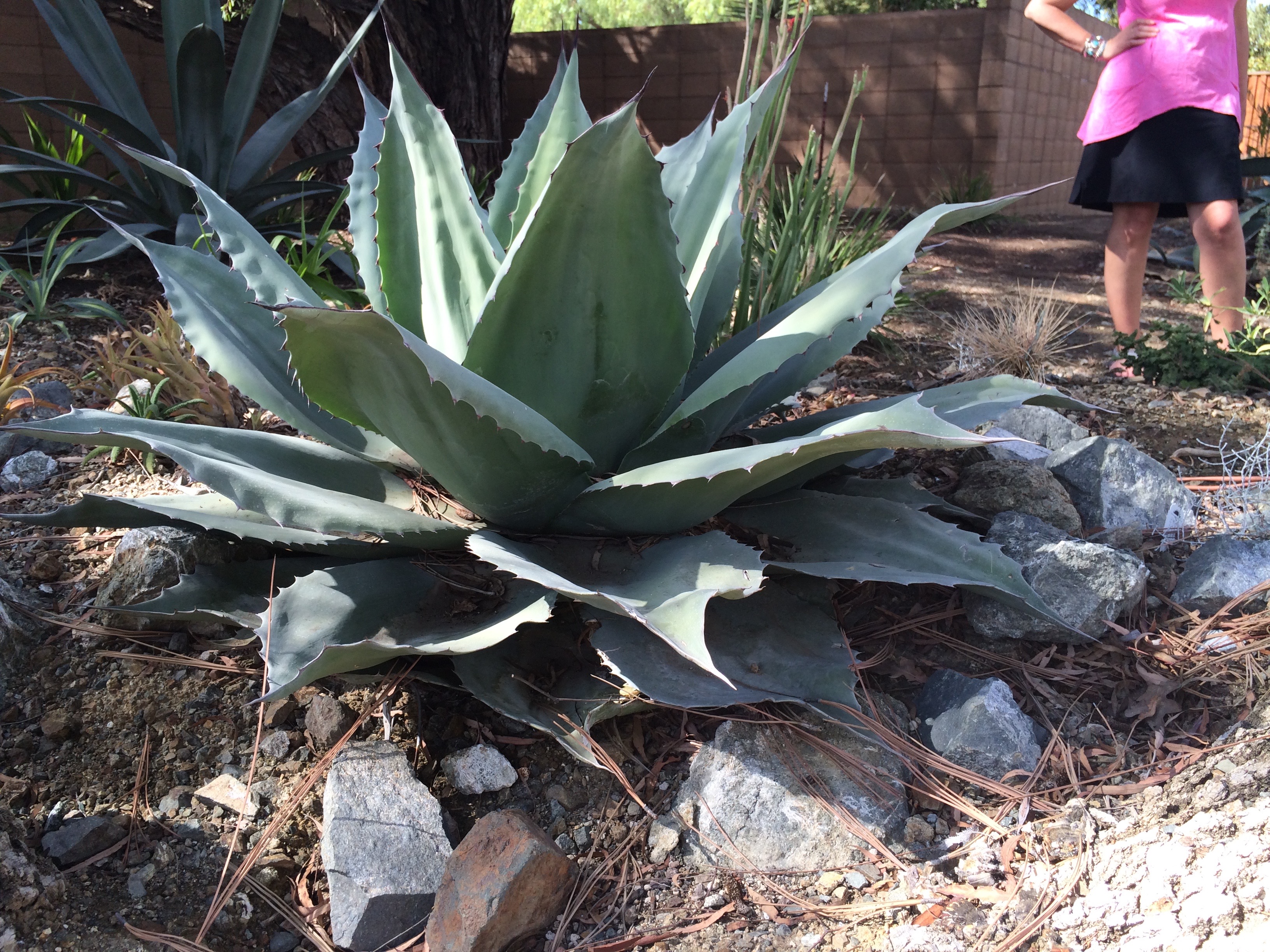
My picture, but not my plant. Alas! I just potted my start up to a 1gal purchased from Sean at Cistus. Agave ovatifolia 'Vanzie'. Several of these big beautiful cultivars are growing in the Bancroft Garden. It is distinguished from the species by its undulating longitudinal waves across the wide guttered leaves.

My picture, but not my plant. Alas! I just potted my start up to a 1gal purchased from Sean at Cistus. Agave ovatifolia ‘Vanzie’. Several of these big beautiful cultivars are growing in the Ruth Bancroft Garden, in Walnut Creek, CA.  We visited on a nice 80F+ day last October.  It is distinguished from the species by its undulating longitudinal waves across the wide guttered leaves.  Each leaf can be over 10″ across.

When we garden in the public view, and most of us do, at least where we front along the street, or even when we invite others into its more private and inner sanctum, and we grow plants successfully, people are going to ask you: ‘What’s that?’  ‘I didn’t know you could grow those here!’ and, ‘What did you do? they always die for me!’  In short, if you’re successful, people will regard you with respect and assign to you the attributes and position of ‘expert’…when all you did was try to follow the gardening maxim of ‘Right Plant, Right Place!’  In short, you tried not to kill it.  Genuine expertise requires broader experience, study even, that the simple buying and planting of one particular plant cannot earn you.  If you’re like me such easy success and adulation, can be embarrassing and often serves as a prompt, to look through books, search the internet and ask others, that you know who have way more practical growing experience than you yourself do, and gradually, the assignation of ‘expert’ feels a bit less flimsy, maybe even ‘earned’.  I often tell gardening friends that I consider myself to be more of a dilettante, flitting from one plant or group of plants to the next.  Inquisitiveness has always been a part of me and growing one Penstemon, one Banana or one Agave, never adequately ‘grounds’ me.  Grow a few more and I feel a little more comfortable with it.  Look into some of its ‘cousins’ and the particulars of where something grows, its climate and soils particularly, and I feel ‘better’, much like I did when I was preparing for mid-terms at school.  And then I move on, my interest sated for the time being, somewhat comfortable in what I know and curious about the next group.  Over time they all start forming a bigger picture out of what once seemed like a massive, unknowable puzzle and I enjoy solving puzzles.  Having said this, I still don’t consider myself to be an expert, just an avid and focused gardener. Continue reading

Gardening at City Hall- Lessons in Reality & Frustration

IMG_5159

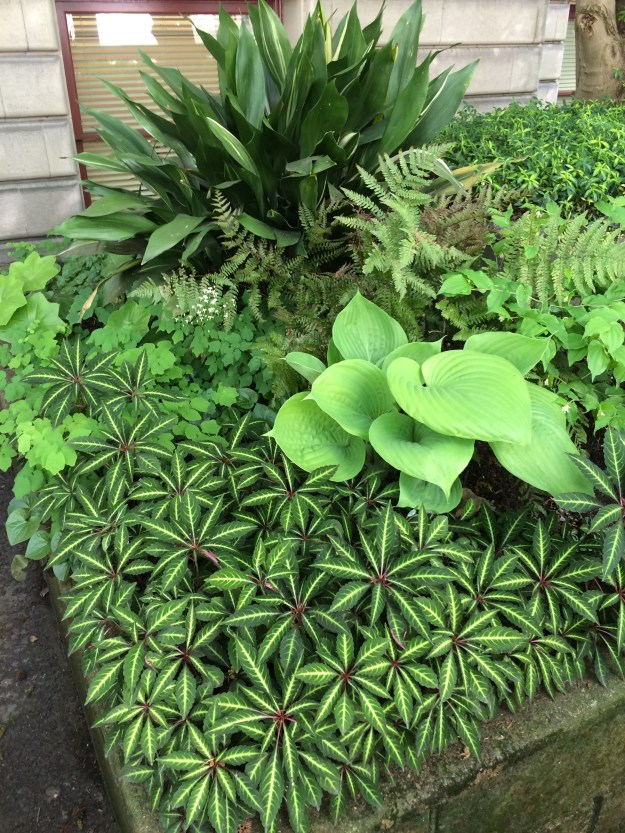
Impatiens omiense fronting a composition including: Vancouver hexandra, Podophyllum pleianthum, Aspistra elatior, Dryopteris erythrosora, Hosta ‘Sum and Substance’ and Prosartes hookeri (previously Disporum hokkerig). This is the south bed on the 5th St. side of Portland’s City Hall.

I’ll bet you thought this was going to be about the hours of meetings wherein Council pours over the issues surrounding the plantings and landscapes of which the City has responsibility…Hah!!!  No, this will be a bit more mundane, hands in the ‘dirt’, and about some of my experiences gardening in the limited ground around City Hall, as well as some observations and comments on what it’s like to garden in such a public spot.  There’s also a bit of hand wringing and hair pulling here.  I’ll be telling two short stories of gardening, one on the 4th St side, but first the 5th Street side of the building. Continue reading

The Fields Park: Brownfields, Compaction & Drainage – a Missed Opportunity

IMG_4444

The Park enterance, framed by the four bio-swales (I can’t bring myself to call them ‘water gardens’ as they look very ‘un-garden like’) that take runoff from the adjacent hard surface as well as from the drain system installed across the lawn. They are planted with Betula nigra cultivars along with Cornus stolonifera ‘Isanti’, C. s. ‘Kelseyii and an Iris. As you walk through the Park you will move over eight different hard surface treatments!

The Fields (Click here to see the final design plan), completed in spring of 2013, is Portland’s newest Park in the north end of the Pearl District.   While I was still with Parks I did the horticultural review during the design process and was an on site inspector, periodically, during construction.  New Parks like this one require a huge time commitment by Parks.  Selection of designers, outreach to all of the stakeholders and many other meetings involving more technical aspects of such a project all in an effort to deliver to residents a Park that is beautiful, serves the needs of residents and is affordable in terms of long term maintenance.  Before  the project is offered to the design community functional goals are set for the Park and a general design theme is chosen.  Various firms offer proposals.  Concepts are bandied about.  Eventually, one is chosen.  In this case, the Office of Cheryl Barton, a San Francisco firm, was awarded the design contract (To see what they have to say about it). Continue reading