
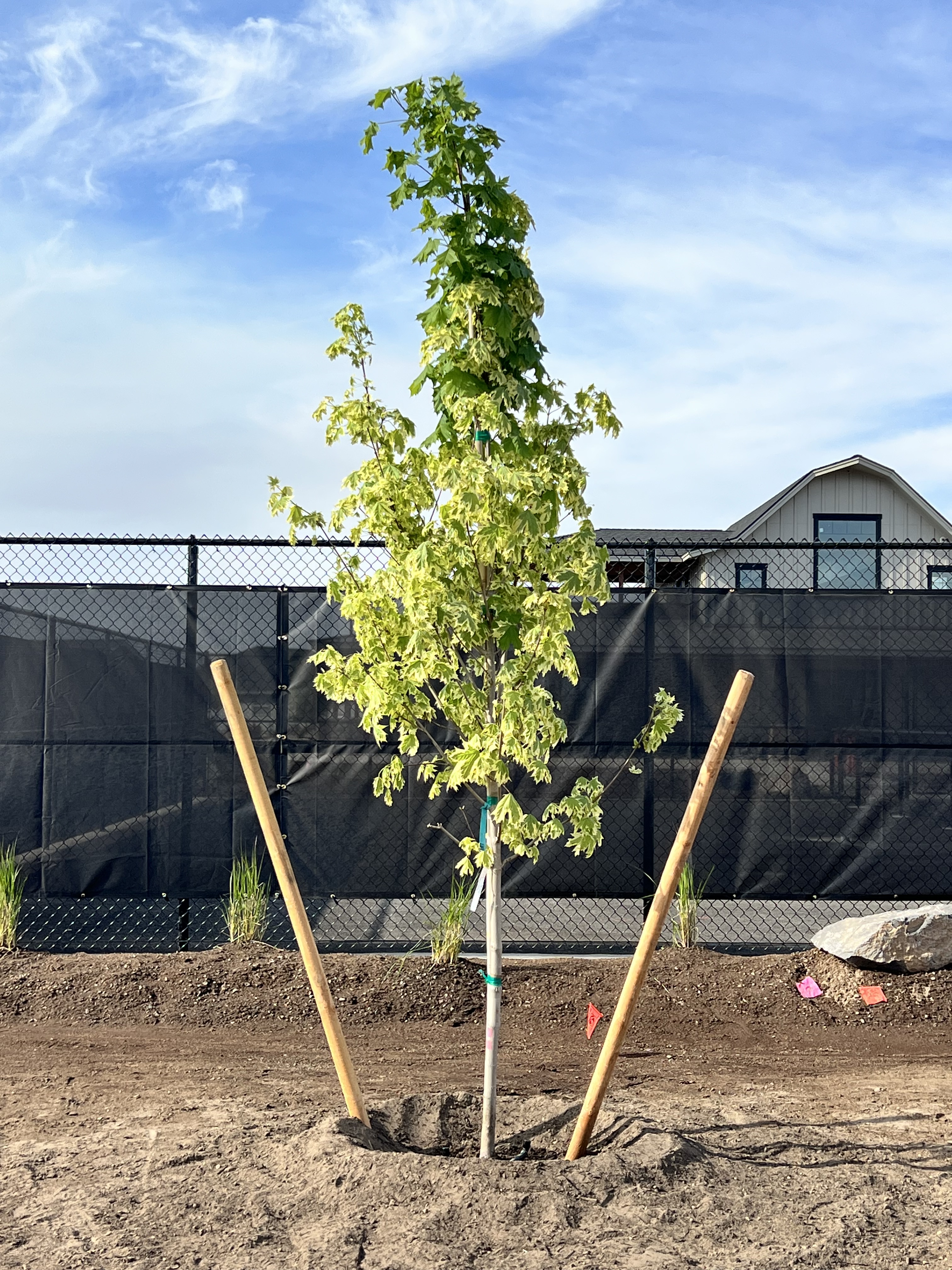
The reversion on this competing leader threatens to dominate the canopy if not removed. The planting appears good, straight trunk, well staked. It is always what is below ground, that is not readilly visible, that’s critical.
When I was still working for the city of Portland Parks, one of my jobs, for a number of years, was to do design reviews and construction inspection on big capital Parks projects being built from scratch downtown including South Waterfront, Caruthers, Jamison Square, Director’s Square,Tanner Springs and The Fields. I’d attend meetings with our project managers and the landscape architects, charged with assessing the appropriateness of their plant choices given their requirements, the site conditions, our capacity to provide the necessary maintenance over time, whether their combination presented conflicts, without commenting on the aesthetic of their designs, which was considered outside my expertise. Sometimes I was asked to do the same for projects in other areas. I’d visit the project sites regularly to observe prep work, planting and follow-up care, suggesting changes to the contractor and writing up my report. The architects generally approved, or rejected, the plant stock coming into a job, accepting or rejecting substitutions. It was my job to make sure that plants were properly cared for on site before planting, the prep appropriate, that they were planted properly and cared for over the first year of establishment.
most problems could be traced back to the fact that as municipality such projects had to be awarded to the lowest priced qualified bidder, as per Oregon state law. To be disqualified a contractor had to have a record of repeated nonperformance….This necessitated tightly written specifications and methodical ongoing inspections.
There were two commonly occurring problems with trees used in our landscape projects: First, that the trees may have been improperly grown at the Nursery before sale, their problems becoming glaringly obvious during planting. and, second, that the trees were planted too deep in the landscape. I’m retired now, but you don’t unlearn these things, so when I see trees going into the ground in this condition, these are at our clubhouse in our development, it bugs the hell out of me.
Both varieties of Maple, the Autumn Blaze and Drummond‘s being planted at our development’s new clubhouse site, were grown in nursery pots. (Other than being a resident here, HOA member, I have no official position from which to make comments. The developer, hired a landscape contractor, one he has a long term relationship with, and that’s that! To my knowledge there was no professional horticulturist hired to review or comment on the plant choices, their conditions or how they were planted. I’m limiting my comments here to the trees used here, the shrub choices and herbaceous plants are a different matter.) I did not see these actually being put into the ground, but I suspect that given their caliper and the container size, that all of these have circling woody roots, which I seriously doubt were addressed by the crew doing the planting.
Given this I wager that if I pulled one of these out of the ground, you would see the woody roots circling the perimeter as they were in the nursery pot. As any good gardener knows these won’t straighten themselves out and so will determine the root structure for these trees in the future. This will result in a structurally weaker rooted tree and be slower to establish into the surrounding soil with possible girdling roots.
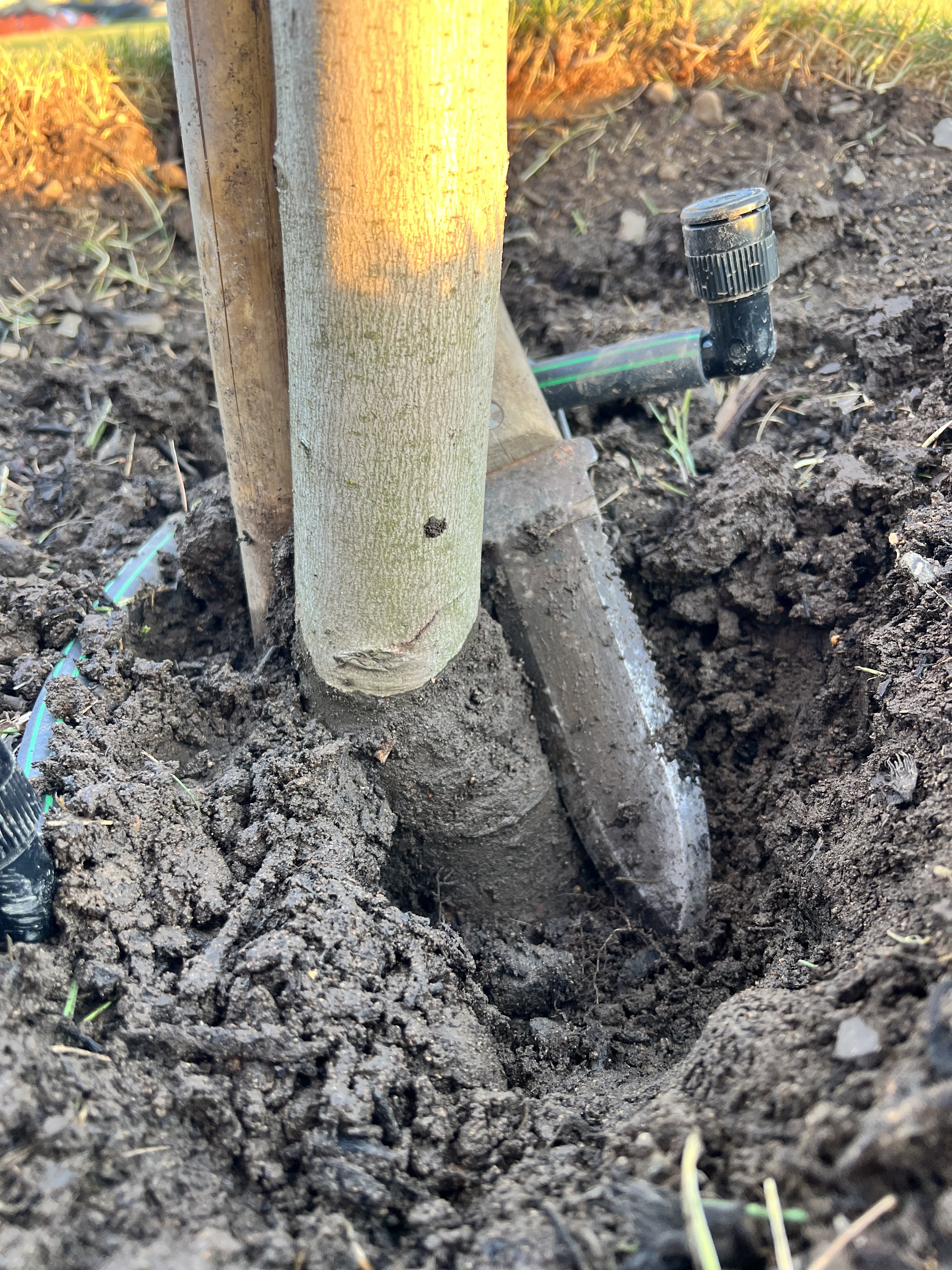
The top of the graft is right at the soil line on this one. I didn’t dig down to the flare. I’m about 4” deep to this point. The blade on my hori hori is 8” long.
My other concern with these is that most were planted too deep. Some of these are planted so deep that the graft, which was made on the root stock, a few inches above the root flare, is completely below the soil surface. On some others, the graft is above the soil line, but the root flare is still 2”-3” or maybe even more inches deep. I dug around several of them with my hand and a Hori Hor, in an attempt to find the root flare. In doing this, I discovered all the fibrous smaller roots that have grown through the potting soil ‘above’ the root flare. This was a nursery mistake that would have alerted a knowledgeable buyer to avoid these.
Second, a few of these trees then had more soil placed on top when planting them further burying them. This should never be allowed to happen.
Seedling trees growing in place are ‘smart’ enough to grow with their roots in the proper relationship with the soil. People ignore this or assume it doesn’t matter. Dry land plants figured this out around 400 million years ago, but some people think they know better.
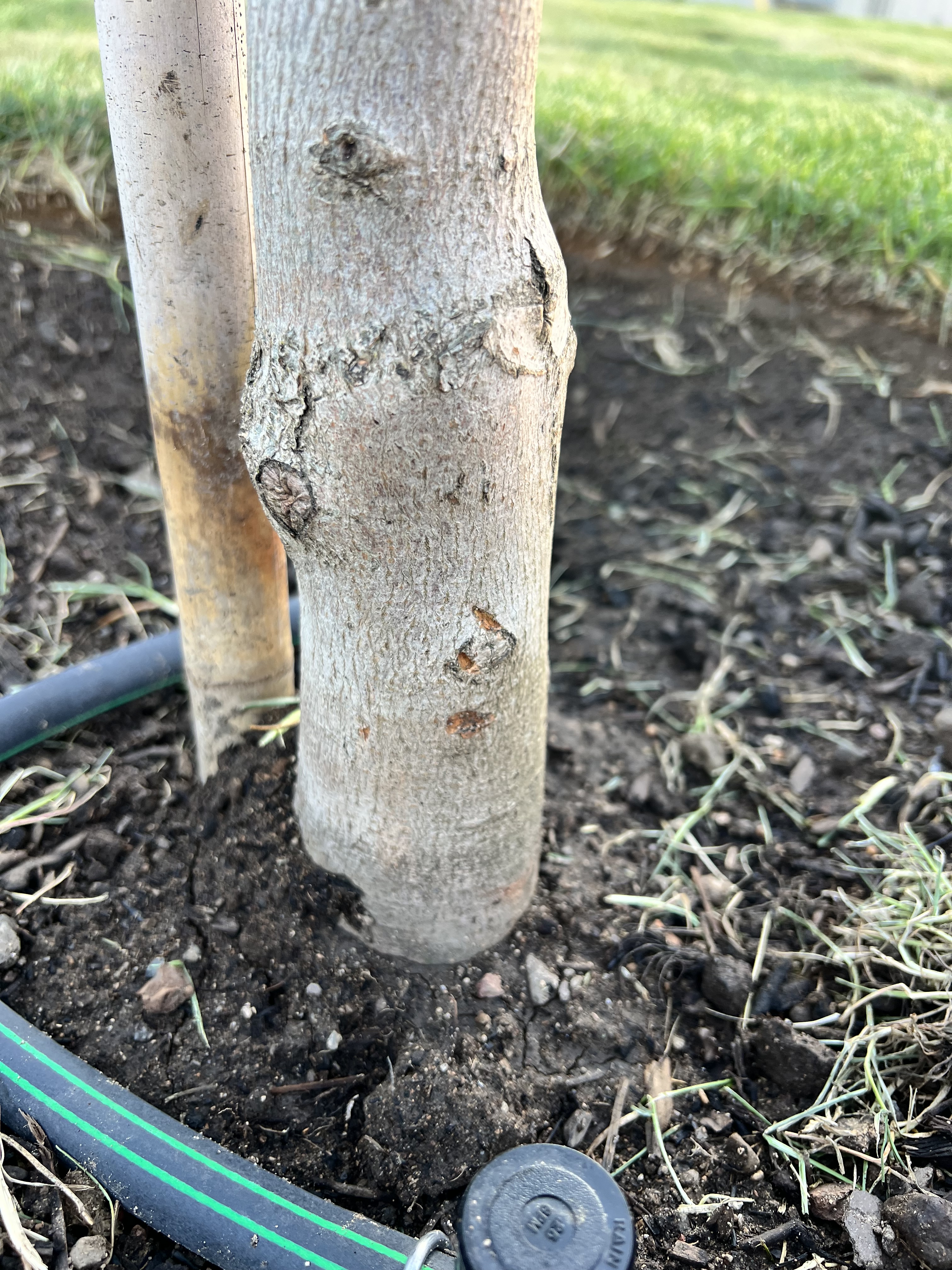
This maple has its graft clear of the ground, but notice the trunk is still going straight down. Planting deep does not cause roots to form like a tomato will when planted deep. This zone, and the graft itself is sensitive to burial and will be subject to rot and fungal disease. In addition, roots spread out from the flare at or just below the soil surface. They do this because oxygen is most available nearest the surface and roots require oxygen to respire. That carbohydrate plants manufacture in their leaves is transported to all of their living cells where it is burned/oxidized to release the energy that powers their growth, including their continuous root growth!
Ideally these would have been rejected before they were bought and brought on site. When planted too deep in the pot the grower has effectively reduced the container size and available soil volume. Trees are typically specified by caliper size, their diameter just above the root flare where the trunk begins a more uniform extension…not by container size. The trees, in order to develop healthy structure under container culture must be regularly up-potted to avoid circling roots. This is usually done during dormancy so, theoretically, any root problems can be seen and corrected which requires manual manipulation, probably some trimming and straightening. This is stressful to the tree and so best done under cool conditions not when newly leafed out and actively growing in warm conditions. Obviously this costs a grower money. Some growers will then be slow to do this. They will push growth with water and fertilizers to maximize caliper in too small containers, which reduces product cost. These trees will be slower to establish and will likely have structural root problems that can lead to their later failure. Some professionals recommend root washing so you can see and disentangle the roots and treating them as if they were bare root stock. Growing trees in standard nursery pots is for handling convenience and a bit if a crap shoot. Some growers, most often who grow Oaks, grow them pot in pot, a double, air gapped system, the smaller interior pot having plentiful holes, not just in the bottom, but in the sides as well. This helps reduce root circling, but attention still must be paid and the trees up/-potted.
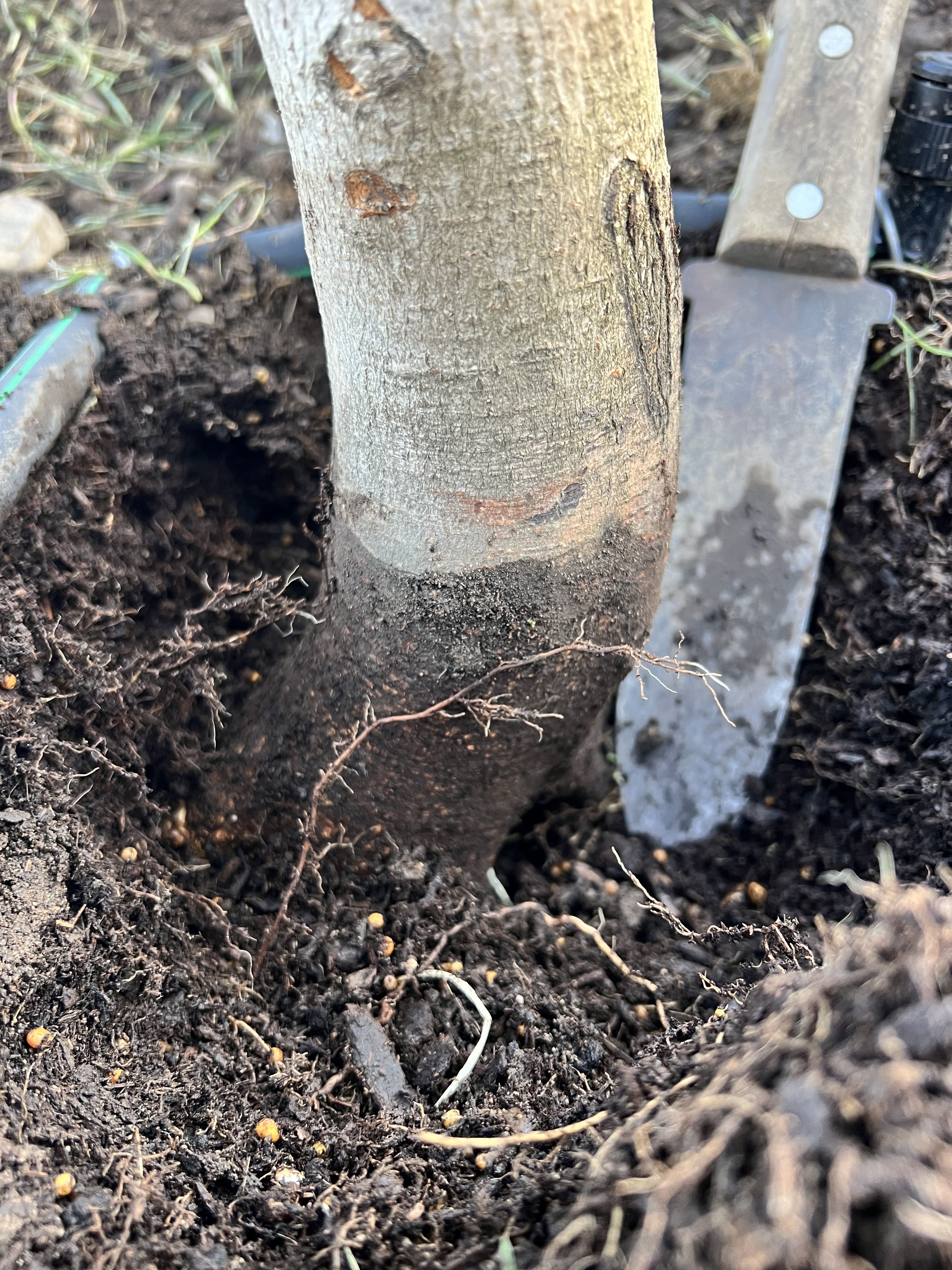
I dug this out a good 3”+, found no flare. This ‘slope away from my hori hori blade could indicate a girdling root below, but it’s hard to tell without further excavation.
Nursery grown stock isn’t as simple to produce as manufacturing widgets. Trees are alive and continuously changing as they grow. A grower must be continuously paying attention and be able to act as and when needed…they must also keep their costs down if they are to survive. Mistakes will be made. Container culture is highly problematic. Buyers always want healthy, appropriately sized trees, well branched trees…at minimum cost. Clients want instant effect. Something is too often forced to give. Clients, the public are relatively ignorant of plants and the production problems facing growers and the cost of producing a quality product. They are also under the constraint of an income that they have trouble stretching to meet their own needs and desires. This often makes price the all important concern, forcing some growers to cut their production costs where they think they can. Under such conditions price can play too large a role in the equation and some growers and installers will make that choice.
Correct culture will be more expensive. There are reasons why the same sized tree might be cheaper than those from a more attentive grower.
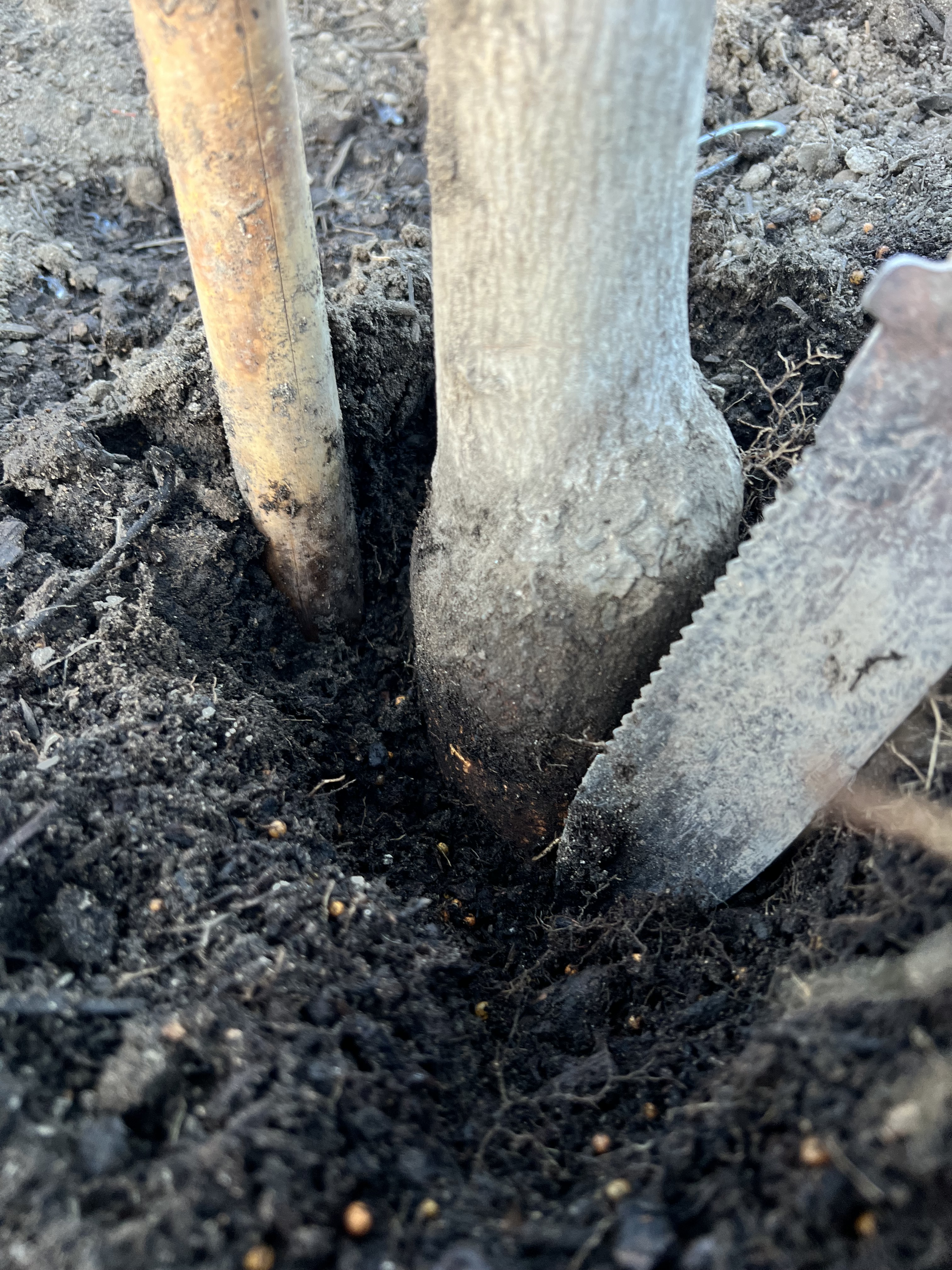
The graft union is prominent here. The rootstock’s flare could be 4”-5” below. The zone in-between the flare and graft is full of fine roots growing in potting soil, a result of their up-potting practice. When watching the crew plant some of these I saw them tamping the soil with posts packing it in as if they were setting fence posts.
There are reasons why tree stock. Held too long in one pot size may be discounted. Be aware that root problems may occur because of earlier handling at a smaller size and may be ‘hidden’ by being planted in a larger container later without having been corrected. History and reputation when buying are important. Don’t buy just based on price and availability.
When one is without an official position, in a community, that is largely ignorant of horticultural realities and both good and bad practices…what is one to do.? The professionals involved are under no obligation to listen and the ‘clients’, being largely ignorant of what this means down the road, smile and write my concerns off as another one of my fussy complaints. At this point now it is after the fact. The trees were purchased, as imperfect as they are and now they are in the ground. Landscaping is a business and the contractor has little incentive to either change things or admit that there might be a problem. Doing either will cost them money. Doing nothing will cost us, the largely ignorant HOA members in the future. Our society lives outside of an effective relationship with the living natural world.

