
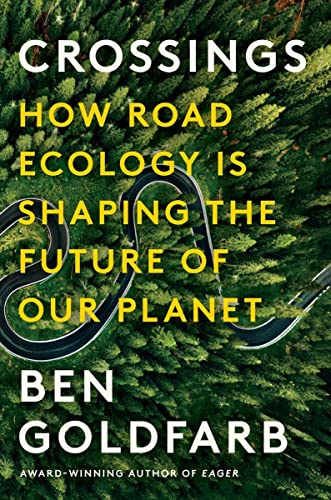
 Had I not read Ben Goldfarb’s 2018 book, “Eager”, I probably wouldn’t have picked this one up. Why would I want to read an entire book on ‘roadkill’? But I trusted him. And so I read it.
I found his writing here crisp and engaging, like his other work, but I was still hesitant and did my reading in fits and starts. I’ve read several books lately about impending environmental crises and I didn’t really have the energy to do another, but I did finish it and found it a worthwhile and satisfying experience. Amongst these earlier books was Slaght’s, “Tiger’s Between Empires” which returned repeatedly to the problem of how devastating even the relatively little travelled roads of Russia’s remote Primorye Province are for its endangered population of Amur Tigers. In the world of ecology, roads routinely bring death to the wildlife they literally impact, as well as because of the discontinuities they create in the landscape, physical and chemical changes they visit upon the animal’s environment and the surrounding biotic communities. This is about the wholesale implementation of a technology ‘alien’ to the animal world, that purports to meet the ‘needs’ of humans while making little allowance for the uncounted species that reside alongside them.
A road is a novel manmade ecosystem. Roads exist only out of our efforts. Nature has never created more than wildlife trails which link them to locations that serve to meet their survival needs. Roads create a new kind of ecosystem. They aren’t just a physical strip of asphalt, they radically reshape the conditions under which resident organisms must adapt and endure, simply to live. If they don’t…well, they die. And that is the crux of our road problem. Roads are ‘structures’ we have created to provide us access, a freedom of movement. They have become a critical link in the supply chains upon which we have come, more and more, to depend. We demand this freedom of movement, often times for its own sake. Movement is a defining characteristic of humans, of most animals. We are not plants so we must move in order to meet our needs and live. But how we move is a choice. How build, and how we move along our ‘roads’, impacts the life around us. That is a choice, that is shaped by how we value the lives we disrupt in our movement. What our relationship ‘with’ that life is, or, as is often the case today, our denial of any meaningful, reciprocal, relationship with the life of these ‘lesser’ others. It would not seem to be too much to ask that when we build and travel roads that we consider the many millions, billions, of organisms that we might impact. Our economics, to which we are committed, however, often fails to recognize any inherent value to them and so they are widely excluded from such consideration, if and when we do cost/benefit analyses. Their consideration, historically, hasn’t been part of our process.
Road ecology isn’t a branch of science I was aware of. Goldfarb travels the roadsides through farm and wilderness, through the Brazilian rainforest and its tropical savannah, the Cerrado, that covers 23% of the country; the arid woodlands of California, the Wyoming’s Rockies, the severely compromised woodlands of the eastern US and the conifer forest of Washington’s North Cascades…in the company of road ecologists. Their subject sof concern, of study, are how roads impact wildlife, how they disrupt the migrations and movements of animals as they go about their lives, the toxins that bleed into the surrounding lands and waters, because it isn’t just the frequency of road kill incidents on a population that matters, but how the whole phenomenon of the road effects them.
To appreciate this they must first understand the lives and movements of wildlife in undisturbed, intact, landscapes, their ‘territories’ whole, not cut up and shrunken. Too often, our understanding of the territories, the habits and requirements, the ‘preferences’ of wildlife, have been truncated by our ignorance of them from ‘before’ all of our disturbances of them, that where we commonly find them today, is in the compromised landscapes that remain, which may only minimally meet their needs. Wild animals must be able to move toward food, water, safe resting places and those in which they can raise their young. Those are the conditions they evolved with. Where they are today, may only be what they must settle for to survive, their health and lives stressed and compromised. Their travels vary with their species ranging maybe a hundred yards to hundreds of miles (Of course many birds and even a few butterflies, lilke Monarchs, may migrate thousands of miles, but along their routes they must still have habitat, corridors, that meets their needs.) They radio tag the living, mapping their routes through the seasons, draw samples from their bodies to assess their health, examine what they eat, assess its availability, sample their DNA to understand their genetic diversity and conduct necroscopies to understand why they died, rescue and treat the injured when possible and put them down when there is no hope. Then they look at their behavior around roads to inform strategies intended help them cross, knitting their fragmented landscapes together.
The book opened me up to ideas I hadn’t fully considered before, questions of biology and behavior, how any species will approach a problem uniquely. Roads are a big problem to animals. We humans aren’t ‘designed’ to survive impacts at speeds much greater than we are capable of moving our own bodies. Motorized vehicles erase those limits although most of us, most of the time, are capable with training, with experience, of controlling such vehicles at speed, as we become accustomed to it…and the environment in which we drive them. So engineers follow standards when they build roads that most of us can navigate at the ‘designed’ speed…as long as everyone else does the same. Wildlife have evolved their defenses similarly to ours, adapting over time to slowly changing conditions. Us judging them inferior because they can’t judge the speed of a vehicle, is like a hummingbird judging us, because we can’t perceive the ultraviolet spectrum which adds so much to their perceptions. Imposing human standards on wildlife, and disregarding them for their ‘lacking’, just shows our ignorance and selfishness. The fact that we build structures and vehicles that ignore the needs of other species, doesn’t speak very well of us as a fellow Earth species. So, animals die by the millions on our roads, or stricken, wander off to die elsewhere. Most of us barely notice anymore and part of that is because of the drastic declines in their populations.
Prior to reading this book, I had never heard of the word necrobiome. I was aware of the processes it includes, just not the term. The necrobiome of the roadway includes the scavengers, necrophages, eaters of the dead, various insects and organisms that decompose flesh, feeding on roadkill. Goldfarb writes, “in the necrobiome the car is a keystone species. Roadkill isn’t a natural cause of death. It simulates a natural process and the necrobiome’s custodial staff operates with remarkable speed and skill. In Florida, researchers found that dead chickens and snakes vanished from the road within 36 hours vacuumed up by vultures, raccoon, skunks and fire ants which skeletonized carcasses. In Brazil scavengers carried off nearly 90% of bird kill within a day. It’s largely these covert efforts that prevent roads from being paved with corpses. One biologist estimated that Wales’s roadkill rates were up to 16 times higher than surveys suggested, mostly because scavengers so rapidly dispose of the dead…. The necrobiome air brushes our roadsides camouflaging a crisis by devouring it.” pg 181
Vultures, like many birds, are poor judges of speed who flee danger based on its proximity, not its velocity, the car subverts the victim’s evolutionary history and turns their instincts against them. P 183 Consequently, vultures themselves, and other carrion feeders, frequently are added to the road’s death toll.
Just as the ‘road’ is a manmade ‘novel’ ecosystem, motorized vehicles are foreign, mechanical abstractions, imposed on others that haven’t had the time to adapt to them, if they ever could. These two changes, roads and the vehicles that stream along them, introduced into the living world, are both powerful change agents.
Some animals, given their own functions and peculiarities, have found new niches in this changed world, the necrophages, the decomposers, carrion feeders…at least may live in a land of plenty along roadsides, at least until those animals upon which they feed have themselves been removed from the landscape. The most successful of these roadkill feeders are known as synanthropes, those animals, and plants, which are well adapted to human created environments like cities and roads. To be successful with this requires intelligence, the capacity to observe and learn and, many scientists also believe, they must have the capacity to ‘teach’ their young to avoid the deadly collisions with the Apex predator, the vehicles, in these biological equations, these literal ‘mash-ups’.
Necrophages work alongside a vast army of human maintenance personnel…layers of federal state, county, and private workers tasked with sanitizing the violence of automobility […I like Goldfarb’s use of this term, our presumed right, our expectation to move about via motorized vehicles and the ‘costs’ of its use on our own lives and the world around us…]. In most places, workers simply cart, the dead to landfills, incinerators or dump sites, thus stymieing vultures and coyotes. Our “aseptic” approach to carcass management has short circuited processes, like scavenging and decomposition that have buttressed ecosystems since the dawn of life. P 186
Rather than reflexively discarding carrion, we might do better to treat it as a resource. Goldfarb considers using larger roadkill, such as deer, as a food source for golden eagle which are slow and cumbersome on the ground and during take off, when compared to so many other scavengers, and often become victims themselves, so rather than burying the meat in landfills, where it does no good, it can be used to lure these big raptors away from the roads where they’re safer when they feed.
He concludes the chapter talking about the human practice of salvaging roadkill, to feed themselves and others, relating that to the lifestyle of early peoples who sometimes ran predators off away from their kills to eat it themselves. Years ago, when I worked at a residential home for boys caught up in our legal system, sherrif deputies would drop off freshly killed deer they found along the road and the center’s cook would break it down and salvage what she could for us and the residents to eat. I don’t know if that practice continues.) Every chapter is peppered with tidbits…excuse me, with related facts I was oblivious of. It’s been more a bit of a trip of discovery than I expected.
There is a chapter titled, ‘The Moving Fence’ in which Goldfarb describes how as the traffic volume increases, at a certain species specific level, animals will no longer attempt to cross, but below that level, they will and this is where you see high volumes of roadkill. The animals recognizing what they consider to be a ‘safe’ break, failing to understand the speed factor, attempt to cross and are struck. Over that volume, and the road becomes an effective wall to all movement, the animal’s territory shrunken, their ability to find mates and enough food, truncated as well, compromising their health and greatly decreasing the survival of the resident population. This is especially true for carnivores which require vast territories. There is a great section discussing the problem the highways in and around LA’s Santa Monica mountains are for all species with their extremely high volumes, 24-7, across as many as 12 lanes! To illustrate this he focuses on the lives of cougars.
This isn’t a book limited to road kill, it is also about what it means to the countless biotic communities criss-crossed and cut up by roads, what little we are doing to both ameliorate our impacts and the relationship between our economy, the still expanding system of roads and what this, if left unchecked, means to all life here!
Goldfarb goes far beyond the phenomenon of roadkill and the fragmentation of territories, as he looks into the effects of road noise, the chemical pollutants that befoul the air, ditches and rivers, the consequent warming that can be lethal to many fish, species the broad reach of impacts less commonly seen than the flattened and smashed more charismatic mammals left along the roadsides. Road ecologists classify them according to how the are able to respond and react to roads and traffic so that we might better place and design roads. We often fail to recognize these differences in cognition and response. While we may have the ‘sense’ to avoid dangerous situations, we aren’t going to attempt to ever cross a heavily travelled, multilane freeway on foot and most ‘higher’ animals won’t either, but those with simpler nervous systems won’t have this capacity and will venture out directly into danger. They have no comprehension of the danger the situation presents or, perhaps, when alerted to it, like a turtle, simply retreat into their shells and become a statistic, should anyone bother to observe and count them
In the third section of the book, the picture becomes in ways even more grim. Goldfarb writes of the road’s ‘edge effects’, how it is not just the hardened road surface and speeding vehicles that pose the danger, it is the expansive effect they have on the air and space that abuts and extends out from them. They create zones of broken landscape that are sunnier, warmer, drier, windier and so may not be able to support the same plant communities. When the cross hatching of roads becomes too close, the entire local climate can be radically transformed, the conditions no longer supportive of what once grew there and the animals that depended upon them. This is what is occurring at an accelerating rate across Amazonia’s rainforest. Roads can literally change local weather and when such changes are widespread enough there can be a climate collapse across vast regions.
Roads, in addition to climatic conditions, reach out even further with a ‘wall’ of noise, that stresses and pushes many species further and further away. Even the simplest, dirt road, can create these kinds of impacts, the upslope cuts and downslope fills they require, changing the local hydrology. Probably the most devastating impacts roads bring, is human development, the widening and improvement of roads and with that the extraction of resources, the vast expanses of agricultural monocultures of corporate farms, vast areas stripped of their diversity, roads carrying in supplies and harvests to ports, and then around the world. The needs of a locale, forgotten and obliterated. Roads serve a vital role in our consumptive economic system which consumes, diminishes, destroys a landscape’s capacity to support the complexity and diversity of living communities.
Roads, and our relentless development of their adjacent lands, the extraction of valued resources and the wasting of those not valued, also lead to conditions that are destructive to human communities and life, extirpating indigenous peoples along with the problematic wildlife. This process also tends to create conditions for the spread of disease as now displaced and stressed wildlife, their habitat gone, live closer and closer to humans, diseases that they once tolerated, their own immune systems breaking down, overwhelmed, so that they now produce and shed more viruses and pathogens that can cross, never before crossed species barriers, creating pandemics. Historically, it was the flow of diseases from invader to invaded that decimated human populations, but now, in a diminished and crowded world, they more commonly flow back and forth. There is a parallel infection process occurring in the plant world as plant communities become stressed and in conflict with exotic species better adapted to a changed world. Along with desired goods and resources travel the diseases and pests our domestic species, and we ourselves, have less resistance to. It’s easy to understand, really, healthy organisms, healthier biotic communities, are less likely to develop and suffer disease, their defenses intact, at least to a point. When either is compromised, well….
Roads then, while likely a necessity for ‘modern’ human life, when unlimited, when designed and built without consideration for their impacts on life, our own and those of the wider world, become tools of decline, of disease. Examples are all around us, as the rates and range of our travels increases, so does the movement of pathogens. Disease outbreaks become more common. Roads and other modes of modern travel are not just human ‘vectors’ they serve as disease vectors. In medicine, doctors learn that ‘the dose makes the poison’. As in all things, moderation is the wise choice. Homeostasis is a balancing act in any single organism and the same goes for biotic communities. Each ‘challenge’ to life and health, undermines the system and ultimately, us. Life exists in dynamic balance…pushed too far in any one direction and there is collapse.
In his chapter titled, ‘The Tsunami’, Goldfarb travels through Brazil with its collapsing rainforest, rapidly expanding road system, destruction and consumption of the landscape, a cascade of failures driven by any expanding human population, its consumptive economy, aided by corruption in spite of a legal system that has more protections than our own…if it were only recognized and respected. The ‘Tsunami’ of the title refers to an ‘infrastructure tsunami’, a massive wave of road and railroad building, the construction of new and improved shipping ports and the utilities that serve them, all at a rate never seen before, opening up resources around the world for extraction. Much of this roadbuilding and development is funded by China’s Belt and Road Initiative (BRI), a massive global project whose goal is to secure those resources for China and it is financed through Chinese state banks, that don’t require that their monies be used in ways that don’t harm diversity.
Some road ecologists work with the powers that be attempting steer more damaging projects away from sensitive areas and placing them in ways that concentrate development rather than in the more random, slice and dice, patterns that often prevail. There is simply too much money behind these projects and too few officials willing to say no. More than a few of the ecologists see their efforts as a kind of ‘greenwashing’, bandaids on the expanding wounds being inflicted by a road system and the pattern of development it permits, but what can they do? It is daunting and depressing. What is occurring in Brazil and around the world is not a collection of tragic accidents, but the results of a structural and systemic crisis. The system is what needs to change. A patchwork of legal bandaids cannot ever stop the destruction.
“The history of road ecology, has today, been more reactionary than anticipatory. Not until America’s interstates throttled deer migrations, did we install underpasses; not until logging roads scarified our national forests, did we notice the damage.”…”Most road ecology studies appear to have a little influence on road planning and design. This isn’t an ecologist’s fault. Blame instead the agencies, planners and engineers, who have failed to solicit their input. If we expect developing countries flush with BRI funding to construct nature sensitive highways out of the kindness of ministers hearts, we’ill be sorely disappointed. But nor are those nations beyond influence. The infrastructure tsunami, like the autonomous vehicle revolution, is an epochal transformation that we still have the power to shape”…. “We have a government that doesn’t care much about nature in general, but I am an optimistic person”. Fernanda Abra, a Brazilian ecologist said. “If you don’t ask for something, they’re not going to do it”. P270
While our reliance on a voracious economy disposes us to support the destructive nature of roadways, it is also our demand for speed, that once we’ve experienced it, prevents us from slowing, considering the world and life around us, and. In so doing, sparing the lives of uncounted millions. “Our highways and cars want us to go fast, and we’re helpless to resist. The virtue of slowness”, historian Gary Kroll lamented, “seems like an impossible dream.”
“In Brazil, however, the dream of slowness lives on. On entering Carlos Botelho Park you found that the SP-139 was curvaceous, and undulating, it’s been rising and falling in waves, like a gentle roller coaster. We were prevented from speeding, not only by law, but by design. Practically every highway, I’ve ever driven on, I realized, was built to facilitate swift and seamless automobility. SP-139, by contrast, deliberately transgressed the conventional ideals of engineering, frustrating human users in service to wild animals”.
“We crept through the park, conscious of the gathering dusk. Golden sun seeped through foliage”.
Goldfarb does not leave us alone in the gloom of our impending doom. He finishes with the chapter titled, ‘Reparations’ and took this reader in an entirely unexpected direction. After laying out all of the problems that roads impose on wildlife and the living world, he brings it back to us, closing the circle, by including us, we humans, amongst the living organisms ‘wronged’, damaged and killed by our roadways. He writes of the thousands killed in traffic ‘accidents’, of the diseases many suffer due to auto caused air pollution, and of the physical destruction of communities caused by road construction and how busy roads cut up and divide cities socially, neighbors isolated, easily neglected and often forgotten. Road building as a tool to impose racist engineering concepts. Separating and isolating black and white residents, in this case, in Syracuse, NY. This is a story much like that of the one roads impose on wildlife. This was a refreshing twist, a fact of modern life that we so often reflexively deny. People, especially Americans, and likely all of the others wedded to the idea of unending expansion, convenience, progress and an economy, that contrary to every other system on Earth, expects that ‘we’ can grow infinitely, and that some are more entitled to its benefits than others. Goldfarb, makes the links and connections that these same roads of progress, put us all under very similar stresses and strains, undermining our lives in ways that we have become inured to, numbed by the same stresses that do so much damage to the living world around us.
For both humans and animals, the concept of ‘connectivity’, of creating a world that is walkable by feet, supportive of local life and community, [is central to this shared vision of a more humane, rich and equitable landscape]. Humans like virtually all animals thrive by moving between discrete locales: we obtain food in different places than we seek shelter; we court our mates in different places and we attend to our hygiene. The great promise of automobility was that it would allow people to move smoothly between these habitats, […] but in so many cities, roads have made humans less free”, […less healthy, less satisfied]. P 286
In his epilogue Goldfarb quotes Aldo Leopold when he called for a new land ethic, “A thing is right when it tends to preserve the integrity, stability and beauty of the biotic community.” As enormous and systemic as the problem is, there is no quick fix…no single fix at all. But in spite of this Goldfarb is still hopeful. He writes briefly of a gradual sea change in attitudes amongst politicians and engineers. He does not write about Trump’s massive retreat from those earlier hard fought for improvements, dismantling of environmental programs and full throated and bellicose support, of the petroleum industry, the automobile and roads, all things that should be on the road to oblivion, if we expect to survive in a healthy and diverse world. Americans, overall, are slowly becoming more aware of the need for action, inspite of the MAGA crowd, that still claims that our future lies in the past, in denial of the evidence, a future that is more sustainable, more supportive and consistent with all of the life and energies, their cycles, that is and of Life on planet Earth.

