
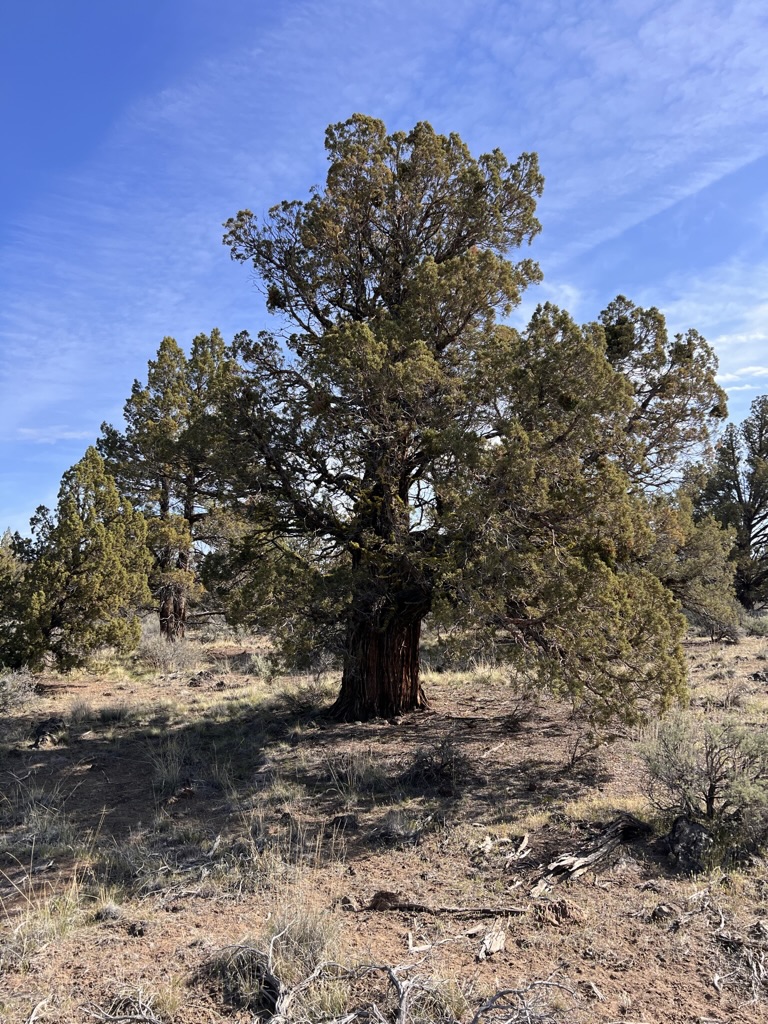
A Juniper like this one, growing out on BLM land around Cline Buttes, attains this squat and sturdy stature only after hundreds of years. Growing as they do on shallow, raised rocky areas, not only do they grow slowly, but there tendency is to caliper up. In irrigated pastures, these grow overly fast, spindly and upright. Look at that taper!
Ecologists will regularly claim that fire plays an essential role in the life and dynamics of the Juniper woodland, our sagebrush steppe and the grasslands of our arid and semi-arid plant communities, that without it, the landscape will deteriorate. Okay, but what does that mean? How can fire actually lead to a landscape’s improved vitality and diversity? What does fire actually do and what happens when it is eliminated? The short answer is that fire, in burning the collected fuels on the ground, breaks them down and returns them in nutrient form to the soil and the cycle of life. It provides the space necessary for a healthy and diverse landscape. To get there requires more thinking.
First some essential definitions and clarifications are needed: what are these ‘types’ of landscapes that together can be found in the arid reaches of Central Oregon; all landscapes are dynamic, evolving, changing over time according to the forces in effect on them, they are not static or fixed; what is meant by arid and semi-arid; fire, what is it, what is actually occurring when something ‘burns’; what is going on at a molecular level when an arid landscape burns; if this is so necessary, what fulfills this role in wetter landscapes; what’s the relationship between fire, rot and digestion; how, and does it, serve the nutrient availability and the necessities of organic growth. In understanding these basic parts we can better understand the self-renewing CYCLE of life as an ongoing process and how disruptions to it negatively influence its capacity to continue.
Water and Life
Because water is essential to the existence of all organic life, in every individual’s actual metabolic processes, as a resource itself essential to many of these processes, as a carrier of nutrients to, through and away from an organism and as a regulator of climate which helps set the conditions under which an organism lives. Water’s availability has a powerful effect on every single individual, regardless of species. While there are many other factors that effect living organisms, water’s availability greatly effects everything from an individual’s health to the ‘richness’, diversity and complexity of the living community within which an individual lives. Roughly, as a landscape dries, there is a decline in ‘richness’, the overall biological ‘mass’ that a landscape can sustain; its diversity of species and the complexity of relationships within its community.
Plants are ‘autotrophs’ they produce the ‘food’ they themselves require for life and so create the base upon which most all of life depends. Animals are ‘heterotrophs’, they consume other organisms, living or dead, to obtain the nutrients/energy they require for life. Fungi also must consume other organisms, the same for most bacteria although some are photo-trophs like plants, and others are chemo-synthetic autotrophs capable of metabolizing non-organic minerals and compounds. All are effected by water.
Arid Landscapes
An arid climate is one that annually receives 10” or less precipitation annually. This isn’t some immutable ‘law’, it’s a human observation based on the performance of landscapes around the world and our agreement. Nothing ‘magical’ happens, there are no abrupt changes were the precipitation of an arid landscape suddenly switch to semi-arid, or wetter still, mesic conditions. Change grades gradually from one to the other. By definition an arid landscape is qualitatively and quantitatively different from wetter landscapes. A semi-arid climate is one that generally receives 10”-15”, although some push that to 20”. A good local standard for assessing rain fall is the presence of Ponderosa Pine. Locally, this tends to occur where annual precipitation increases beyond 15”, although the availability of subsurface water from seeps and in canyon bottoms near active streams, can be sufficient to extend the Ponderosa community out finger like into more arid, desert like conditions.
Western Juniper tends to occur in areas receiving less than 15” although although it can be found in those receiving as much as 30″ and so can overlap with Ponderosa Pine. Where this regularly occurs such places are referred to as ecotones, mixtures of these two broad communities. As precipitation levels continue drop below 10″, becoming more arid, the Junipers thin out, eventually disappearing, leaving scattered scrub and grass lands, until drier still these can’t be sustained either. The driest conditions also often possess soil mineral differences that accumulate over time, and can be relatively toxic, such as salts that the low water amounts are incapable of dissolving and carrying away. This often occurs in those broad shallow lakes like Abert Lake. As conditions dry, fewer species are adapted to survive and communities become ‘thin’. In those where ‘salts’ build up, even fewer plants can survive.
Aridity often comes with the other attributes of a ‘continental’ climate, separated by distance and or mountains from very large bodies of water, which have a moderating effect on climate. Without these, conditions are drier, minimum temperatures lower and the daily temperature swings greater. The relative spareness of such regions also leaves them more exposed to sun and wind, both of which have a desiccating effect exacerbating the effects of dryness.
It is not just the precipitation totals that are of concern, it is when it falls. In Central Oregon June, July, August into September have the driest conditions, the occasional thunderstorm the exception. In some years the months of July and August receive little to no measurable rain at all, our hottest months. Soil moisture is depleted rapidly through both evaporative losses and plant growth. Plant growth here occurs primarily in spring. Flowering is in most cases finished as summer sets in, with a few exceptions like our Rabbitbrushes and Sagebrush which flower at summer’s end. Annuals, native perennials and grasses finish their cycles and go into dormancy leaving their dried top growth to bake in the heat.
Arid landscapes share a readily visible characteristic, the plants that do occupy them tend to be separated by expanses of bare soil and/or rock. Even most of our native grasses are ‘bunch grasses’ and grow as separated individuals. The spring flush of growth may bring with it the arrival of annuals forbs, broadleaved plants, and that amount can vary widely, occurring most heavily in those years with above average rainfall. These annuals may also occur most heavily across ‘disturbed’ areas, with more open ground to cover. As bunch grasses and shrubs enlarge the frequency of annuals will decrease. Our native annuals will also progress through their growth/flowering cycles quickly and disappear before summer sets in. At that point it is the perennials, shrubs and trees, the more stalwart of the arid community denizens, that remain, although they will fade with the ongoing heat and dryness, and you see the surface separation becomes even more pronounced. Separate above ground, these durable community members have extensive root systems below. Below ground water and nutrients are the limiting factors, so they spread their roots, which also dive to necessary and allowable depths, while their top growth, in order to conserve the losses that more extravagant growth can accrue, shape and limit their spread. So again, precipitation effects the patterns and membership of our arid communities.
Each community member finds its niche, carves out its space and adapts to its limited world. Increasing or decreasing available soil water changes the dynamic and will change the resultant plant community’s composition and density. The availability of water then effects the individuals of the plant community reducing or increasing their number, size and separation, configuring them into densities and patterns that are sustainable as an overall community. As individuals all are in a constant state of flux, their individual needs and the community demands on a very particular place. It is a continuous dance.
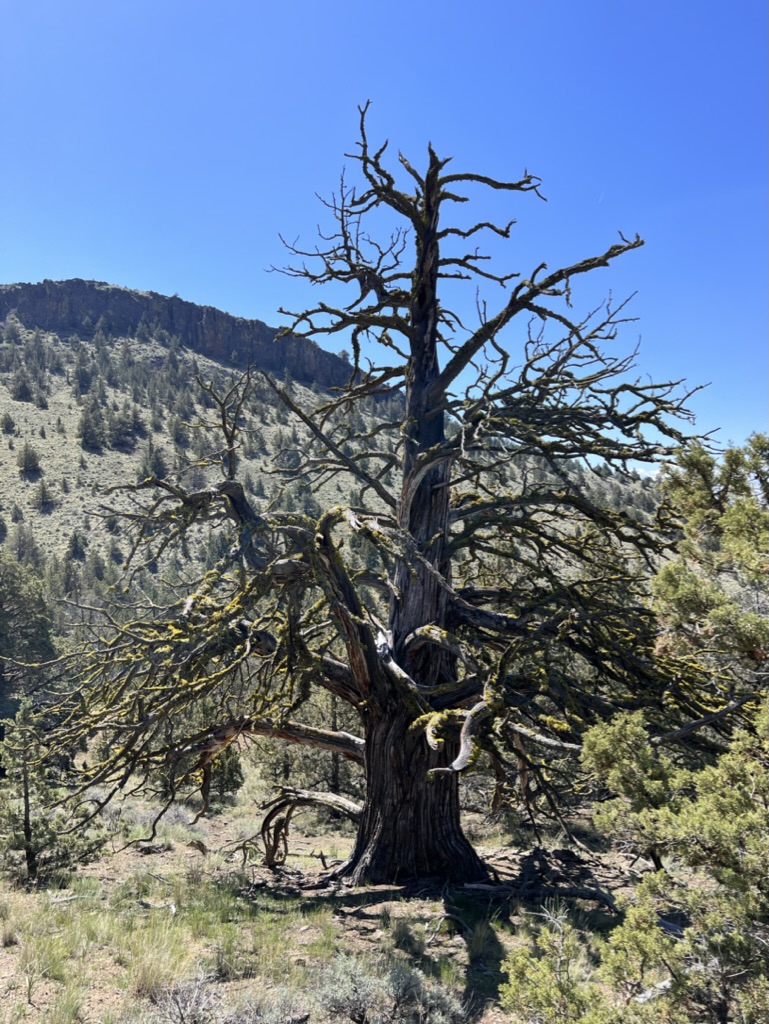
Even in death Juniper retain their beauty for decades.
The growing season is longer within a Ponderosa forests and, with its consequently more ‘lush’ ground level growth, producing richer and more diverse plant communities, which simultaneously increases in ground level ‘fuels’. Arid and semi-arid conditions both set strict limits on growth.
Dead Plants, Their Parts and Duff…Nutrient or Fuel
Death occurs regularly within every landscape. Entire plants, their lives exhausted, decline and die adding their bodies to the detritus accumulating on the ground…just as we would, if we weren’t processed by the funeral industry. They also shed leaves, stems, twigs and branches annually, as they grow and cycle through the seasons much as we do our skin and hair. In doing this they collectively modify the growing conditions around them, in several ways adding to the organic duff layer which aids in moderating surface soil temperatures, water loss through evaporation, the soil’s texture and nutrient load as these materials ‘break down’. So what happens to all of this accumulating dead plant debris? That depends on multiple factors, one of the most important of which is water, the available moisture in and around these fallen, discarded, materials.
Were the dead left as they fell without decomposing, the Earth would long ago have been buried in bodies, bereft of life their soils largely devoid of nutrients. But they aren’t. They are consumed, decomposed, rotted or otherwise disappeared and more than that, in this process the components of their structures, all of those nutrients that went into forming them in the first place, are ‘returned’ to those more ‘basic’ forms, recycled into those molecules that will again serve as those essential building blocks of life. Over the long term, and I mean generationally, and geologically, this process builds richness, complexity and diversity. From the mineral world, the existing organisms, the availability of water and sunshine, one plus one becomes three, organic richness, creating nature’s profit, while sustaining the ‘magics’ that do so.
How does this work in the water deficient arid and semi-arid landscape? As moisture levels drop and life becomes more limited, so do the decomposers the countless insects, fungi and bacteria that consume this ‘waste’, breaking down the carbohydrates, proteins, fats, the cellulose and lignins that compose the structures of organisms, all of the metabolites plants create and utilize in their growth, signaling, self-regulation and defenses. Arid landscapes are spartan as is evidenced by any comparison of life’s richness and diversity as you move from arid to wetter landscapes. In breaking down these molecules, these organisms harvest/utilize the energies released from the chemical bonds that previously held them together, just as we do when we eat ‘food’. Everything, given the appropriate conditions, is food for something else. When those conditions are not available the ‘waste’ of the dead, does not breakdown. It can only desiccate, give up what water still remains in its ‘body parts’…and, as it dries it becomes ever more flammable.
Plants, their stem structures, particularly woody plants, but grasses too, are comprised largely of cellulose and lignins. Grazers and browsers eat these, and have more complex gut environments than we do, and can break them down into forms their bodies can utilize. These compounds, especially as they harden and dry, add to their durability and go to determining our use of some of them as building materials and tools. Termites, which can digest these molecules, can do so only in supportive environments, with appropriate temperatures and moisture. In them they can survive to eat these castoffs and ‘waste’, but even then depend on various species of bacteria in their guts, to actually break down these complex molecules so that they can utilize them for their own growth. They then excrete what they don’t use as waste, in an even more broken down chemical form. Fungi and bacteria occupy special environments that maintain the temperature and moisture they require so that they can further breakdown these compounds, utilizing what they need to meet their own requirements. It is a continuous process. Each succeeding step of decomposition brings the once living back into the cycle of growing…of becoming. But arid regions largely lack these conditions. The bodies of the dead accumulate and desiccate and, in the process, become highly susceptible to burning (although over the interim they may serve as cover for animals). So how is this accomplished in dry environments which lack the necessary moisture for these decomposer organisms to live and do their ‘work’?
On Fire
A little secret. The process of burning, is one of ‘explosive’ oxidation. Oxidation is that chemical process in which molecules are broken down into simpler forms as they combine with oxygen. Heat, at sufficient levels breaks the chemical bonds that hold molecules together. In this highly ‘excited’ state, they are extremely reactive and will readily recombine with oxygen, releasing large quantities of heat, that support and continue the process of combustion. These molecules, broken down into simpler forms are in this way made available to living plants in the immediate area. Keep in mind that the organic molecules that comprise organisms are not solely composed of Carbon which is converted into carbon mon- and di- oxides. Recall that elements are basic forms of matter which under normal circumstances do not break down into smaller bits. Oxygen may readily combine with other elements and molecules, but it can’t say, breakdown itself into other smaller elements…it stays ‘oxygen’, like hydrogen. Nitrogen, another element, is an essential part of every protein molecule, can be ‘removed’ from them, when consumed by another organism or fire, but they remain ‘nitrogen’ and can, under the right circumstances, be reused to build other protein molecules. Elements are thus released through either decaying or burning.
These elements, having accumulated over time in various plant tissues are then effectively recycled on either path. Decomposition and rot, a more gradual process in moister environments or burning after accumulating on the ground and drying in more arid landscapes. More frequent fire does not ‘create’ more nutrients. Following either path can release only that which has accumulated over time. They are either conserved and consumed from the ‘bodies’ of the dead or must be ‘mined’ from the soil. Burning releases them. Fire delivers a quick infusion of nutrients into a local plant community, its ‘raw’ material accumulating on the ground over a period of perhaps years, the nutrients freed from their limbo in dried dead tissues. Fire breaks all of the available fuels down molecularly. It provides a nutrient boost to that which grows there. In this way fire can fuel the later growth of Cheatgrass, which as an early spring grower, is often able to utilize much of this boost for itself, using it up before the growth of most native ‘kicks in’.
Combustion, the explosive oxidation of carbon based molecules, which all organic molecules are, is much the same as the oxidative processes that occur in all organism as they go about supplying the energy they require to metabolize the molecules they need to grow and maintain their homeostasis, that dynamic balance which animates all organisms. The primary difference is that in an organism the process is extremely controlled and directed. We burn carbohydrates to power life, yet we don’t burst into flame. We can do the same with fats and even proteins when carbohydrates are in short supply. Plants, as autotrophs ‘harvesting’ sunlight, both create the carbohydrates from available raw materials that they require, then ‘burn’ them to power their life processes. When fire is eliminated from the arid landscape this cycling is interrupted. The decomposition and ‘rot’ which occurs continuously in wetter landscapes is absent. The ‘fuels’ accumulate, the low nutrient mineral soil, reduced even more. Predators still consume prey, and browsers and grazers consume living plants, but the fallen dead, the detritus accumulating on the ground, remains intact, the cycle broken.
Fire doesn’t just function in this way, in arid landscapes, releasing nutrients bound up in growth. Many indigenous people in wetter regions, including the Amazon Rain Forest, would practice what they called ‘slash and burn’ farming. In such an extreme opposite environment nutrients are regularly dissolved and carried away from a site, if not locked up in the dense growth of the rain forest above. The soils are relatively poor, particularly in terms of nitrogen which is very water soluble. If it isn’t ‘tied’ up in the tissues of organisms it is quickly dissolved in water and carried away by streams or leached away down through the soil beyond the reach of roots. The nutrient treasure trove is in the growth above. In burning patches then, in addition to allowing sun light down to the ground level and power the growth of their food plants, a vast storehouse of nutrients is released that is utilized by their crops. After harvest, the land spent, they would move to the next patch and leave the last to recover. In the event of runaway land clearing for ranching and the growing of soy beans across large acreages, the removal of the rain forest plant community is of massive scale and ‘permanent’ duration. Its nutrient richness lost, the rains that follow further depleting the soil, the now ‘fields’, no longer replenish themselves, the community above gone along with its capacity to rebuild the soil. Chemical fertilizers become necessary to grow anything. In the case of the rainforest, the climate is radically changed as well the verdant growth gone and with it the massive quantities of water it used to cycle back to the clouds as a direct product of growth and transpiration.
Active growth uses water. Heavy growth uses ever more water and loses it to the atmosphere where it is endlessly recycled. In arid regions, with their simpler living cover of drought adapted plants that have devised ways to conserve water use, less water is released to the atmosphere, while ill adapted plants draw more heavily on whatever is available. Some plants, like Western Juniper, are supremely well adapted to drought, however, when growing in a situation with available irrigation water, they will speed along in their growth, consuming more water than necessary to grow at abnormally accelerated rates. They aren’t more ‘thirsty’ than other trees, they simply aren adapted to an abundance of water and have little protection against it. They are opportunists.
Of course there are other roles that fire plays in our local landscapes and an important one is the removal and ‘thinning’ of growth, and in so doing, promoting the health of the long term landscape. Even relatively low intensity fires kill Western Juniper and Sagebrush out right. Grasses are the first to return. Rabbitbrush can resprout if the fire isn’t too intense, but Sagebrush must re-establish from seed provided by adjacent unburned areas or those that have been recolonized. Much the same goes for Bitterbrush and Western Juniper. Over years these will return the Juniper generally following the arrival of the shrub community, largely because this is where resting birds can perch where they ‘poop’ out the undigested seeds contained in the Juniper ‘fruits’ they’ve consumed, first these burned areas dominated by grasses. At some point, after sufficiently above normal precipitation years, so called ‘recruitment years’, the Juniper returns. This tends to occur in those gulleys, draws and deeper soiled grasslands where their roots can easily penetrate to depths to find water. Then as the density of growth continues to increase with their fuel loads, they eventually burn again. Only on the generally higher, rocky, thin soiled areas where ground level growth is sparse, which can support less frequent, less intense burns, do the Juniper survive long term and live for hundred’s of years. All landscapes are dynamic and our local ones, in order to remain in a state of health, a condition with maximum species diversity, fire is an essential element…not too frequent, not too rare. We tend to see landscapes as fixed, but they are all dynamic, effected by the totality of forces and members in them…including, and perhaps most importantly, us.
As long as we as a society view fire as bad, as destructive, and refuse to acknowledge its essential ecological role, we will remain embroiled in this conflict, our landscapes tending toward overly dense and wide spread stands of Western Juniper, a declining acreage of native bunchgrass lands and Sagebrush steppe landscapes. When wildfires then do occur, they will burn more intensely and over larger area due to heavy fuel buildup. Given those grasslands and steppe landscapes with heavy Cheatgrass infestation those areas will likely burn too frequently and favor the increasing dominance of the invasive and disruptive Cheatgrass. Indigenous peoples around the world, have viewed fire for thousands of years as a tool and necessary element in maintaining a healthy and productive landscape. Though learned this by close study of these landscapes and how different patterns of fire effected them. By continuously interrupting/preventing the natural processes of any landscape we create increasingly problematic landscapes, over complicating them with our engineered solutions, when the most effective and economic alternative has always been in front of us. Sadly, today, with our landscapes pushed so far out of homeostasis, our propensity to occupy and build in picturesque and necessarily flammable landscapes, we have created an impossible situation, one we seem unwilling to address, continually dismissing its importance while ignoring the solution, refusing to learn from the places in which we live.
It is important to remember, or understand, that nature wastes nothing. That everything it produces it has ‘accounted’ for. When organisms, their castoff parts, or expired bodies, move beyond those healthy limits, it is ‘recycled’, providing the base material for the following generations. We humans, so intent on our own idea of profit, of neatness, our demand for individual experience, for recreation sans responsibility, have separated ourselves from these natural cycles of life, granting ourselves an abstract superiority, that supersedes the billions of years old program of life on this planet. We have taught ourselves to ignore this as inconsequential and have removed ourselves from meaningful relationship with it. Life’s simple and direct arithmetic, we’ve decided, doesn’t apply. We grant ourselves this magical choice. We want what we have come to want and dismiss the processes of nature as somehow irrelevant, burdensome, wasteful, inefficient or without purpose, excluding ourselves from its ledger. This is based on our ignorance and refusal to accept our place in nature’s broader systems. Consequences we dislike, we dismiss. Diminutions of nature’s capacities, we excuse as irrelevant and, in our arrogance, we pile on acts of hubris which put everything and everyone under threat, as we unweave the fabric of life that holds it all together.
We excuse our excesses, our endless takings, as reasonable acts of individuals…individuals who cannot possibly have a significant impact on something as all encompassing as nature, and we don’t flinch when we attribute such power to its processes, while at the same time we dismiss its centrality to life. We insist, with the logic of a child, or the uninformed, that incremental changes, such as those we pile one on top of the other, can only ever have incremental effects, and, should the world ever reveal any result that might be significantly detrimental, having found the world’s limits, if indeed there are any, that we can merely, backup, and put it back to rights. No harm. No foul. We behave in ways entirely ignorant of how complex systems, which the world is, actually work. How small changes can result in uncontrolled, cascades of changes, that cannot be put back, that must instead undergo a period of readjustment, a ‘rebalancing’, far beyond human control, that may in fact, leave us out of the solution. But no, we insist, that couldn’t possibly be….We shall see. Everything is related. Ignorance and self assured smugness, greed, are no protection against misguided actions. The other ‘shoe’ will drop.

