
 Talk of environmental crises is everywhere, climate change, mass species extinctions, losses of critical habitat, the privatization of once public resources and landscapes (and their subsequent ‘pillaging’ by corporate entities), critically dropping aquifers, what a chaotic climate may mean for world agriculture and our food supply, a world beset by an increasing rate of diseases and diminishing efficacy of the tools we have to combat and treat them….it is daunting and depressing. At the same time, generally barely mentioned in mainstream media, are notices of studies and ideas of what we can do to not just lessen these problems, quite a few of which are being implemented, but to repair the organic and global systems, whose faltering is leading to these increasing problems and potential catastrophes. To make head way on these is going to require a much more concerted effort by most of us. What, many are asking, can we do to usher in a return to a healthier, better functioning, world…before any looming system ‘course corrections’ do the ‘work’ themselves, eliminating the human problem, that ’we’ have collectively become.
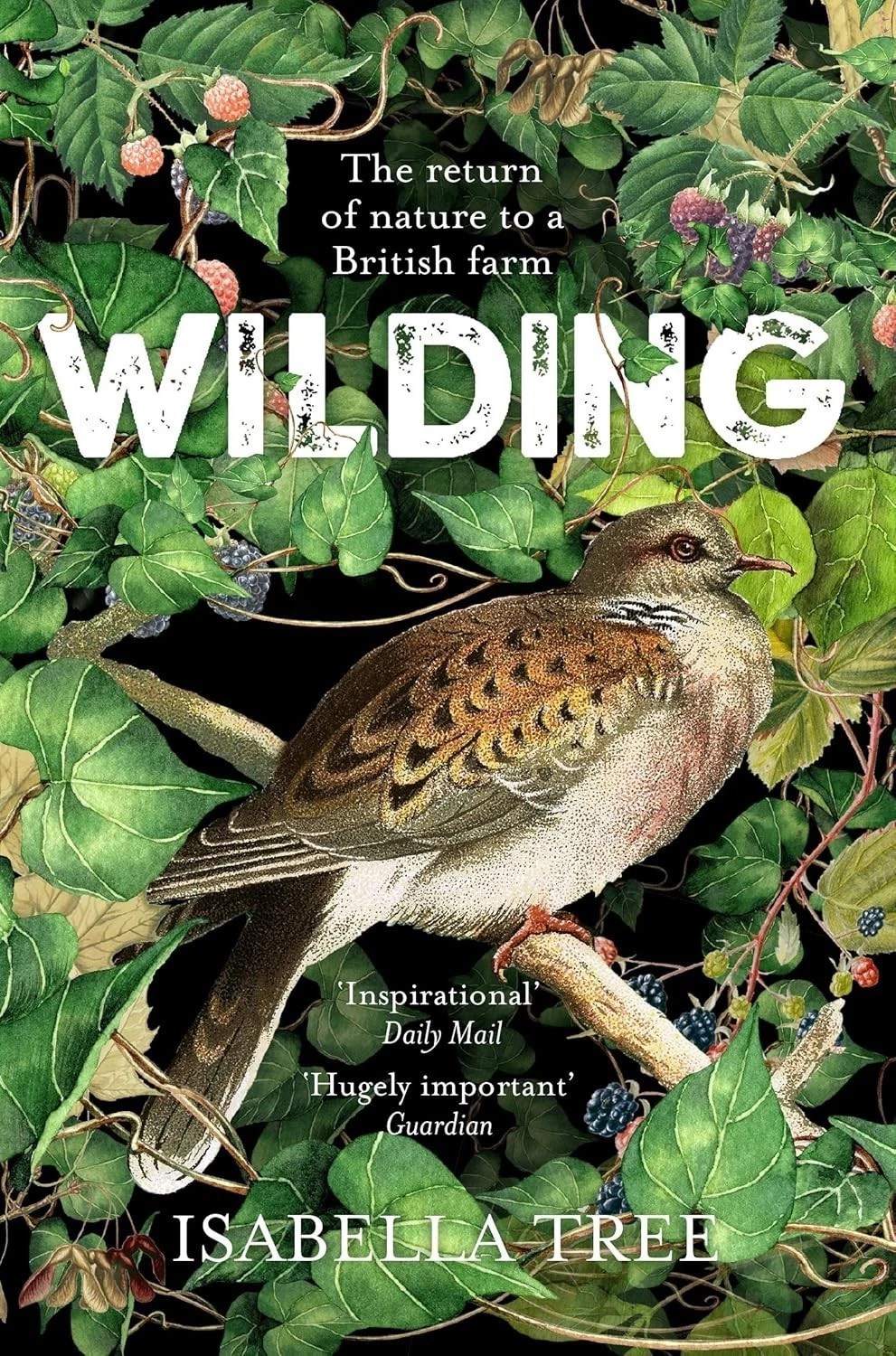
Isabella Tree’s, “Wilding: the Return of Nature to a British Farm”, which prompted this post, supports an approach in which mankind takes on a more responsive and respectful, while simultaneously, a less active role, in the management of the landscape. A ‘less active role’ because what she’s describing requires that we step back, relinquish some control, and allow the powers of nature to heal itself, stepping in where, when and how we must when those ‘forces’, diminished to the point where they are ineffectual, need the support…but no more. She calls for us to trust that our own evolved status is a product of the natural world, a potent nature with the inherent capacities and tendencies, to create, balance and heal, in like proportion to what it ‘takes’ and consumes; that we reclaim our ‘membership’, our historical relationship with this place and all of the life with which we share it. We are active agents of change and must, to the same extent, do the necessary work to heal those wounds, we’ve inflicted upon it through our economic demands and industrial power. Her story here is one of a shared fate and a faith in life, which is illustrated time and again as she and her husband, Charlie Burrell, work to understand the land and life they are beginning to re-envision, more as curious students than confident ‘experts’. The process quickly becomes one of open discovery as they attempt to understand the health of the place they previously managed as a farm, with the economic expectations of a modern world that has itself become disengaged from life, seeing it narrowly in economic terms that had long ago been separated from ecological reality, limits. and the richness of a place.
The idea of ‘wilding’, of releasing the species and cycles that they once brought about, and have historically ‘worked’ to maintain vital, diverse, and complex landscapes and the life upon them, to do that once again. Such a strategy acknowledges nature’s power and our role as a partner in its processes. Nature, and natural selection, nature’s facility for ‘decision making’, are a dynamic and free process to which we must relinquish some degree of control, trusting in it and understanding our own problematic biases that have shaped many of our decisions which have gotten us into this mess. Don’t blame it on ‘them’. None of this is ‘God’s will’. This is on us and can only be resolved by us…if we, as a species want to remain ‘players’ in its future. Life is far more complex, than we can even imagine, or, as someone else more accomplished than I once wrote,
‘There are more things in heaven and earth, Horatio, than are dreamt of in your philosophy’
Take a look at several of the books I’ve suggested previously, “The Ghosts of Evolution: Nonsensical Fruit, Missing Partners and Other Ecological Anachronisms”, Connie Barlow, Basic Books, 2000; “Nature’s Ghosts: the world we lost and how to bring it back”, Sophie Yeo, 2024, “Braiding Sweetgrass: Indigenous Wisdom, Scientific Knowledge, and the Teachings of Plants”, Robin Wall Kimmerer, 2013, Suzanne Simard’s, “Finding the Mother Tree: Discovering the Wisdom of the Forest”, 2021 (and her new book, “When the Forest Breathes”, I haven’t read yet!); Edward O. Wison’s, “Half World: Our Planet’s Fight for Life, 2016”, Robert MacFarlane’s, “Is a River Alive”, see my earlier posting; all suggest a path not taken so that we might bring about a healthier, world than we appear to be headed toward, one that’s intact, diverse and fully functional. I would also add Isabella Tree’s, “Wilding: The Return of Nature to a British Farm” and her more recent book, “The Book of Wilding: A Practical Guide to Rewilding Big and Small”.
(For contextual purposes it would also help to read books like David Graber’s, “Debt: the First 5,000 Years” which addresses how we’ve become ensnared in an economy that traps us in its maze of consumption and commitment to an ideal that draws us relentlessly away from the possibility of contentment, limiting our personal freedom’s in the process; and Adam Smith’s, treatise on, “The Wealth of Nations”, the originator of the idea of a capitalist economy, which overtime many economists and ‘businessmen’ have cherry picked in shaping the economy to meet their own selfish purposes, while ignoring those ideas that were more contextual, focused on the sustainability of an economy and the welfare of the people.
We often speak of ‘mother nature’ and her capacity to heal, to regenerate, but either don’t seem to trust this, continue to meddle, or we have no desire to see a wild nature return. Nature, much like God, is beyond us and requires that we cease our obstruction of it, and, in a sense, surrender to it, not as helpless and passive watchers, but as humble and dedicated servants TO it. This seems to be the thrust of wilding, or of what some refer to as rewilding, a landscape. Isabella Tree, and Charlie Burrell, are doing this on their farm in the UK. Tree takes the reader through the history and processes of their project on the marginal lands of their own Knepp farm in Sussex. It is a practical look at adapting ecological thought to the reimagining of their landscape, a farm which struggled, given the conditions there, the politics and programs which supported the status quo and stood in the way of the innovative and necessary strategies they and those they worked with were trying to implement. Whether you are a farmer or not, whether yours is a comparable property or not, the idea is well presented and should prove adaptable to many different landscapes while methods and outcomes will have be ‘tailored’, fitted, to one’s particular landscape, the conditions acting within it, your expectations, as well as the legal laws, limits and supports within which you operate and the climate within which it exists.
Their approach is, first and foremost, about adapting their relationship with the land and their expectations in ways that work with their particular place…not pouring money, resources and energy into an effort to make it something it can never truly be. It is about creating genuinely sustainable landscapes, biotic and abiotic, wholistic, communities that meet the needs and capacities of that place, taking no more than it can afford to give. Health of place is paramount.
Sustainability has become a hackneyed term, over used, stretched and greenwashed by marketers, politicians and sellers of products and services, until it has become nearly meaningless, (I coined a word, ‘blurfillication’, several years ago, which describes this process, and posted on it here, defining it and its intent) but that is what this is about. Living within the natural limits of a system, not pushing it to excess until it exhausts itself; not maximizing profits at the expense of health and place. Nature is cyclic. It reinvests and profits in balance, often delivering more, if one is prudent and respectful. This is nature’s way. Over the long term biomass increases. Species richness increases. What is produced, never wasted. Everything continuously recycled. Life and death in balance. Ecologists speak of carrying capacity, what life can be supported by a landscape without diminishing its capacity to continue doing so? It is not about maximizing output for the sake of profit taking.
Profit, in such complex systems, in nature, is that portion that which increases the richness and diversity of place. The needs and contributions of all ‘players and contributors, are taken into account. Pollution is an aberration, an error, an imbalance, that occurs when ‘taking’ without considering the full ‘cost’ of production. Profits are excessive in natural systems when their capacity to continue, at the same level, is compromised. Devaluing that which is lost, is a costly ‘trick’ of present day business accounting, just as is the avarice of owners who deny labor their share, their essential contribution. When resources are undervalued. When genuine need is ignored, desire and power create unsustainable imbalance.
This is an engagingly written, a fascinating telling of the evolution of a farm being returned from its highly unstable and disturbed state, a product of our dominant agricultural industry, to a landscape of healthy relationships, that require minimal inputs of human labor, petrochemicals, energy, fertilizers, and the myriad chemical control agents used widely in agriculture today. Along the way, as health returns, profit, harvest, increases, within limits.
Tree tells her story as she and her husband, Charlie, visit with pioneering Dutch conservationists, who promoted their concept of ‘rewilding’, and with whom they would discuss, plan out their ‘program’, consider changes and decide what practices to stop, altering their goals, monitoring results and continuously reevaluating their strategies and methods. Theirs becomes a practice of what restoration ecologists call, adaptive management. Study the situation, set goals, define strategies and tactics, implement them, monitor, re-evaluate and adapt. In their interpretation their goals become broader, more open ended, focusing on the health of the system, not a particular outcome. Narrowly and rigidly defined goals can trap you in an endless series of strategies and tactics that can never be realized as one pursues a goal that the landscape and the forces active upon just can’t ever support, or whose attainment requires a high level of involvement indefinitely. Wilding, or re-wilding, is the practice of returning a place to the forces of the intact communities that once determined the biotic community of a place’s composition, plant, animal, fungal, everything, which in turn, go to shaping the physical characteristics of a place. It is an act of faith in process and it requires a fair amount of humility on the part of the humans involved. Plans are plans, themselves adaptable, set aside along with ‘good’, though perhaps misguided Intentions, the health, diversity and complexity of place then serving as the goal.
In their beginning Tree and Burrell focused on the megafauna missing from their landscape. Their role was still that of managers, but their strategies were significantly altered. They looked for models in nature, but understood that the island upon which Britain is located has a very long history of human occupation and disturbance, so they struggled with what their end goal might look like, realizing that the dynamism of the landscape has changed it drastically. Much of the megafauna that once freely roamed and shaped this place, has long been absent. They set out to approximate those conditions as best they could, returning the several species of ungulates they could while substituting more hardy, less bred horses and cattle, that could mimic their extinct ancestors while being hardy enough to survive the less ‘manicured’ and programmatic conditions available with their increasingly ‘non-farm’ conditions that ‘wilding’ would bring. And then there were the legal and policy conditions in action, some which continue beyond the books writing, that were working against them.
Still they persevered, doing what they could, operating their farm as a model of change, which they hoped would encourage others and begin to soften the blockade of regulations that impeded them, while in the process, convincing others, specifically those in control of various monies and their neighbors, that theirs was a venture not just worthy of funding, but to use as a model for the transformation of other marginal farm lands, into something that could help support Britain’s badly compromised environment.
Obviously unable to resurrect extinct megafauna species, that set out with the aid of others to select and bring in, proxies for them, those species and breeds which could at least in part fulfill the roles of those earlier species…and this was a process itself, although they were able to tap into those elsewhere who protected and promoted these less popular older breeds. Their highly breed dairy cattle were inappropriate for their purposes, but their parcel was large enough for them to transition. So they brought in Exmoor ponies, long horned highland cattle, roe, fallow and red deer over time, after removing most of their fencing and let the animals work. These were all hardy beasts that did not rely on high quality pasture. They could browse and ‘forage’ across the fields.
They brought in a hardy breed of hog to root and disturb areas that had become static. They sought to naturalize the several streams that ran through the property and encouraged species that could ‘soften’ the straight and confined water courses. Gradually the landscape began to transform, and with it came an increase in wildlife, birds and butterflies, rare across Britain and Europe, while greatly increasing common species as well. Plant species, absent before began to find and create larger niches, larger populations. They kept doing what they could and worked toward what kept being denied them by authorities, notably the reintroduction of the native Beaver, extirpated from the island many decades ago. There seemed to be an odd enmity by the conservative government against this wetland species which the author attempts to explain through a telling of British history, its many wetland landscapes and moors, unusable for traditional agriculture and so drained over many years so they could be put to use. Their’s has been a culture predisposed to the beaver and the notion of wilding. Landscapes were of little value if they did not directly serve economic goals. Why would you allow them to ‘deteriorate’ into a wild state?
The other considerate problem was they lack of larger predators beyond the ubiquitous foxes which are everywhere. They longed for the return of wolves, lynx, bear even wolverine, animals which had once occupied the island of Britain, and were being re-established on much of mainland Europe. For them this lack of larger predators results in their own efforts of ‘culling’ or harvesting of excess population to keep the community in balance, the ‘meat’ from which, if they can’t market it, having to be disposed of. (This lead to another problem in that local law and authorities required that dead animal be immediately removed which undercut the local carrion feeders and associated decomposers, which limited the nutrient ‘recycling’ on the property. There was also the cultural problem of visitors and neighbors being repulsed by the sight of degrading carcasses left in place, even though in a healthy landscape, the aforementioned species can make relatively quick work of them. (There are public trails through the property.) Predation limits the populations and works to maintain the overall health of the herds, through the removal of weaker individuals. Without such efforts, the grazing and browsing of resident ungulates would soon lead to the landscape’s deterioration, not in an aesthetic sense, but perhaps that too, but in terms of its homeostasis, its capacity to retain its resilience, its capacity to respond to healthy flux and change. At the time of writing, this was still a bridge too far.
This is a book that registers the authors’ discoveries. We, the reader, learn much the same way she has. Each chapter tells a story…which leads to the next…which later, after reflection, leads to a reconsideration and review, new discoveries and changes, or refinements, in tactics. Throughout the book we share in her amazement, the joy, of what they have accomplished, and their hopes for more. In doing this she tells tales of specific creatures, surprises, sometimes their own discoveries, other times those made by an increasing community of naturalists who return time and again to survey changes, experts from various NGOs, universities and others who are simply driven and passionate for all things related to their own obsession, be they ancient Oaks, beavers or butterflies, Tree and Burrell, find their people and, through their ‘project’, provide a rallying point that brings all of these people together. It is a remarkable story. One cannot be unimpressed by Tree’s breadth and depth of knowledge of both her place and that which is taking place within it.
What follows is an example drawn from the book, on dung beetles and their role in a healthy landscape.
There are about 60 species of native dung beetles in the UK. Unlike African dung beetles, which are famous for rolling away dung balls up to 50 times their weight over long distances, some using the Milky Way to guide them, most of our dung beetles are tunnelers—pulling the dung down into the soil to nest chambers that can be up to 2 feet deep, either near or directly underneath the dung site. The dung provides a food supply for the beetle’s larvae, allowing them to develop deep inside the nest away from predators.
There have been dung beetles on the planet for 30 million years. They exist on every continent, except Antarctica and specialize in every form of animal dung there is, though the majority prefer the plant material contained in the dung of herbivores. Dosing, livestock and pets with parasiticides that pass into their excrement, kills any insects that eats it, including dung beetles. This is one of the most serious problems affecting our soils. The process of a dung beetle’s tunneling, eating and digesting adds organic matter, increases soil fertility, aeration, and structure, and improves rainwater filtration, and the quality of ground water runoff. Ironically, by eating the parasites harbored in dung, and by swiftly processing the dung itself, dung beetles also reduce the transmission of parasites, and hence the need for chemical livestock warmers. Only now, when several of our dung species are on the verge of extinction, are farmers beginning to appreciate their value. Dung beetles are estimated to save the British cattle industry £367 million a year simply by encouraging the growth of healthy grass and, of course, they are part of the food chain.
Tree and Burrell are as much subjects of the process as is their 3,500 acre of farm. Their’s is an exploration of ‘proper’ roles, of monitoring and adapting practice in a way closely related to the ‘adaptive management’ practices of more traditional applied ecologists and conservationists. One of the main differences between these and their wilding project, however, is that even their goals are adaptable. Modern conservation efforts have tended to focus on a single species or a steady state landscape, largely ignoring the dynamism of a living landscape, settling instead on the idea of a more or less fixed ‘climax’ landscape. Efforts then go to maintaining that, while the landscape continues to cycle and fluctuate. In Tree and Burrell’s world, as well as that of their like minded associates, any given landscape is in constant flux, much as is the body and life of any given individual organism, and using a fixed standard ignores the reality of the many thousands, even millions of years process of evolution, life and death, that has resulted in the the dynamic, diverse and robust communities that populate and shape the world.
Tree describes their wilding strategy as ‘process led conservation’. In more recent years conservationists have focused on a particular species or community and sought to ‘maximize’ it, a more static approach that works to optimize a place and its life rather than viewing it as a dynamic process without a fixed goal other than health and diversity. In Tree and Burrell’s world of ‘wilding’ human effort takes on the role of supporter, of allowing the process to develop, patiently observing, learning. Variation occurs naturally over time, a boom-bust cycle of a species’ population, is understood as normal. Where small and fragmented landscapes may not be able to function in this way, a large enough landscape, a connected series of functional wild landscapes, with connected, continuous, corridors, can. How big a landscape will vary with all of the usual factors, climate, soils, hydrology, species diversity, the intactness of its species communities, their relationships. At the top of all of these are the predators which demand the largest intact territories in order to lead healthy lives, without causing irrecoverable crashes of prey species. Among these considerations are us, the human species, which some ecologist describe as an essential ‘keystone’ species, although one, through our own efforts, have removed ourselves from the responsible day to day interactions, dependencies and supports that that relationship requires. We are a part of the landscapes biotic community, like it, or deny it, or not.
Each landscape will be more or less resilient, have more or less capacity to both produce and adapt to changing conditions. Fragility, or ‘brittleness’, generally refers to a community’s or a systems inability to respond to changes, its capacity to sustain itself, and so, is set by each place, each community. Health, the homeostasis of any living system, is then determined by that system’s ability to remain within vital margins. Healthy systems do this. Unhealthy systems, compromised communities, threaten or do at least periodically, move outside of those margins. The dynamism, the variation, the flux of any given system, the indefinable level of ‘chaos’ necessary for any given system/community, then will be unique. Chaos, flux, is a part of all natural systems. But, again, too much is, well….
Nassim Nicholas Taleb, in his book, “Antifragile: Things that Gain from Disorder”, refers to the fragility of systems, systems that require continuous tinkering to keep them operational, lest they degrade and collapse. Systems which are ‘anti-fragile’, are systems that REQUIRE unpredictable chaos to sustain themselves, to generate themselves. He references Darwin’s concept of ‘natural selection’ as a system that is anti-fragility. Nature, both he and Darwin argue, requires chaos, random mutation, diversity, unpredictability, as a generator for needed future options in its determinations of fitness and evolution. Evolution requires this capacity to produce options. In such systems remaining ‘fixed’, being static, is simply awaiting decline and eventual death. Evolution is not just a system of reduction, of the selection of the fittest, and the loss of the less fit. That would be a literal dead end. To evolve, one must have innovative alternatives, otherwise, one suffers stagnation and loss. In nature alternative abound and each one will be variable. Which ‘one’ will lead to success is unpreictable, especially over a period of multiple generations, so available options must be broad. Failures will be a necessary outcome of success. This would seem to be entirely consistent with the ideas of Tree and other practitioners of ‘wilding’, that with enough variation, a complex system, community, can adapt and reform itself into one better suited for the conditions at any moment, conditions themselves which are forever in ‘flux’, and, as such, are unpredictable, beyond our ability to logically plan for. In such systems, we are forced to take on a reduced role as a support player, not a driver. To do otherwise is to put the system in jeopardy. To reduce its options.
Tree writes in her chapter titled, ‘Purple Emperor’, that, “It was becoming clear to Charlie and me that had we set out with the intention of creating a perfect habitat for Purple Emperors [a rare species of butterfly in the UK, which she both describes physically, as well as the transformations of the landscape that supported its return and proliferation] we would never have achieved the numbers that have spontaneously emerged through rewilding. The phenomenon is an example of what we are learning to refer to as the emergent properties. [Such properties are those which flow from complex systems as a direct product of the system as a whole.] An emergent property is a property which a complex system has, but which the individual constituents of that system do not have, like the cells of the heart which, on their own, do not have the property of pumping blood, but which together create a higher level aggregate complex organ that does, previously missing or dormant components coming together, striking up extraordinary and unexpected outcomes—in effect 2+2 was making five—or more; and this imposed on us, as midwives of the system, acceptance and humility about our role. {….} What seems imperative is that we take care not to fall into the trap of assuming, as conservationists have so often in the past, that a couple of specifics—some tall trees and a massive amount of sallows [In the UK a sallow refers to a couple common species of native Willow.] is basically all the Purple Emperor needs. This is tantamount to asserting that the individual cell of a heart has the property of pumping blood—an assumption known as the ‘fallacy of division’. The Purple Emperor butterfly, with its complicated life cycle, involving numerous stages, requiring different conditions over the course of almost a year, beats its wings to the tune of the entire symphony orchestra that has conjured it into being.” Pp. 182-183.
This is a book to return to, so I’ve added it to my library. There is a chapter on soils in which she discusses Elaine Ingram’s work and promotion of her concept of the Soil Food Web, soil as its own intricately connected community with all of the life upon it; discussions of livestock and the work of Temple Grandin; on the politics of their project and the community aiding them in their work; on the necessity/danger of establishing a monetary value on nature, how in our heavily weighted economic world we grant little value to nature and so often fail to argue successfully on its behalf, often because of our own reluctance to ‘reduce’ nature to a dollar value. All of this is a complex nest of contradictions and conundrums, but argue and fight we must, because, most of all, this is a time for the experimentation needed to test and trial different methods for renewal, because what we’ve been doing has been only marginally effective and much of the work, as performed, has been labor, resource and economically intensive.
Alternatives, particularly those that are both efficacious and more cost effective are needed, so that we might share this approach and put it more widely into action, thus normalizing such methods if we are to stand a chance at wider success. This will bring with it a more wholistic understanding of nature and our place in it, its beauty, complexity and necessity for our own survival, so that we can make the political inroads and connections that the effort requires. This all comes down to, our own relationship with the natural world, of which we are a part, and the appreciation, even joy that it can bring us. We may be beset with an endless list of problems, but we must be careful not to be paralyzed by the enormity of the task. If Tree and Burrell, along with their like minded practitioners of wilding are correct, the task is not all ours alone. We are here first to ‘allow’ and support the corrective actions of nature. Our first task is to remove the obstacles we have set in place that obstruct this collective action…collective in the sense of ourselves and the forces of a nature with which we align ourselves.
We live in a world littered with the promises of marketers, who have sown within us a deep dissatisfaction, even unease, with the natural world, putting us at odds with our own survival. That cannot stand. Satisfaction, contentment, meaning, purpose, have to come from nature, in living ‘with’ nature, with that which supports life, not from those things and services sold to us which TAKE, over and over again, from a beleaguered and declining world. That’s what Tree’s book is about. Life will always contain struggle, but we cannot be defined only by them. We require joy along with that which nourishes our own and the bodies of all others. They are inseparable. And that joy, along with our many other human emotions, arise out of our relationship with nature and out of our celebration of it with others.

