Category Archives: Horticulture

Drought Tolerant Plantings: A Review of Riverplace and South Waterfront, Summer ‘12 (updated Aug. ’14)


Riverplace Esplanade Bank looking south along the Marina toward the Marquam Bridge

Riverplace Esplanade Bank looking south along the Marina toward the Marquam Bridge.  My last big xeriscape experiment.

The following is an evaluation I initially did while still working for Portland Parks and Recreation.  I’ve edited it a bit and added a few things to make it more current.  I think it’s important for people to know what others are doing, what they’ve tried and what were the successes and failures.  While kind of long it is still a brief look at the conditions on a few sites that were under my care and my observations concerning their performance.  As Downtown area Parks these landscapes are very accessible for those curious to see how these plants have done on the ground.  Now, most of you if your gardening is limited to your own backyards will never have to deal with landscapes so large, nor will your growing conditions, specifically your soil, be the same, I thought that it would be interesting to share this anyway, in addition to letting you know where you can come see how these plants can look in a landscape.  All were planted small as they tend to better adapt to their sites when small, but some are beginning to mature and show what they can do.  Anyway, I view our Parks as a public asset.  There are many valuable and important plantings around us, that the public is largely unaware of.  Part of my role here is to change this situation through promotions like this and by continuing to work with horticulturist to create some kind of database of public and private plantings that is accessible for viewing by the general public. Continue reading →

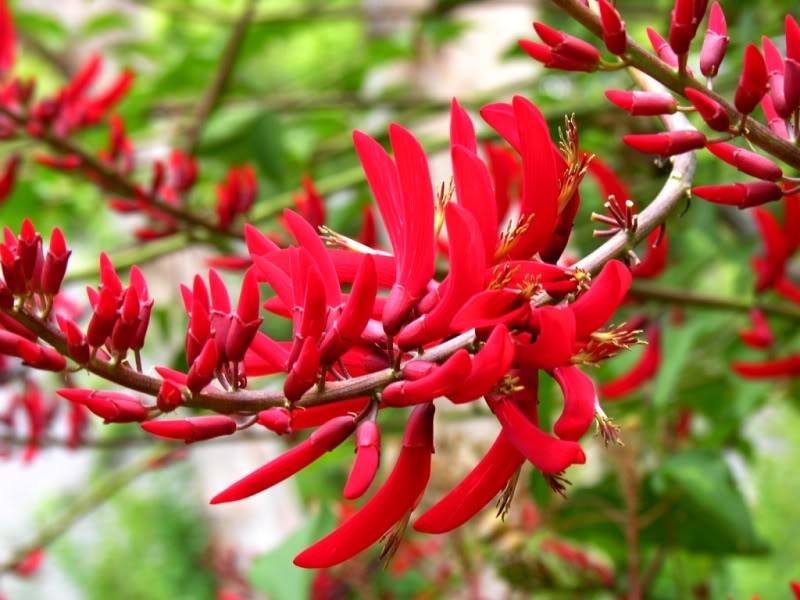
Erythrina x bidwillii: Coral Bean Shrub


Erythrina x bidwillii from Piece of Eden

Erythrina x bidwillii from Piece of Eden

Every gardener makes decisions about which plants to buy, which to increase, limit or get rid of. It’s part of gardening. We each have our biases that cause us to tolerate plant ‘behavior’ that an otherwise ‘rational’ person would never choose. A ‘rational’ gardener would not knowingly acquire plants they knew to be tender in their zone nor would they collect plants with growing requirements they cannot provide. Who said gardeners were rational?  Much of our lives as gardeners we spend learning just these things about ourselves and our little plats of earth. Most gardeners are hopeless optimists and find themselves constantly tempering their runaway excitement for a never ending parade of plants, after all we have limited budgets for replacements and only so much energy to deal with too much attrition. Besides, all of that plant death can get kind of depressing.

The reality is that we each draw this line differently. Continue reading →

Evaluating Your Garden Site

Perhaps the most important question any gardener can ask is, “Where do I garden.” While this may not be as sexy as choosing the plants we’ve always wanted or re-creating a spectacular garden we’ve seen, it is absolutely essential over the long term for the health and success of your garden or landscape. While we can stray from the limitations of our sites, it will cost us. So it is still important to know our sites, to make the necessary modifications whether they be protection from winter winds, improving soil drainage to whether or not we will even need to irrigate, how often and how long. If you go to considerable expense to install your landscape and it fails to meet your expectations, you will need to re-evaluate either your site, your expectations or both.

There is more to gardening than locating yourself on the Sunset zone map and simply plugging in plants, though this is where many of us start. Continue reading →

Hello…is anybody there?

Horticulture: the art and science of growing plants.

Riot: noun; 1, a violent disturbance of the peace by a crowd.  “riots broke out in the capital”

2, an impressively large or varied display of something.  “the garden was a riot of color”

verb; take part in a violent public disturbance.  “students rioted in Paris

To pursue the practice of good horticulture today in the public landscape is a political act.  It is an act of defiance.  It tells people that horticulture and the landscapes we live in matter.  Landscapes are not simply backdrops to human activities.  Landscapes are a wedding of life to place.  They reflect society’s relationship with the  green world.  Ours today demonstrate our lack of connection, as a people, to the landscape around us.  My purpose with this blog is to advocate for good horticultural practice and I intend to do that with both good and bad examples, primarily in the ‘green’ city in which I live, Portland, OR.

I also intend to use this site to discuss just what is good horticultural practice from the importance of knowing your site and the requirements of what you chose to grow on it to good pruning practice and the tools that we use to do the work.  There are no ‘green thumbs’ only people who care enough to pay attention.

There will also be the occasional article discussing plants I have grown well and those I’ve been less successful with. The plant combo shown in my header, Iris x pacifica ‘ Simply Wild’ and Fabiana imbricata is indicative of the scope of plants I choose to grow myself.  The Iris is a hybrid of several of the native species found only on the west coast of North America, grown and selected from the garden, supremely well adapted to our region, but nowhere else in North America.  The Fabiana comes from the dry uplands of Chile and Argentina, an area that shares a climate very similar to our own here.  I love the textural contrast of the two and as a member of the Tomato family or Solanaceae this speaks to my interest in the exotic…familiar and different.  As we begin to confront the issues of sustainable landscapes and climate change, we need to be looking to such mediterranean regions like these.  Gardeners and horticulturists in other parts of the country will have to evaluate there home regions and how their climate is shifting to know which climatic regions of the world they can look to to find candidates to fill the gaps in their own broken landscapes.

That, is something we all share today, the fact that our landscapes are broken and that we are continuing to push them out of balance as we build and attempt to maintain our modern and destabilized world.  It is my intention to refocus the discussion and provide you with some needed support because most  of our institutions and practices are still moving us in the wrong direction.  Green-washing, can never work.  Conflicting priorities and a consistent under valuing of our landscapes lead to too small budgets and understaffing.  Politics often get in the way.  Good horticultural practice can move us in the right direction, because it is firmly grounded in place and health.  It can serve to illuminate the discrepancy between words and deeds.  It is a firm personal belief of mine that everything we choose to either do or not do is a political decision.  Horticulture matters.  Consider this a call to action.  Be bold.  Never doubt the transformative power of gardening.