Category Archives: Horticulture

Jefferson Circle of Waterfront Park: NW Tropical Theme & the Question of Design

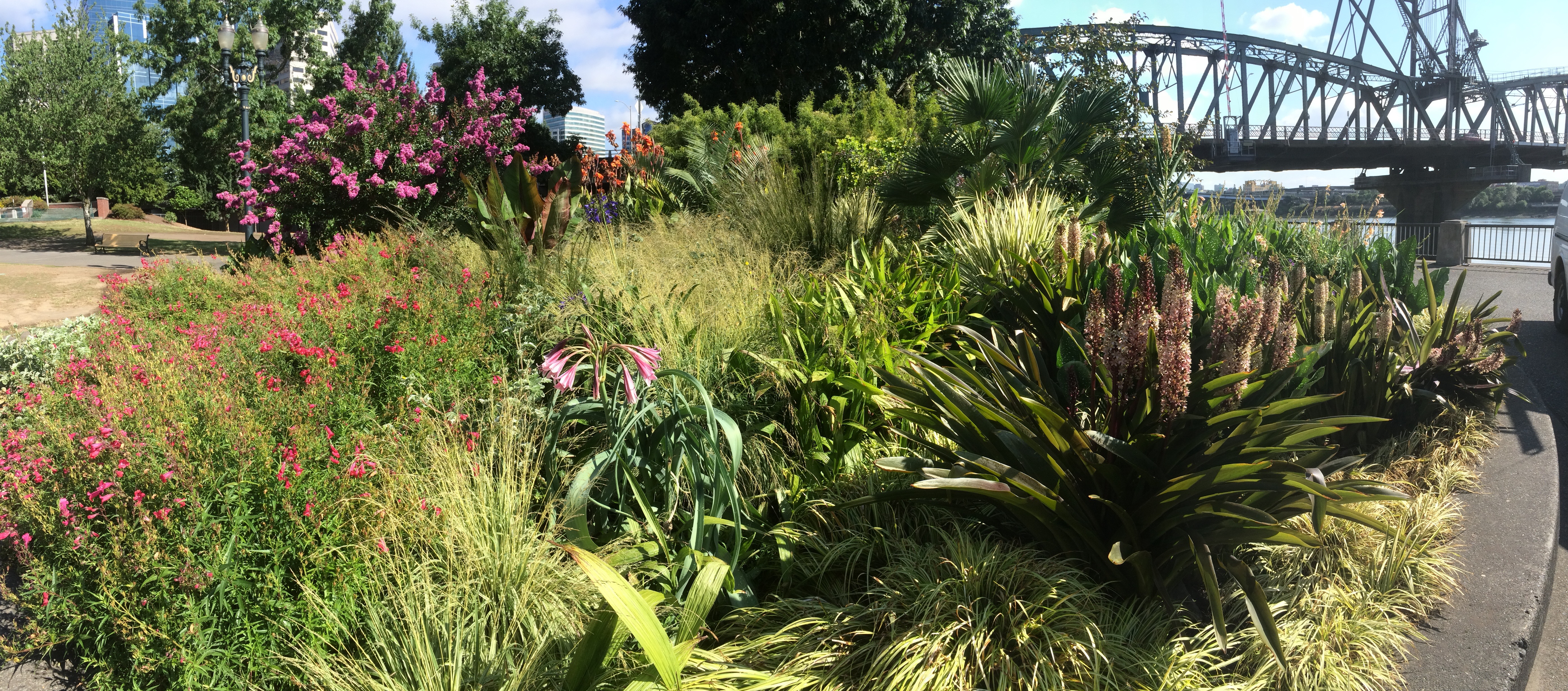
High summer with a wide angle distorting it a little but....

High summer with a wide angle distorting it a little but….

Jefferson Circle lies at the south end of the downtown seawall in Tom McCall Waterfront Park helping to anchor what we always referred to as ‘the bowl’, site of the Dragon Boat races, July’s Blue’s Festival and the end of Summer Oregon Symphony performance.  The curving slope of the lawn that sweeps across the site assures attendees of a more clear view of the stages erected for big events.  Jefferson Circle and ‘5 Flags to the south, permanently ‘backup’ the temporary stages, while a third display bed, Columbia Circle, marks the main entry from downtown on the west.  All three beds share a common theme though they are by no means a mirror image of each other.

These three beds were part of Waterfront’s original design from the ’70’s.  Jefferson Circle an actual circle 40’ in diameter defined, like the others by a concrete bench that surrounds it.  Columbia is an ellipse stretched along its north/south axis, while 5 Flags is an ‘organic’ form with 5 ‘corners, each defined by a flag pole that for years displayed ours and a changing assortment of three other international flags.  Their plantings have changed over the years. I take responsibility for their current theme and most of their plantings. Continue reading

‘Reed Canyon’ and Crystal Springs Creek: ‘Reclaiming’ a Natural Area

IMG_4523

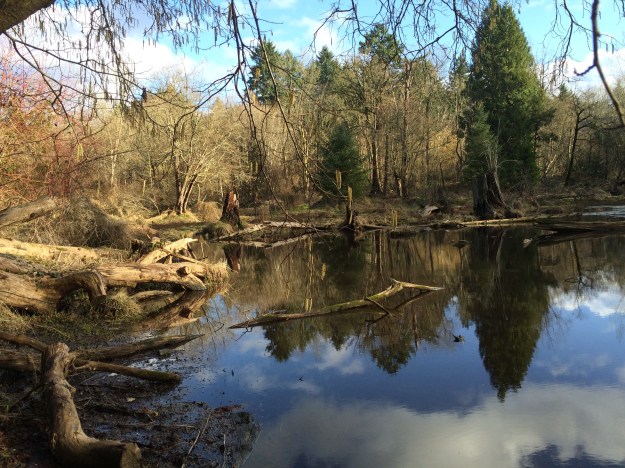
The east end of Reed Lake looking south.

The landscape is the land we live in.  It is the place and the territory that surrounds us: built, disturbed, neglected or purposeful.  A garden is a piece of that landscape that we have defined as special, that we have applied our own purpose to, a theme, above and beyond the natural forces at work across its face to grow plants of our choice.  Many urban places are feral, once domesticated, now gone to ‘weeds’.  A few pockets may be as nature made them, eroding at their edges, surrendering little bits of themselves to exotics tramped in on our boots, the hooves of our horses, the hair of our dogs, floated into place by streams or rivers or flown in by birds and on the wind.  Most landscapes exist somewhere on that continuum between undisturbed nature and the wastelands we have left in our wake of disturbance, vacant land waiting in that limbo, land on its way to purpose, value and development.  As Portland became urbanized over the last 150+ years the land has been literally transformed, become an expression of our culture, via a matrix of values and forces, that act as a particular and devastating template, a process that is still occurring and will continue to do so as long as value is measured in dollars, and demand, fashion and greed, keep cycling and reinventing this place we have made our home.  These in-between places are what French landscape architect, Gilles Clement, calls the Third Landscape.  Few areas are they that have escaped this process.  The Reed Canyon, that contains most of the headwaters of Crystal Springs Creek (another spring lies within the City Parks owned Crystal Springs Rhododendron Garden), the last of the free flowing such creeks on the east-side, may have been spared the heavy handed re-contouring of its terrain, but it has suffered much over the years anyway. Continue reading

Manzanita, Arctostaphylos, a Genus Whose Time has Come: Advocating for a Plant

IMG_4669

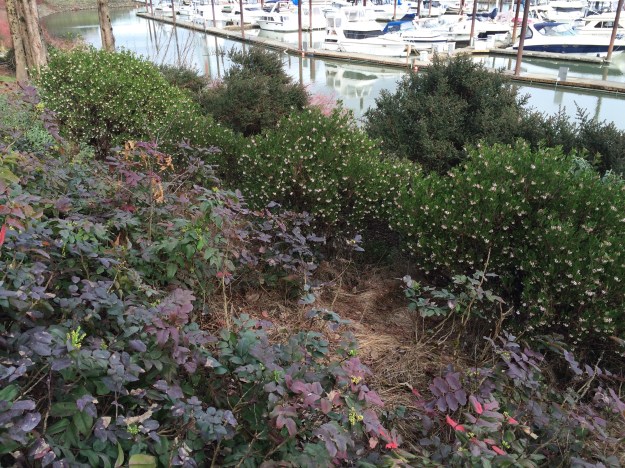
Many Arctostaphylos, like these A. densiflora ‘Howard McMinn’ make admirable landscape plants on xeric sites. This is above Riverplace Marina on the east facing bank of the Willamette in nutrient poor, compacted fill. It shares the site with Compact Oregon Grape and a variety of local dry site natives, Mediterraneans and Californians.

Thirty years ago, when I first moved here to the Portland area from the Central Oregon High Desert country, very few people were growing Manzanita.  Those plants that you did see were local natives that you had to search out, remanent populations of widely scattered stands, in western Oregon, in the Cascades, parts of the Gorge and Siskiyous or on old stabilized dunes above the beach, e.g., near Manzanita.  They were mostly ignored in the trade, barely recognized by anyone other than those in the Northwest native plant societies and hikers who would go out on forays botanizing. When I still lived in Bend, I would occasionally order dry-land native plants, like Cercocarpus, that could be seen in the Ochocos, from Forest Farm in southern Oregon.  My first two horticulture books, other than the many vegetable growing guides I bought from Rodale Press and Steve Solomon’s guide, were the Sunset Western Garden Guide and Arthur Kruckberg’s, “Gardening with Native Plants of the Pacific Northwest”…I went through them over and over again.  In the small space Kruckberg devoted to Manzanita he wrote, in the first paragraph, “Only Arctostaphylos uva-ursi…, A. nevadensis…and possibly A. patula are hardy in colder areas.”  Because I lived in one of these ‘colder areas’ this stayed with me, effecting my view of the genus.  I’ve already posted on A. patula, of it growing in Central Oregon, the eastern slopes of the Cascades and as a specimen outside of our breakfast window in my childhood home.  Other than A. columbiana, a denizen more of the western Cascade slopes and the high ground of the Coast Range, Kruckberg barely mentions the other species and forms…of which there are argued to be between 50 and 100, primarily in California and  southern Oregon.   Continue reading

Pruning: The Aesthetic Choice, Consistency & Good Horticultural Practice

The Pruning Series, 3

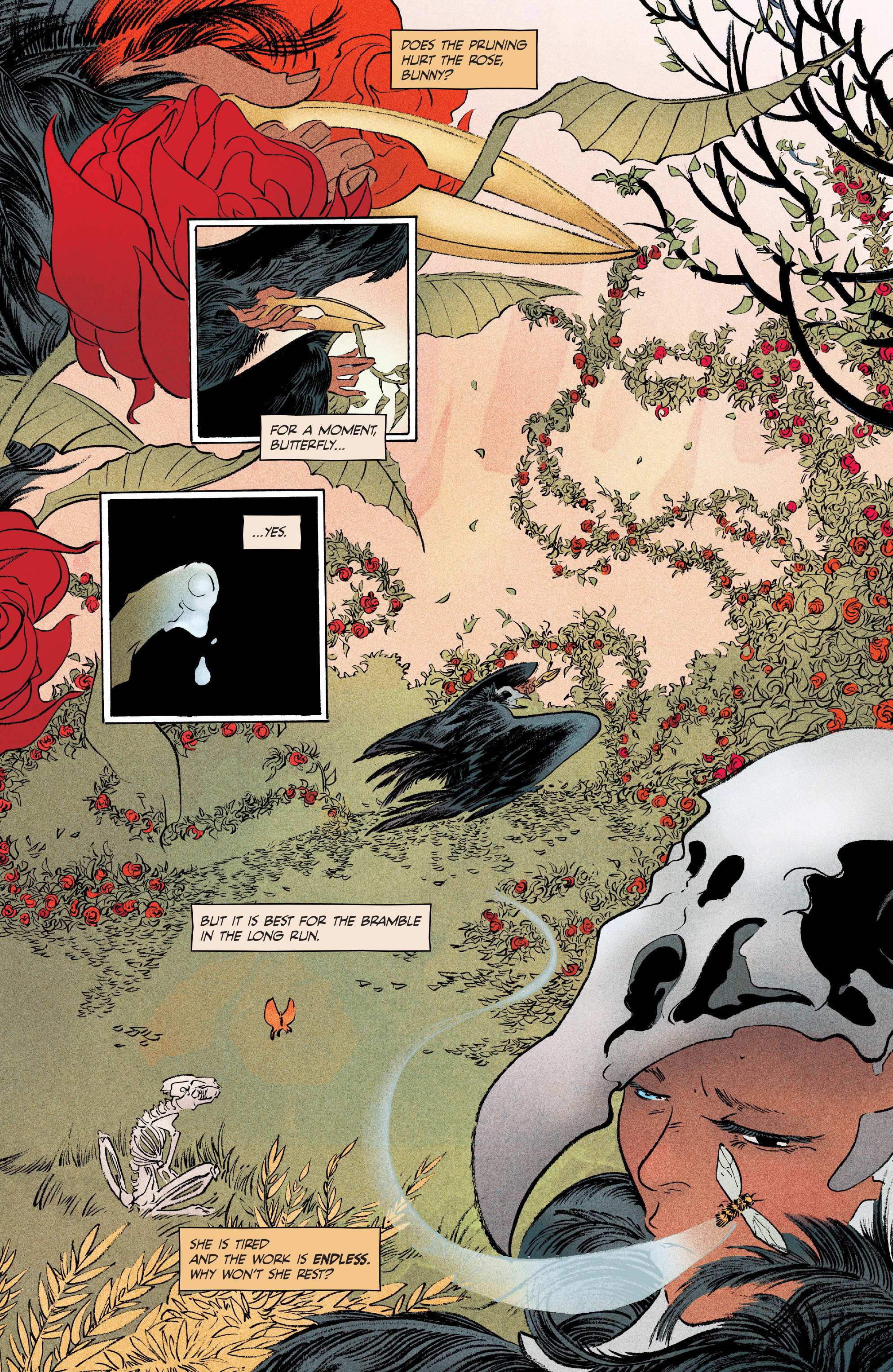
Illustrations from 'Pretty Deadly', written bj Kelly Sue Deconnick, art Emma Rios, colors Jordie Bellaire, Image Comics 2015

Illustration from ‘Pretty Deadly’, written by Kelly Sue Deconnick, art Emma Rios, colors Jordie Bellaire, Image Comics 2015, (007-002).  Straight-up classic art, whether oil painting or illustration, like these two pages from a graphic novel that I find beautiful, involve ‘craft and, an understanding of one’s materials and techniques, that are necessary for any artist to create work. In illustration, like this, the art must resonate with the story to be successful. Horticulture and pruning are no different.

Plants often present pruning challenges to the gardener.  I’ve already introduced the issue of understanding ‘why’ you are choosing to prune, the physical structure of a ‘normally’ growing individual and how it will respond to the cuts you choose to make.  There are several good books out there that discuss how and what constitutes a ‘good’ individual cut and what approach you might take with different types of growers…it should be the goal of any gardener to understand the technical details of pruning, so that they become ‘natural’, reflexive. (In an earlier posting, I discuss pruning tools and provide an introduction to what constitutes a ‘good’ pruning cut.) Like all artists we develop a style that may distinguish us from others.  Even understanding all of this and possessing the technical competencies there are the ‘aesthetic’ decisions the gardener/pruner must make.  Two different gardeners can prune in the same landscape and it can be obvious when they are finished that they have very different aesthetics.  The results can be ‘disjointed’ or harmonious.  Every plant, every branch, every internode, presents a choice and because each individual plant of a given species or variety, though it may grow following a shared genetic code, will grow uniquely in response to the physical conditions it faces…and the damage and pruning it has received over its life.  Like most things in life our control of a plant is limited and the more we attempt to control it the less like itself it will be. Continue reading

Pruning…Why do we do it? Cutting Woody Plants Down to Size

The Pruning Series, 2

IMG_4297

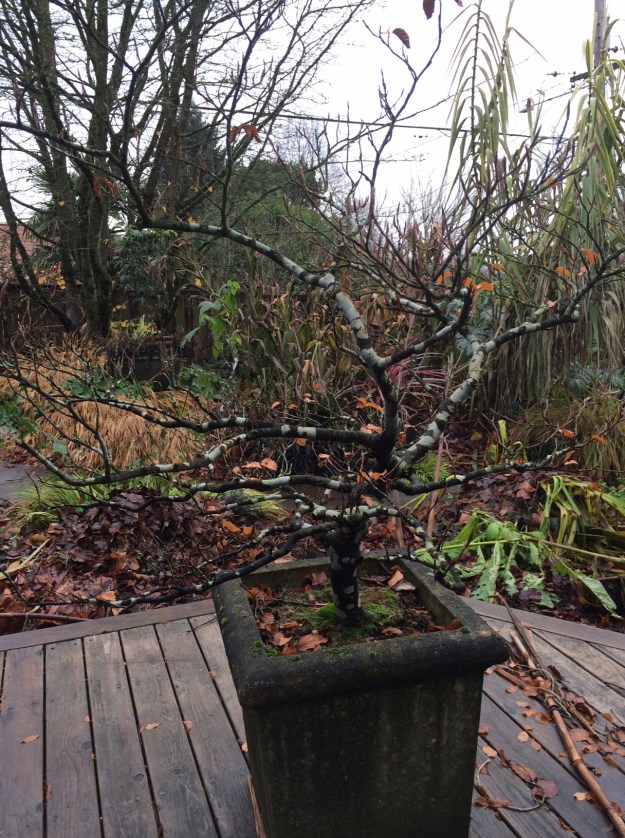
This Fagus sylvatica has been in this pot around 20 years. I grew it from seed 30 years ago from a mother tree in Sellwood that has a canopy 100′ across. It is approximately the same age as the trees pictured below.

I’ve heard it said often enough that trees and shrubs got by just fine for millions of years before we started pruning them, so why do it now?  That’s a good question and if you can’t answer it, you shouldn’t be pruning.  Horrible examples are all around us.  Trees repeatedly stubbed off their natural branching form and elegance destroyed.  Others sporting long scars where someone removed a branch with a single top cut causing the branch to drop pulling a long tongue down the trunk where it was still attached.  Still more with split trunks and scaffold limbs where multiple sprouts, vying for dominance fail and tear down.  Poor pruning has lead to the collapse and premature deaths of many trees and reduced many shrubs to inelegant space fillers jammed up agains buildings.  The first thing you should ask yourself is, ‘Why I’m I doing this?” Continue reading

Chilling, Freezing & Surviving: Understanding Hardiness & Preparing Your Plants for Winter

IMG_4248

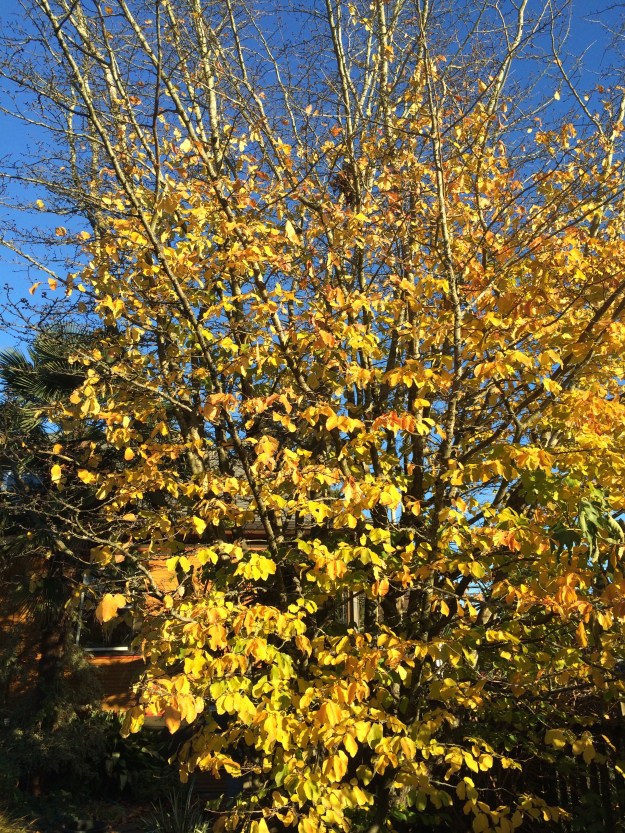
Parrotia persica, Persian Ironwood, has long been among my favorite trees, for its leaf shape, substance, fall color, the overall plant form and for its exfoliating puzzled bark. Hardy to zn4 this plant is tough as nails here requiring no protective effort at all.

[A note to the reader. This is not a scholarly treatment of all of the peer reviewed material on this topic.  There are no footnotes or listed sources.  This is a product of my more than 35 years of horticultural field experience and gardening along with what I’ve gleaned from reading several technical peer reviewed articles on the subject.  Such material is difficult to read and can be off putting and intimidating to even the educated layperson.  This posting is my attempt at interpreting the research and reviews that I read in a way I think is understandable without overwhelming the reader with bi0-chemistry and the technical esoterica scientists must consider in their pursuit of understanding.  Any faults are mine.]

I’ve been thinking about plants and their response to cold having watched the deciduous trees drop their leaves, dug tender plants out of the garden and moved pots around to where they would be adequately protected from freezing temperatures.  We all know what happens to water when it freezes, going from a liquid state to a solid one, its molecules forming crystalline structures, expanded and rigid, responsible for burst water pipes and snowflakes.  Water possesses some amazing qualities, as a solid, kind of counter-intuitively, it becomes less dense floating rather than sinking even taking on some insulative qualities and stopping the convective flow of heat that is normal in liquid water.  At the instant of freezing water releases a small but measurable amount of heat. What happens inside plants when temperatures drop below freezing? How does the plant keep from bursting its own cell walls like the water in pipes within an unheated crawl space or wall cavity of a building?  You’ve seen what happens to plants like Coleus and the sodden black heaps they become upon thawing out. Continue reading

TriMet’s Orange Line Landscapes: SW Lincoln & 4th to SE Milwaukie Ave

[I had been delaying the posting of this entry as I was waiting to meet the project manager with TriMet.  As I’ve heard nothing back from him, I’m going ahead and posting.  It would seem that my earlier posts concerned him, but I suspect now that time has passed and the sky has not fallen…he has moved on to more pressing matters.  It is a common tactic not to engage ‘critics’ so as not to give them any energy.  Ignoring critics can be effective, albeit, a very frustrating treatment to the one who is being ignored.]

Part 3 of the Series

This is an introductory note.  Yes, I realize I started the series in the middle, in a linear thinking world this would have been the first posting, but I live nearest the middle portion of the Line…and I have my own motives. Those of you who don’t know me, I do not mean this to be overly critical in spirit.  I’m a person who is always thinking what next? How can I do this better?  I have similar high expectations of the organizations around me.  Organizations all tend to be conservative in action.  There is a reason mature bureaucracies have a reputation for mediocrity.  It is not my intent to question the intent of TriMet or of its hired contractors.  I am a big supporter of transforming our City into a more livable place and the Orange Line is part of that.  There is nothing to be gained through polarizing a situation or setting someone up as ‘the bad guy’ and putting them unnecessarily on the defensive…having said that, sometimes a ‘push’ is in order.  We live in times of rapid change, many of them destructive, and it does no one any good to not work toward the changes that they see as positive.  That is my intent here.

I began this series with a discussion of scale and how it acts as a magnifier.  I spent some time talking about the problems caused by compacted, heavily disturbed, soils and I emphasized the issues created by a history of bad weed management…this first section of the Orange Line landscapes, from SE 11th to its beginning at SW Lincoln and 4th is heavily impacted by these factors.  Built on heavily graded and or imported fill, often on abandoned industrial sites, on or adjacent to sites that have been out of control weed generators for decades, this section may pose the biggest problem for landscape maintenance of all.

It is dangerous to assume that a new urban landscape is created on a ‘blank slate’.  Merely scraping a landscape off and beginning anew does not return it magically to its ‘pristine’ condition prior to the arrival of ‘modern’ white American culture and all of our accumulative impacts.  To be successful some effort must be expended to ameliorate at least the worst of these conditions.  Even if we make our ‘best’ effort to do this, landscapes such as these with their ‘heavy’ impact histories will present a powerful challenge to those charged with maintenance.  It is easy to underestimate the severity of this problem.  We have developed an ‘alien’ aesthetic that really doesn’t belong anywhere and as such is outside the bounds of the function of the normal cycling of energy and resources common to nature.  We impose this aesthetic and our designs on our landscapes and then expend a great deal of energy, in the form of labor and chemistry, to maintain them, or they quickly degenerate.  In some ways it would have made maintenance much simpler to have buried all of the surface beneath concrete sealing the problems beneath it.  But then the priorities of urban tree canopy, the capture and ‘treatment’ onsite  of stormwater would have been negated, the possibility of groundwater recharge further reduced and the ‘softening’ of a very hard edged urban ‘landscape’ stymied. Continue reading

Selecting Trees: Surviving in Hell(Strips)!

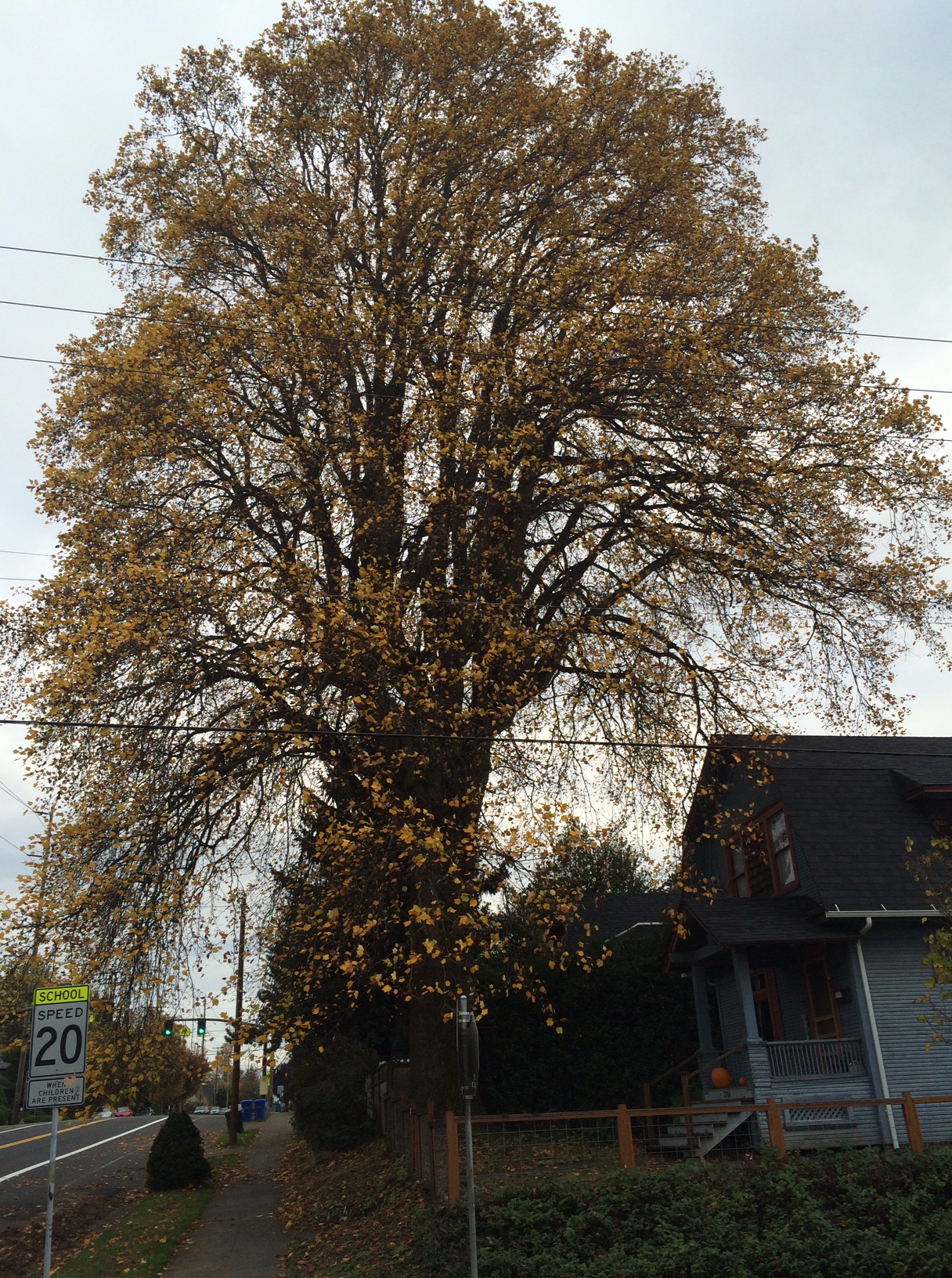
This Liriodendron tulipifera, a heritage tree in my neighborhood, has a canopy over 90' across. It is a beautiful and dominating tree dropping tons of drain clogging leaves and negating any need for actual street trees in the vicinity.

This Liriodendron tulipifera, a heritage tree in my neighborhood, has a canopy 90′ across. It is a beautiful and dominating tree dropping tons of drain clogging leaves and negating any need for actual street trees in the vicinity.  Little can grow in the dry shade beneath it.

I’m a horticulturist, a person trained and practiced in the ‘art and science of growing plants’…a classification to which trees belong. I’m not a ‘tree expert’ though I like to think I’ve learned a few things having spent most of my last 35+ years out working in the landscape, planting, caring for, diagnosing and designing, the bulk of which was maintenance, trouble shooting and tweaking landscapes so that they work ‘better’. Trees were always part of it…so I have opinions.

            [One of the lessons most of us learn on our journey to adulthood is to avoid the topics of religion and politics in casual conversation. These can be very divisive. In Portland the topic of trees can also elicit strong feelings amongst their advocates. The City of Portland has worked toward the protection of its trees. Here we have, in many cases, codified the planting, pruning and removal of trees in an attempt to stop the most egregious offenses and to expand the urban tree canopy. The City, through its Forestry Division, also works to help educate a public that too often has little to no connection to the green growing world. It is a huge task especially when so many other public institutions, like public schools, play almost no role. I spent the biggest part of my professional work life in Portland Parks and Recreation and I know that most Park’s staff have a passion for the work as well, even after years of working in a very political atmosphere with inadequate support. It would wear on anybody. So when I criticize aspects of the City’s tree program I want to be very clear that I am not criticizing the people or their intent.]

Portland loves its trees, except for the malcontents who view each leaf that falls on their property as an affront not to be tolerated, oh, and those developers looking to build and cash in on ever square foot of space that they can appropriate. Yes, these people are out there, just as are there opposite. Continue reading

Choosing Trees for Larger Public Landscapes (and your yard!)

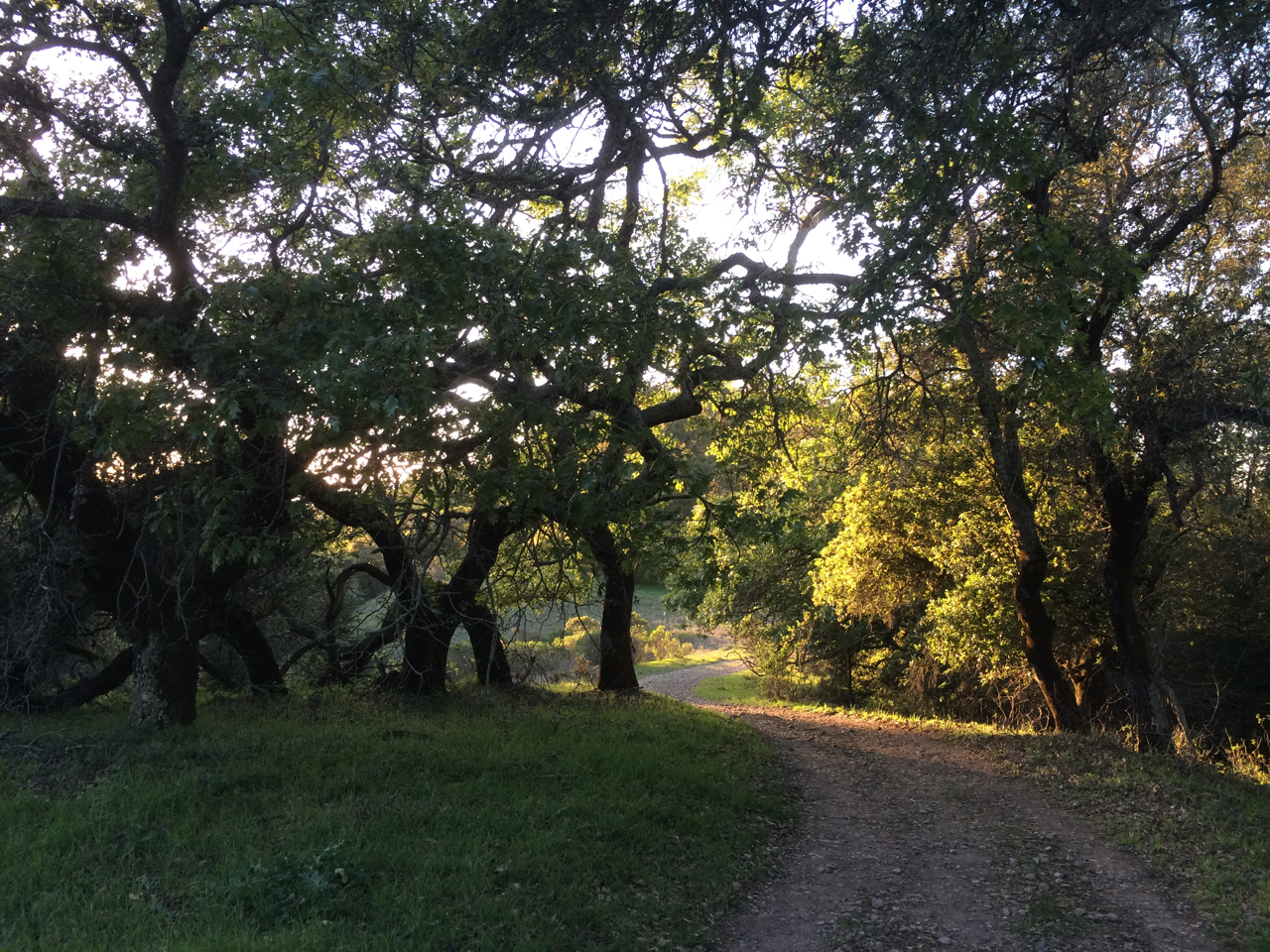
Still one of my favorite Oak photos. This one take in the late afternoon beneath a canopy of Interior Live Oak (I think) at Shiloh Ranch Park, last March.

Still one of my favorite Oak photos. This one take in the late afternoon beneath a canopy of Interior Live Oak (I think) at Shiloh Ranch RegionalPark, near Windsor, CA, last March.

A friend recently asked me if I had some favorite trees that I would recommend for planting on school landscapes, that would be like asking if I had favorite park trees, no I don’t…and I don’t have a list of proven performers either. A planting site being located at a school, only tells me something about the uses/abuses one can likely expect on a site, and nothing more. When we choose plants we need to be paying attention to a lot more than that. Many people are intimidated when it comes to choosing trees, there are so many and potentially, they live so long, growing from year to year…all of this tends to magnify the ‘weight’ of our decision.  People often look for short cuts because there are so many things to keep in mind when choosing. There are two major questions that need consideration first, the site conditions and design, what will the tree have to put up with and what do you expect? Continue reading

Tri-Met’s Orange Line Landscapes: Bybee Stop to Oak Grove

Part 2 of the Orange Line series

Looking south from the top of the stairs at the Bybee Stop. This is pretty much the same view as looking north with respect to the landscape.

Looking south from the top of the stairs at the Bybee Stop. This is pretty much the same view as looking north with respect to the landscape.  BNSF’s tracks lie to the left, the east.  The railroads have their own ‘landscape’ maintenance standards set primarily for safety reasons.  Within so many feet of their tracks they have a zero tolerance for plant growth and use sterilants.  There is also a zone within which the will ‘brush back’ trees and shrubs to keep site lines open.  Metro will have its own standard.  The two side by side show their combined effect.  Also, typically railroads do not fence off their tracks making clear sight lines a more pressing safety concern.  Trimet has fenced off the tracks from casual pedestrian ‘conflicts’.  Fencelines are problematic for maintenance unless ‘dead zones’ are expanded to include both sides.

Heading south of the Harold St. overpass the Orange Line leaves the most urbanized portion of its route, or at least its most densely populated stretch.  Traveling south to the Bybee, the Tacoma/Sellwood and then the Milwaukie stops, the line run alongside the BNSF tracks and there is very little ‘landscaping’ of the corridor.  The railroads contract out maintenance of their thousands of miles of tracks. (For a brief look into their approach check this link.) Continue reading